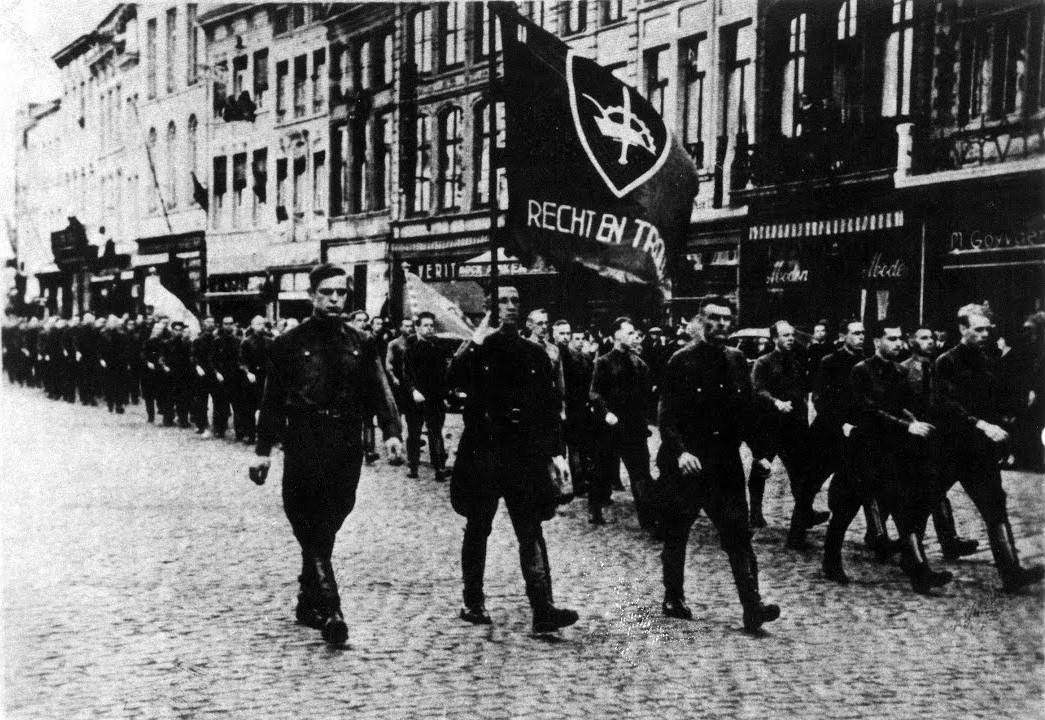
A look at the origins of Belgium’s particular fascism with roots in reactionary Catholicism.
‘Fascism in Belgium’ by A. Habaru from International Press Correspondence. Vol. 6 No. 19. March 12, 1925.
Mussolini’s semi-official organ, the “Popolo d’Italia”, wrote recently, in discussing the events of the week: “It can now be said that Fascism is now established in Belgium.” The Italian newspaper enquires into the characteristics of the “flag day” concludes that a Fascist movement exists and regrets that there is no leader in the country who is capable of guiding this movement.
Do the statements of the Fascist paper correspond with reality?
The “flag day” of February 9th does not mark the establishment of Fascism in Belgium. It is however a serious sign of the reaction which is beginning to become prominent in the ranks of the middle-classes against the democratic regime, its taxes, its increase in the cost of living and its vassaldom to international finance.
It is nothing new for people and organisations in Belgium to occupy themselves with praising Mussolini and imitating the Black Shirts. Noisy nationalistic picked troops which, in common with certain organisations of young catholics form groups with pronounced Fascist tendencies, have arisen out of the “Committee for National Politics” which was founded in 1919 and of which the socialists Piérard and Destrée were members. There are now appearing the “National Legion”, the “Belgian Fascio” and since a few days the “National Guard”, further a weekly paper “L’Action Nationale”.
Apart from these parade organisations, there is, among the Young Catholics and also the Liberals a tendency of ideas which must not be overlooked. It is a kind of nationalistic renaissance which is developing among the young bourgeoisie. Influence of Maurras and the “Action Française” is growing among the Catholic intellectuals. A Fascism adapted to the social conditions of Belgium is rather to be expected from that side and from the Citizens’ Union (“Union Civique” than from the camp of those who imitate Mussolini.
Is it possible that the general preliminary conditions for the development of a real Fascist movement exist in Belgium?
For this it would be necessary for the democratic regime to prove incapable of solving the economic, financial and so crisis of post-war times; parliamentary tradition would have to feel itself threatened with having to pay for the restoration of their own economic position; the capitalist Great Powers would have to have an interest in destroying legality and in subsidising the fighting groups of Fascism. Finally a deep-reaching disillusionment would have to seize hold of the masses and make it possible for the Fascist organisations to win over the workers by a demagogic programme.
These preliminary conditions are not yet realised, Democratic tradition still holds its own. Reformist defeatism promotes the cutting down of wages (the metal workers have just returned to work after a strike of 8 months, with a reduction of 5% on their wages and with despair in their hearts), and allows the capitalists to make the workers pay the consequences of stabilisation. Along with the National Bank, groups of great financiers support the Catholic-Socialist Left Bloc which looks after their affairs. It must however not be forgotten, that stabilisation will be followed by a serious economic crisis, that the despair of the working masses will increase, that the victims among the middle classes are beginning to stir and that the demagogy of the Government is calling forth progressive reaction in capitalist circles. It is doubtful whether all this will lead to a Fascist coup d’etat. It is, however, inevitable that a strengthening of reaction and of its pressure on the Government will result.
In reality, however, the bourgeoisie is on the way towards creating a Fascist reserve army and at the same time rousing a strong movement of public opinion against the Government. A “League for Public Interests”, with Senator Despret, director of the Bank of Brussels at its head, which is supported by the Central Committee of Industrialists is opposing the Government’s programme by that of the “producers” and is finding numerous partisans throughout the country. At the same time the Fascists are gaining an increasing number of the petty bourgeoisie and earn the applause of the Liberal and the Right Catholic Press.
The bourgeoisie is thus creating a Fascist reserve which, in case of need, it would throw into the balance, although it is more likely that it will only make use of it as a constant threat in order to influence the Government Coalition.
International Press Correspondence, widely known as”Inprecorr” was published by the Executive Committee of the Communist International (ECCI) regularly in German and English, occasionally in many other languages, beginning in 1921 and lasting in English until 1938. Inprecorr’s role was to supply translated articles to the English-speaking press of the International from the Comintern’s different sections, as well as news and statements from the ECCI. Many ‘Daily Worker’ and ‘Communist’ articles originated in Inprecorr, and it also published articles by American comrades for use in other countries. It was published at least weekly, and often thrice weekly. A major contributor to the Communist press in the U.S., Inprecorr is an invaluable English-language source on the history of the Communist International and its sections.
PDF of full issue:https://www.marxists.org/history/international/comintern/inprecor/1925/v05n19-mar-12-1925-inprecor.pdf

