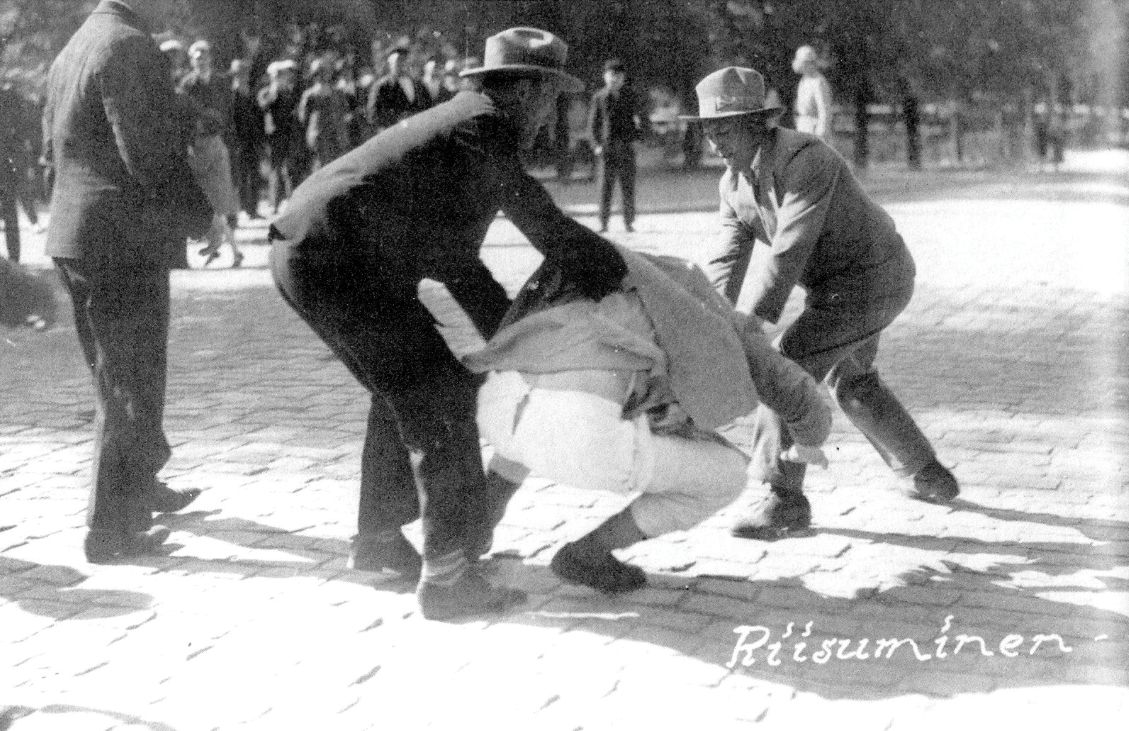
Needing a two-thirds majority in parliament for a proposal to outlaw the Communist Party and revolutionary organizations, the reactionary ruling class of Finland, with the extra-legal aid of the fascist Lapua movement, simply beat, disenfranchised, and terrorized the left from the voting booth. Though the Social Democrats were the largest party, the capitalist parties got their two-thirds majority and duly made democracy redundant.
‘The Fascist Dictatorship in Finland’ by O.W. Kuusine .from International Press Correspondence. Vol. 10 Nos. 37 & 38. August 14 & 21, 1930.
What is Happening In Finland?
In the last few weeks it has by no means been sufficient, in order to explain the situation in Finland, to speak generally of preparations for a “fascist coup”. For such a general characterisation could contain a false as well as the correct view.
What was the false opinion regarding a fascist coup in Finland? It was expressed in the characterisation of the situation given by the Finnish social-democratic press (as well as by some other bourgeois papers, as for example, “Swenska Presen”). According to this characterisation, fascism in Finland is represented only by the “Lapua Movement”; only the Lapua people, who made ready for a campaign against Parliament and against “the democratic parties” in order, it is said, to replace the parliamentary regime by their own illegal dictatorship with a despotic dictatorship at the head, are fascists.
This version might appear somewhat plausible at first sight to anyone not fairly well acquainted with political conditions in Finland and who did not take sufficient care to avoid a (in this case) misleading, superficial view of some of the purely outer analogies with happenings as they occurred in the well-known fascist upheavals in Italy, Bulgaria and Poland.
Things are different in the case of Finland. It is true, here there took place a change of government, which constitutes not an unimportant event, but a change of regime in the sense of an extreme fascisation. The new Swinhufhud Government will function as the head of Finnish fascism. It takes the place of the former government of the “Land Union”, which is the numerically greatest party in Finland. This party has the main part of its adherents in the rural districts, in the ranks of the middle and big peasants, of the village bourgeoisie and partly also among the small peasants. It likes to pose as the party of the peasantry. Thus, one could easily gather the impression that the situation of the government of the Finnish “Land Union” with regard to the fascist advance was similar to the position of the Stambulisky Government at the time of the fascist putsch led by Zankoff on 9th June, 1923. This view is, however, absolutely false. In Finland there could be no talk of a fight between the Land Union and the fascist movement. Than with the party of Stambulisky one could somewhat better compare the Finnish Land Union with the “Chiena Piast”, which was one of the government parties in Poland on the eve of the fascist putsch led by Pilsudski. Pilsudski’s coup was directed immediately against the government of the Chiena Piast and of the National Democrats; and even if it did not come to a serious fight between the two camps, as was the case in Bulgaria, there was nevertheless an open and bitter conflict between them at the time. But in Finland there was absolutely no conflict between the Government of the Land Union, which resigned, and Swinhuvud, the head of the fascists. On the contrary, the Land Union Government had a few months previously hastily summoned Swinhuvud home from abroad and sent him to Lapua for the purpose of getting into personal touch with the Lapua fascists. It was agreed beforehand with the party executive of the Land Union that he should form the new government.
Relander, the President of Finland, who is at the same time one of the party leaders of the Land Union, at the reception of the delegations of Lapua fascists at the beginning of June, demonstrated his warm solidarity with all their demands, and in the middle of June made a propaganda tour in south and central Osterbotten, not against but for fascism. These districts of the country are for the most part Kulak districts and have always been the chief strongholds of the Land Union. The majority of the “Defence Corps” people in these districts are members of the Land Union, and the participators in the present Lapua movement are no other than the most active and savage elements in the ranks of the local Defence Corps. It is therefore quite a matter of course that very many of the Lapua fascists are members of the Land Union. Even the local leader of these fascists in Lapua, Wichtori Kosola, is a member of the Land Union.
It is true, it would not be correct to assert that the Land Union is the leader of the Lapua Movement. It would like to be, but it is not. Who is the leader, then? Swinhuvud has of course a popular and authoritative name in all fascist circles in Finland, and as a ruthless reactionary is prepared to take part in any plans for throttling the working sections of the population. He is, however, more a tool in the hands of the active political leaders of the Finnish bourgeoisie. He can no doubt be regarded as one of the leaders of Finnish fascism, but not as the leader. Still less can any other person be regarded as the chief leader of the Finnish Fascists.
There is, however, a collective leadership, but it will not show itself openly at once. That is one of the characteristic features of the Finnish variety of the fascist movement. In other countries the leaders of the fascist camp, as a rule, advertise themselves as much as possible. In Finland they make a great advertisement of insignificant provincial figures in order to retain the real leadership themselves behind the scenes.
The Mobilisation of the Lapua Movement.
The real general staff of the Finnish fascist movement is not in Osterbotten, but in Helsingfors. This general staff is the party leadership of the so-called Coalition Party, the party of the Finnish big bourgeoisie and of the landowners. It has organised the affair, but at the same time has remained invisible as far as possible.
The leaders of the Coalition Party attempted already in the autumn of last year to mobilise a broad anti-communist movement. It was arranged to send a number of delegations of citizens from various parts of the country to Helsingfors, but things did not turn out as intended. Since then, however, as has now become known, various local agitators of the Coalition Party, particularly some parsons, have during the whole winter worked with passionate zeal personally upon all suitable subjects among the village bourgeoisie. This did not happen without instructions from Helsingfors. The headquarters of the coalitionists, both before and after the night raids by the Lapua gangs on the printing works of the workers’ paper in Vasa on March 28, sent special emissaries to Lapua in order to instruct the bandits. The Governor of Warsa, Sarlin, an agent of the coalitionists, did everything he possibly could in order to aid the fascist bands in their attack on the printing works. During the farcical court proceedings on June 4 in Varsa, one of the most active leaders of the Coalition Party, the bank director Rantakari, appeared personally on the spot in order, during the public mishandling of the business manager of the worker’s newspaper Nieminen, to initiate the Lapua people in the methods of fascist terror. The communist lawyer, Salo, was dragged from the court room and placed in a motor car, in which he was conveyed from place to place for several days, all the time being continually subjected to mishandling and terrorist threats by fascist bandits. These methods introduced by Mr. Rantakari have since then been employed practically every day in Finland. Many bestial mishandlings have been committed by fascists, usually drunk during such kidnappings. A number of the abducted representatives of the legal labour movement in Finland have been driven over the frontier; many others have disappeared, that is to say, murdered in all probability. The assertion of the Finnish bourgeois press that these acts are attributable to an elementary “patriotic” indignation of the peasantry, is proved to be a palpable lie by the fact that the fascist bands everywhere have motor cars at their disposal. They are the heads of the village bourgeoisie, landowners, big peasants, officials, parsons, merchants etc., who have been mobilised by the leaders of the Coalition Party.
The fascist “Peasant” delegations which in June came to Helsingfors from Lapua and other plaaces, consisted likewise of heads of the bourgeoisie and a whole number of well-known big capitalists, belonging partly to the Coalition Party and partly to the Land Union; and the whole of their demands, which relate to the removal of the communists from the whole public life of the country, were identical with the demands which the Coalition Party had already submitted to Parliament five months previously. In various localities the formation of sections of a country-wide fascist organisation bearing the name, “The Lock of Finland”, has been commenced by emissaries of the Coalition Party.
The task of setting going the so-called “elementary ferment of the peasantry” was, it is true, at first no easy one for the coalitionist leaders. Not that there existed no susceptibility in the ranks of the village bourgeoisie, no inclination to acts of banditry. No, susceptibility was there as well as sufficient candidates for blackguardism; there was only lacking the necessary courage and ruthlessness. The instigators had considerable difficulty in overcoming the qualms felt by the bandits in regard to open acts of lawlessness. The first bands from Lapua, headed by the band director Nicula, made their preparations and carried out their work (wrecking the workers’ printing works in Vasa) with the greatest secrecy and then disappeared under cover of the night without leaving any traces. It was impossible to induce these heroes to come forward openly and acknowledge their work and receive their laurels. The most that their instigators were at last able to achieve was that a fascist meeting in Lapua decided to send a telegram to the government stating: “The act was organised by our detachment.” The chairman of the meeting, Viktor Kosolo, put his signature to the venturesome telegram, and thus the country obtained a hero.
In addition the bandits were inspired with fascist courage and bestiality by means of alcohol. It should be remarked, by the way, that the coalition party is conducting energetic propaganda for the withdrawal of the prohibition of alcohol.
It was also not so easy to bring the Lapua bandits, who are not schooled in high politics, to the idea of a “march on Helsingfors”. To beat up a few Communists and to destroy the printing works of the labour newspaper, that was quite right and patriotic. The idea of a demonstration against Parliament, however, was bound to appear to them not only as very risky but also absolutely senseless.
They were, however, taught better. The gentlemen in Helsingfors who dominated the majority of Parliament, wanted to see a fascist mass demonstration in front of Parliament. They themselves invited the bandits of Osterbotten to Helsingfors. Swinhufhud came to Lapua and assured his hearers that a journey of the fascist bands to Helsingfors was an equally “Patriotic” idea as the ill-treatment of the Communists in Vasa. The President of the Republic came and said the same thing. And even the President of Parliament, Paavo Wirkkunen, Doctor of Divinity, came and said: “Please, you must come without fail. Your demonstration against our Parliament is on the agenda for 7th of July. Please don’t be late.”
One had to believe that Helsingfors required a march of the fascists from the country. One could very easily believe that.
The First State Act of Fascism
For what purpose were all these efforts of the leadership of the coalition party necessary? Perhaps only in order to obtain government power: No, they could have obtained that any day they wished without any great efforts. The Land Union would have raised absolutely no objection to forming a government along with the coalition party. Apart from a few exceptions, all Cabinets in Finland since the civil war have been government blocks between the coalitionists and the Landbund with or without the participation of other bourgeois parties. The last time a government was formed by the Land Union without the coalitionists it was because the latter did not wish to participate, as they perceived the difficulties with which the government would be confronted.
The Kallio government did its best in order to parse a course to complete fascisation in legislation (government bills for abolition of right of combination, freedom of the press of the labour movement, changes in the law regarding state of war etc.) The adoption of the government bill on associations by Parliament in December last, with the help of the social democratic deputies, meant a considerable step towards depriving the labour movement of all legal rights. A number of similar steps would undoubtedly have received the sanction of Parliament if there had been the time and patience required for Parliamentary bargaining. This method was, however, too slow and clumsy for the purposes of the Finnish bourgeoisie, and it would also have confronted Finnish bourgeois Parliamentarism with a very great problem: what would be the result of the coming elections if all bourgeois parties, including the social fascists, compromise themselves in the eyes of broad strata of the toilers (who according to the Constitution still have the right to vote) by fascist enactments? A fresh election victory of the Communists, fresh defeats of the coalitionists?
An awkward dilemma. What more could the government do than what had been done by the Kallio government? Another government would not have had the freedom of movement necessary in order to carry out the thorough change of regime at a sufficient rapid tempo, as so urgently demanded by the class interests of the Finnish bourgeoisie since the year 1929. Here was the dilemma. The Constitution had become far too narrow for the Finnish bourgeoisie. It was a Constitution of the Finnish counter-revolution, the “White Finland Constitution”: it was borne out of the furious orgies of revenge of the bourgeoisie in May 1919, in which over 30 000 workers were murdered after the end of the fighting in the civil war. This Constitution was formulated and decided in the Parliament of the year 1919, in which there was not a single Communist and in which the government of the coalition Land Bund block had more than 99 per cent of the votes. This Constitution had now become dangerous to its originators. The builders of this Constitution, which was to last for centuries, were only ten years older when they were compelled to declare that their wonderful craft had hopelessly run aground and that there was no constitutional way out: that they had to tall in the aid of the pirates in order to blow up the wreck.
The destruction of the Constitution that is not a trifle. But it is a question not only of the Constitution but of much more; of complete fascisation of the State apparatus and all other forms of bourgeois class rule. That is the task into the fulfilment of which the leaders of the Finnish bourgeoisie have flung themselves with all their energy. The destruction of the Constitution was for them, on the one hand, the necessary precondition and, on the other hand, the first great step of the new fascist regime. Further steps will not be long in following. In particular, in all probability further important steps will be undertaken in economic and military policy.
The whole programme of fascism is, of course, even in the best case, not capable of being carried out in a few weeks. How far an absolute complete fascisation is at all realisable, and for how long, is in the first place to be regarded as a concrete question of the class struggle. In any event we must reckon with the fact that the Finish bourgeoisie will do everything in order to pursue a definite fascist policy along the whole line. For the purpose of facilitating and accelerating the carrying out of this policy the leaders of the Finnish bourgeoisie had to avail themselves of the services of fascist bands, with the aid of which they can proceed most brutally.
And that is the essence of the matter and not an alleged fight of the fascists in Lapua for the overthrow of a “democratic” government.
International Press Correspondence, widely known as”Inprecorr” was published by the Executive Committee of the Communist International (ECCI) regularly in German and English, occasionally in many other languages, beginning in 1921 and lasting in English until 1938. Inprecorr’s role was to supply translated articles to the English-speaking press of the International from the Comintern’s different sections, as well as news and statements from the ECCI. Many ‘Daily Worker’ and ‘Communist’ articles originated in Inprecorr, and it also published articles by American comrades for use in other countries. It was published at least weekly, and often thrice weekly. A major contributor to the Communist press in the U.S., Inprecorr is an invaluable English-language source on the history of the Communist International and its sections.
PDF of full issue: https://www.marxists.org/history/international/comintern/inprecor/1930/v10n37-aug-14-1930-Inprecor-op.pdf
PDF of issue 2: https://www.marxists.org/history/international/comintern/inprecor/1930/v10n38-aug-21-1930-inprecor-Virginia.pdf

