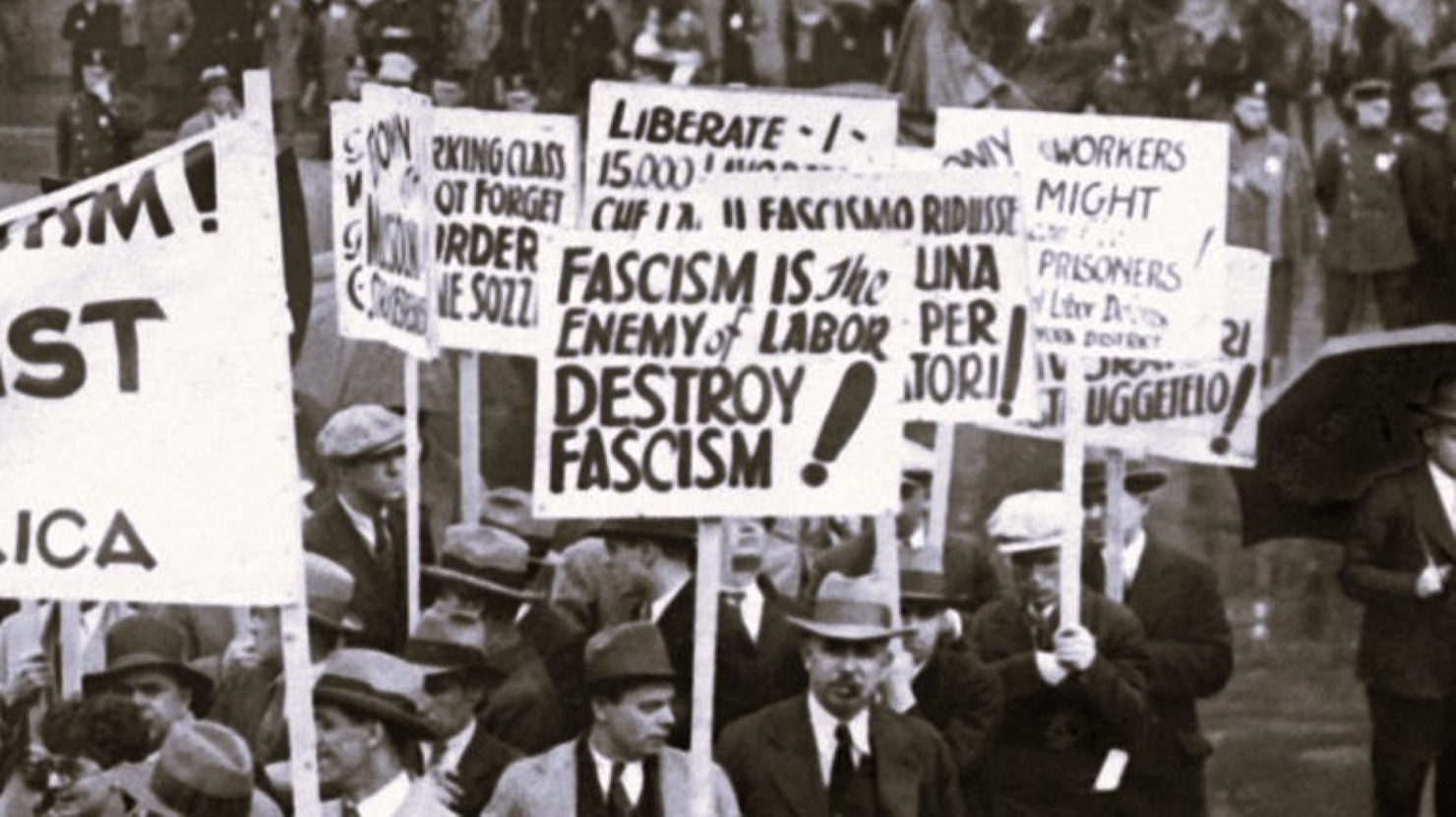
A day-by-day account of the Communist International-called International Anti-Fascist Congress held in Berlin during March, 1929 chaired by Willi Münzenberg.
‘The International Anti-Fascist Congress in Berlin’ from International Press Correspondence. Vol. 9 No. 15. March 22, 1929.
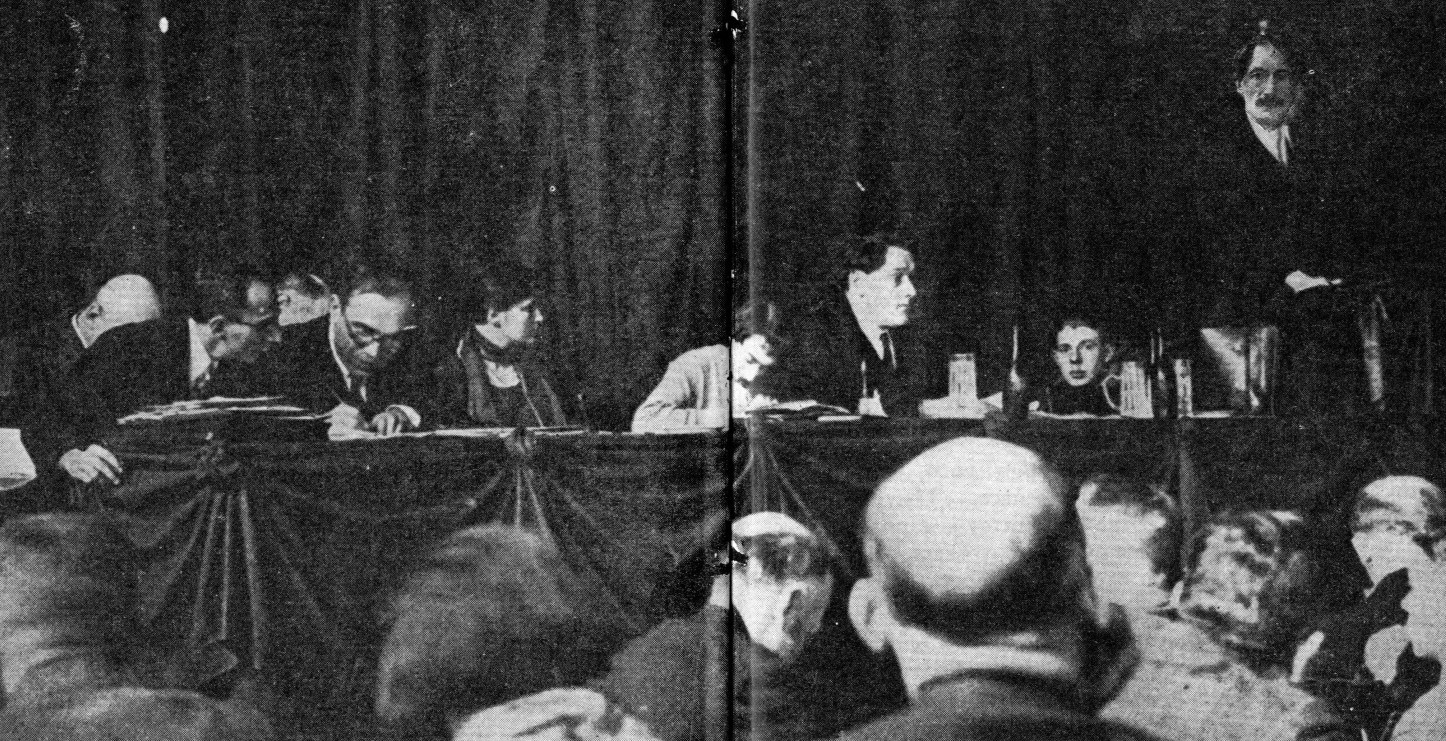
The International Anti-Fascist Congress was opened at 10 a.m. on Saturday, 9th March in the great hall of the Berlin Trade Union House. Delegations from numerous countries were present. The four delegates from the Central Council of Soviet Labour Unions were unable to be present because the German Consular representatives in Moscow had refused to grant them visas. The German consular representatives in Belgium also refused to grant visas to the Belgian delegation.
The composition of the congress is as follows: From Germany 70 delegates are present, from France 34, from Great Britain 12, from Czechoslovakia 20, from Austria 11, from Poland 6, from Norway 14, from Sweden 3, from Denmark 5, from Switzerland 9, from Lithuania and Latvia one each, from Spain 7, from Italy 19, from Hungary 3, from Rumania and Bulgaria four each, from Yugoslavia 3. The national minorities in the Balkans are represented by 6 delegates. The various groups are strongly represented at the congress, thus there are 30 peasants’ delegates, 22 delegates of the youth, 17 delegates of the national minorities and 7 delegates of the war invalids.
A number of well-known personalities participate in the congress. Michael Karolyi, the former Prime Minister of the Hungarian republic, Fan Noli, ex-Prime Minister of Albania, Guido Miglioli, former deputy of the Catholic People’s Party in the Italian Chamber, Ledebour, Paquet, Theodor Lessing, and various members of the Polish, Swiss, German, Czechoslovakian and other parliaments.
After a short opening speech by Henri Barbusse, the following presidium was unanimously elected: Barbusse, Snook (leader of the British Workers Legion), Heinrich Bittner (member of the Polish Seym), Michael Karolyi, Guido Miglioli, Muenzenberg, Heckert, Stassova (Soviet Union), Yevreinov (Soviet Labour Unions), Landova-Stychova (member of the Czechoslovakian parliament), Alfons Paquet (author, Germany), Fan Noli, Martelli (France, Peasant Leagues), Folli (Italy, youth organisation).
The Rumanian delegation proposed the election of a number of well-known victims of Fascism, White terror and class justice in various countries as honorary members of the presidium. The idea was enthusiastically adopted and the following comrades were elected: Terracini, Gramsci (Italy), Mathias Rakosi (Hungaria), Buvor, Stefanov and Dobrogheanu-Gherea (Rumania), André Marty, Carotti (France), Rudolf Margies (Germany), Hofmaier (Switzerland) who was only some days ago sentenced to 15 years and 9 months hard labour in Italy, comrades from Poland and Yugoslavia.
The chairman of the congress Comrade Muenzenberg, announced the provisional agenda which was then unanimously adopted.
Comrade Wilhelm Pieck then made a speech of greetings in the name of the revolutionary workers of Berlin. He pointed out that there was an uninterrupted line from the policy of Noske who murdered the best fighters of the German proletariat ten years ago, down to the policy of the social democratic police president of Berlin, Zoergiebel, who prohibited workers demonstrations and refused to permit them to honour the memory of their murdered comrades.
The chairman then read numerous telegrams and letters of greetings from various organisations and persons, including a meeting of 10,000 workers in Basle, the Red Aid organisations of Toland and Switzerland, the land-workers union of Norway, the Unitary Trade Unions of Roumania, etc. A letter was read from James Maxton, the chairman of the British Independent Labour Party, explaining with regret that he was unable to attend the congress owing to pressure of other important matters.
Henri Barbusse then made the opening speech upon the first point on the agenda, Fascism, Imperialism and the Danger of War: The anti-fascist congress is of tremendous importance because it aims at rallying the broad masses of the workers and the intellectuals in all countries to mass action against Fascism. The scourge of Fascism is not brandished by individual person but by the capitalist system, which strives to hold down the working masses who have arisen for a decisive struggle against the capitalist order of society. Only in the Soviet Union have the workers been triumphant. In all other countries the bourgeoisie is still in power, partly openly fascist and partly under the mask of democracy. The capitalist governments are favouring fascism with all possible means. They are building up fascist organisations everywhere: These organisations are composed of bourgeois and petty bourgeois elements.
The historical phenomenon of fascism must be understood broadly. Not the various external forms are important, but the nucleus of fascism. Fascism is in power not only in Italy but also in Spain, Hungary, Poland and the Baltic and Balkan States. The danger of fascism is growing in Germany, Austria, Czechoslovakia, France, Belgium and Great Britain. The imperialist powers are contributing largely to the maintenance of fascism the smaller States.
The persecutions of the working masses by fascism are terrible. Massacres, tortures and prison horrors are the methods of fascism. The workers are being robbed of all their rights and their organisations are being destroyed. The main weight of the fascist terror falls upon those enemies mostly feared by the capitalists, i.e. the communists. But others also who refuse to bow down are crushed.
However, the anti-fascist congress has not met in order to mourn, but to appeal to the working masses, to the working-class organisations and to the intellectuals to rally in a joint struggle against fascism, to free its victims and to destroy its system. At the conclusion of his speech, which was answered with tremendous applause, Henri Barbusse expressed the greetings of the congress to the Soviet Union, the fatherland of all toilers and the one country which has no place for fascism.
Manfred Georg, the chief editor of the “Tempo” one of the largest Berlin dailies, declared that the fascist danger in Germany was becoming acute. The petty bourgeois leaders of the masses were the greatest hindrance in the struggle against fascism. Nothing had been left in Germany of the achievements won by the workers in the revolution.
George Middleton, one of the leaders of the Hunger March of unemployed workers upon London, declared that Great Britain could no longer be considered as a bulwark of democracy. Strong fascist tendencies existed, a good example of this was the anti-trade union law which had been adopted after the general strike and whose aim was to clear the way for an imperialist war against the Soviet Union. Mondism was another example. The abolition of the rights of the working class was being carried on with the support of the reactionary trade union leaders. Despite their attitude, however, the fighting spirit of the workers had not been crushed. On the contrary, the enthusiastic reception which the hunger marchers had received in Londo was very promising for the future struggles. The British working class would resist all attempts to introduce fascism into England and would finally break the neck of British imperialism.
Count Michael Karolyi declared that the statements of the German reactionaries that he was anti-German were untrue. On the contrary, he was a friend of the German working class. Of course, he opposed the reaction in Germany just as he opposed it in all other countries. Fascism in Hungary copied Italian Fascism and was supported by the latter, which expected that the Hungarian workers and peasants would be used as cannon fodder in the furtherance of Italy’s imperialist aims.
Two witnesses to the Fascist terror in the “democratic” republic of Czechoslovakia, then spoke. The worker Nazarevitch from Boronova in Carpathian Russia and the miners wife Kladenska from Kladno. Both of them had been the victims of police punitive expeditions in the mining centre of Kladno and in Carpathian Russia. In Kladno the wives of the miners who had abused the strikebreakers were arrested, taken to Prague and held for weeks in prison without trial. Such terrorism occurred repeatedly in Czechoslovakia and was a proof that Fascism was developing swiftly.
Dr. Welti, a member of the Swiss National Council described the beginnings of Fascism in Switzerland. In any case, Switzerland was a centre of world reaction because it was the seat of the League of Nations whose whole activity was directed against the Soviet Union. The passivity of the Swiss bourgeoisie represented objectively the promotion of Fascism. The prohibition of the antifascist demonstration in Ticino by the government represented a further strengthening of fascism. The Swiss social democracy and the Swiss trade union federation refused to join in the struggle against fascism, so that the only organised anti-fascist force was the Communist Party.
Fritz Heckert, a member of the German Reichstag, dealt with an article in the official organ of the German social democracy, the “Vorwaerts” which declared that the congress was a communist manoeuvre and that “the only power which has the moral right to conduct a struggle against Fascism is the social democracy”. The contrary, he declared, was the case, for the social democrats were the fathers of fascism.
The social democracy declared that democracy was a protection against fascism, but all the facts showed that bourgeois democracy was the breeding ground of fascism. This policy of the German social democracy contributed to the growth of fascism and to the preparation of a new imperialist war, above all against the Soviet Union.
Many well-known facts showed what “moral right” the socialists had to talk of fascism; D’Aragona and numerous social democrats had gone over to Mussolini in Italy; in Hungary Peid and Peyer had assisted in consolidating the Horthy regime; in Poland one of Pilsudski’s chief assistants was the former member of the Central Committee of the Polish Socialist Party, Moraczevski and a whole groups of social democrats. In Greece and in Yugoslavia the social democrats supported the reaction. In Yugoslavia the social democrat Topalovitch was cooperating with the military dictatorship; in Spain the social democracy supported Primo de Rivera. The social democratic Secretary of the International Labour Office, Albert Thomas, could find nothing wrong in Roumania when he was there, and whilst in Italy he had declared that Mussolini was a fighter for Social progress. He also shook hands, whilst in China, with Chang Kai-shek and congratulated him upon his seizure of power. The French social democrat Paul Boncour had declared, whilst in Poland, that Poland was the bridge-head of European civilisation and that it must be defended against the Bolshevist hordes. Hundreds of facts proved that most social democratic leaders were embryonic fascists.
The ten years history of the German republic was a chain of bloody actions by the social democrats Noske, Hoersing and Co. against the working masses. The bloody suppression of the Ruhr struggle of the workers after the Kapp Putsch. the murderous suppression of the insurrection in Central Germany and of numerous other great proletarian mass actions was the work of the German social democratic leaders. A document which had just been published proved conclusively that the social democrat Hoersing, the chairman of the Reichsbanner, had asked the industrialists for money for the Reichsbanner with the remark that the latter would defend the republic against the attacks of the communists.
Last but not least in the portrait gallery of social democrats who had “the moral right”, to fight against fascism. must come the police president of Berlin, Zoergiebel, who had threatened the anti-fascist congress with dire penalties should it attempt to hold any demonstrations on the streets against fascism. This fine social democrat had even prohibited the May Day demonstration. From reformism to fascism was only a small step and the reformists were prepared to take this step at any given moment. Whoever wished to struggle against Fascism must also be prepared to struggle against reformism. (Applause.)
Second Session.
In the afternoon the second session of the congress was opened in the great hall of the Neukoelln Townhall. First of all various commissions were appointed and then the former deputy of the Catholic People’s Party (Populari) to the Italian Chamber Guido Miglioli spoke on the second point of the agenda Chamber Guido Miglioli spoke on the second point of the agenda: Fascist Terror and the persecution of the national minorities. There were, he said, three main stages in the development of the fascist terror in Italy. In the first stage the armed fascists exercised a bloody but illegal terror which was, however, tolerated and even encouraged by the State as it aimed at suppressing the workers. This period ended with the March on Rome and the seizure of power by the fascists. The second period represented a legalization of the terror, whereby however, certain democratic principles were still maintained. The third period of the terror commenced after the Bologna “attempt” upon the life of Mussolini when the exceptional laws were introduced. This was the period of the fascist Special Tribunal, the deportations and the final abolition of all the democratic rights and freedoms. The fascist terror was then not only legal terror, but an integral part of the State system. Now even the Church has been forced into the service of Mussolini. Despite everything, the tens of thousands of victims have not suffered in vain. The struggle against fascism was going on tirelessly and would cease with the final overthrow and destruction of fascism. The task of the present congress was to work out ways and means for conducting this struggle.
Heinrich Bittner, a member of the Seym (Polish parliament) described the fascist regime in Poland. The fascist government ‘had refused the other Polish delegates their passports. A considerable amount of the fascist terror was directed against the national minorities which made up forty per cent. of the total population of Poland. The main reason for the brutal terror against the national minorities, particularly in the Western Ukraine and in West White Russia was, that the workers and peasants of this district wish to be reunited with the Soviet Ukraine and Soviet White Russia. In addition to the terror against these national minorities the Polish fascists are attempting to corrupt the possessing classes in these districts and win them away from the national revolutionary struggle.
The speaker reviewed briefly the terrorist acts of the Pilsudski government; the mass trials against the Hromada, and against all workers and peasants organisations, the imprisonment of thousands of workers and peasants and the murder of their best representatives, the pogroms against the Ukrainians and the economic terror against the national minorities, the suppression of the minority schools, the abolition of the minority rights and the complete enslavement of the workers. The national question was closely connected with the social question and the workers and peasants of the national minorities knew that they could only win their freedom in the political struggle and with revolutionary means. Poland was a danger to the peace of Europe and therefore Polish fascism had to be fought not only with words but with deeds.
Ledebour, the old German revolutionary, declared that fascism arose everywhere where the dominance of the bourgeoisie was threatened by the workers. At such times the reformists became the allies and supporters of the fascists. Noske, Ebert, Scheidemann and the others were the forerunners of Mussolini.
In Germany the fascist danger was very great. Therefore the most important lesson of the defeat of Italian socialism must be taken to heart, i.e. that fascism could be destroyed only by an armed insurrection of the workers against the fascist system.
Mgr. Fan Noli spoke concerning the persecution of the national minorities in the Balkans. Fascism in the Balkans means war, war against the external enemy and against the internal enemy, i.e. against the left-wing parties, and the national minorities. Fascism in the Balkans has the support of the imperialist powers and above all of Great Britain. He then described shortly the terror of the Liantcheff government in Bulgaria. of the Maniu government in Roumania, of Achmed Zog in Albania, of Generala Ziokovitch in Yugoslavia and of Venselos in Greece. Everywhere the militarists were in power and behind them stood the bourgeoisie. Everywhere preparations for new wars were being made. In the Balkans more than half of the population were national minorities and were oppressed in consequence. The workers, peasants and national minorities enjoyed none of the usual civil freedoms. Some compact masses were doomed to utter extinction, and the speaker gave a number of terrible examples. Those masses who were forced off their lands to make room for the conquerors were hopelessly lost. There was only one solution of this terrible situation, which was being maintained with the help of the League of Nations and the reformists, and that was a federation of workers and peasants republics in the Balkans (Applause).
Stoyanoff (Bulgaria) declared that the wave of blood which carried the bourgeoisie in Bulgaria to power had no precedent in the history of Europe. 20,000 workers and peasants, the opponents of capitalism, had been murdered. Tens of thousands had been imprisoned. Today 12,000 political prisoners were still in gaol. Abroad there were 2,000 Bulgarian political fugitives. But the resistance to the terror was growing and international solidarity was making itself felt to an increasing extent. The congress must unite the struggle against fascism in the Balkans with the general struggle for the overthrow of fascism.
Jean (Lithuania) dealt with the present situation in Lithuania. The fascist coup d’Etat had been directed above all against the workers and peasants in 1926 because they were going over to the Lithuanian C.P. The social democracy had prepared the way for fascism. Before the fascist seizure of power the social democracy had been in the government, but it had done nothing to stop the preparations of the fascist organisations. Its only aim had been to keep the revolutionary opposition, the C.P. of Lithuania, in illegality, and thus when the fascists seized power the best fighters of the revolutionary movement were murdered with the assistance of the social democracy. The economic situation of the workers and peasants was terrible. The average monthly wage was about 7 to 9 dollars and strikes, whilst not being officially prohibited, were crushed with all the weight of the State apparatus and their leaders put into prison. Despite the persecutions the C.P. of Lithuania was steadily growing. It was the only power which was fighting against the military plans of the Lithuanian government.
The chairman Fritz Heckert then read the following telegram which had arrived from the Soviet Union:
“The delegation of the Central Council of Soviet Labour Unions sends the Congress its fraternal greetings. It is convinced that the assembled friends and comrades will find ways and means of fighting against fascism. The delegation will be unable to be present at the congress because the German consular representatives refused to grant the necessary visas, Evreinon, Passtuchova, Belenetz.”
Blache, the secretary of the Red Aid of France, declared that in France, unlike Roumania, the elections were “free”, but nevertheless the deputies Marty, Doriot, Menetrier and Duclos had been sentenced to long terms for their parliamentary activities. The repressive laws against the workers were being intensified. In the colonies all civil freedom had been abolished. The terror of the government itself made, for the moment, all fascist organisations superfluous. There were however signs that such organisations would play a role in the future. The workers of France must fight against fascism with all the means at their disposal. The League for the Rights of Man was absolutely useless as a leader in the struggle against fascism. Only the revolutionary proletariat in France and in the rest of the world could stop the development of fascism.
Folli, a member of the Young Communist League of Italy, declared that fascism was trying to win the working youth, but that fascism was unable to offer these young workers anything. They had to work long hours for little wages and they therefore marched behind the Y.C.L. into the front against fascism. Despite the persecutions, despite the terrorist sentences, they organised mass demonstrations, carried out actions in the factories, formed united front committees etc.
Dr. Petrescanu, a member of the Roumanian delegation, declared that the oligarchy in Roumania had destroyed all working class and peasant organisations. The reformists alone had been spared. The terror was directed above all against the C.P., the Y.C.L. and the I.R.A. which were only able to operate illegally, but even the W.I.R. and the intellectuals were subjected to persecution. The national minorities suffered bloody oppression. According to official figures 2,000 peasants were murdered in one night in Tatar Bunar in Bessarabia. The state of martial law in Roumania had existed for 11 years. The new government of Maniu had not altered the state of affairs. Despite its “democracy”, it is continuing the oppression of the people. Therefore the congress should also carry on the struggle against the cloaked fascism which existed in Roumania.
Professor Gennari, then made the opening speech upon the third point on the agenda, the situation of the workers, peasants and Intellectuals under fascism. The social essence of fascism was first of all a high development of capitalism (finance capital) and secondly a colossal exploitation of the working masses, and above all of the workers. The present situation of the Italian worker could only be compared with the situation of the Chinese coolie. According to the official statistics of the Italian trade unions, which only embraced 1,222,882 workers, the average hourly wage was 2.19 Lira, From June 1927 to the end of the same year wages were cut all-round from 10 to 15 per cent. Despite the increase in the cost of living a new reduction of wages has been announced. The purchasing power of wages and the wages themselves diminished the further south one went, until in some parts of the south of Italy the purchasing power of wages was about one-tenth of the purchasing power of a workers wages in Great Britain (average). The taxation of the broad masses had been greatly increased by fascism, particularly the indirect taxation. The State income from direct taxation had fallen considerably during the first 5 budget months of 1928 29, whereas in the same period the income from indirect taxation had risen from 1849 to 2230 million Lira.
The petty-bourgeoisie which was deceived by fascism and which supplied the latter with its shock troops, is being mercilessly exploited in the interests of the bourgeoisie. During the first 5 budget months of the present year no less than 75 per cent. of the total income went for the finance and war ministries. As the means for the fascist militia were taken from the budget of the Ministry of the Interior, no less than 80 per cent. of all the State income went for debt interest, for the preparation of war and for the holding down of the population. All this was made possible by the destruction of the class trade unions of the workers and their replacement by fascist so-called trade unions. The contributions for these unions are deducted from the wages of the workers by the employers and handed over to the State. The class trade unions of the workers were working quite illegally. The blind hatred of the fascists against these unions is caused by the fact that fascism has been unable to extend its own social basis, on the contrary, this social basis of fascism has been diminished. The struggle for the free trade unions thus becomes a struggle against fascism as a whole. Fascism can only be overthrown the toilers under the leadership of the industrial proletariat. (Applause.)
Closing Session.
After the Commissions had met in the forenoon of March 10 and drawn up the resolutions to be submitted to the Plenum, the Congress was reopened in the Neukölln Town Hall. The discussion on the third point of the agenda was continued.
The first speaker was the delegate from the United State—Markov–who greeted the congress in the name of the millions of anti-fascist workers in America. The United States government supported the fascist states with loans, for instance the last dollar loan to Mussolini. However, amongst the people of the United States there was a strong anti-fascist movement. Millions of foreign-born workers, who come from fascist States are now living in the U.S.A., for instance there are five millions of Italians alone. Anti-fascist committees are being organised amongst these workers and numerous meetings and two conferences have taken place as the commencement of the anti-fascist struggle.
Hermann, a member of the Austrian social democracy described the difficulties placed by the social democratic leader in the way of the anti-fascist struggle. The left-wing social democrats would carry on the struggle against fascism despite the threat of expulsion from their party. (Applause.) The numerically strong Austrian social democracy was permitting fascism in Austria to develop into a great danger. The fascist dictator ship in Austria and the march on Vienna were real danger. In many large industrial districts, such as Stvria, factory fascism was prevalent thanks to a pact made by the trade union bureaucrats with the fascist employers. In Austria also a struggle on two fronts was necessary, against fascism and against reformism.
Romagnoli, a delegate who had come direct from fascist Italy, was greeted with a storm of cheers by the congress. He informed the Congress that the Confederazione Generale del Lavoro had decided to affiliate to the congress. After the treachery of D’Aragona the Italian General Confederation of Labour had been compelled to exist illegally. Despite the tremendous terror, the illegal factory and peasant Committees were doing good work, also inside the fascist unions. Hunger was a constant companion of the workers and peasants in Italy who were in revolt against the fascist system. Citrine and Sassenbach had gone to Italy behind the backs of the Italian workers in order to give the workers in other countries an entirely wrong picture of the situation of the Italian workers. Such people were the most dangerous enemies of the working class. Fascism could be overthrown only by an armed insurrection of the Italian workers and peasants.
Kaladyayev, a former deputy of the Bulgarian Workers Farty, declared that the imperialist powers were the strongest support of Bulgarian fascism. Thanks to the help of imperialism, the fascist governments were able to hold themselves in power despite the terrible economic situation of the workers and peasants. Unemployment was very great and the eight hour day and labour protection were unknown. The trade union organisations had been destroyed but the government of Bulgaria had not been able to form fascist trade unions. All the objective conditions for the setting up of a united front against Bulgarian fascism were present. The most important thing was the organisation of an international struggle against fascism and imperialism.

Nicoletti, the representative of the red peasants of Italy, pointed out the great significance of the peasants’ movement in the anti-fascist struggle. He declared that it was wrong to say that fascism represented the interests of the peasants. The contrary was the case. The situation of the peasants in Italy was terrible. They were not allowed to marry or to receive visits from their relatives without first of all obtaining permission from the landowner. In this situation the peasants represented fruitful ground for anti-fascist propaganda. A united front of the workers and peasants would have to be formed to organise an armed insurrection for the overthrow of fascism. (Storms of applause.)
The chairman Fritz Heckert then read a letter from the former member of the Italian Chamber and chairman of the Republican Party of Italy, Mario Bergamo, to the congress. This letter expresses itself in favour of the aims of the congress and condemns all those who stand on one side and sabotage and slander the congress, i.e. the social democratic parties. Mario Bergamo regretted that he could not attend owing to sickness. “The congress was an honour to Europe”, declared Bergamo in conclusion.
The chairman read a number of telegrams to the congress from various organisations, including the International Red Aid with 11 million members, the workers sports organisations in Czechoslovakia with over a hundred thousand members, from the World Youth League, from the Workers and Peasants Fraction of the Latvian parliament, etc. Comrade Inard, one of the few surviving communards, had also sent a letter in the name of his comrades welcoming the congress.
Voitinsky, a Polish peasant deputy, greeted the congress in the name of the poor peasants of Poland and described their terrible situation, which made them realise more and more the necessity of an alliance with the proletariat against fascism. Not only had the Hromada been destroyed, but all other organizations of the working peasants and national minorities. The resistance of the masses was growing. An international struggle against fascism was necessary because British and French imperialism was preparing for war. with Poland as an ally.
Gorkin, a Spanish delegate, declared that the dictatorship Primo de Rivera was being supported by the Spanish trade union bureaucracy and the representatives of the Second International. The reformist organisations were neither prohibited or suppressed. The revolutionary organisations, on the other hand were compelled to work illegally, and the Catalonian separatists were bitterly persecuted.
Volkou, a Dutch delegate, described the fascist methods of the Dutch government in Indonesia. The Indonesian insurrection had been drowned in blood. Seven natives had been hanged and a great number sentenced to terms of hard labour ranging from eight to fifteen years. In addition, hundreds of national revolutionaries were banished in the internment camps where they died like flies of malaria. The communists had to bear the main weight of the persecution. Strikes were prohibited and the freedom of the press and the right to organise had been abolished. Even in Holland itself there were sign of fascism, above all ideologically. The social democratic party of Holland was co-operating with the Dutch government.
Hornik, welcomed the congress in the name of the Red Front Fighters League of Germany. Fascist methods, he declared, were being used not only to suppress the workers and peasants, but also to prepare an imperialist war against the Soviet Union. The German social democracy had commenced to use fascist measures. The Republican Reichsbanner, which consisted to ninety per cent. of social democratic workers, was the Praetorian guard of the bourgeoisie. For this reason the struggle against fascism was also a struggle against the second International. The German Red Front Fighters League would carry out the decisions of the congress.
Professor Nejedly from Czechoslovakia declared that Fascism was not only a problem for the workers and peasants but also for the so-called intelligentsia. A considerable portion of the intelligentsia was in the camp of Fascism. We must tell these people that the workers and peasants have no respect for them and that they will fight them like the other fascists.
The congress then listened to the reports of the various commissions on point 4 of the agenda: Ways and Means for Conducting the International Struggle against Fascism. Heinrich Bittner made the report for the political commission. Dr. Welti for the commission on the right of asylum, Sandini for the trade union commission, Fan Noli for the national minority commission, Leibbrand for the youth commission, Trostel for the amnesty commission and Guido Miglioli for the peasant commission.
Miglioli read the following telegram from the International Peasant Council:
“In the name of the oppressed and exploited peasants of all capitalist countries and in the name of the peasants of the Soviet Union the International Peasant Council sends its fraternal greetings to the International Anti-fascist Congress and is convinced that the congress represents the commencement of a victorious struggle against fascist tyranny and capitalist exploitation”
The congress decided to send the following reply:
“We greet the peasants of the Soviet Union, admire their great achievements, wish success in their work and assure them that the oppressed and exploited peasants of all countries will follow their example and gain the final victory.”
The chairman Fritz Heckert proposed that the congress should accept the resolutions presented by the commissions as a basis and hand the same over to an editorial commission. This proposal was unanimously adopted and the presidium then presented a resolution for the formation of a permanent International Anti-fascist Bureau in Berlin. The casks of this Bureau to be laid down by the presidium of the congress in discussions with the delegations and the anti-fascist committees. The nucleus of this Bureau to be the congress presidium. Further additions to be made from various countries in order to secure complete representation. The resolution was adopted with great enthusiasm.
Henri Barbusse, who received a great ovation, made the closing speech:
Every single delegate must return to his country and take his place as a soldier in the great army of anti-fascism. Despite great difficulties this congress has been held, and I think we may say that it has done that which it set out to do. This congress is a great weapon against the international reaction. We do not wish to say that the congress has completed its work, no, it has begun it. The resolutions of this congress must be regarded as orders to action. The call of this congress must penetrate far beyond the walls of this hall and reach the ears of the masses of the oppressed and the exploited. These masses must be mobilised. That is the most important thing. Every working class organisation and every factory must become a detachment of the great army struggle. The offensive of fascism must be answered at every of the anti-fascist step by a counter-offensive of the toiling masses. We must remember, however that fascism can finally be defeated only by the revolution. Another word for the anti-fascist struggle is revolution. The defence of the positions of the workers is not enough, a decisive offensive must be commenced. Such an international offensive against fascism will grant us the victory. Down with Fascism! Long live the international anti-fascist front of the workers and peasants! (Tremendous applause and the singing of the “International”. Further cheers and the Italian delegation commenced to sing with great enthusiasm “Bandiera Rossa”.)
Max Hoelz who had been arrested in the morning on the way to the anti-fascist demonstration of the Berlin workers in Circus Busch, and held the whole day in the police presidium, arrived in the hall just after the speech of Barbusse and addressed a few words to the congress. He described his arrest, which he declared was another proof of the fascist methods being used in a so-called democratic State, and the delegates expressed their indignation. The congress concluded amidst great enthusiasm and the singing of revolutionary songs.
International Press Correspondence, widely known as”Inprecorr” was published by the Executive Committee of the Communist International (ECCI) regularly in German and English, occasionally in many other languages, beginning in 1921 and lasting in English until 1938. Inprecorr’s role was to supply translated articles to the English-speaking press of the International from the Comintern’s different sections, as well as news and statements from the ECCI. Many ‘Daily Worker’ and ‘Communist’ articles originated in Inprecorr, and it also published articles by American comrades for use in other countries. It was published at least weekly, and often thrice weekly. A major contributor to the Communist press in the U.S., Inprecorr is an invaluable English-language source on the history of the Communist International and its sections.
PDF of full issue: https://www.marxists.org/history/international/comintern/inprecor/1929/v09n15-mar-22-1929-inprecor.pdf

