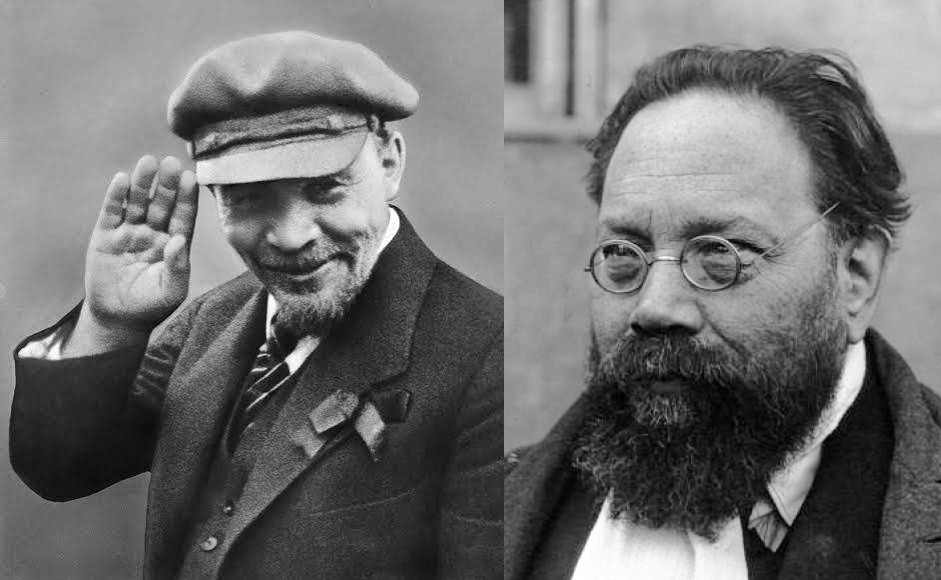
The veteran Russo-French Communist on his relationship with Lenin.
‘Memories of Lenin’ by Charles Rappoport from Workers Age. Vol. 7 No. 34. August 20, 1938.
(Charles Rappaport is a distinguished Marxist, for decades closely associated with the French labor movement. At the outset of his activity, Rappaport worked with the Russian socialist groups abroad and thus came into intimate personal contact with Lenin. Rappaport was one of the founders of the French Communist Party. A few months ago, he resigned from this party because he could not tolerate the “Moscow trials.” This article is first of a series on reminiscences of Lenin written especially for the Workers Age. Editor.)
TO INSIST that Bolshevism or Leninism is exclusively and exceptionally a Russian product is to profess ignorance of the actual conditions under which it was born and developed. Lenin evolved his teachings not merely under the pressure of the reactionary Czarist regime but also thru the theoretical struggle against the revisionism of Bernstein and the reformism of Jaures a struggle which Lenin followed very closely, as evidenced by Krupskaya’s biographical notes. As a true Marxist and revolutionary, Lenin was never deceived by the period of relative and temporary capitalist prosperity which had led the others into revisionism and reformism. He stood for whatever action was necessary for the realization of socialism. The fight against opportunism in Russia was to him a fight against opportunism in the international working-class movement. He never separated the two.
I Hear Lenin
I was greatly impressed when, at a public meeting in Paris at the beginning of this century, Lenin stated that only an armed rising of the proletariat could defeat the Czarist regime. This was the first time I had heard him. It is wellknown that the Marxist leaders of the Socialist International did not want a revolution and considered it a relic of a by-gone romantic age. And, whenever they did use the word revolution, they hastened to add that they really meant only a gradual transformation of the existing social system. In discarding revolutionary methods, the Socialist International had also abandoned its revolutionary aims. Bernstein frankly summarized the position of the Socialist International in his famous sentence: The goal is nothing, the movement everything–in other words, socialism is nothing, reformism everything. Lenin, on the other hand, showed himself already at that meeting true to our revolutionary goal and tactics in the face of these denials of socialism and the revolution.
I heard Lenin a second time when he lectured at the Sorbonne before a select audience presided over by the great Russian philosopher, Maxim Kovalevski, on the agrarian situation in Russia. In this series of brilliant and learned lectures, Lenin showed the other side of his conception and applies the Marxist method to the specific conditions of the Russian peasantry; he showed that the Russian peasants, if allied with the proletariat, could regain their chief instrument of labor–the land of which Alexander II had deprived them through his famous “emancipation.”
Factional Alignments
At that time, I had not yet met Lenin personally. As a founder of the Social-Revolutionary Party abroad, which took the form of an isolated group uniting the Russian revolutionary socialists, I was not yet completely free from the ideology of the terrorist group “Narodnaya Volya” (“Will of the People”).
Bernstein’s revisionism and Jaures’s ministerialism cured me of this malady. By 1902, I was a Marxist. In 1903, the fight between the Bolsheviks and Mensheviks broke out. Being a newcomer in the Social-Democratic Party, I espoused the cause of neither and supported George Plekhanov in his plea for unity. Subsequently, I supported Lenin in the fight against the opportunists who insisted on the necessity of liquidating the underground revolutionary social-democratic movement. And it was probably due to this that I owed the personal visit which Lenin paid me in Paris in 1910 when the entire apparatus of the Bolsheviks had been brought to this city. I began my collaboration with Lenin by writing in the central organ of the Social-Democratic Party, which was still unified, though the fight against the Mensheviks had never ceased. This official organ, which was controlled by the Bolsheviks, published among other things a series of articles written by me entitled: “Menshevism As Part of International Opportunism.” I saw Lenin very often and I worked side by side with him in the National Library where he came each day on his bicycle, which incidentally was stolen from the yard of the library. I had a number of conversations with him. I was greatly impressed with his simplicity and modesty. He was always ready to learn and never assumed the air of being a man of authority or importance. He had the manner of a Socrates; frequently only a mischievous smile indicated that he never revealed himself wholly to his interrogator. The only interest life held for Lenin was the revolution and the organization of the party. I once told him jokingly: “Let’s go with the other comrades and see how Paris amuses itself. You seem to have no human weaknesses and I am afraid that when you attain power you will send all of us to the guillotine.” Lenin smiled without answering.
Separation And Reunion
My temporary separation from Lenin proved to be very painful to me. Here is how it happened. Having decided to break with the Mensheviks, Lenin asked me to see him. When he told me of his decision to split, I answered him frankly: “I don’t see the necessity for a split since we are in the majority. Martov (the leader of the Mensheviks) is at our mercy and I don’t see why we should deal with him, a la Stolypin” (i.e., liquidate him). Lenin replied briefly, with a gesture of impatience: “I am fed up.” By which he meant that he was tired of the eternal battle with the Mensheviks and the loss of time it involved.
Lenin had appointed me president of a Marxist school which brought militant workers from the great industrial centers of Russia to Paris at the expense of the party in order to prepare them for the organization of a Bolshevik party in Russia. This school ran during the summer of 1911, I believe, at Longjumeau, a small town near Paris. Lenin, Zinoviev, Kamenev, Riazanov, Pavlovich and I were the instructors. At the school were the outstanding forces of the great Bolshevik party, among them future leaders like Ordjonikidze and Dogadov and many others. Despite my separation from him and my criticism of the split, Lenin, who unlike Stalin was not vindictive or vicious, sent me warm greetings when I arrived in the U.S.S.R. in the spring of 1922. Unfortunately, on the day that I was to see him, he suffered the first attack of the sickness which caused his death on January 21, 1924, and I was thus prevented from seeing him again and talking with him.
Workers Age was the continuation of Revolutionary Age, begun in 1929 and published in New York City by the Communist Party U.S.A. Majority Group, lead by Jay Lovestone and Ben Gitlow and aligned with Bukharin in the Soviet Union and the International Communist (Right) Opposition in the Communist International. Workers Age was a weekly published between 1932 and 1941. Writers and or editors for Workers Age included Lovestone, Gitlow, Will Herberg, Lyman Fraser, Geogre F. Miles, Bertram D. Wolfe, Charles S. Zimmerman, Lewis Corey (Louis Fraina), Albert Bell, William Kruse, Jack Rubenstein, Harry Winitsky, Jack MacDonald, Bert Miller, and Ben Davidson. During the run of Workers Age, the ‘Lovestonites’ name changed from Communist Party (Majority Group) (November 1929-September 1932) to the Communist Party of the USA (Opposition) (September 1932-May 1937) to the Independent Communist Labor League (May 1937-July 1938) to the Independent Labor League of America (July 1938-January 1941), and often referred to simply as ‘CPO’ (Communist Party Opposition). While those interested in the history of Lovestone and the ‘Right Opposition’ will find the paper essential, students of the labor movement of the 1930s will find a wealth of information in its pages as well. Though small in size, the CPO played a leading role in a number of important unions, particularly in industry dominated by Jewish and Yiddish-speaking labor, particularly with the International Ladies’ Garment Workers’ Union Local 22, the International Fur & Leather Workers Union, the Doll and Toy Workers Union, and the United Shoe and Leather Workers Union, as well as having influence in the New York Teachers, United Autoworkers, and others.
PDF of full issue: https://www.marxists.org/history/usa/pubs/workers-age/1938/v7n34-aug-20-1938-WA.pdf

