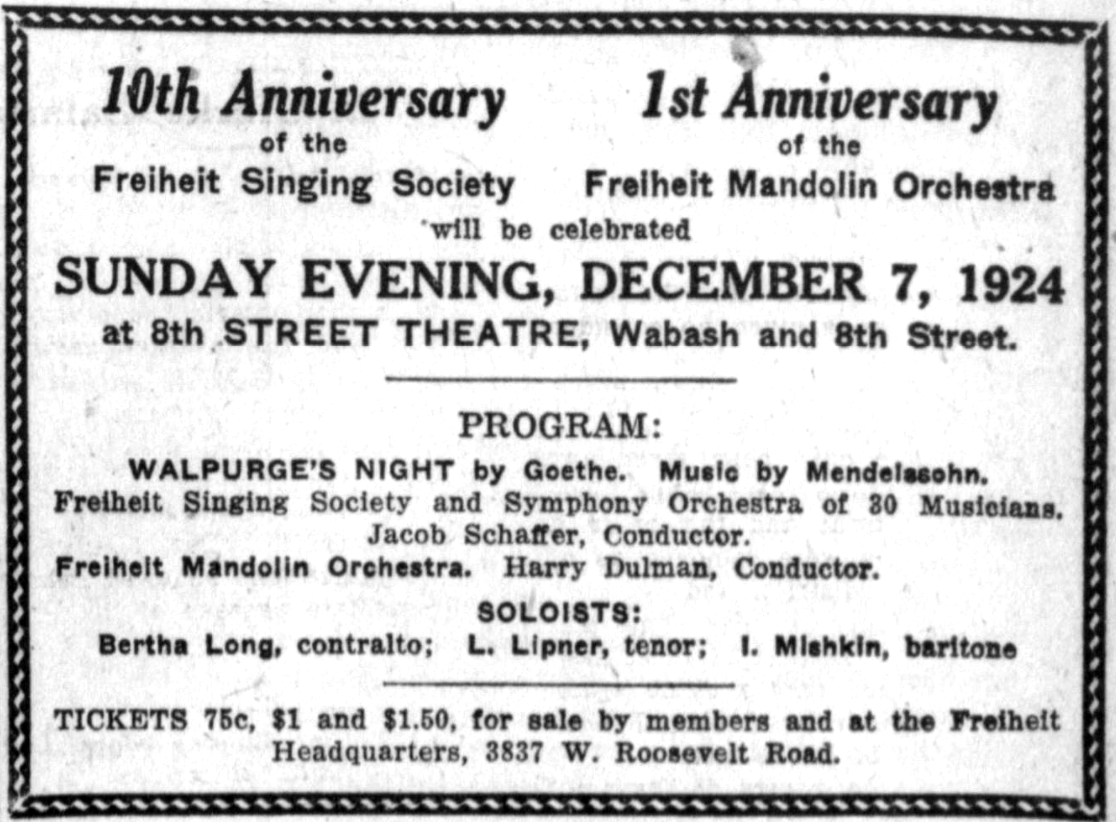
A review of the first decade of the Freiheit Gezang Farein, a major cultural institution of the Yiddish-speaking left, and its founder Abraham Kochansky. The chorus is still active today.
‘Freiheit Singing Society—Tenth Year’ by M. B__n from The Daily Worker. Vol. 2 No. 221. December 6, 1924.
SUNDAY, Dec. 7 (tomorrow) our Communist Singing Society, “Freiheit” is celebrating its Tenth Anniversary (with a public concert).
THIS event is of special interest to our proletarian Revolutionary movement, to the organizations and members of the Workers Party. It is necessary to acquaint our English-speaking comrades and federations with this organization, for in our everyday work for the revolutionary movement, in our propaganda and appeal to reason and class-interest of the workers, we forget or almost neglect one important factor–to stir not only his class consciousness, but also his emotions, his innermost feelings which are a part of the human intellect.
SOMETIMES a song, a revolutionary song, reaches depths of the worker’s soul, that no amount of oratorical exuberance will do. This elementary factor is perfectly understood by our comrades in Soviet Russia where the revolutionary song is made great use of. This was also understood by our Jewish comrades who had the experience of their revolutionary activity in the old countries. Ten years ago, in December, 1914, a few comrades decided to supply the movement with revolutionary song: and in a few weeks an organization was formed with about ninety members.
THE founders and the most active members of the organization (who, by the way, are all, with the exception of three or four, now members of the Workers Party) are still active. They were: Comrades Shaefer, Bailin, Ab. Kochansky (about him later), Aspis, M. Dobrow, J. Karish, the Steinbergs, especially Mrs. L. Steinberg, L. and A. Simons and others whose names space does not allow to mention. All, without exception, proletarians, workers of shops and factories.
THEIR first public appearance, in April, 1915, was greeted by the Chicago Jewish workers with enthusiasm. It was felt by every one that a great cultural void was filled, a great need in our movement was satisfied. The following years of existence and development of the organization showed that the utility of the chorus for the movement is inestimable, not only because their song (all their song) urges to action, calls for struggles, supplies the stimulus and wakes enthusiasm, but also because they became the center around which proletarian culture began to develop, even a symphony orchestra was organized (existed two years).
WE have before us most of the programs of their ten years’ activity. A huge number of songs, oratorios, cantatas, etc.–and not a single song that does not urge to action in the class struggle, that is not of proletarian-revolutionary contents and character, beginning with their first song in 1915, the International, and ending with their last cantata, “The Twelve,” depicting the revolution of November, 1917!
THERE is plenty of proletarian and revolutionary poetry in the Yiddish or translated literature, but music has been written for a very few of them Where do they get the music? They pick out a piece of poetry that answers their revolutionary purpose, if it has the music, Comrade Shaefer arranges it for the chorus or for an orchestra with the chorus; if it hasn’t the music, Comrade Shaefer gets busy and composes it. His music not only depicts and expresses the contents and meaning but always brings out in relief and underlines the most appealing and revolutionary moments of the piece. Comrade Shaefer being a working man himself (a carpenter by trade) with a real “under dog” pedigree, was almost from his childhood brought up and educated in revolutionary movement, first in Russia (Bund)–then here. He somehow instinctively feels the yearning and soul of a revolutionary appeal and expresses it as only one of the strugglers and fighters can.
A FEW words about the chorus and its organization. When you hear the chorus on the stage–you enjoy the perfect rhythm and execution of the song, you marvel at its fine harmony, organization and discipline, but you never know how much work and energy lays behind it. Come to the rehearsals of the chorus, in the kitchen where the song you enjoy is prepared and you will get a conception of the amount of work and drudgery required. None of the comrades of the chorus, except Comrade Shaefer, had any musical education, a very few of them can read music, the song has to be learned by heart, bar by bar, sentence by sentence, phrase by phrase, first with the sopranos their part, then altos, then tenors, baritones, basses. It rains a cacophonia of meaningless sounds; and this drudgery lasts weeks until the different parts are learned, and only then, when they are assembled, the singers themselves hear the song, enjoy the music and are repaid for their hard labors.
FOR a stranger at a rehearsal the arises: What brings these working people here? What compels them, after a hard day’s work in the shops and factories, to spend here their few spare moments that are so needed for rest in order to be able to slave the next day? The answer is–the instinctive call of the song, which cannot be satisfied in the shop or factory nor at home where he is crowded by other people who will not allow him to disturb their rest by vocal expression of his accumulated feelings and emotions. Hence, in the region of song, the worker is compelled or instinctively strives to action en masse, in company. He works in industry in company, he struggles and fights his battles in company-he wants to sing in company–i.e., choruses.
BUT a chorus is an organization and requires incessant work: executives, organizers, etc., and money. But our singing comrades are so knitted together, so devoted to their organization that no sacrifice is too great for them, with some of them even their very lives is not too great a price for their organization.

WE will mention here one who seems to be one of several and probably of many of this unique organization, the deceased Comrade Abraham Kochansky. He was one of the creators and nurses of the singing society, he nourished it literally with his blood. He was a typical product of the Russian revolutionary movement entering it while a youngster and living through the whole gamut of a revolutionist: privation, illegal existence, prison, Siberia, escape, etc. Here in the United States, he, being an irremediable walking protest incorporate, could not adjust himself to the slowness of the milk-and-watery socialist party movement and he devoted himself to the building up of an organization that can give “pep” and enthusiasm to the working people.
BEING a printer by trade, he could earn enough to keep alive, but then he would be compelled to give only his evenings or nights to his pet which, according to him, was not enough; for work there was a plenty! And he cheerfully gave his days in addition to his nights. If he did work in the shop his earnings were spent not for himself…Due to this he was always in a state of semi-starvation and seldom with a roof over his head. Only a very few comrades knew it. Help was always offered but never accepted by him though money for the organization he always sternly demanded. His health and resistance were gone, and in the winter of 1921, while preparing a public appearance for his singers and at the same time helping to organize a bazaar, he over-worked himself in exposure–he never was clothed sufficiently–caught “a cold” and died a martyr for Communist culture.
THE labors and sacrifices of the Kochanskys (there are a number of them still at work in the Freiheit Singing Society) were not in vain. Sparks and rays of the Chicago Freiheit Singing Society have been thrown over to New York, Philadelphia and a great number of other cities where Jewish workers and comrades are organized in our movement, and new Freiheit Singing Societies have been organized. There are now sixteen or eighteen cities with Communist Freiheit Singing Societies with a provisional national secretary, Comrade Saroff of New York.
THEY now contemplate calling a national conference of all the Freiheit Singing Societies with the aim to establish different “national” institutions, as a directorate, a publishing house for proletarian music, etc., even a Communist conservatory.
The Daily Worker began in 1924 and was published in New York City by the Communist Party US and its predecessor organizations. Among the most long-lasting and important left publications in US history, it had a circulation of 35,000 at its peak. The Daily Worker came from The Ohio Socialist, published by the Left Wing-dominated Socialist Party of Ohio in Cleveland from 1917 to November 1919, when it became became The Toiler, paper of the Communist Labor Party. In December 1921 the above-ground Workers Party of America merged the Toiler with the paper Workers Council to found The Worker, which became The Daily Worker beginning January 13, 1924. National and City (New York and environs) editions exist.
PDF of full issue: https://www.marxists.org/history/usa/pubs/dailyworker/1924/v02a-n221-dec-06-1924-DW-LOC.pdf

