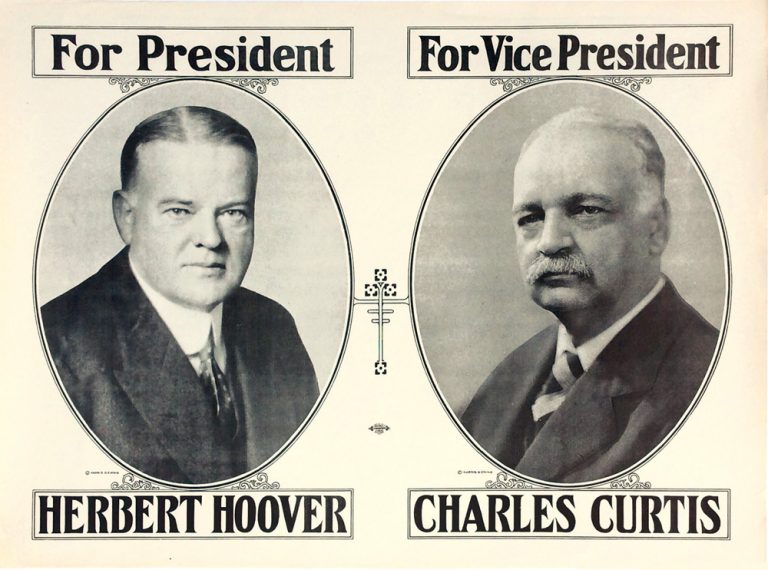
Swabeck analyzes the 1928 elections which saw the Republicans continue to dominate national politics with the ascension of right-wing millionaire Herbert Hoover to the presidency.
‘The Presidential Election Campaign in the United States’ by Arne Swabeck from International Press Correspondence. Vol. 8 No. 60. September 6, 1928.
In many respects the coming presidential elections will mark points of greater interest than heretofore as well as a beginning toward more clearly accentuating class issues in American politics. This is expressed in the following.
First, in the general line up of candidates and forces of the two major parties. Captains of industry and finance play a more direct and a more outstanding role, making a reality of the slogan “More Business in Government” and more than ever throwing off the fetters of bourgeois democracy. This itself signifies not only the growth of power of American imperialism but also its more conscious and deliberate preparations to remain in power.
Secondly, in the almost complete elimination of issues of difference between these two parties and a marked beginning of their inner dissolution upon issues resembling a class character. This is a process so far held back mainly by the low level of development of the American working class movement. It is a beginning of the disappearance of the reactionary two-party system.
Thirdly, by the further and complete disappearance of any working class semblance of the Socialist Party and the absence of any third party or labour party movement as a nationally organised and political factor of consequence.
Fourthly, by the emergency of working class issues as an integral part of the elections becoming apparent to important sections of the workers. Together with this a better prepared and more conscious participation by the Workers (Communist) Party, raising the banner of revolutionary class struggle and becoming a greater political factor.
These four factors alone suffice to indicate a prelude to a more definite constellation of class forces and, viewed in connection with the growing industrial depression, also a sharpening of the class struggle.
Unquestionably the selection of the presidential candidates and the committees to manage their campaigns shows more than ever the hands of big business, finance and industrial capital. Herbert Hoover, candidate of the leading party of capitalism, himself signifies big business in its most ruthless form despite the attempts to fasten the humanitarian halo onto his skull. On his campaign advisory boards are such men as Henry Ford, E.W. Litchfield, president of the Goodyear Tire and Rubber company and others. The part played by the multi-millionaire, Andy Mellon, was not merely a secret backroom affair but performed in public view.
While strenuous, and possibly successful efforts will be made to have Al Smith, the democratic choice, continue in his pose as the people’s man and friend of the workers, the selection of John J. Raskob as chairman of the democratic party national committee and campaign manager, with the assistance of such personalities of the financial world as Du Pont, Herbert H. Lehman, the Wall Street banker, and others is not without significance. Raskob is Morgan’s man, proclaimed heir to the mantle of the deceased steel king Elbert Gary and vice president of the General Motors, the largest corporation in the world. The Democratic Party may now fully as well as the Republican Party lay claims to being the representative of Wall Street with the dominant capitalist imperialists completely taking over the direction of its affairs.
The Workers (Communist) Party platform states, “There are no real political differences between the two big political parties. Both are parties of capitalism, both are the enemies of the working class.”
The deletion of the issue of the class struggle from its programme by the Socialist Party at its last convention coincides with its more recent attitude as, for instance, expressed by its leading elements at the New York Socialist Party state nominating convention. There the main appeal was made to the middle class, the small business men. The labour party movement as a nationally organised political factor is at a low ebb. Its existence as an independent force in the state of Minnesota and a few other isolated points will hardly be of any real consequence in the presidential elections.
The history of the American labour movement during the last few decades has been one of failing to keep step with the rapid consolidation of capitalism. While this consolidation has reached the point of a mighty empire the level of development of the labour movement is still a very low one. The signs of radicalisation of the workers are so far visible mainly in their economic struggles. The traditional two-party system has in the past been the main factor preventing the development of such tendencies in politics. The American workers do participate in political elections but not as a class.
These elections will become a test of the Workers (Communist) Party’s ability to apply its programme of action. This programme contains demands in keeping with the economic needs of the workers.
The growing competition for world markets and the process of capitalist rationalisation now definitely indicate the beginnings of a permanent industrial reserve army in this country. The election platform of the Workers (Communist) Party demands unemployment insurance, initiation of public works and reduction of working hours.
The attacks upon the working class standard of living has become general. The forms of attack have varied from the cunning bribing of willing trade union officials, through class collaboration schemes and company unionism to open onslaughts, mustering all the forces available, from economic pressure, to courts, police and use of military forces. Despite shortcomings our Party has already proven itself the only force capable of organising effective resistance. It has led important struggles to save the trade unions and to maintain the standard of wages and working conditions, both from the attacks of the bosses and from the treasonable conduct of the labour lieutenants of capitalism. It has led the fight for amalgamation and militant union policies. It has now also made a beginning towards organisation of the unorganised into new unions. These struggles themselves must become a direct part of our election campaign and a means of helping to mobilise the workers for class political action.
The issues of government strike-breaking and anti-labour injunctions are very pertinent parts of our election campaign. The altitude of both major parties, while differing in form, is, the one of maintaining this system so indispensable to American capitalism and its continued possibility of keeping the workers in suppression. In some fields of struggle, notably in the late Pennsylvania and Ohio miners strike, our Party has made its stand clear by actually making the first attempts to organise the workers for mass violation of injunctions and against the systematic strike-breaking. These examples will live in the memory of thousands of workers and lead them toward support of Communism in these elections.
The growth of American imperialism and its war preparations are issues in these elections. An effective counter-campaign can be expected only from a working class party, in other words only from the Workers (Communist) Party. Our efforts so far in this respect have not nearly had a sufficient broad working class character. While carrying on our election propaganda it is of the utmost importance that simultaneously the workers be actually set into motion against American imperialism and for the defence of the Soviet Union.
The Workers (Communist) Party is a small party in a large industrial country, ruled by the most powerful imperialist bureaucracy in the world. This merely means that the difficulties which we have to overcome are so much greater. We even have remnants of our own past attitude towards parliamentary elections to struggle against. When we remember that as late as 1920 our Party, then existing illegally, issued the slogan of boycotting the elections (without any effect upon the workers) it is but natural that among our members there should still be somewhat of a dual attitude to this question. One of accepting the necessity of participation without fully recognising or utilizing the opportunities available. Yet these present elections should, and surely will become a starting point toward the firm establishment of our Party as a political factor in the United State, capable of fulfilling its great historical mission.
International Press Correspondence, widely known as”Inprecorr” was published by the Executive Committee of the Communist International (ECCI) regularly in German and English, occasionally in many other languages, beginning in 1921 and lasting in English until 1938. Inprecorr’s role was to supply translated articles to the English-speaking press of the International from the Comintern’s different sections, as well as news and statements from the ECCI. Many ‘Daily Worker’ and ‘Communist’ articles originated in Inprecorr, and it also published articles by American comrades for use in other countries. It was published at least weekly, and often thrice weekly.
PDF of full issue: https://www.marxists.org/history/international/comintern/inprecor/1928/v08n60-sep-06-1928-Inprecor-op.pdf

