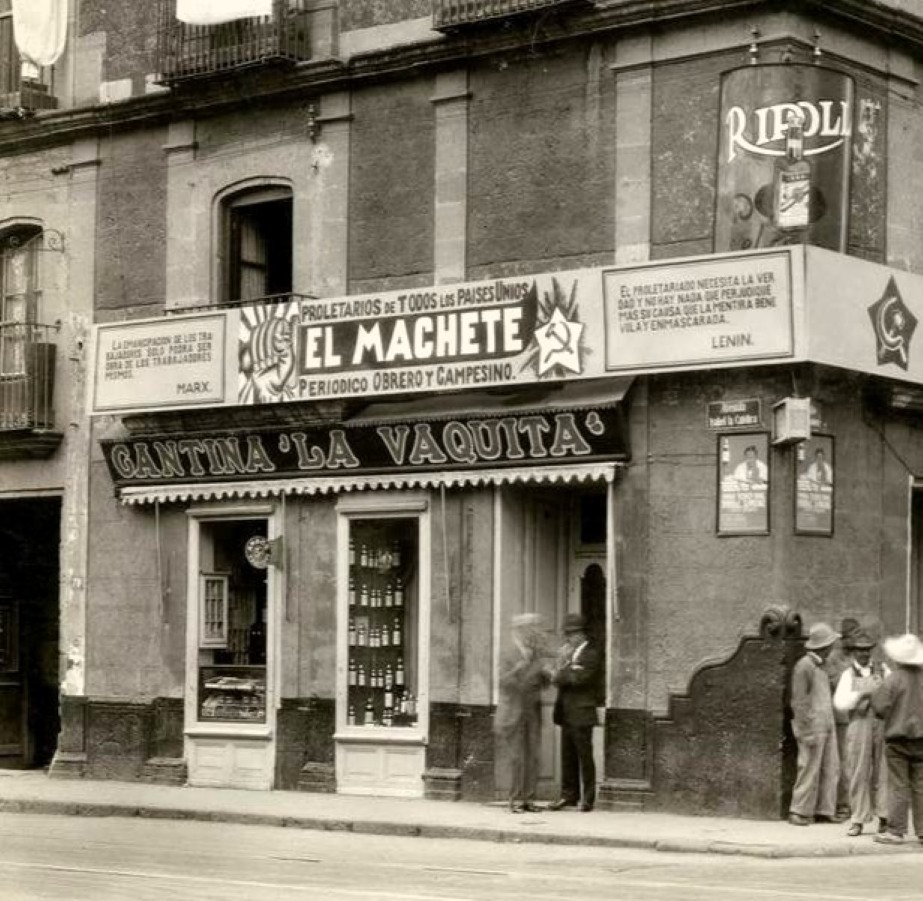
Wolfe, acting as Comintern representative to the Mexican Communist Party, reports on its second national congress in 1923.
‘Communists of Mexico in Second Congress’ by Bertram D. Wolfe from The Worker. Vol. 4 Nos. 273, 274, 275 & 276. May 5, 12, 19 & 26, 1923.
MEXICO CITY. “You and your esteemed family are invited to attend a celebration on the occasion of the opening of the Second Annual Convention of the Communist Party of Mexico.”
With this quaintly worded invitation full of Spanish formality the Communist Party of Mexico publicly announced its forthcoming convention.
The convention is being held in the “Casa del Pueblo” or “People’s House”, a huge low, one-story building, ancient and impressive, here and there the yellow “tezontle”, or baked clay, cracked and red brick showing through, till 1922 one of the ancient convents of Mexico, the land of 8,568 churches–and now “The House of the People.” But one cannot mistake it for a convent for over its entrance flies a huge, weather-scarred red flag.
I enter the unguarded gate, walk through long corridors where children play and chickens stroll, for the spacious building harbors many families of evicted rent-strikers, and I make my way into a huge, dim hall, the main one of the convent. The score of delegates are quite lost in front of it.
So these are the delegates! Peasants in peasant costumes, except that they have on a pair of shoes. Workers in ragged overalls. One or two with collar and tie and others betraying trade marks of “the intellectual”. Their faces are almost entirely Indian, grave and thoughtful. high-cheek-boned, dark-skinned. The one who presides is a full-blooded negro. On the high ceiling of the one-time convent are painted a sacred heart, crosses, a bishop’s mitre The whole front of the stage is a biblical scene depicting Christ in Jerusalem, but the figure of Christ has been covered by an enormous picture of Karl Marx and his disciples peep out between rents in huge Red Flags. And above, in gold letters, is emblazoned the legend. “This house was taken by the people. June 11, 1922, for the Communist Party of Mexico and the Union of Striking Tenants.”
An official begins to read the report of the outgoing National Executive–“To use all efforts to obtain a United Front of the working class in Mexico, eliminating and showing up as traitors to their class all those who opposed themselves to the benefits that the united front will procure for the workers.”
“This resolution,” declares the committee reporter, “was the principal instruction of the last Congress to the Central Executive” He proceeds to report on the mistakes and successes of the last year. He tells how the committee made mistakes in connection with the movement for a rival Federation of Labor, how as their united front activities grew the Communists met opposition both from the “yellow” leaders of the Mexican Federation, and the “red” anarchist leaders of the General Confederation. He declared that the opposition of the leadership of both factions, combined with tactical mistakes of the Communists in the early history of the General Confederation had been effective in aiding the leaders of both factions of the labor movement to set up a sanitary cordon around their organizations to quarantine them from Communist infection. “Our response,” he declared, “was to go directly to the masses of the workers everywhere, arouse in them” the already powerful longing for unity of the workers forces in the face of Fascism and the Capitalist offensives, until it became a burning and unquenchable passion. With this work the party must go on, and a United Front will inevitably result.”
II.
Contact with the masses of the workers was secured by the Mexican Communist Party largely as the result of the formation of the Unions of Tenants and the Initiating of a nation-wide rent strike under Communist direction,
Everywhere, the members of both the red and yellow unions, and their wives, and the unorganized workers lined up with these Tenants’ Unions. The governments, the officials of the Yellow Unions and of the Red Unions, united against these activities because they feared the effect upon. the masses of the Communist leadership.
The government attacked the public meetings of the Tenants’ Unions with military force, and the union leaders formed rival tenants’ unions. In Vera Cruz 90 men and women were arrested and are still in jail. But the movement there is powerful enough to support a Communist daily.
The National Committee of the Mexican Communist Party attacks the Parliamentary leftism of the party and proposes parliamentary activity in the forthcoming elections It reports its activities among the Peasants that have resulted in its assuming leadership in two states and developing a strong influence in three others. It proposes that the party initiate a movement for the Federation of all Peasants Communes (there are over a thousand in the nation) into a national organization. It reports that early this year the Union of Painters and Sculptors under the leadership of Mexico’s greatest painter, Diego Rivera, adopted a Communist program and affiliated with the Red Trade Unions. As a result many intellectuals are joining the party and nuclei are being formed among the student bodies. (Hitherto the party has had almost no intellectual elements). The Revolutionary Communist Party of Guanajuato has applied for admission and the committee recommends acceptance. It also recommends a study of growing unemployment, the position of the workers against Fascism, of protecting the peasants of certain localities against governmental disarming movements. Fraternal Delegate Carrillo rises to report for the Young Communist League, which during the preceding year under the leadership of one Valadas, has demanded independence from the party and compelled the party to yield.
“Our convention was held on April 8 and 9,” he begins. “We come here to acknowledge our errors of the past year, to retract our decision on independence from the party, to apply for reaffiliation with the Communist Party of Mexico as the Mexican Section of the Communist International, and to report that as a pledge of Communist good faith, we have expelled the elements that led us to our un-Communist actions of the past year.”
He outlines the activities of the league. Most interesting is his report on the anti-militarist Campaign of the Communist Youth. “Our principal anti-militarist activities are directed against the present recruiting system. Young peasants, not yet firmly rooted in the agricultural life of their communities, are recruited in sections where they know their fellow peasants, sympathize with the movements for confiscation of the land, know and are opponents of the big land owners, and realize the necessity of acquiring land if they are to find a future for themselves.
“They are then moved into other sections where they do not know the peasants nor the owners nor the local conditions, and used there against their brother peasants. Against this form of recruiting and moving in localities, the other Communist Youth is beginning to direct its chief efforts.”
The delegate from Victoria rose to report that he had been sent to the convention not only as a representative of a Communist local but also from an organization of his whole community into a “League for the Protection of the People,” which had been formed to fight an irrigation tax of two pesos per head and month, which irrigation scheme would aid only the rich. The league has been so successful that the tax had been withdrawn and the League is now turning its attention to the problem of the redistribution of the land. His fellow peasants in the League have asked him to go to the Communist Party Convention and find out whether the party thought they had been right in their activities. The delegate from Jalapa told how the “Yellow” leaders there had forbidden their rank and file to join the Tenants’ League “But we proceeded to organize their wives,” he reported, “and now the men of Jalapa are in a yellow union and the women are all in a red union.”
III.
From his jail in Vera Cruz came the voice of Heron Proal, to the Second Congress of the Mexican Communist Party, announcing by message the purchase on credit of a printing press for the Communist four-page daily newspaper here, “El Frente Unico.”
The delegates from Vera Cruz appealed for party support for the paper on a more adequate basis, and threw an interesting sidelight on the poverty of the peasants y explaining that the paper cannot e sold to them but must be given o them because it costs more than he land which represents their right to live. “They pay 12 pesos a year or their land,” explains one. “We are forced to charge 10 centavos five cents) a day for the paper, which makes over 36 pesos a year, or three times the cost of their right to live. The party must make it possible to sell the paper for five centavos and also to give it free to he poorest elements.”
Later, under the head of Press, the Secretary of the Party, Manuel Ramirez, moved that “El Frente Unico” be taken over by the party s its national daily organ for the se of workers’ and peasants’ unions, hat is continue to be published in Vera Cruz but that its circulation be made nation-wide and funds raised everywhere to purchase outright the mortgaged printing press, on which 500 pesos is owing, and thus put the paper out of financial danger.
“La Plebe,” he explains, will continue to be the national political organ of the Central Committee published weekly in Mexico City. His notion carries unanimously. The delegate from Orizaba reports that the “yellow labor government” here in conjunction with “yellow labor leaders” in the unions, is persecuting the Communists, preventing them from getting work and boycotting them. He requests moral and material aid for his district and the sending in of representatives of the National Executive.
A peasant delegate rises to inquire how he can explain to his fellows the United Front, the Red Trade Union International, and reasons in favor of co-operation between the Peasants’ Union and the Communist Party. He listens patiently to patient lectures by Ramirez, Lorenzo, Carrilk and others.
The Red Labor International is taken up. An anarcho-syndicalist tendency manifested by me of the delegates, is rebuked by Manuel Ramirez.
“As Communists,” he declares, “we believe in a united front of labors’ political and industrial organizations. Clause 2 of Article 11 of the Statutes of the Red Trade Union International, provided for interchange of committee members of the Red Unions and Communist Parts. At the Second Congress of the Red Unions which he attended as delegate from the Mexican “Red” Unions we threw out that clause because the anarchists of the entire world attacked it. In its place we provided for Committees of Action such emergencies as confront the French, German and Belgian Parties and Unions in the present Ruhr crisis, where they have formed a temporary united front. But this is not good, because it is not permanent, is not planful, it is not organic. “We continue to believe as Communists, in organic unity, but offer his as a concession to unclear elements in order to form a united bloc. “Here in Mexico it is difficult to form a united front with the present yellow leaders. (The shameless ones he calls them.) They have a united front with the government. In any workers’ crisis, the government plucks them by the car, whispers instructions, and they are obeyed.
“Consequently, efforts for the united front in this country take the form of Committees of Action, similar to the Syndicalist Revolutionary Committees of France and Spain, which are nuclei within both sets of unions to force a United Front.”
The convention takes up the agrarian problem, urges the peasants to refuse to be disarmed, elaborates details for the uniting of the agrarian communes into a nation-wide organization, provides for lessons on stock-raising and other matters in the daily paper, “El Frente Unico”, plans to unite the peasants unions with the Red Union International.
Resolutions are adopted congratulating the workers of the United States, thru the Workers Party, on the victory scored by Foster in the jury disagreement; congratulating the American workers on Fosters’ work and leadership. providing for reaffiliation of the Young communists with Interchange of committee members, denouncing the formation of tenants’ unions by the yellow leaders in places where tenants’ unions already exist–which they were not able to control; calling for the workers of all factions to unite in armed battalions of combat against the Fascisti and counter-revolution.
Frederick W. Leighton, director of the Mexican Branch of the Federated Press, addresses the convention in Spanish on the work of the Press, announcing the imminent starting of a Spanish news service, and calls for endorsement and the appointment of a party representative on the, “all-faction” advisory committee. The Federated Press is endorsed and delegate provided for.
It is reported that the paper “Laborista”, of the rival Laborista Party has stated that Enriques Flores Magon has returned to Mexica to assume leadership of the Communist Party, and that the capitalist paper “El Mundo” declared that the Party wanted a united front of all workers in order to put Magon at its head. The convention adopted resolution informing those interest ed that it has nothing in common with Magon who is an anarchist.
IV.
The big struggle of the Mexican Communist Party began when a member of the National Executive moved the approval of a resolution on participation of the forthcoming regional elections. He opened the debate by reading the theses of the Communist International on the subject.
This “voice of the International” dies aways and there is silence; painful, hostile. Everybody waits. Finally, Manuel Ramirez rises and begins the most brilliant speech of the convention. He is obviously its outstanding figure. He draws examples from the history of Argentine, Brasil Chile, from England, Germany, Russia. He speaks of “historical facts that we cannot destroy by a mere cloud of words”
“This country has been the scene of a series of insurrections, intermittent, but ever possible and often present, from 1821 to 1910. Governments were not elected into office but insurrected into office. Elections had little significance, often did not occur. But conditions here have changed since 1910 and the party has condemned itself to stagnation because it has not perceived this and adapted its tactics to changed conditions.”
He speaks clearly, intensely, brilliantly and with relentless logic and his face seems more Indian than ever under the stress of his thinking. He speaks without notes, yet never drops a link in the chain of his thought. He takes the wind out of the sails of the opposition and steals its thunder by branding in searing phrases the parliamentarism careerists of the labor movement. He gives ten measures whereby the party can prevent careerism and assure itself that the conduct of its parliamentary fraction be revolutionary and not bourgeois. These are (1) Inspection by the central committee of the personnel of local nominations; (2) Responsibility of elected officials, and nominees to the central committee; (3) Full power of the committee to set aside local nominations; (4) Be ruthless with careerists. Choose not “experienced parliamentarians” who tend form a professional bureaucracy in the labor movement. Choose rather workers without parliamentary experience so long as they be trusted fighters of proved ability and courage and long experience in the labor movement; (5) Limit their salaries to a workers’ wage; (6) The Central Committee must control the parliamentary fraction, instruct it be represented in its caucuses, prepare with it, its debates on vital issues, select its spokesmen, define its attitudes; (7) Every candidate must render a signed resignation in advance of the campaign which the central committee may use at any time after he is in office to force his resignation from office: (8) Work within parliament must be subordinated to vital mass issues outside of parliament. Elected officials must never lose contact with masses; (9) They are not legislators and statesmen but workers’ representatives inside an institution which serves the enemy, which they must show up, and which the workers will eventually destroy: (10) Let the fraction be small so long as it be dependable, rather than large and wavering.
There is only one Communist in the British House of Commons, but the whole country rang with the audacity of his attack on the throne in answer to the address of the crown. Even the labor delegation was stirred. He denounced the throne although it was high treason, because that was his mission. It was not his mission to keep within the law, regard himself as a statesman, receive his salary and give alms from it to the party.”
Long silence follows his speech. The opposition finds itself robbed of its thunder. When its leader rises to the attack, he is weak, uncertain and a bit awed. Young Carrillo of the Communist Youth follow with a clever speech outlining the disastrous results of non-participation in elections with well-selected examples from recent local history in various states. “Our comrades believed that the masses yearned for a political party that was anti-parliamentary,” he challenged. “They believed that by abstention we would conquer mass support. We have not. The experiment of conquest of mass support through abstention has been tried and has failed. Let us abandon our unsuccessful tactic.”
All that day and all the next, the debate goes on pro and con. Slowly it changes its character from a debate to a school room lesson. When the vote taken it is UNANIMOUS! Every delegate has been educated to the viewpoint of the National Executive and the anti-parliamentary period of the Communist Party of Mexico is at an end. The convention draws near to a close. It is the last day–Sunday. The week’s labors are ended. The new committee is elected. Among the new names is that of Mexico’s leading artist, Diego Rivera. Lorenzo, the bearded “philosopher”, and Ramirez, the canny secretary are re-elected to the new committee. At Sunday noon they sing the International and adjourn to a dinner given in their honor. The dinner is followed by sweet, melancholy Mexican song. Then come exhibitions of Indian and Mexican dancing. Ragged workers come in their ragged Sunday best–some barefoot, some sockless and sandaled, some in native Indian costume with long serapis or blankets of many colors wrapped around them–squalor, misery and hope.
Follows the cheering–the inevitable “long live’s” or vivas. Once more the International is sung, and the convention is over.
In December 1921 the above-ground Workers Party of America merged the Toiler with the paper Workers Council to found The Worker, published in Chicago which became The Daily Worker came from The Ohio Socialist, published by the Left Wing-dominated Socialist Party of Ohio in Cleveland from 1917 to November 1919, when it became became The Toiler, paper of the Communist Labor Party.The Daily Worker beginning January 13, 1924. National and City (New York and environs) editions exist. The Daily Worker began in 1924 and was published in New York City by the Communist Party US and its predecessor organizations. Among the most long-lasting and important left publications in US history, it had a circulation of 35,000 at its peak.

