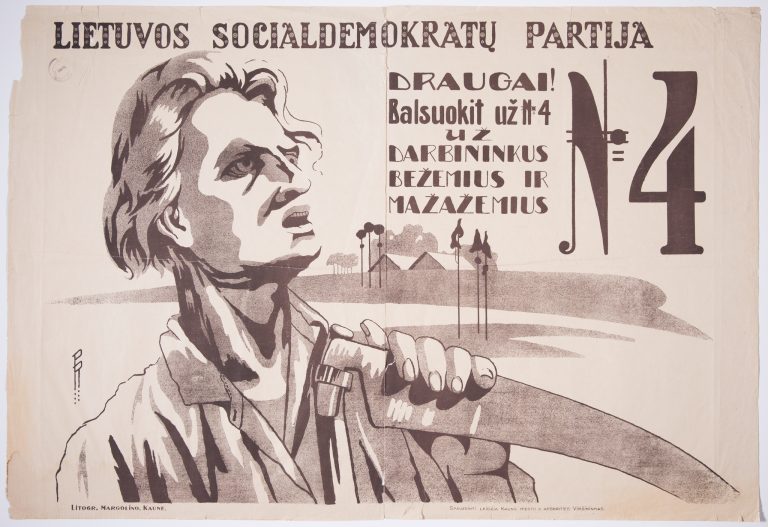
Continuing our tour of fascism’s origins in individual countries, we come to Lithuania where on the night of December 17, 1926 a military coup took power from the democratically elected Social Democrat-Peasants Union government and gave it to the small fascistic party, the Lithuanian Nationalist Union which would hold power until the arrival of the Soviet Red Army in 1940. While what is general about fascism is relatively well observed, it is in learning the specifics of movements that can be the most illuminating in understanding our enemy.
‘The Fascist Upheaval in Lithuania’ by W. Mickiewicz-Kapsukas from International Press Correspondence. Vol. 7 No. 3. January 6, 1927.
During the last few months, and more especially during the last few weeks, the Lithuanian Fascists, led by the so-called christian democrats, have been preparing quite openly for an upheaval. This is avowed by the entire Lithuanian press. The Communist Party of Lithuania and the left-wing workers had untiringly pointed to the threatening danger and demanded that it be energetically combatted; however, the government, which was composed of popular socialists and social democrats, could not make up his mind to any decided action.
If we inquire into the nature of the present upheaval, we cannot but recognize that it is a fascist-capitalist movement, directed in the first line against the working class and the poor peasantry. Under the petty-bourgeois regime of the Narodniki (popular socialists) and social democrats, who came into power after the Lithuanian Seym elections in May 1926, the working class and the working peasantry had succeeded in making considerable progress in regard to the freedom of coalition, assembly, and the press, besides, attaining a practically complete amnesty for political prisoners and the removal of the Ochrana butchers and of certain officials of particular notoriety as embezzlers of public property, and at the same time concluding a guarantee agreement with the Soviet union. The working class of Lithuania could breathe more freely and commenced the formation of trade unions, while there was a series of strikes throughout the country. The poor peasantry demanded that at least the most outrageous acts of the land reform effected in the interest of the formerly prevailing clique be subjected to revision, and that the embezzlers of public property be called to account. The government of the Narodniki and the social democrats failed to comply with these demands. Under the pressure of the reactionary clerical bourgeoisie, which was louder and louder in its allegations that the government was likely to plunge the country into Bolshevism, the latter began to incline more towards the right. Steps were taken to dissolve the trade unions which were under the influence of the left, certain Communists were arrested, and so forth. The Communist Party failed to attain any legal status, while the Fascists were allowed to carry on their work and found their organization quite openly. During the last few weeks, it is true, the government responded to the growing danger and to the pressure of the peasantry and working class and affected a certain movement towards the left, placing the Fascist leader Glovatzkis under arrest and prohibiting the publication of his paper. These measures, however, proved insufficient.
At the head of the Fascist movement in Lithuania are the christian democratic party (Chadeki) and the party of the Lithuanian nationalists. The former comprises three organizations, the actual christian democratic party, the union of big peasants and the Yellow Federation of Labor. It is the party of the reactionary Lithuanian bourgeoisie, the bankers, the big peasants and landed proprietors, under the lead of the catholic clergy, the banker Vailokaitis, Krupavitchius, the others. Up to the last Seym elections, this party was in power; by unscrupulous, corrupt, and brutal practices, by a misuse of public property, by the pressure it exercised on the peasants and workers, by openly favoring with government commissions and contracts a small number of profiteers (such as the parson-banker Vailokaitis), by allotting the “centres” of the dismembered estates to its own proteges, by serious infringements of the law, by giving free play to the jesuits, by the “electrification” of political prisoners, and by similar misdeeds, the christian democrats aroused so much discontent in the country as to entail their severe defeat at the last elections. Immediately after these elections, which turned out so badly for them, the christian democrats set to work to institute a Fascist dictatorship by means of a general upheaval, Plechavitchius being designated for the post of dictator. The elections, however, had so far weakened the party, and the general dissatisfaction with their rule had grown so great, that they found themselves under the necessity of deferring the coup d’etat and of waiting until the new liberal government should in its turn have sufficiently compromised itself, in the meantime preparing for the coming struggle. The clerical reactionaries of Lithuania devoted their attention in the first place to the formation of Fascist fighting organizations out of the reserve of officers, former volunteers of the Lithuanian army, students, sharp-shooters (wealthy farmers’ sons) and the like, in which direction they had pronounced success. Their main slogans were “Down with the socialist freemason government!”, “Down with the dictatorship of the trade unions!”, “Down with the Communists!”, and “Down with the agents of Moscow!”. The class-character of such slogans is quite obvious. During the last Seym elections, the nationalists, headed by ex-President!
Smetona and Voldemaras, were in the opposition against the then ruling christian democratic party; from the point of view of class-physiognomy, however, this small party of monarchist landed proprietors and peasants is closely allied to the christian democrats. It is, therefore, no wonder that, after some vacillation, they came to form one party with the latter in the Seym, and of late began to turn most pronouncedly against the rule of the Narodniki and social democrats.
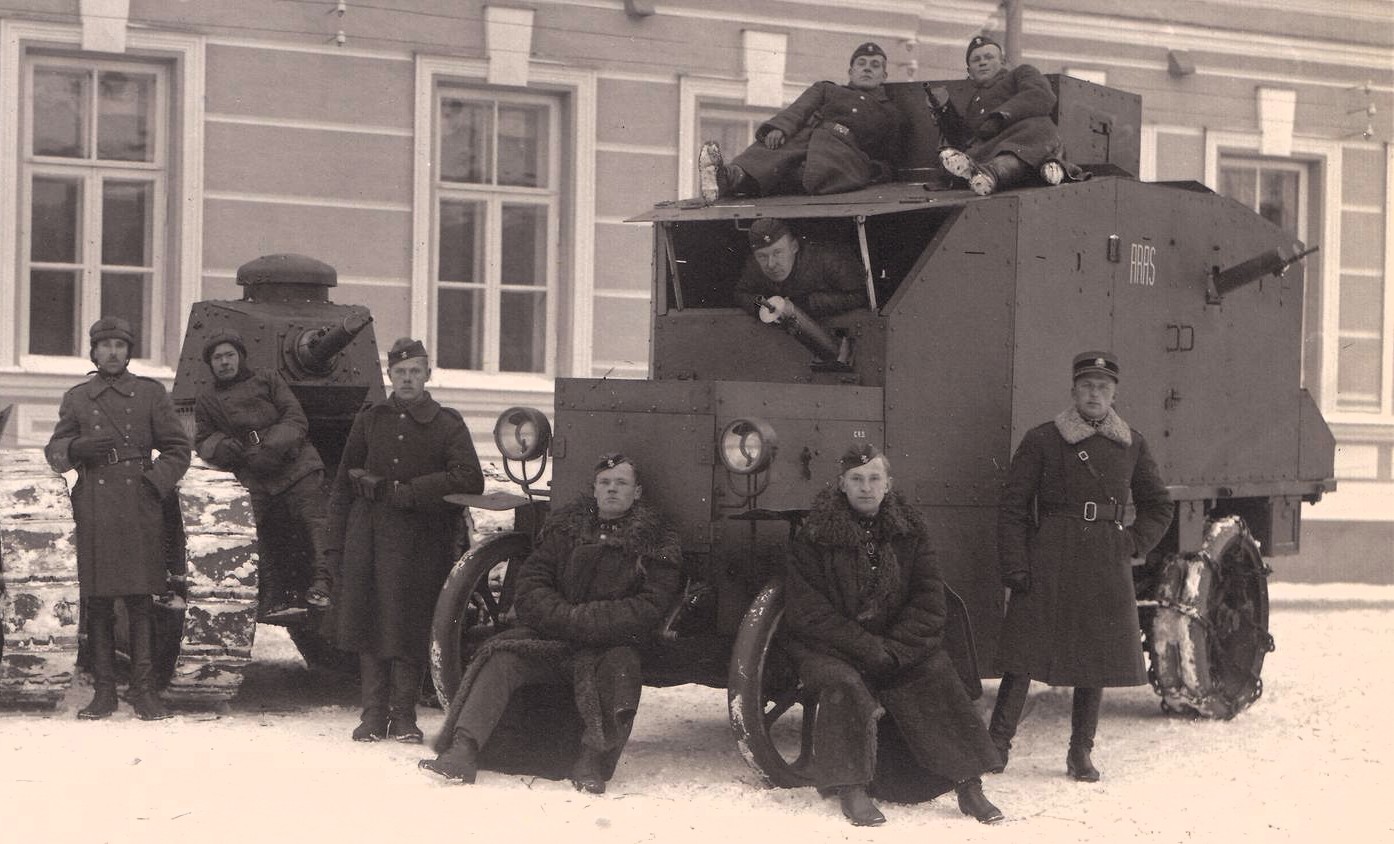
These two reactionary parties, which, to the delight of Great Britain, aimed at bringing about a rapprochement between Lithuania and Poland, and an estrangement from the Soviet union, initiated the Kavno upheaval, in which connection the christian democrats required the aid of the nationalists so as at least slightly to mask their tactics from the working masses who hate the very sight of them.
The leader of the entire movement, Major Plechavitchius, a former czarist officer belonging to the class of Polish landed proprietors in Lithuania, had already distinguished himself in 1919 in his bestial execution of the Bolsheviks of the Shmudj region (in Lithuania), thereby gaining credit in the eyes of the christian democrats; Colonel Glovatzkis, likewise a former czarist officer and one of the landed proprietor class, made a name in the summer of 1919 by causing a number of Communists to be shot in the Kupishski and Rakishski districts. Both are in favor of an alliance with Poland.
The leaders of the Narodniki and social democrats proved incapable of forming a bloc with the working class and the village poor against the big farmers, landed proprietors, and capitalists, and of putting up a resolute fight against the Fascists. They merely kept declaiming on the threatening danger and had a lot to say about democracy and the will of the people; meanwhile the Fascists organized their ranks and then proceeded at an opportune moment, and without meeting with any resistance, to arrest the entire government, occupy the government buildings and place the commanders of such regiments under arrest as had remained loyal to the old regime. Here, as in Bulgaria, the failure of the petty-bourgeois parties became patent.
Even before the upheaval, the Communist party of Lithuania constantly and emphatically advocated a struggle against Fascism, if necessary with the use of arms. Without actually supporting the government of the Narodniki and social democrats, which was after all a bourgeois body, the Communist party urged it to fight against Fascism, clearly recognizing all the advantages of this government as compared with the Fascist and christian democrats policy of the big peasants and big bourgeoisie class (according to Lithuanian standards). After their coup d’etat, the Fascist proceeded to arrest numerous Communists, left wing and even social democratic workers. There can naturally be no doubt whatever that the overwhelming majority of the workers and working peasantry of Lithuania are radically opposed to the whole movement and to the dictatorship of the christian Fascist bankers and land owners and, if for the time being they do not take any active steps, there is no question that in a very short time they will take up the fight against this form of dictatorship along the whole front. The lead in such a struggle cannot but fall to the share of the Communist party. The late President Grinius, whose interment has meanwhile been repealed, has dissolved the Sliashevitchus cabinet and entrusted the nationalist Voldemaras with the formation of a new government. The Fascist upheaval and the new Fascist government of Lithuania have, therefore, already been placed on a “legal” footing. Besides the pronounced reactionary and Fascist elements, the christian democrats and nationalists, the government comprises a representative of the farmers’ party and an independent, all its members being extreme Right champions of the Lithuanian bankers, capitalists, big farmers, and big landed proprietors. The attitude observed towards the Soviet union and the guarantee agreement concluded with the Soviet union, by the late government, is openly hostile in the case of the christian democrats and in that of the nationalists superficially, i.e., allegedly, friendly, while the attitude assumed with regard to Poland is friendly to the extent of servility in the former, and professedly hostile in the latter case. The christian democrats were not averse to using the aid of Pilsudski in the subversion of the Narodniki and social democratic government. The fact meanwhile that in spite of the fight they had until recently waged against the christian democrats, the nationalists agreed at the crucial moment to form a bloc with the latter, shows how superficial the differences between the two parties really were. The developments ensuing in the little Republic of Lithuania have, indeed, come to acquire great international importance.
International Press Correspondence, widely known as”Inprecorr” was published by the Executive Committee of the Communist International (ECCI) regularly in German and English, occasionally in many other languages, beginning in 1921 and lasting in English until 1938. Inprecorr’s role was to supply translated articles to the English-speaking press of the International from the Comintern’s different sections, as well as news and statements from the ECCI. Many ‘Daily Worker’ and ‘Communist’ articles originated in Inprecorr, and it also published articles by American comrades for use in other countries. It was published at least weekly, and often thrice weekly.
PDF of full issue: https://www.marxists.org/history/international/comintern/inprecor/1927/v07n03-jan-06-1927-inprecor-op.pdf

