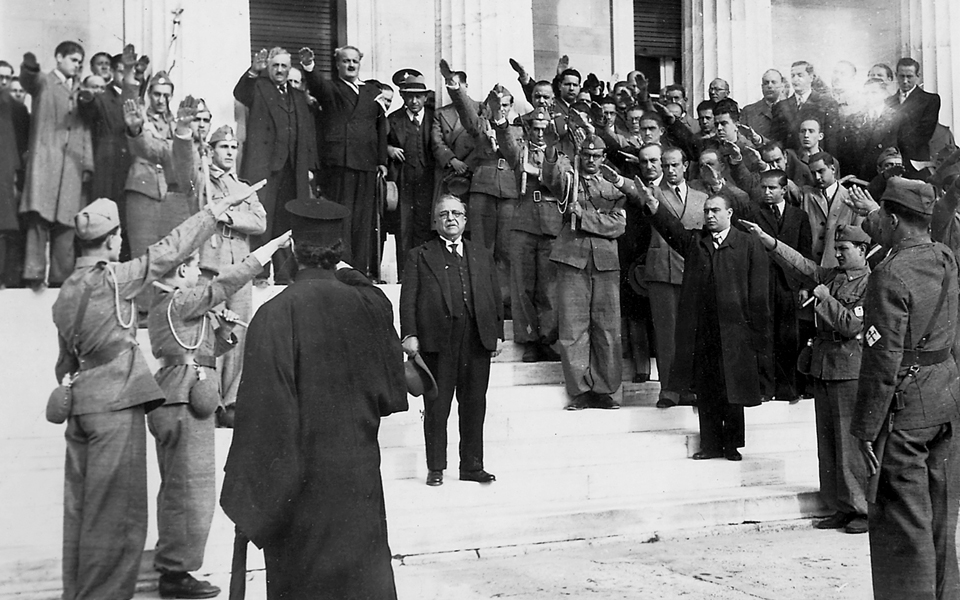
Karagiorgis, would later play a central role as Communist military leader in the anti-Nazi Resistance and Civil War, on the rise of several competing Greek fascist organizations beginning in the late 1920s. Metaxas would take power in 1936.
‘The Growth of Fascism in Greece’ by Kostas Grypos (Karagiorgis) from International Press Correspondence. Vol. 14 No. 20. March 29, 1934.
The systematic fascisation of Greece began with the taking over of the government by Venizelos in the year 1928. He paved the way for open fascism and did all he could in order to shift the main burden of the crisis on to the toiling masses by means of ruthless wage cuts, monstrous taxation and brutal enforcement of the tax decrees.
Venizelos endeavoured at the same time to crush the political forces of the toilers. He issued the “anti-Communist law,” which forced the C.P. of Greece almost into illegality, threw thousands of workers into prison or sent them into exile. The International Labour Defence was prohibited just as was the Unitary Trade Union Federation, the large tobacco workers’ trade union and many other revolutionary workers’ organisations. But neither the workers nor the civil servants were intimidated by these measures.
Last year Venizelos gave place to his worthy successor Tsaldaris, who was called upon to accelerate the establishment of open fascism.
The two bourgeois blocs are proceeding along separate lines. The camp of Venizelos attempted a putsch already on March 6, 1933 The present government party has similar designs, for which purpose it is effecting changes in the officers’ corps and gathering its adherents round the War Minister General Kondylis. Another group is aiming at power gathered round General Metaxas.
Apart from these strivings of the bourgeois parties and groups in the last quarter there arose the idea of the so-called “Third Situation,” a movement which is directed against all existing bourgeois parties and is intended to become a purely fascist mass movement on Hitler’s lines. The sponsors of this idea are big bankers, Ministers and higher officers. A large sum has already been placed at the disposal of this “third situation,” and the newspaper “Hestia” which maintains good relations with the British Embassy, has taken over the ideological work of preparation.
All the groups which advocate fascism need fighting troops for the realisation of their aims. Four fascist fighting bands have arisen in Greece in the course of the last six years.
The fascist organisation “Iron Peace” was formed by the followers of General Pangalos after the overthrow of his military, fascist dictatorship. This organisation played a certain role only in Athens and Piræus. It could not become a mass organisation: during strikes its members acted as strike-breakers.
The followers of the exiled King George II intended some years ago to set up a monarchist-fascist movement with Prince Ypsilantis at the head. But their attempts failed.
The “Yellow Shirts,” a fascist organisation which is known only in Athens, attempted to come into contact with the proletariat, but encountered fierce resistance. Yannaros, the chief, editor of the monarchist paper “Esperini,” was Its founder.
Ex-Minister Mercuris has founded a national-socialist labour party, but in spite of Hitler’s agents in Athens they were unable to gain many followers and the organisation did not even venture to run candidates at the last parliamentary elections.
Some years ago the National Union of Greece E.E.E. was founded in Salonica. This organisation, which found adherents in some towns of Macedonia and later also in Athens, is based on the model of the German “Stahlhelm.” The members are trained by reserve officers and non-commissioned officers. The E.E.E. also attempted to establish a footing among the workers and the masses of impoverished refugees. The members of the E.E.E. in Salonica and Athens organised numerous attacks on workers which resulted in many killed and wounded. One of their vilest acts was the pogrom in Salonica in 1931, in which the Jewish colony was burnt and many working Jews were killed and wounded.
The E.EE. gradually won the confidence of the capitalists. The Venizelos group then generously financed the E.E.E., had them trained by officers and supplied them with arms, so that to-day they are regarded as a fighting troop of a broad fascist movement and are employed as such. The differences between the government and the Opposition led to the splitting of the E.E.E. organisations in Athens and Salonica into Venizelists and Tsaldarists. At the Salonica congress the fascist band was converted into a “party” (with a programme similar to that of the Hitler party) which did not need to take seriously the prohibition of its organisation in Salonica, for it was able to take part unhindered in the municipal elections and received 700 votes.
The reason why the decisive capitalist circles do not yet make use of the E.E.E. fascists as the core of a broad mass movement lies in the degree of their inner disintegration and the level of their cadres and, the hatred which the working masses display towards this band of murderers.
Greek capitalism is more and more aiming at bridging the differences in its own camp with the aid of fascism and completely subjugating the masses of the working population by means of terror.
In view of this danger it is necessary to mobilise the masses in the whole country under the leadership of the Communist Party in order to resist the threatening fascist attack.
International Press Correspondence, widely known as”Inprecorr” was published by the Executive Committee of the Communist International (ECCI) regularly in German and English, occasionally in many other languages, beginning in 1921 and lasting in English until 1938. Inprecorr’s role was to supply translated articles to the English-speaking press of the International from the Comintern’s different sections, as well as news and statements from the ECCI. Many ‘Daily Worker’ and ‘Communist’ articles originated in Inprecorr, and it also published articles by American comrades for use in other countries. It was published at least weekly, and often thrice weekly.
PDF of full issue: https://www.marxists.org/history/international/comintern/inprecor/1934/v14n20-mar-29-1934-Inprecor-stan.pdf

