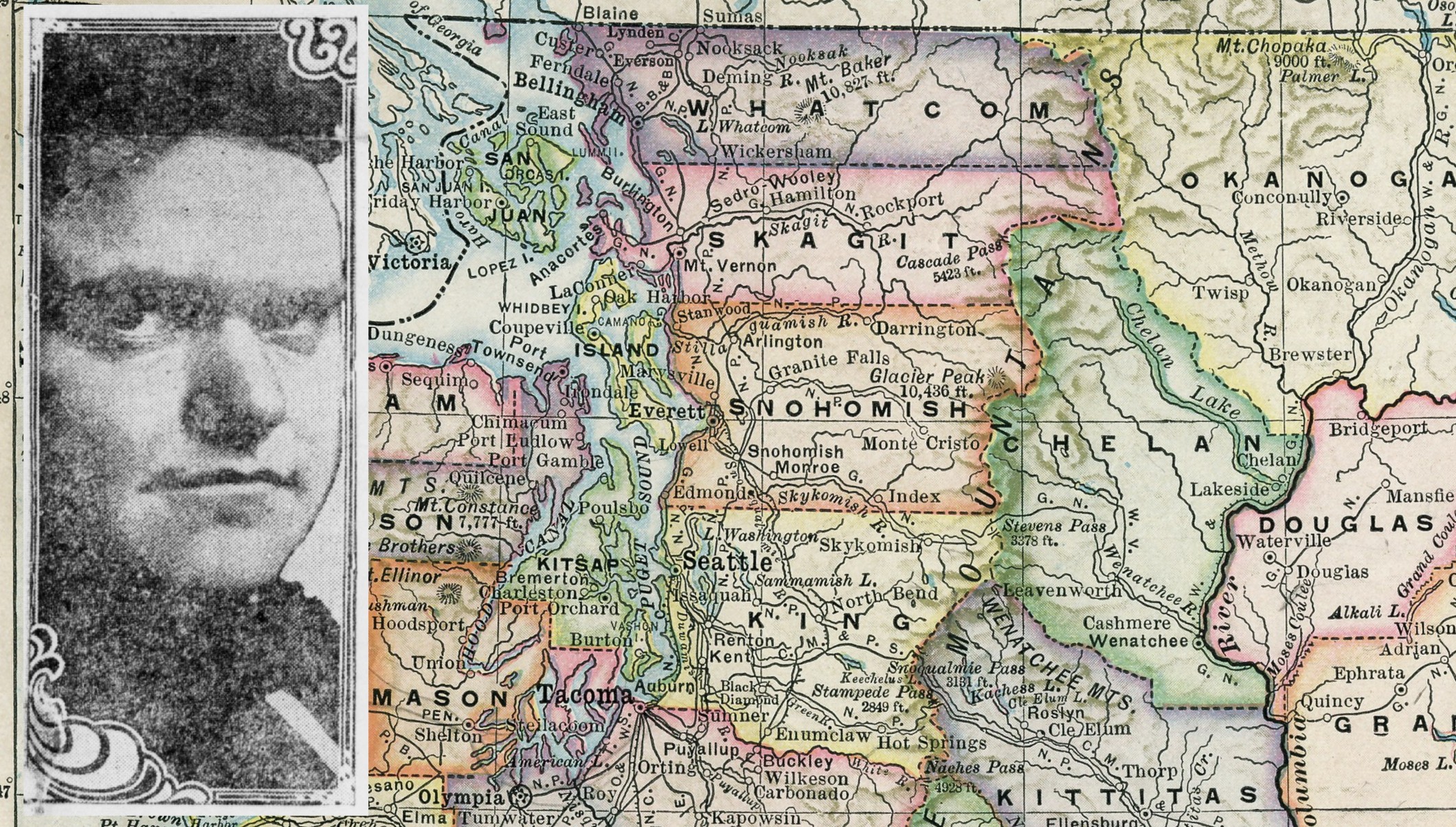
Bruce Rogers, State Organizer for the Washington Socialist Party sends in a report full of details on the places and comrades visited during a tour of the small towns along the Skagit River.
‘Log of an Agitator’ by Bruce Rogers from The Commonwealth (Everett), No. 113. February 27, 1913.
Leaving Concrete on February 4, sorely puzzled and blue over the labyrinth of cross purposes, opportunism, material self-interest and downright crookedness of our own members that had strangled to death at large and prosperous local. I arrived at Sauk in no good frame of mind. I loafed in the “company” store while Comrade Edmund Anderson attended a meeting of the school board of which he is a member. It followed that our dandy meeting was held in the good warm old fashioned school building around a high heater. We had the school building and the young principal of the school and most of his pupils and their parents in attendance–result of having a school board member.
Sauk is the tiniest little mountain village imaginable and at this time is gorgeously beautiful in a setting of front and snow. I bunked in the bachelor shack of Comrade George- Wilkins on the bank of the Skagit river and he cooked ham and eggs and coffee as only bachelor woodsmen know how to cook them. He is the village ferryman, keeps all the socialist papers and magazines and is an earnest socialist of the old Appeal “army” type. Rockport, about a couple of miles further up in the mountains, is the terminus of a jerky, wheezy branch of the Great Northern. Comrade Ira Hays brought the Rockport comrades down on a hand car and they helped to make the lecture a success. Comrade Mrs. E.H. Miller was temporarily selected as woman correspondent and arrangements were begun for the lecture of Comrade Gribble on “The War of the Classes,” which is to follow in the Lyceum course. Both the collection, and literature sales were good and well handled.
At Sedro-Woolley Feb. 5
I arrived at Sedro-Woolley at 9 a.m. I knew that I did not have to worry about arrangement details here, for comrades are “up to snuff” and never fail to advertise the meetings well, and when there is a socialist speaker you can see his posters every where. So I went straight to the hotel and had the entire day for reading and writing.
Comrade and Mrs. W.E. Elbe, of Mt. Vernon. were in attendance and we talked over the lecture to be given in their town February 25.
At Wickersham
No formal meeting was attempted at this point. It is one of those small railroad towns left high and dry in poverty by the closing down of shingle mills. The comrades thought they could not secure a hall, although they had made no active effort to secure the school building or the little church. A dozen or so people gathered at the home of Comrade Royer, who is the station agent, and after the lecture delivered in the easy conversational style that I like so well, his good wife served sandwiches and chocolate. Regular arrangements were then begun for the lecture date of Comrade Gribble to come six weeks later.
Miss Ida Zobrist, one of the teachers, was present and became greatly interested in socialism. Comrade E.E. Boddy, a long time socialist, is on the job and the balance of Lyceum course will be a success notwithstanding the difficulties under which the comrades labor without spare money and against more than usual amount of unreasoning church prejudice.
Meeting at Clipper Feb. 7
Few words are needed to describe the visit here. It is the brightest, cheeriest spot in this Odyssey so far, and I can say that the local’s organization and work is the most perfect and fractionless I have ever seen. Comrade J.B. Strausbaugh, pretty generally known over the state as an active worker, lives here and was in charge of the very successful meeting which yeilded a surplus to the local and more than the maximum sale of books. An interesting story is told of how for a good many years Comrade Strausbaugh was the only socialist in Clipper and has name was used to frighten children with, “Strausbaugh ‘ll get you if you don’t watch out.” It was prophetic for now he is member of the school board and the preponderantly socialist town shall not soon forget Comrades C.A. Strand, his wife and the four interesting sons.
At Echo Valley I was met at Nooksack by Comrade Severance instead of Comrade Wm. Jones, of Everson, who was sick. I looked around for Comrade Severance’s “rig” to put my grips in when he informed me that I would have to hike it across to Echo Valley, and I have never seen a more quaint and peaceful place. It might well be taken for a village in another world or in the peasant communities of Europe. Comrade Severance and his kindly, bright-eyed wife may be said to be Jesuits for socialism; that is all for the cause. They have accumulated none of the world’s goods and have given their lives to libertarian effort–lives that are well beyond the noon-time to where the shadows fall ever and ever farther to the eastward, and hand in hand they are going down the western slope of their pilgrimage, still loving and still serving each other, not gladdened or solaced by the bubbling laughter of children, but encouraged and strengthened in the hope that socialism will come.
The meeting was poor from every standpoint except the unfailing kindly and student like attention that is being given the lectures at every point. When the meeting was over a comrade informed me that he had received word I was to speak at Sumas at 2 p.m. on Sunday, February 9. This made it necessary for me to tramp across country to Everson in order to take an early train. I knew that there ought to be a local organized at Everson and although it was nearly midnight I looked around to see if I could find some rebel. There was a wake in town–some pioneer had expired–and a dance. These two functions were absorbing the social strength and aside from the village dog there was no one to talk to except a sleepy lad in front of whose place there hung unevenly a dingy sign board bearing the disconsolate legend “pool room.” There was nothing for me to do but hunt up the hotel which in country towns always bears the ambitious name of “Palace” or “Royal.” Such are the lights and shadows in the life of a flying agitator.
At Sumas.
The comrades at Sumas have the neatest and best equipped hall and library I have ever visited. Besides a circulating library and a bountiful store of the best socialist books the spacious room is most tastefully adorned with neatly framed portraits, prints of revolutionary paintings, mottoes, etc., such as “A people fit for liberty cannot be enslaved.” In the center of one of the side walls I was amazed to observe in two gilded. frames life-sized bust portraits of J.P. Morgan and John D. Rockefeller, side by side, in a setting of American flags and bunting and over them the quotation, “Render unto Caesar the things that are Caesar’s.” I was inclined to scold about this until I saw the biting satire of it. And immediately across the room was framed in dull wood Art Young’s masterpiece, “Labor Crucified,” in a setting of crimson flags and pennants. The meeting, which was successful in every particular, yielded the maximum collection and we sold entirely out of literature. After visiting a bit with Comrades Mosely and Brockway I went with Comrade L.G. Atkins to his bachelor shack–a mere shanty containing a small old fashioned cook stove, a rough lumber bunk, not a sign of a chair, and bare floor. Atkins’ one handleless tin water cup had to serve us, first coffee for me, then tea for him, and his one tine pie plate had to be a dish from which we each ate sausages and baker’s bread. On rough pine box shelves were as carefully selected a lot of books as I have ever seen, books rare and valuable, new and old, the best in English and French. On the oil cloth table lay open a much thumbed volume in French, but description would too greatly lengthen the day’s “Log.”
At Lynden, February 10.
On this Odessey I sometimes meet men and women who were refugees from the Rocky Mountain war in the days of Peabody and Sherman Bill. Such the “Weyler of the Rockies” refugees are Dan and Nellie Farrell of Arletta and invariably they are comrades of whom experience has shorn all fool illusions. Such a man was the town marshal of Lynden. The meeting at which many were turned away was in the town hall and he acted as janitor, literature agent, usher and all. Comrade Ed. Edson was chairman. He’s a socialist and it was due to his efforts that the meeting was held. He knows socialism is coming but wants it to “come easy” for he is well fixed. At first survey one would think that the socialists of Lynden labor under the most favorable circumstances, but the contrary obtains for what is thought to be a genuine socialist sentiment is in reality but a sort of crazy horse bull moose-itis.
After the lecture I asked the socialists present to remain a few minutes and made a brief organization talk whereupon we organized with ten charter signatures. While we were signing up a rat colored old fossil “butted in” with the objection that the card membership run the affairs of the socialist party. I kept the charter application away from him and next morning learned that he is a skinflint money lender who had settled there and allowed the growth of the town to make him rich. It is my advice to the Lynden local to keep such knocking soreheads out. Comrade Bauman was made secretary. He is young, energetic and studious, and Lynden will stay on the socialist map.
The Commonwealth was a Socialist Party-aligned paper based in Everett, Washington that began in February, 1911. First edited by O.L. Anderson, the weekly paper was quickly involved in the state’s very fractious inner Socialist Party life. Editors followed the changing political fortunes with Anna A. Maley directing The Commonwealth from September, 1911 until May, 1912, who also focused the paper nationally. Maley left the paper to run for governor in 1912, the first woman and first Socialist in the state to run for that office, winning a respectable 12% of the vote. Six more editors followed Maley, including Maynard Shipley. The paper’s orientation was left and supported the I.W.W. when many S.P. papers were denouncing them. The Commonwealth struggled, like nearly all left publications in history, with money financially and sold to the Socialist Party of Snohomish County in April, 1914 to be reborn as The Washington Socialist.
Access to PDF of original issue: https://washingtondigitalnewspapers.org/?a=d&d=COMMONW19120712

