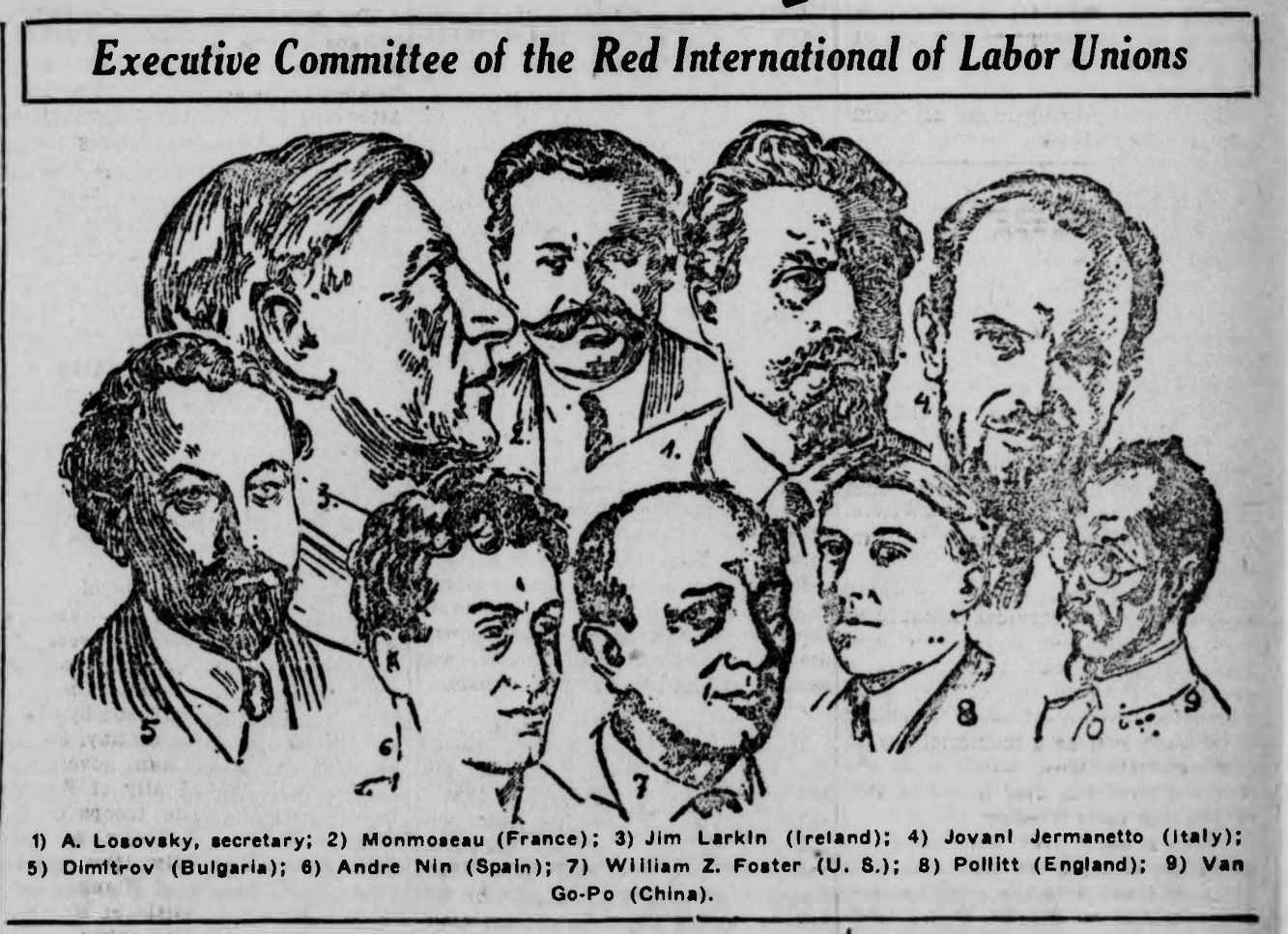
The General Secretary of the Red International of Labor Unions on the issues of its coming Third Congress, including attitudes towards existing unions, uniting the labor movement, factory committees, strike strategy, R.I.L.U. structure, a labor press, and much more.
‘On the Eve of the Third Congress of the Profintern’ by A. Losovsky from Labor Herald. Vol. 3 No. 6. August, 1924.
WE are on the eve of important changes in the international labor movement. The characteristic features of this coming change are the movements of resistance by large masses of workers against the aggressive actions of capital, and, second, offensive movements by the workers to regain a number of lost positions. In this respect it is necessary to point out the big strikes that have taken place in England recently, also the large number of strikes that have taken place in Germany, particularly the present strike of the German miners, and the intensive activities that are taking place at present in the labor movement of France. In a number of countries and industries the capitalists are being compelled to make concessions to the workers, as can be seen from recent events in England and France. Which proves that within the ranks of the working class there has been accumulated a tremendous amount of energy and that we are entering a new phase in the class struggle.
It would be a mistake, however, to believe that the period of capitalist aggression has come to a close and that the workers have started the offensive on the entire front. What we are witnessing at present is the appearance of the first symptoms of a new epoch characterized by the working class taking the offensive again. It is impossible, of course, to say how long this new epoch may last. One thing is clear, that the new spirit of aggression noticeable in the ranks of labor is bound to develop and produce very serious conflicts, and in some countries, as for instance Germany and Poland, it may lead to considerable disturbances.
This change of spirit in the ranks of labor on the economic field, and consequently also in the political struggle, must be taken into consideration when deciding upon our tactics for the future. The revolutionary trade unions are being confronted now with a number of new problems which demand an immediate solution. The situation at present is such that not only political but also economic struggles of the workers must be fought against the Social-Democracy and the trade unions of the Amsterdam International, which means that the line of our tactics must succeed in breaking the resistance not only of the capitalists but also of international reformism.
Shall We Destroy or Capture the Trade Unions?
This question must be formulated again primarily because the strike breaking activities of the Amsterdamers, their brutal attitude towards the revolutionary workers, have given rise in a number of countries, mainly in Germany, to a certain tendency which insists on the revolutionary workers leaving the reactionary trade unions. This question has been discussed in Germany during the year of 1919-20. It is true that at that time the leadership of the Amsterdam International did not dare to pursue the tactics that they are pursuing at present. It is known that it is precisely upon this question that a split occurred in the German Communist Party at its Congress in Heidelberg. The majority of that Congress adopted the position that we have got to destroy the reactionary trade unions. The result, however, was that the only thing that was actually destroyed was the Communist-Labor Party of Germany. The reactionary trade unions did not suffer at all. The minority at that Congress, which accepted the position of the Comintern defined by Comrade Lenin, has, because of that, grown into a powerful mass Communist Party in spite of the numerous defeats suffered by that party.
In considering this question we cannot be moved by any moral or sentimental consideration. That the leaders of the Amsterdam International are becoming more counter-revolutionary and corrupted every day, no one will deny. But from this, it does by no means follow that we must leave the trade unions. It was never our conception that to capture the trade unions means capturing their treasuries, real estate, etc. We always believed that our main purpose was to conquer the minds, the consciousness, of the working class. Our main problem was to separate the masses from the ideology and tactics of the reformists. And is it not a fact that in doing so we have succeeded in winning over to our ideas hundreds of thousands of workers who are now following the Profintern? And is it also not true that this was the only tactic capable of achieving such results?
We would have committed the greatest mistake had we permitted the Amsterdam International to provoke us to accepting the policy of leaving the unions. Because this is precisely what the reactionaries desire, they want to get rid of us. They are reasoning in the following fashion: The revolutionary wing in the trade unions is growing; if we don’t get rid of them now and immediately, then this revolutionary wing may be able within two or three years to conquer the leadership over the entire trade unions. But in order not to appear responsible for a split it is necessary to provoke the more impatient left-wingers to leave the unions, and in doing so, take upon themselves the responsibility for having split the organizations. This is the line of reasoning and policy of the Amsterdam International.
It is precisely this policy that is prompting the reactionaries to persecute and expel the most active left-wingers. And it seems to me that we shall be very poor revolutionaries and Communists if we let ourselves be provoked into leaving the unions by the leaders of the Amsterdam International. No. Irrespective of what this reactionary gang may do, we have got to remain inside the trade unions, fight for leadership, and remain there until the time arrives when we will be in a position to rid the trade union movement of all the reactionaries and betrayers.
Unity of the Trade Union Movement
The above policy can be pursued successfully if we continue energetically the fight for unity of the trade union movement. It is at this point that we will no doubt meet serious difficulties created by the multiplicity of forms in the revolutionary trade union movement. We have at present a number of national dual unions, also small groups of split-off or expelled. These latter attempted to organize their In Germany, forces and extend their influence. Czecho-Slovakia, the United States, Poland, and in a number of other countries, the following problem will confront us. 1) Shall we conduct a struggle for unity where there are in existence dual unions? 2) What shall be the relations between the existing revolutionary unions and the revolutionary minorities within the reactionary unions? 3) Shall we create special organs for the unification of all followers of the Profintern in each country? The main problem, however, is, shall we continue the struggle for unity or shall we declare openly that the time has arrived for a complete split?
On this proposition we have noticed serious waverings among the comrades in Germany. There we find a whole group of comrades who consider that the slogan of unity in the trade unions is no longer applicable. These comrades are asking the following question, “Why shall we fight for unity at a time when no unity is possible with the reformists? Why shall we propagate a slogan which the masses don’t believe and have no confidence in?” These comrades maintain that it is necessary to give up the idea of capturing the unions and find a new basis for our activities among the masses (Factory Committees). It seems to me that by refusing to continue the struggle for unity we will commit an unpardonable mistake. For the reformists will immediately monopolize this slogan of unity for themselves. In passing, I want to say that our fight for unity is not We demagogic at all, as the reformists maintain, really desire unity. We are fighting for it. The only difference between us and the reformists consists in this; that while we desire unity for the purpose of the class struggle, the reformists desire unity for the purpose of class collaboration. This difference is serious enough to establish a clear line of division between us and them in the international labor movement. The struggle for unity must be continued also in the future. Even in those countries where we already have parallel dual organizations (France, Czecho-Slovakia) also there and particularly there we must wage an energetic fight for unity of the working class. Only thus can we succeed in unifying the masses and make them follow our leadership of their struggles.
Factory Committees
It would seem that everything has already been said on this question. In reality, however, when we examine the activities of the factory committees wherever they exist, we find that the workers of one country have very scant knowledge of the experiences of other countries along this line. The factory committees in the countries of western Europe are at present only in their beginning.
What is a factory committee? In the first place it is an organ of unity of the workers, and, secondly, the direct representative of the employes of a given factory. To succeed in this field, one must develop the maximum amount of energy and initiative. Even in Germany, which has at the present time quite a large number of factory committees, these have not yet crystallized into definite form. In other countries as, for instance, Austria and Czecho-Slovakia, the situation is much worse. In France they are now taking the first steps for the organization of factory committees. In England this movement has been almost completely extinguished. In the United States it does not exist.
This is the situation, and yet it remains true that no serious revolutionary trade union movement is possible if it does not base itself on factory committees. There was a time when the discussion revolved itself around such questions as, “How shall we build these factory committees? Shall all the workers employed in a certain factory be permitted to participate in the elections of the factory committee?” What shall be the functions of these committees?” etc. The period of such theoretical discussion is past. We have got to begin the actual building of the factory committees. One might say that this is the main task of the followers of the Profintern, particularly in those countries where the trade union movement is split and where we find in each given factory, workers affiliated to one or more of these unions, to unite all these workers into one factory committee, to turn this committee into the actual leader of the struggle of these workers, to extend the competency of these committees as far as it is possible.
To bring the factory committees into actual leadership of the economic struggles of the workers, make these committees participate in the building up of various committees of action, also the means of organizing the unorganized, and to gradually prepare these factory committees to fight for and assume control over the factories–these are the simple but very important tasks confronting the followers of the Profintern.
On Strike Strategy
The experiences of the past year have emphasized the need of clarifying the question as to the best methods of the economic struggle. The conditions of this struggle have become very much worse primarily because the capitalists have succeeded during the past year in strengthening their organizations and in developing a complicated system of struggling against the working class.
The old-style strikes are no longer effective. No amount of enthusiasm will be able to overcome a well-organized and resourceful enemy. Notwithstanding all this, very little has been done by the trade unions to study and devise new and more effective methods of struggle against the capitalists. Was there anywhere an attempt made to outline the fundamental and general rules of struggle on the economic field? We know, of course, that there is no such thing as a pure economic struggle. That every economic struggle is also a political struggle. But that doesn’t help us any because even on the political field very little has been done to generalize and crystallize the experiences of the international revolutionary movement. And still less has been done to study and understand the economic struggles of the workers.
Our backwardness in this respect becomes the more apparent when we see what has been done for the study of national and imperialist wars, for instance. There isn’t a single important battle which hasn’t been investigated and described in numbers of volumes. Every phase of an important war, even if it happened hundreds of years ago, has been at one time or another a subject for study. The capitalists have created numerous military schools, a tremendous literature, all of it devoted to a study of the strategy and tactics of the military arts. Thousands and thousands of people are studying it.
And now see what we have got with regard to the economic battles of the working class. Almost nothing, although from the point of view of social developments, an important class conflict is incomparably more important than any large military battle. Will anyone contend that the battles around Mukden (Manchuria) are more important for humanity than the strike of 1,200,000 English miners in 1921 that lasted 13 weeks, or the present gigantic fight of the German miners is less important than the battles between the Anglo-French and German armies on the Ypres? Merely to ask this question is to state the answer.
We have done very little to organize our struggles on the basis of past experiences. We must frankly say that none of the internationals has done anything in this respect. This question was never even placed on the agenda of any of the internationals. The explanation for it lies probably in the fact that it is a difficult problem. It requires serious study. It demands the building up of a real strike strategy. It is a difficult problem but it must be solved.
The reformists are not bothered by it because they are trying to avoid the class struggle. They believe they can fool history and get along without gigantic social battles. But for the revolutionary wing of the labor movement, which believes only in its own power, which understands that even the left-wing of the bourgeoisie is just as hostile to the working class as is the right-wing–for us the problem of strike strategy is an important problem. We must succeed in gathering the collective experiences of the international labor movement. We shall have to consider the creation of special literature, special textbooks on strike strategy, and also the creation of special schools. We already must begin considering the question of building up a conscious leadership for the revolutionary struggles of the workers, a leadership which will, after the victory is secured, become the conscious builders of the new society. It is a new question, it has been studied very little so far. Only a serious effort, the collective will and thought of all of us, can succeed in solving this problem.
Leading Organs of Struggle
The solution of the above problem becomes still more difficult because of the fact that we are compelled right now and in the middle of our fight to create our theory as well as practice. We are compelled to assume leadership not only of the political struggle but also of the economic. And this we must do not only in those countries where we already have powerful organizations but also where we are as yet only in a minority. And really since the reformists have surrendered to the bourgeoisie, if they are attempting to play the role of strike-breakers and betray the workers to the capitalists, then we are compelled to assume leadership of the struggles irrespective of whether the circumstances are favorable for such action.
In a number of strikes in Germany, England, and other countries, the followers of the Profintern have been placed in responsible positions of leadership by the mere force of events. Why? Because they are the most revolutionary section of the working class and, being its vanguard, they necessarily find themselves in the front ranks. The difficulty of the problem consists mainly in this, how can we right now begin the preparation of proper organs of leadership for the common struggle? We cannot leave this problem unanswered because if we do so we risk the fate of the common struggles of the working class. The question is how shall we start these preparations? Experience will show that we have got to so unite the revolutionary sections of the workers that they will be able at any moment to assume the leadership in the struggle.
The Communist Parties, together with he revolutionary minorities in the trade unions, must assign special comrades. These comrades are to prepare themselves for leadership in the various committees of action and strike committees that will be formed during the struggle. We have got to create a staff of specialized workers who could be distributed according to the demand of the situation.
We must see to it that our organization becomes more elastic and adaptable. In Europe and in America there still exist craft prejudices even among Communists, that only a member of a strike can lead the struggle of that trade. This is a dangerous idea against which we must wage an energetic struggle. We have got to select out of the ranks of the workers the best, the most daring, the most energetic revolutionary elements, and utilize them in all the serious struggles that may come, introducing them by all possible means into the various committees of action and into the strike committees. We cannot afford to continue as of old, we have got to make a change or else the revolutionary labor movement will not be able to succeed.
We must create leading organs for the common struggle and in the measure in which we succeed in creating these organs will we also succeed in assuming practical leadership over the economic struggle of the workers. And in the same measure will grow the influence of the Profintern.
Intelligence Service on the Economic Field
The labor movement is compelled to deal with a splendidly organized enemy. The employers’ organizations present themselves as very complicated mechanisms whose functions and mode of procedure is being held in strict secrecy. We only know the general outline of the construction of these organizations. We do not know their inner workings and can very seldom see those obscure forces which are operating within them in time of serious class conflicts. Our ignorance in this respect is almost criminal. What do we really know of the secret funds of the employers’ organizations? What de we really know of the methods that are being practiced to organize strike-breaking, outside of the information contained in a few accidental exposures? What knowledge have we in our possession of the methods practiced by the employers’ organizations to buy the support of the press, the courts, and the entire apparatus of the State? Very little, indeed. And our struggles are becoming every day more difficult. And here, just as in war, we have got to resort to military manouvres and methods.
In time of war, each party to the conflict organizes its own intelligence services to secure information regarding the disposition of the forces of the enemy. Why don’t we do the same thing? Why don’t the trade unions organize such an intelligence service? Why don’t we try to learn the secrets of the employers’ organizations? Why can’t we get on our side those people who are working for the employers’ organizations and get from them the secret mobilization plans against the working class, also information regarding the inner structure of the employers’ organizations, sources of their income, etc.? The reason why we don’t do it is, because many workers are still dominated by the rules of petty bourgeois morality, while the employers, not feeling embarrassed by any such rules of morality, are sending into our organizations their own agents to inform them of whatever is transpiring in our organizations. Moreover, they not only have in the trade unions their paid scouts, but they also secure the support of the trade union bureaucracy, which in essence is nothing but the transmitter of bourgeois ideology into the working class ranks.
The employers are doing everything possible to break the resistance of the workers. And we, we hesitate. We can find in our own ranks people saying that it is no good to secure information about the employers’ organizations by means of illegal methods. That it is no good to send into their organizations our people in order to expose their secrets. We must put an end to those petty bourgeois conceptions of morality. War is war. We are confronted with a powerfully organized enemy. We have got to study them. We have got to learn their plans. their forces, so that we can strike at the right time and at the most exposed place. We must see to it that every important labor organization establishes its own intelligence service. If we don’t learn what’s doing in the camp of our enemy we shall continually be beaten.
Questions of Organizational Structure.
An important question for the revolutionary trade unions is how we shall continue to build our organizations. The difficulty arises in the fact that there are in existence so many forms of organization. We have general trade union centers, then the revolutionary minorities in the reformist unions, independent unions, etc. This variety of organizational form makes it very difficult for us to unite into one center all the revolutionary working class forces. The question is, what is our fundamental organizational task? What is the substance of this organizational question? The answer is, to create such an organizational form as to give us the maximum of elasticity, freedom of action, and the possibility of drawing into the sphere of our influence ever wider and wider masses.
We must say, in passing, that the revolutionary minorities in the old unions are not as yet organized in all countries. In some countries these minorities are nothing more than merely ideological groupings without strict organizational form, as, for instance, in England and America. In other countries (Germany) we already have definite organizational structures. The trouble, however, is that these structures have been built from the top down and not vice versa as it should be, since our movement in order to succeed must be based upon the lower units of industry. We must build our organizations on the basis of factory groups, from those groups to organization by industry, and then to a national organization of all industries.
We must also deal with the question of new and more modern forms of organization for the trade unions. The concentration of capital gave rise to the idea of creating a concentrated alliance of labor in the form of one big union. This idea has quite a number of followers in Czecho-Slovakia where they have created a one big union based on industrial sections. We believe this form of organization to possess great merits. It is precisely the type of structure towards which the trade union movement will come sometime in the future.
The question is, is this form of organization adaptable to the conditions as they prevail at this particular moment? Considered from this point of view the one big union form of organization will not everywhere succeed in getting into its ranks large numbers of the workers. We must take note of the fact that craft prejudice is too prevailing not only among the masses but also among members of the Communist Party. For this reason it is necessary to approach the application of this form of organization very carefully. Unity of all forces of labor is absolutely necessary. We must, however, take care not to rush too fast, otherwise we may encounter very unpleasant consequences. We have got to make a detailed study of the accumulated experiences of the one big union movement and on the basis of this experience make concrete practical decisions for our future work.
Another important question of organization is the question of representation of the Profintern abroad. We have at present a number of such representations which have proven themselves very useful. We had the Central European Bureau, the Bureau of the Latin Countries, and the British Bureau. Although different in organization structure, and also in the nature and extent of their work, yet they are functioning as effective transmitters of the ideas of the Profintern. Under the present conditions there is no other way of influencing the international labor movement than the one adopted. It will be, however, a mistake to convert these bureaus into political parties. No. Every bureau must carry out the instructions of the Profintern, organize and supervise the distribution of its publications, transmit to the Profintern information of the western European labor movement, etc. The least attempt on the part of these bureaus to overstep these technical limits will bring dualism into a distortion of our political leadership. It is understood that our representatives in the various countries must take the initiative to investigate and settle internal conflicts that may arise in their respective countries. This form of representation of the Profintern abroad we consider as a temporary one, in the measure in which our movement will grow and develop the functions of our representatives will have to be assumed by ourselves.
The next organization question is the question of financing the revolutionary trade union movement in general and the Profintern in particular. Up till this very moment the expenditures of the Profintern are practically covered by the membership dues of the Russian unions. In the future, it will be necessary that our affiliated organizations make stronger efforts to assist the Profintern financially. The difficulties are very great because in many countries we only have minorities which do not pay to the Profintern membership dues. In these countries we shall have to limit ourselves to securing funds by collections, thereby establishing a stronger financial connection between the Profintern and the revolutionary minorities. At any rate, we shall have to, in this instance, strengthen our ideological connections with a material connection.
We shall have, further, to continue our activities for the Fund for International Solidarity. This Fund has been created at the last Congress, but the demands for other activities has been so great, class conflicts so numerous, that whatever sum we succeeded in collecting was altogether insufficient for these activities. Extraordinary efforts will have to be exerted by the revolutionary workers in all countries in order to secure substantial results. Of course, we shall never grow so rich as to be able to assist in a financial way large strikes. But even a small contribution is at times effective in securing victory for the workers. To build this Fund of International Solidarity, and to strengthen the finances of the Profintern generally, will be one of the most important tasks of the coming Congress.
The Trade Union Press
Although great advances have been made in building up a revolutionary trade union press, yet we have really succeeded in accomplishing very little. Our press is weak. In every country the circulation of our papers is much lower than the number of followers of the Profintern. There is very much to be done in building up our press. We have, at present, a number of serious weeklies in France, Germany, Italy, England and Czecho-Slovakia. But this is not enough. Our aim must be to bring the circulation of our weeklies to a number which would exceed the number of the followers of the Profintern.
We must also aim at the creation of industrial organs, and also one central organ in each country for the entire revolutionary trade union movement. As a transition measure, we must see to it that the Communist press establish permanent trade union departments. And in those countries which have no trade union press at all, the Communist Party organs must set aside special pages for the trade union movement. We must also build up the serious literature on questions of revolutionary trade unionism. In this respect the Profintern has already accomplished a number of achievements.
Conclusion
From these general remarks regarding the immediate tasks of the revolutionary trade union movement, we can see what a tremendous amount of work will have to be done by the coming Congress of the Profintern. It would be wrong to separate our political tasks from the organizational and technical problems. The two are inseparable. Without a good organization one cannot pursue an effective political struggle, and a correct political policy is effective only so far as there is a good organization to carry it out. This connection with the questions of organization, the questions of policy becomes very apparent when we study the activities of the Russian Communist Party, the Comintern, and the Profintern.
Is it necessary to change our tactics in order to fulfill the tasks confronting us. Some comrades have declared the necessity of “new” tactics. The question is, what should these new tactics consist of? Shall we reject the slogan of unity in the trade unions? Shall we declare against the tactics of a united front, and in favor of a split? We have already dealt with the slogans of unity and splits in the trade union movement. We will now say a few words regarding the tactics of the united front.
Those arguing against this tactic have forgotten to observe that it is they themselves who have grown to power and influence because of the tactics of the united front. It is the German Communist Party within which there prevails now a desire to do away with the tactics of the united front, that has grown into a mass party because of the united front tactics. Our German comrades insist that if the tactics of the united front are to be applied at all, it must be done from below. This method of applying the united front cannot be considered a principle of universal applicability. In one country and in one industry it may be to our advantage to apply the united front from below, while in other instances we may find more advantage in applying these tactics simultaneously both ways, from below and from above. It all depends upon the time, place, and the conditions of struggle.
The tactics of the united front in those instances when it produced poor results, was bad not because it was applied from above, but because it was applied poorly. At the international conference of the Transport Workers (May, 1923) the tactic of the united front was applied from above. Will anyone maintain that because of this the results were bad? Everyone will admit the important political significance of that experience, consequently the tactics of the united front remain our most important means of maneuvering in the class struggle.
It may be necessary to reformulate this tactic more precisely, to carefully work out our plans on the eve of each united front campaign. We must develop our ability to quickly change our position and always consider carefully the opinions and sentiments that prevail among the working masses. In some places we may have to apply the united front tactics from below. In other places we may have to apply this tactic from below and from above. But the purpose remains always the same, to attract the masses to our leadership.
One more important question is the relation between the trades unions and labor governments. The relations between revolutionary trade unions and the revolutionary labor government are perfectly clear. Where the government is the organ of the proletarian dictatorship, as in Soviet Russia, the revolutionary unions will render this government every possible assistance and support, because then the unions represent the main basis of the proletarian revolution. The question arises, what will be the attitude of revolutionary trade unions to a labor government of the type of the British government. Here, too, the situation is clear. The labor government in England is in reality a certain form of coalition government. We have got to expose this coalition nature of the British government, its weakness, hesitancy, its fear of decisive action, its refusal to carry out any important social reform, and its surrender to the bourgeoisie.
To expose it merely in words will not be sufficient. Large masses of the workers all over the world, and particularly in England, still believe in the labor government. These masses are still under the influence of democratic parliamentarian illusions. In order to expose the labor government, it is necessary to present to it a concrete program of social legislation, calculated to improve the conditions of labor, to change the system of taxes, to do away with the imperialist colonial policies of capitalism, etc. By presenting the labor government with such a program, we compel it to lay its cards on the table. This can be achieved only if we carry on a systematic campaign demanding the realization of our program. Then, the masses will understand the nature of the labor government. Wherever labor governments are in power, the followers of the Profintern must be doubly careful in applying the tactics of the united front with respect to those masses which still support these labor governments.
It can be seen from the above what tremendous and complicated problems are confronting the revolutionary trade union movement all over the world. Our road is difficult. We still have to win over tens of millions of workers for the struggle against the bourgeoisie, against the capitalist state, and against the reformists. It is a difficult task, but one that we will eventually succeed in accomplishing. What we need is more tenacity, more energy, more revolutionary elasticity, and loyalty to the social revolution, and then victory will be ours.
The Labor Herald was the monthly publication of the Trade Union Educational League (TUEL), in immensely important link between the IWW of the 1910s and the CIO of the 1930s. It was begun by veteran labor organizer and Communist leader William Z. Foster in 1920 as an attempt to unite militants within various unions while continuing the industrial unionism tradition of the IWW, though it was opposed to “dual unionism” and favored the formation of a Labor Party. Although it would become financially supported by the Communist International and Communist Party of America, it remained autonomous, was a network and not a membership organization, and included many radicals outside the Communist Party. In 1924 Labor Herald was folded into Workers Monthly, an explicitly Party organ and in 1927 ‘Labor Unity’ became the organ of a now CP dominated TUEL. In 1929 and the turn towards Red Unions in the Third Period, TUEL was wound up and replaced by the Trade Union Unity League, a section of the Red International of Labor Unions (Profitern) and continued to publish Labor Unity until 1935. Labor Herald remains an important labor-orientated journal by revolutionaries in US left history and would be referenced by activists, along with TUEL, along after it’s heyday.
PDF of full issue: https://www.marxists.org/history/usa/pubs/laborherald/v3n06-aug-1924.pdf

