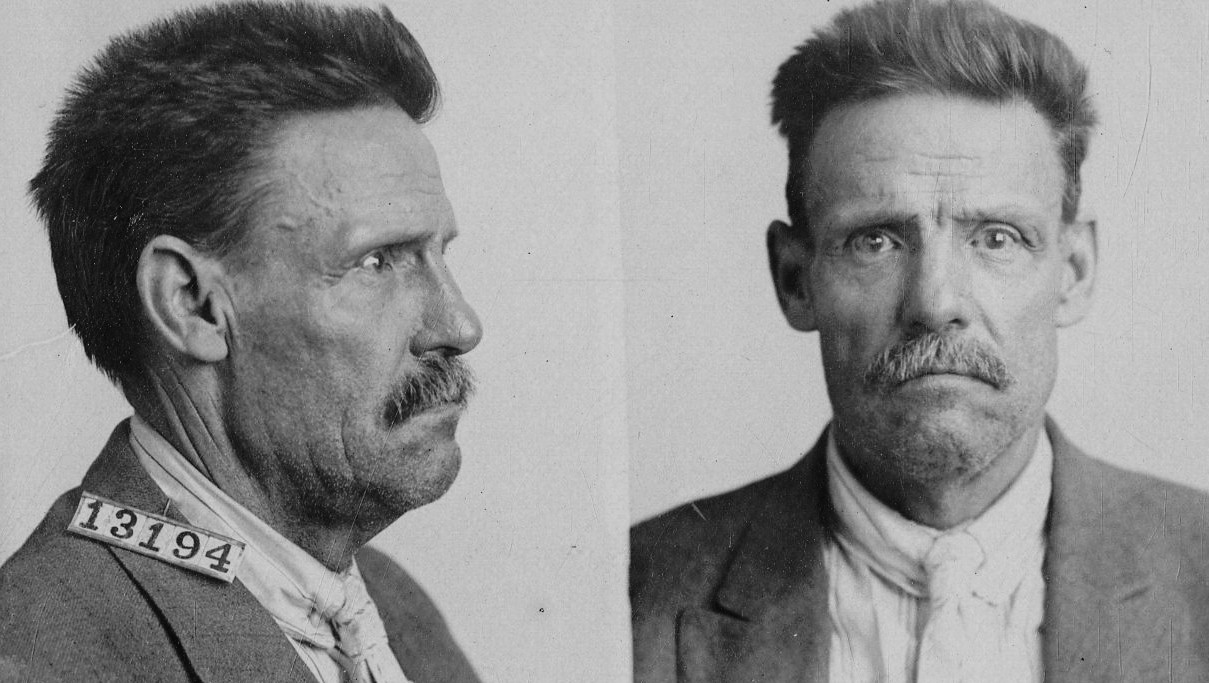
A report on the Seattle funeral of George Speed, stalwart of the One Big Union and active in the labor movement for sixty years.
‘George Speed, Rebel Tried and True’ from Industrial Worker. Vol. 13 No. 34. August 22, 1931.
Impressive Services For a Veteran of the Class War Are Held In Seattle
“Never withhold a blow at error to save making an enemy; and never compromise the truth to make a friend.”
Quoting from memory the words of a famous revolutionist, Fellow Worker James P. Thompson, himself a charter member of the I.W.W., chose those words as the most typical rule of life followed by George Speed, whose funeral was held at the Home Undertaking Co. chapel in Seattle on Sunday, August 30, at 3 o’clock p.m.
The chapel was crowded to the doors and many stood in the wide hallways to pay final tribute to the memory of one of the bravest and truest-hearted advocates of industrial unionism–one who was in at the birth of the I.W.W. and who during a long life of 76 years and 3 months, never compromised with his avowed principles or hesitated to act however dangerous the road that led to the goal.
The casket and bier were banked high with flowers, many friends from various cities sending a tribute to their old friend and associate in the class struggle. For George Speed was known and respected wherever men of labor struggle against oppression.
Briefly recounting the dates of birth and of various highlights in the career of the famous rebel, Fellow Worker Thompson recalled his own association with Fellow Worker Speed over a long period of years. George Speed was born in May, 1855 at Baltimore, Maryland. He had been a member of the old Knights of Labor, the Socialist Labor Party and was one of the first to join the militant I.W.W. in 1905, its–birth year.
Fellow Worker Thompson recalled the words of Frank P. Walsh, chairman of the Industrial Relations Commission of 1911-12:
“Of all the voluminous testimony taken in that famous investigation of industrial conditions in America, the most impressive was the testimony of George Speed and William D. Haywood.”
Thompson recalled the free-speech fight in Spokane in 1909 when with Speed he “enjoyed the hospitality of a boarding-house in Spokane where if your term of board was not expired, the host would try to bring you back to board it out.” That was the city jail where the men who battled for freedom of speech slept upon the cell flours together. Leavenworth, where they shared the persecution of the ruling class, was also remembered.
A letter from another veteran of the labor movement, Fellow Worker George Holmes of San Francisco, was read.
“I have never heard his integrity or sincerity questioned,” said Fellow Worker Holmes. “He was in the Knights of Labor, the A. F. of L., the S.L.P. and helped to organize the Sailors Union here in San Francisco in 1886, on a lumber pile on Folsom St. He has a long and militant record and his memory should be honored.”
Dr. Marie D. Equi sent a floral wreath and a touching tribute to the memory of the veteran organizer from her sick bed in Portland.
A typical revelation of the acuteness of thought of the stalwart laborite in his advanced years was related by James P. Thompson: At a meeting in the I.W.W. Hall in Seattle last winter, George Speed arose and put a question to Thompson who was speaking. It was:
“Was there ever a time when a subject class made the laws?”
“The question,” said Thompson, “answers itself and sums up the whole class struggle in a sentence, for were the political pretense that workers make the laws true, they would not be a subject class.”
The participation of George Speed in the Colorado strike of 1927-8 was recalled, when, at the age of 74 he voluntarily made his way into the strike zone and endured the hardships and dangers of that troubled time. He slept upon the cell floors with the other miners arrested by the gunmen of the C. F. & I. and went thru the long winter struggle with the stamina and militancy of a younger man.
The rebel girls sang “The Commonwealth of Toil,” “Solidarity Forever,” and “The International,” the last as a closing number. The large number of those who came to pay tribute passed before the bier and looked at the determined features of the dead rebel, strong even in death, and then the casket was borne to the crucible for cremation.
The memory of George Speed will best be recalled in future years by the poem by Matilda Robbins, written as a tribute to
GEORGE SPEED AT SEVENTY
Undaunted by defeat
He labors on
Amid the thinning ranks;
His eyes still bent
Upon a distant goal,
Unflinching through the smoke,
His tall, spare frame
Denies fatigue,
Defies disease,
And marches on and on.
Brave comrade!
When your day is done
Who’ll follow then
With faith like yours?
Who’ll give of life–
As you have done–
Unselfish to the end?
And who, like you,
Will not surrender
And break–nor even bend?
The Industrial Union Bulletin, and the Industrial Worker were newspapers published by the Industrial Workers of the World (IWW) from 1907 until 1913. First printed in Joliet, Illinois, IUB incorporated The Voice of Labor, the newspaper of the American Labor Union which had joined the IWW, and another IWW affiliate, International Metal Worker.The Trautmann-DeLeon faction issued its weekly from March 1907. Soon after, De Leon would be expelled and Trautmann would continue IUB until March 1909. It was edited by A. S. Edwards. 1909, production moved to Spokane, Washington and became The Industrial Worker, “the voice of revolutionary industrial unionism.” A victim of finances and internal disputes, the IW ceased publication in 1913, only to be revived in 1916 and surviving as a weekly, sometimes more, until 1931. Easily among the most important working class newspapers in U.S. history and an essential resource on the wobbly, and larger radical labor experience.
PDF of full issue: https://washingtondigitalnewspapers.org/?a=d&d=IWW19310822

