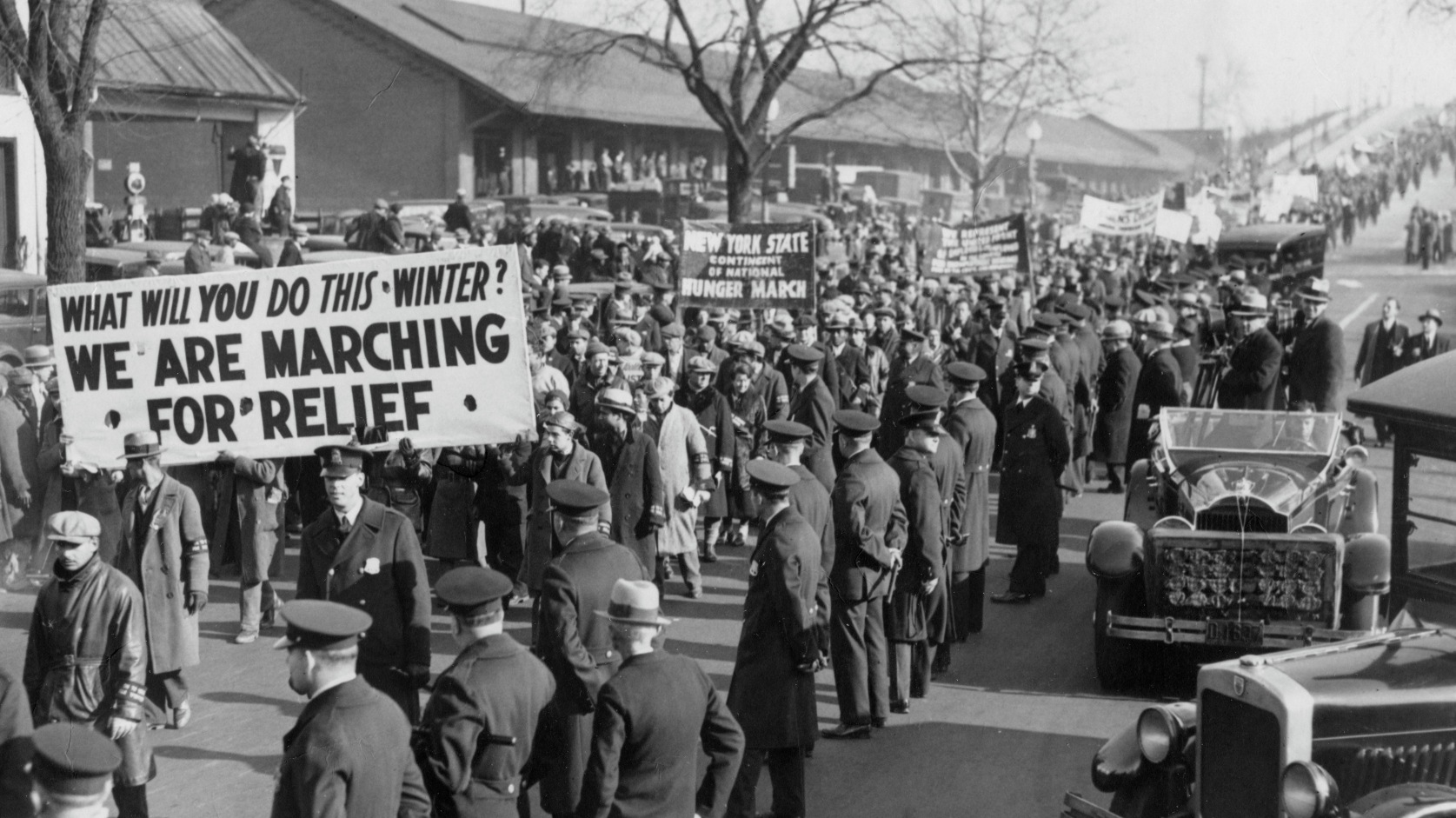
This fantastic piece of street-fighting reportage has Olgin, traveling with the Northeastern Column of Hunger Marchers on their way to D.C., describe hours of combat as police in Wilmington, Delaware attempt to disrupt their way, to no avail.
‘The Battle of Wilmington’ by Moissaye J. Olgin from The Daily Worker. Vol. 9 No. 201. December 17, 1932.
The Courageous Fight of the Militant Hunger Marchers in Du Pont’s City
EVER since we left New York we knew that trouble was brewing in Wilmington. Wilmington, we were told, would not permit a parade of the Hunger Marchers. Wilmington would not permit us even to leave our trucks. Press, pulpit and city administration had conducted an insidious propaganda against the Hunger March.
The Hunger Marchers had to prepare. We had to reckon with the possibility of an attack. We discussed the question in our trucks. We made a unanimous decision. And there could be only one decision: We demonstrate on the streets of Wilmington!
WE SHOW OUR STRENGTH!
When we arrived in Chester, Pennsylvania, twelve miles distance from Wilmington, we were perfectly aware of the fact that the stronger our stand in this last stop before the state of Delaware, the more the Delaware authorities would appreciate our power.
It is necessary to understand the psychology of the rulers and their armed servants in relation to the March. They know that there are in the world men of power and beggars. The men of power deserve respect; the beggars deserve contempt. A man like DuPont is a power; he owns Wilmington; he owns its plants and its ammunition factories on the other side of the Delaware, in New Jersey; Governor Buck of Delaware is proud to have married into the house of the Du Ponts. A Du Pont certainly deserves respect. The Hunger Marchers, on the other hand, are beggars; they wear poor clothes: they are unshaven, underfed; they have no food stores and must rely on outside aid; we had no place to sleep in and lay down wherever we found a spot. According to all rules and regulations of capitalist, society, people like the Marchers were to be meek, submissive, docile, thankful for not being locked up. And here, the unexpected thing happened; these beggers came with a pride and a dignity, these tattered individuals did not beg, but demanded, like one who has power. They did have power. What could the authorities do with this kind of a crowd?
THEY were in a quandary and we knew it. We also knew that everything depended upon our stand. If we are better organized, more determined, if the rank and file understands better the whole plan of action, it will be easier for us to confuse the rulers.
We marched into Chester like a well-organized army. We paraded through the city in excellent order. We arrived at the center of the city, in front of City Hall and we told the workers about ourselves and our aims. We told them we were going to parade through the streets of Wilmington under any circumstances. “We will fight to the last ditch,” said Carl Winter, one of our leaders, and his words were heard not only by the workers of Chester, but also by the police; they were heard by the capitalist reporters who transmitted them to Boyd, the Wilmington chief of police, and Black, the superintendent of public safety, who learned that the Hunger Marchers (Our Column) were an army of 1,200 united, embittered and determined fighters.
OUR PROGRAM AND TACTICS
Between Chester and Wilmington our trucks tightened their discipline and made their last-minute preparations. Here are the major points of our program and tactics as worked out on the road and agreed to by every member of every truck:
1. We parade through Wilmington, with banners, placards, music and singing.
2. Individual marchers receive orders from nobody but their commanders.
3. We do not attack the police, but if the police attacks we defend ourselves.
4. We do not break our ranks if individual marchers are arrested.
5. We defend the Negro comrades who would possibly be the first to be attacked by the police: we do not allow them to be snatched out of our ranks.
6. The Negro comrades defend themselves also, not waiting for their white comrades.
7. We hold at least two open-air meetings in Wilmington.
8. We stay overnight in Wilmington.
When we reached the city limits of Wilmington, we were all taut like a bow string.
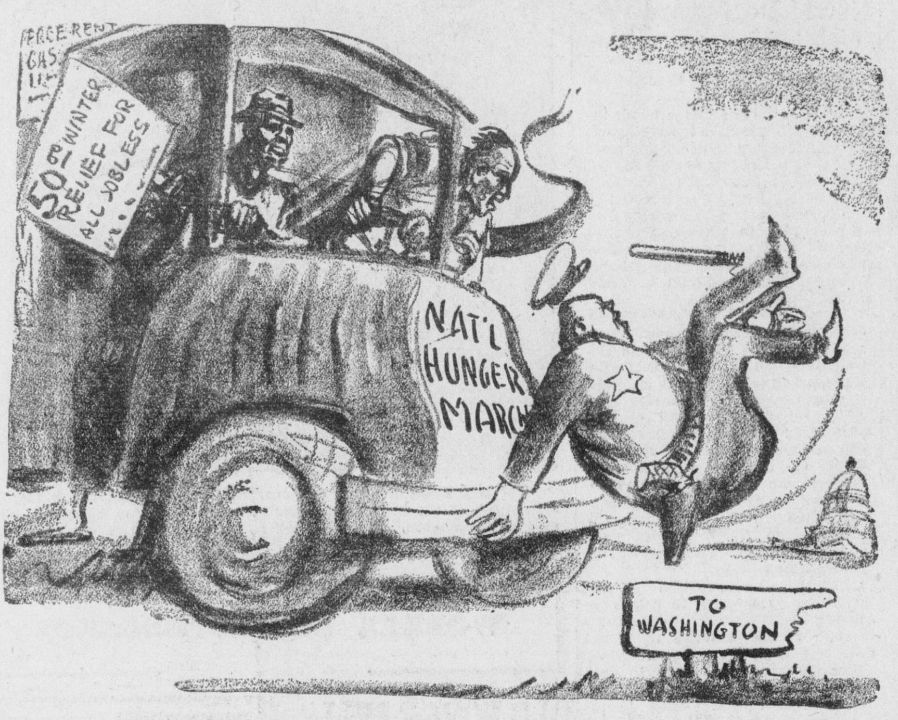
A delegation had been sent by us to inform the police officials that we were going to parade. The answer was “No, you won’t parade.” However, when we all approached, when the comrades left the trucks and, obeying commands, formed a powerful column in as short a time as five minutes, when the chief of police and the superintendent of public safety, standing at the head of a few dozen policemen, realized our power and saw our comrades declaring bluntly, “We are going to parade,” they said, “Go ahead.” I do not think they liked it very much.
WE PARADE
We paraded. We marched with unusual agility; we kept our ranks closed; we sang; we exclaimed; we chanted in chorus, and there was a hot flame of enthusiasm surging through the ranks.
The population poured into the streets to watch us. Many applauded. The crowds stood in thick rows all along the streets, sometimes several hundred in one block. We passed thirty-two blocks. When we saw a Negro crowd we chanted: “Negro and white, Unite and fight.”
This never failed to call forth enthusiastic applause from among the Negroes.
The Column kept marvelous order. The marchers walked like one, rhythmically, crisply, keeping time, heads erect, eyes ablaze. It wasn’t a mob, no indeed. It was not a crowd of beggars either! It was an organization of fighters!
WORD must be said about the marchers. They were elected haphazardly on bread lines, in pool rooms, in flop houses, in block committees. Most of them were a raw element, just drawn into the movement. Most of them had never participated in a clash with constituted authorities. For the first time, they were learning the meaning of revolutionary proletarian struggle. They were awakening to a realization of something overwhelming: the power of their class. We approached the garage at the corner of Front and Madison Sts., where about 800 of us were to stay overnight. Another group of about 200 was sent to the Italian Labor Lyceum. A third was to stay overnight in a Polish Club, in the former building of a Catholic Church. There were many women in this latter division.
IN THE POLISH CHURCH
With shouts and laughter we poured into the Polish church. A large building–one big hall with a platform; a few steps leading down to a kitchen in the basement. The hall was almost empty except for a few dozen chairs. But the entire building was well heated and the floor was clean. We sat down on the chairs and on the floor–some 250 men and women. There was a great deal of shouting, singing, joking. We were all somewhat intoxicated with our own victory. Supper was served down below. The tables could seat only about 80 and we had to eat in three shifts. But that made no difference, since the meal was gobbled up in a minute or two.
Exhilarated after the march, and cheered by the warmth of the room, we started dancing. Somebody banged the piano which we discovered on the platform. Soon several dozen comrades were whirling around the hall. This did not prevent others from spreading their belongings on the floor and going to sleep. It was 9 o’clock. Soon everybody would settle down for a night’s rest.
KNOW OF POLICE ACTIVITY
We knew that there were police detachments on the corner of Chestnut and Adams. We knew that a street meeting was to take place not far from the church. We knew, however, that, our speakers were to address the local crowd.
For us, the mass of the marchers, the day was over. Still, when we heard that a meeting was in progress right in front of the church, many of us stepped out to listen and to support the speakers. We learned that the police had dispersed the meeting scheduled to take place at Chestnut and Adams, and that this was our second attempt to address the local people.
We saw police everywhere.
Squads of police. Uniforms all around. Trucks with mounted machine guns. Policemen armed with sawed-off shotguns. They were forming groups and lines in front of the church, trying to separate the mass of Wilmingtonians gathered in front of the church.
AND this is the scene before the battle started. Police in various corners of the street. Police in front of the church on the opposite sidewalk. Police in the middle of the street flanking the crowd. Our speaker, at the head of the stairs leading from the church to the sidewalk. Around our speaker several dozen hunger marchers, while the majority remained inside the building unaware of what was going on outside. The police were obviously in an ugly temper, but who cared. We had carried out the first part of our program. We were determined to carry out the second part as to an open-air meeting. Our activities were to serve for the local workers as an example of how organization, and determination could break police bans.
The battle started with the police beginning to mount the stairs. Policemen began to push our speakers. Some attempted to make arrests. The marchers offered resistance. Police clubs were raised, but strong hands seized police arms, fists met fists. The bluecoats became enraged. They didn’t expect that. They began to push us back from the porch into the church. The marchers entered the hall but refused to let the police in. They locked the door and pushed against it in a big compact mass. The police were locked out.
In the kitchen below a few dozen women gathered. There is a door leading from the kitchen to the street. The police tried to break that door. But the women built a barricade of tables and chairs. The policemen brought hatchets to break the door. In the meantime the electric light went out in the kitchen. When the bluecoats finally forced their way into the kitchen, they were met by chair legs, wielded aptly. A battle ensued, with the women fighting even better than the men. “The women fought like tigers,” said the Wilmington Press the following morning.
THE main hall was besieged for awhile with the police unable to get in. Then, tear gas bombs were thrown from outside into the hall. Many exploded. Some were snatched by our comrades and thrown back through the window before they exploded. The big hall was filled with gas. The marchers coughed. Their eyes smarted., First they tried to lay down on the floor where the gas was not as heavy. Some comrades broke all the windows to let air in. Others were throwing parts of the chairs into the police force outside. Finally a comrade suggested that all leave the hall through a side window opening into the street. The comrades, about 200, mostly women. soon found themselves in the street–and here the mass battle only began.
PROLETARIAN RESISTANCE
The marchers must be given due credit. They showed an example of powerful proletarian resistance. They did not attack but they did not take attacks passively. They did not provoke, but they did not allow themselves to be provoked. A policeman drew a gun. The moment was tense. He was in a white rage. One of the women comrades began to talk to him. She did not say anything soothing. She just said, “You are a coward. A man with a gun against unarmed people. You better put your gun away and step up; let’s see how you can fight.” While she was talking she was moving down the stairs, facing the policeman, drawing closer to him. He finally put his gun away.
The comrades never yielded ground. They fought for every inch. They returned blow for blow. One policeman tries to arrest a Negro comrade. Several comrades surround him, open his arms, free the Negro. Another policeman lifts his club over a comrade’s head–a strong hand seizes the club, turns it the other way and soon there are blue marks on the policeman’s face. A woman comrade is being hammered with a club over her shoulder. It is painful. But, as she tells subsequently, “I caught him by his necktie and began to pull; he knocks with his club while I pull his tie; it hurts me but I know it hurts him too: he is choking.”
A heavy Negro woman is being poked in the ribs by a policeman. She told us later she didn’t want to start a fight. She was just drawing away. But then a little white woman comrade, just a slip of a girl, saw a Negro comrade being attacked and rushed to her rescue; she screamed, she scratched, she bit the policeman’s hand.
“Well,” says the Negro comrade, “I sees this little kid fighting the cop, and I says to myself, ‘Here is your chance,’ I give him one sock and he just sits down.” The Negro comrade smiles quietly, exhibiting two rows of magnificent white teeth.
23 ARE ARRESTED
The battle lasted for quite a while. Superintendent Black was hit with a bottle over his head, and received lacerations. The police became wild, but the comrades would not allow themselves to be frightened. The upshot was the arrest of 23 comrades, the first the police I could lay their hands on. The police had planned to put us all into patrol wagons and lock us up but they soon realized they would have their hands full all night long, and many of them would suffer. As it is, four policeman were taken to a hospital.
In the meantime the air in the hall became more tolerable and we all returned to our “night’s lodging.”
It was a strange picture. Most of the chairs broken, their legs having been used as weapons. The floor–all covered with glass, remnants of broken bottles and shattered window panes. Nearly all the window panes–colored too–broken. The doors smashed and splintered. Perhaps three-quarters of the marchers had one injury or another–scratched faces, lacerated skulls, welts on back and hip. You come over to a comrade, and put your hand on his shoulder, only to see him writhing in pain; he had just received a blow over his shoulder. The doctor and the nurses, our W.I.R. medical aid, had their hands full. Bandages, scissors, knives, blood–but what spirit! Everybody happy in the knowledge: “We have stood our ground!” The gasses are still strong. Eyes are smarting: tears are running. Somebody says, “Don’t rub your eyes,” and the comrades let their tears flow freely–and thus they are talking to each other, exchanging smiles and explanations while the tears are running down their faces. What a sight! Such a night ties comrades together with insoluble bonds.
AN ORGANIZED ARMY
They had weathered the storm. They had shown the workers of Wilmington and of the whole country that they were an organized army, a power, a collective body carrying out the will of a yet bigger collective body–the working masses that had elected them to the Hunger March.
The moment required that we make clear to ourselves the meaning of what happened. We discuss the situation in groups. The first question is: “Does anybody regret? Is anybody frightened?” Not in the least. We feel, stronger than before. We have carried out our decision a hundred per cent. The second question: “Has the enemy won?” No, they have lost. They didn’t expect such a counter-attack. They didn’t appreciate the fighting power of organized workers. The workers of Wilmington will now realize that it is possible to break the attacks of the police. A third question: “Will we allow our March on Washington to be interfered with?” The answer is: “No. We will march on Washington overcoming every difficulty in our way.”
EYES smart, but spirits are high. A few comrades had been sent out quietly to learn the situation in the other lodging places. They come back with the information that both the garage and the Labor Lyceum had not been molested. The neighborhood around the church, on the other hand, is all aroused: There are groups of people in the street and the police is watching everywhere.
The major part of the column is untouched. The major part of the leadership is safe. We had telephoned Philadelphia and Baltimore to the representatives of the I.L.D. They are coming. They will take care of the prisoners. Our family is on the alert.
It is way past midnight. The nurses have finished their work. The crowd is gradually overwhelmed with sleep. Only a few are awake Those are the older and most responsible comrades. They are working out a plan for tomorrow. They are mobilizing the forces of the Hunger March for a new day of struggle.
The Daily Worker began in 1924 and was published in New York City by the Communist Party US and its predecessor organizations. Among the most long-lasting and important left publications in US history, it had a circulation of 35,000 at its peak. The Daily Worker came from The Ohio Socialist, published by the Left Wing-dominated Socialist Party of Ohio in Cleveland from 1917 to November 1919, when it became became The Toiler, paper of the Communist Labor Party. In December 1921 the above-ground Workers Party of America merged the Toiler with the paper Workers Council to found The Worker, which became The Daily Worker beginning January 13, 1924. National and City (New York and environs) editions exist.
PDF of full issue:
PDF of full issue: https://www.marxists.org/history/usa/pubs/dailyworker/1932/v09-n301-NY-dec-17-1932-DW-LOC.pdf

