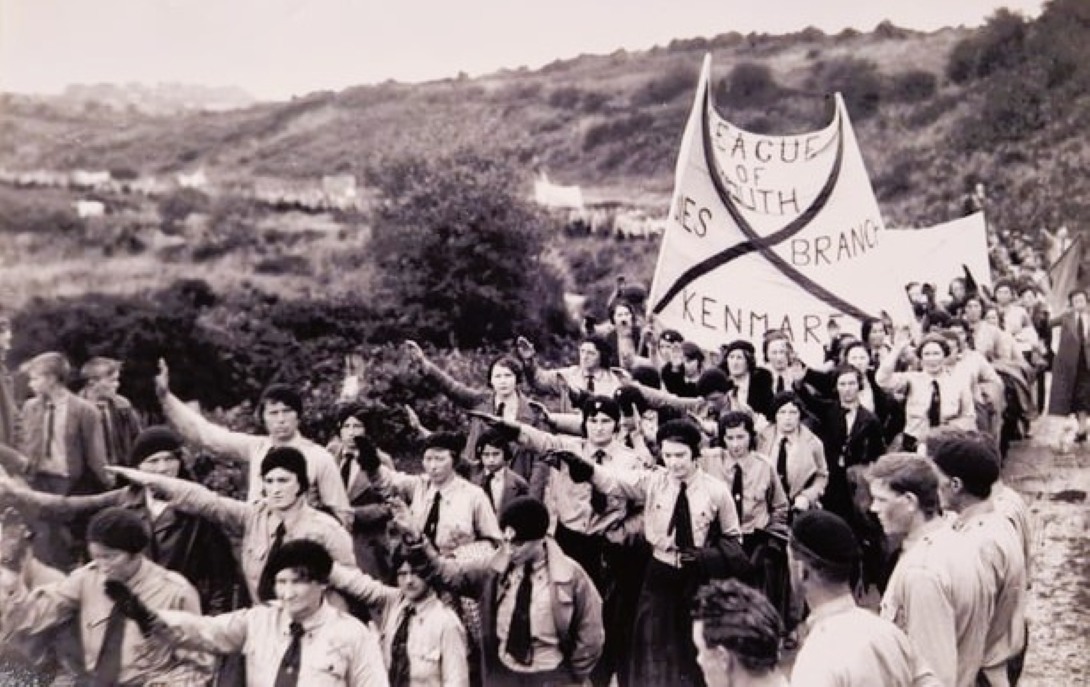
Irish fascism first became a force in the early 1930s and was particular to that country’s recent colonial past, and was very much rooted in Ireland’s Civil War. MacManus reports on the defeat of the fascist Blueshirts, today’s Fine Gael party, in local election as the main defeated party in the Civil War, today’s Fianna Fail, wins a majority of councils for the first time since nominal independence.
‘A Fascist Defeat in Irish Elections’ by Aodh MacManus from International Press Correspondence. Vol. 14 No. 39. July 13, 1934.
The local elections which have just concluded in the Irish Free State were of first-rate political importance. For the first time they were fought mainly on political issues; the candidates of the big bourgeois parties, Fine Gael (imperialist Blueshirts) and Fianna Fail (de Valera), fighting on the basis of their political policies, instead of hiding their identity as “Ratepayers,” etc., as was customary.
The defeat of the fascist Blueshirts (even although it was not decisive) is the outstanding feature of these elections. The Cosgrave Party (now the fascist Fine Gael, under O’Duffy) through the property qualification, which deprives 700,000 workers of a vote, has always held a majority of the county councils: Fianna Fail had not an absolute majority on any council.
The O’Duffy fascists had loudly proclaimed that the elections would reveal their strength. O’Duffy announced that he would win at least twenty councils, and that the result would be a definite indication of the swing against the de Valera government. All the greater, therefore, the blow that has been delivered by the Irish working masses against him. The final results show the number of seats won by the different parties in county and urban councils together to be as follows:
Fianna Fail (de Valera) 728
Fine Gael (O’Duffy) 596
Labour Party 185
Independent Republicans 53
Other Independents 318
Labour, Independent Republican and a small section of those described as “other Independents” will form part of the Fianna Fail bloc, giving it a total of nearly 1,000; most of the “other Independents” will support O’Duffy, giving this bloc not quite 900 seats. The distribution of seats gives the Fianna Fail bloc control of fifteen councils for the first time controlling any county council, with the Blueshirt bloc now holding only six councils. In two councils there is a tie, and in the remaining three of the twenty-six counties of the Free State there were no elections, due to the supersession of the councils by government-appointed commissioners.
But, although O’Duffy’s bragging has been punctured again, the Irish working masses have to beware of the Fianna Fail and Labour Party propaganda that will follow from the election results, to the effect that O’Duffy has been routed and the fascist menace is not serious. Three factors have to be taken into consideration: (1) O’Duffy, standing nakedly on the fascist imperialist programme, secured nearly two-thirds of Fianna Fail’s total poll; (2) the opposition of the masses to fascism was not expressed through support of revolutionary working-class candidates, the small Communist Party being unable to come out as an independent force in the elections; (3) this opposition to O’Duffy, therefore, found expression in support mainly of national and social reformism, or of the very forces that will guarantee to the Blueshirts the possibility of continuing their preparations for a fascist coup.
These factors must be grasped by every Irish Communist and anti-fascist worker. They show the imperative necessity for renewed and much wider efforts to consolidate the anti-fascist fervour of the masses and to guide it into organised channels, exposing Fianna Fail’s propaganda of “support and rely on the government,” and showing the revolutionary struggle for the united Workers’ and Farmers’ Republic to be the only path along which the fascist scourge, the agent of British imperialism, can be defeated.
International Press Correspondence, widely known as”Inprecorr” was published by the Executive Committee of the Communist International (ECCI) regularly in German and English, occasionally in many other languages, beginning in 1921 and lasting in English until 1938. Inprecorr’s role was to supply translated articles to the English-speaking press of the International from the Comintern’s different sections, as well as news and statements from the ECCI. Many ‘Daily Worker’ and ‘Communist’ articles originated in Inprecorr, and it also published articles by American comrades for use in other countries. It was published at least weekly, and often thrice weekly. Inprecorr is an invaluable English-language source on the history of the Communist International and its sections.
PDF of full issue: https://www.marxists.org/history/international/comintern/inprecor/1934/v14n39-jul-13-1934-Inprecor-stan.pdf

