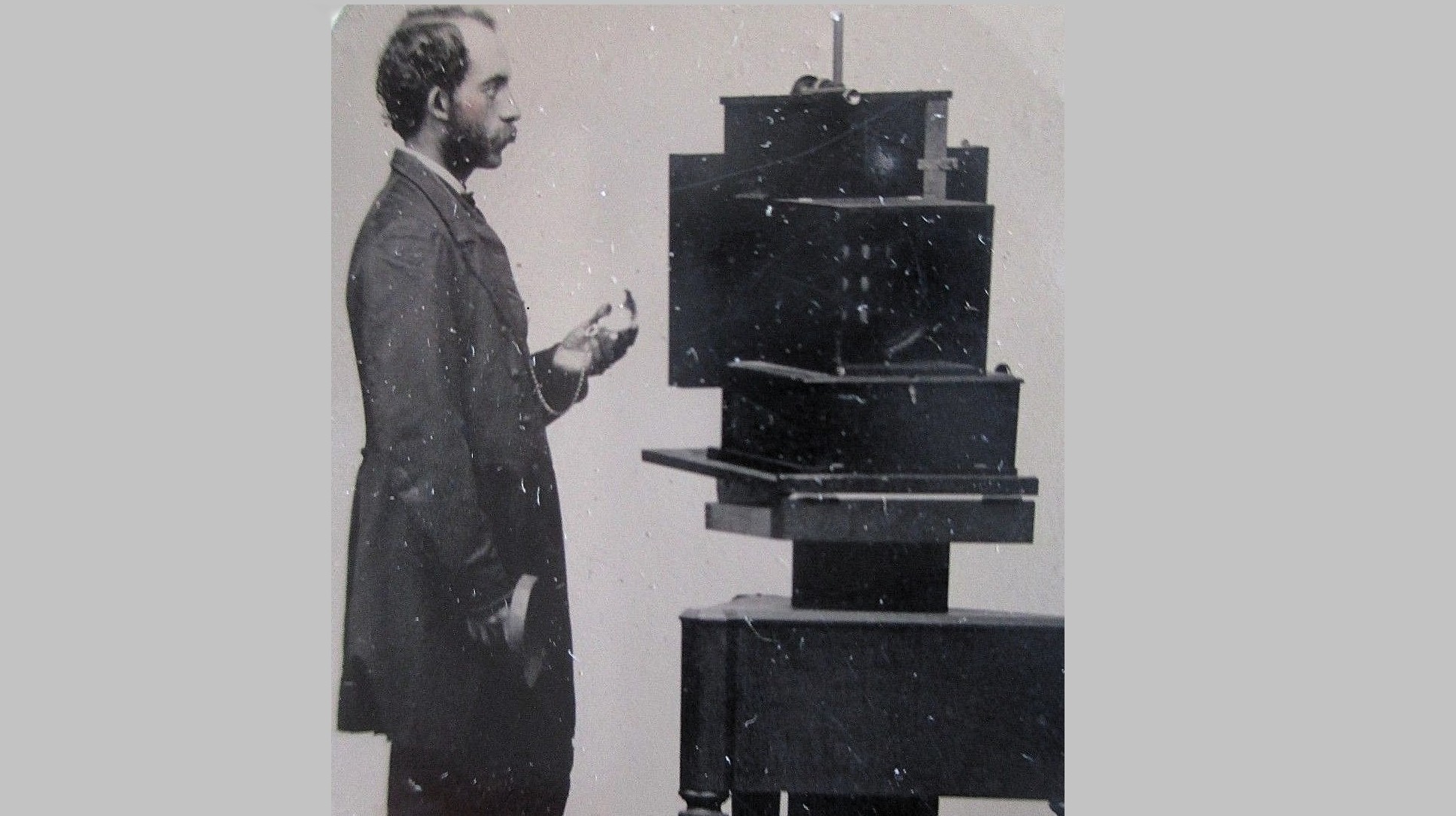
Simon Wing was a person who should have been known for pioneering experimental photography, but is instead known as the ‘first Socialist candidate.’ How it came to be.
‘Simon Wing, First Socialist Presidential Nominee, Dead in Boston’ by Frank McDonald from the New York Call. Vol. 4 No. 34. February 3, 1911.
SIMON WING IS DEAD AT BOSTON
First Socialist Presidential Nominee Passes Away in His 84th Year.
BOSTON, Feb. 2. Simon Wing, the first candidate nominated by the Socialists for President of the United States, is dead at his home in Charlestown, suburb of this city. He was eighty-four years of age.
Wing was nominated for the Presidency by the S.L.P. in the campaign of 1892, and polled 21,164 votes.
He was the inventor of many photographic devices, chief among them the multiplying camera. But few people, however, know him as an inventor.
In 1895, when I had just become interested in the Socialist movement, everyone and everything connected with that movement were of the most intense and burning interest to me. Consequently, Simon Wing, who was the S.L.P. candidate on the first entry of the Socialist party into a Presidential election, seemed to me a hero worth seeing. He was, to my mind, a personage almost as remote as Adam and quite as important as George Washington. So I sought him out and found him in a little photographic establishment in Charlestown, one of the districts of Boston.
I do not know as there ever was a human being who was to me more of a disappointment, or one who was less interesting.
“Yep,” he was Simon Wing. “Yep,” he had run for the Presidency on the S.L.P. ticket. “Yep,” he thought at that time he was a Socialist.
“Were you,” he was asked.
“Well,” he said, “I dunno. Maybe I was. You see I was somewhat deceived in my ideas. I thought it was a religious movement for the uplift of humanity, and having just then left the anti-rum movement I didn’t know what to join. That was why. I went into Socialism, but I don’t know how I was nominated for the Presidency.”
Proud of Nomination.
For all that, he seemed intensely proud of the fact that he had been nominated and he was proud of the fact that he was the first man who ran for the Presidency with the party designation Socialist attached to his own. At that time, 1895, he said that he voted the ticket with certain reservations which he considered important and necessary. He was not a afraid of Socialism. But all the time there seemed in his tone a reservation that indicated that he did not consider Socialism wholly respectable and wholly American. If he could have convinced himself that it was he probably would have voted the Socialist ticket–usually.
So there is a peculiar irony in the announcement of the death of Simon Wing. All his work as an experimental photographer is forgotten, only thing that is remembered is the fact that he was the first man who ran for the Presidency on the Socialist ticket in this country–and he was not a Socialist. Though he mistrusted the movement, there has been a larger and ever larger body of people who do not mistrust it. Though he was doubtful of its “Americanism,” there is a growing body who believe it is the most essential and important of the American political parties. Simon Wing never lived up to the great honor that was conferred on him, but the American people knew and understood.
How He Was Nominated.
From one who attended the convention that nominated him there came the semi-humorous explanation of Wing’s nomination:
“Wing was the only American,” he said. “He happened to be the only delegate who possessed the constitutional qualifications. The rest of us had the Socialist qualifications. But they did not count. So Wing was persuaded to run, and being a vain man we overcame his sorrow at being disillusioned on the idea that this was a religious movement. That is the reason he was nominated. He was the only man, at that time, we could get hold of that was eligible for an office for which we could muster a few thousand votes.”
Simon Wing was not a Socialist when he was nominated. He never became one in after life. Almost nineteen years have passed, and he was to the last the same simple, rather timid man who was pressed into service in 1892. He was proud of the distinction, and he would have liked to believe in the party that nominated him. But he never could. As a landmark he is fine. As a Socialist he is absolutely nothing. He never was and never could be. In another way he indicates the growth of the Socialist movement in this country. At the first convention there was such a scarcity of material that he had to be nominated. At other conventions there has been so much constitutionally available material that it has always been a hard question as to which man should be chosen for the great honor.
The New York Call was the first English-language Socialist daily paper in New York City and the second in the US after the Chicago Daily Socialist. The paper was the center of the Socialist Party and under the influence of Morris Hillquit, Charles Ervin, Julius Gerber, and William Butscher. The paper was opposed to World War One, and, unsurprising given the era’s fluidity, ambivalent on the Russian Revolution even after the expulsion of the SP’s Left Wing. The paper is an invaluable resource for information on the city’s workers movement and history and one of the most important papers in the history of US socialism. The paper ran from 1908 until 1923.
PDF of full issue: https://www.marxists.org/history/usa/pubs/the-new-york-call/1911/110203-newyorkcall-v04n034.pdf

