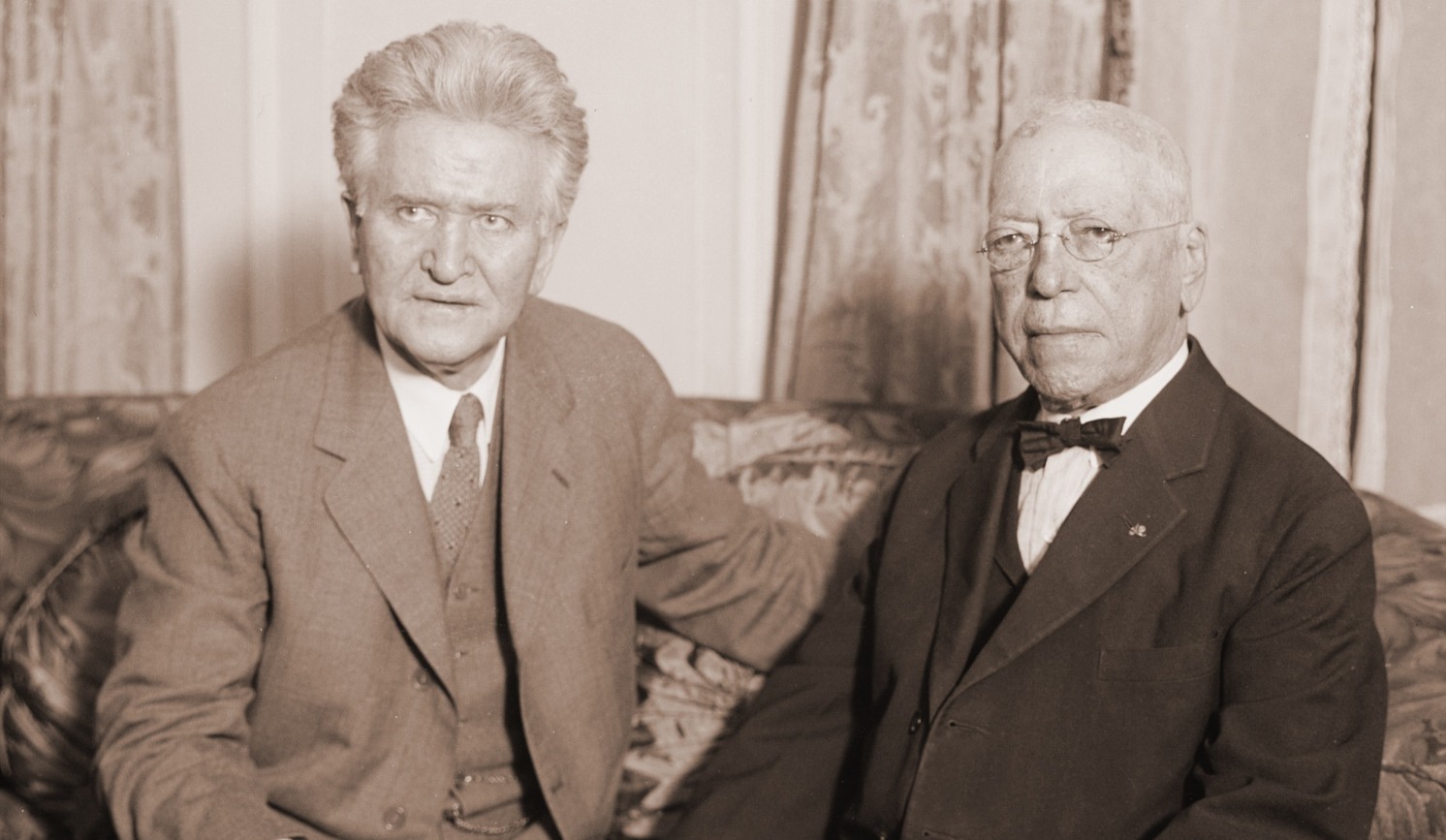
Ruthenberg draws a class line on ‘progressivism’ as the Socialist Party supported Robert LaFollette’s 1924 Progressive Party presidential run, claiming it was the ticket for the working class.
‘Progressive, But Not Labor’ by C.E. Ruthenberg from Workers Monthly. Vol. 4 No. 1. November, 1924.
MANY voices are being raised in the labor movement, particularly from among the Socialists, to declare that the LaFollette-Wheeler-Progressive campaign means the birth of a labor party in the United States. This view is based upon the fact that a large section of the organized workers are supporting the Progressive movement. This, it is argued, must make it a movement of labor which will crystallize in the form of a labor party.
Political parties represent definite economic group interests. They are organized because some economic group has a grievance and believes that through use of the governmental power it can create more favorable conditions for itself. Behind every political struggle there is the solid fact of economic interests. The Republican party is making the safeguarding of the Constitution the issue of the campaign, for the Constitution is the greatest safeguard of the economic interests of the capitalist class which the Republican party represents. Behind the slogan “Back to 1776” in government there lies the desire to recreate some of the economic conditions of 1776.
Does this mean that the support of a political party by a certain economic group makes it a party representing the economic interests of that group? To ask this question is to show at once that the support which organized labor is giving the Progressive movement cannot be accepted as determining that out of that movement will come a labor party.
Organized labor has in the past, through action of the Executive Council of the American Federation of Labor, given its support to one of another of the old parties. The rank and file of the organized labor movement as well as of the workers generally have been and will be quite generally dividing their support between the Republican, Democratic and LaFollette-Wheeler tickets in the election.
How can we judge, then, the economic group interest which a political movement represents? What tests can we apply to the Progressive movement to establish whether in it we have the beginning of a labor party or something else?
There are three phases of a political party, examination of which will throw some light on the question. These are the group or class consciousness which it expresses, its composition, not merely as to its supporters but as to its leading organizations and leadership, and its program.
It is by examining the Progressive movement as to these points that we can establish its economic content and determine whether it is the beginning of a labor party or the beginning of a party representing the interests of some other economic group.
II.
In whose name do the Progressives speak?
We can get the most authoritative answer to this question by referring to the writings and speeches of the leader of the movement, Senator LaFollette. In whose name does he ask support? Whose interest does he promise to serve if elected president?
Search carefully through the writings and speeches of Mr. LaFollette and you will find that never once does he call upon labor to rally to the standard of the Progressive movement, never once does he urge upon the farmers to fight their own battles. Workers and farmers are sometimes mentioned in enumerating the evil things which the privileged class has done, but they are never appealed to as a group to unite for struggle against that privileged class.
Senator LaFollette talks about “the American people” and the “people’s side.” He declares “the rank and file” of both old parties is “progressive.” He appeals to “the plain people” and emphasizes “my appeal will be addressed to every class of people.” He urges “In the uneven struggle against monopoly, the people must insist that the government be the ally rather than, as at present, the active agent of the enemy.” He repudiates sharply the suggestion of a class movement. “We are unalterably opposed to any class government, whether it be the existing dictatorship of the plutocracy or the dictatorship of the proletariat.”
The quotations here made from the speeches of Senator LaFollette might be duplicated from the speeches of Senator Wheeler. Similar quotation could be made from speeches by William II. Johnston, head of the labor section of the Progressive movement. Even Morris Hillquit, since he has cast his lot with the Progressives, has learned their language and no longer speaks in the name of the workers but in the name of the “people.”
Who are “the people?” The farmers, the wage workers, the professional group, the small businessmen and the big capitalists. They all belong to “the people.” The leaders of the Progressive movement call upon all these groups to support them.
This is not the language of a labor party. A labor party speaks in the name of labor. It calls upon workers for action. Or if it is a Farmer-Labor party it calls upon the workers and farmers and sneaks in their name. The language of the Progressive movement is the language which the Republican and Democratic parties have been using. They, too, call upon “the people” for support and make their appeals in the interests of “the people.” Judged on the basis of these utterances of the spokesmen and leaders of the Progressive movement, it is clear that they have no intention of building a party which even predominantly expresses the interests of labor. Labor occupies the same position in this supposed-to-be labor party in embryo as it has occupied in the Republican and Democratic parties. It is part of “the people” to which the Progressive movement appeals and does not pretend to be an organization making a special appeal to the workers because it is fighting for the economic interests of the workers.
The tradition that American democratic institution functioning in the name of “the people,” that it represents all classes alike, is something which has been systematically built up by the ruling class. The Progressive movement is fostering and reinforcing this tradition. For the idea of labor entering politics as a class to fight for its own political interests it is substituting a movement of “the people” qualified by that meaningless, milk-and-water phrase “progressive.”
III.
The composition of the leading organization of the Progressive movement is most significant as an indication of the class interest which this movement represents.
Three movements developed, more or less independent of each other, during the last few years, which were tending in the direction of creating a new political party in opposition to the two capitalist parties which alternated in ruling in the name of the capitalist dictatorship. There was a rank and file movement of workers and farmers openly advocating the formation of a political party which would express the interests of these two economic classes. This movement took the form of an effort to build up farmer-labor parties. The second group consisted of the bureaucratic leaders of a section of organized labor which organized in the Conference for Progressive Political Action. The third group was the insurgent movement in congress under the leadership of Senator LaFollette; expressing a revolt against the domination of the government is a government by the big capitalists on the part of the independent manufacturers, bankers, well-to-do farmers and liberal professional groups.
What has taken place since LaFollette announced his independent candidacy for the presidency is that the third group, representing the revolt of little business against big business, has absorbed and imposed its leadership upon the group organized in the Conference for Progressive Political Action and even upon a large part of the rank and file movement which was fighting for a farmer-labor party.
It is essential to establish this point, because it is the determining factor in establishing whether the Progressive movement has within itself the possibility of establishing a labor party. The first group described above stood openly for the formation of a farmer-labor party. Had its efforts been crowned with success we would have had a radical farmer-labor party in the United States. The C.P.P.A. was dominantly made up of labor elements. Even though dominated by conservative labor leaders, a party created by the C.P.P.A., based upon the labor organizations it represented, would have been a labor party. A party which had as its organization structure local organization created through labor unions sending delegates to a central organization, and state organization created through delegates from labor unions and farmers economic organizations, and a national organization built upon this structure, such an organization, irrespective of what degree of class consciousness it represented or how conservative its platform, would have been a labor party in the historical sense of that term. A party built upon the economic organizations of the workers and farmers would be compelled, in some degree to fight for the economic interests of these two classes.
The fact that the LaFollette-Progressive movement took definite form at the C.P.P.A. convention in Cleveland gives the misleading impression that it sprang out of the C.P.P.A. The fact is that at the Cleveland C.P.P.A. convention a new leadership was imposed upon the C.P.P.A. and it be came an appendage to the LaFollette-Progressive movement.
The proceedings of the C.P.P.A. convention show that the convention determined nothing The La Follette group handed down their decisions and the C.P.P.A. registered them in a public demonstration. Since that time the process of changing the nature and basis of the leadership and of eliminating any expression of the economic basis of the C.P.P.A. in the leadership of the Progressive movement has been made almost complete.
The joint executive committee conducting the LaFollette-Wheeler campaign has fourteen members. Of these fourteen not more than four can by any stretch of the imagination be assigned to the labor wing. Wm. H. Johnston, D.B. Robertson, Morris Hillquit and Edward Keating. Against this labor (?) expression we have John M. Nelson, Robert M. LaFollette, Jr.; W.T. Rawleigh, Herman L. Eckern, Mabel C. Costigan, Rudolph Spreckles, Basil M. Manley, Elizabeth G. Evans, Herman E. Wells and Frank P. Walsh.
No more emphatic evidence of the character of the Progressive movement could be produced than the constitution of this committee. The independent businessmen, and the progressive professional group have made the movement their own. They lead it and dominate it and the labor element sinks into insignificance.
The roster of the state chairman and regional managers of the LaFollette-Wheeler campaign shows the same seizure of control of the movement by the independent business men’s and professional groups. Labor is everywhere an appendage and not the basis on which the organization is erected.
The record of what has taken place in relation to the Farmer-Labor parties in the Northwest is additional proof that the leaders of the Progressive movement, those who today dominate it and hold it in their grasp, not only do not want a labor party, or a farmer-labor party, but are bitterly hostile to the formation of such a party.
In Minnesota there existed a Farmer-Labor party which had built a powerful state organization. It had elected two senators–men who belonged to the LaFollette group. It was not purely a class party representing an alliance between the workers and farmers, but it contained large elements of the small businessmen and professional group.
Did the Progressive movement accept this party as its expression in Minnesota? So far as a victory in that state was concerned there was every reason why the Progressive group should have done this. The Farmer-Labor party had won two victories. It had a powerful organization. LaFollette’s best chance in Minnesota was as the candidate of the Farmer-Labor party.
Yet the LaFollette organization sent the banker John F. Sinclair into Minnesota to create a rival organization as the expression of the Progressive movement. So bitterly hostile is the dominating group of the Progressive movement that it was ready to risk the defeat which might grow out of the confusion resulting from the creation of a rival movement in Minnesota than accept anything smacking of class movements of workers and farmers.
What happened in Minnesota has also happened in South Dakota, Montana, Nebraska and Washington. In place of the strongly organized Farmer-Labor parties based upon the economic organization of the workers and farmers, the LaFollette-Progressives have placed their faith upon newly formed committees dominated by bankers, business men and professionals.
The evidence here is complete. The Progressive movement not only does not contain the basis for a labor party, but it is bitterly hostile to the formation of a labor party and is fighting every manifestation tending in that direction.
IV.
The LaFollette platform has been repeatedly analyzed. The fundamentally reactionary character of the fight to destroy the trusts and its anti-labor character has been pointed out. This proposal is the clearest proof of the class interest which controls the Progressive movement. It is not labor or farmer but independent, little business fighting against big business.
The slogan “Back to 1776” is typically the slogan of little business. W.T. Rawleigh, the Illinois manufacturer on the La Follette-Wheeler joint executive committee stated in an article in the Chicago Herald-Examiner the goal for which the Progressives are striving: “What the businessmen of the United States need now more than anything else is a free, open and competitive market in which to buy their raw materials and supplies and the opportunity to buy, sell and compete on an equal basis in the greatest producing and consuming market in the world.”
That is what the Progressive movement means by its slogan of “back to 1776”–the restoration of free competition, to give little business an equal chance by using the governmental power to restrain the trusts and great organizations of wealth production.
With the exception of its one paragraph directed against injunction in labor disputes and for the child labor law, the rest of the Progressive platform is written with an eye to the interests of the same group. Even government ownership of the railroads is essentially a demand of little business to prevent discrimination against it and establish “free competition.”
Its group consciousness, the composition of its leading organization and its platform, all stamp the Progressive movement for what it is, “progressive” but not labor.
What has happened is that the small business-professional group has been able to seize upon, absorb and make itself the leader of a movement of workers and farmers against the two old capitalist parties. The fact that a large section of the working class did revolt against the two old capitalist parties is progress, even though they have sunk into the morass of the Progressive movement.
The workers have made a step, only to be newly entrapped, but the fact that the step has been made gives promise of a further movement. Today labor moves from the capitalist parties to the Progressive movement. Tomorrow from the Progressive movement to a class fight against its enemy.
The immediate political work before the Workers Party is to hasten the disillusionment of the workers now in the Progressive movement, through merciless criticism and exposure of its shortcomings, through proving its character by its actions on actual issues of the class struggle, to break the grip of the Progressive leadership and bring the day of the workers fighting as a class in their own interests.
The Workers Monthly began publishing in 1924 as a merger of the ‘Liberator’, the Trade Union Educational League magazine ‘Labor Herald’, and Friends of Soviet Russia’s monthly ‘Soviet Russia Pictorial’ as an explicitly Party publication. In 1927 Workers Monthly ceased and the Communist Party began publishing The Communist as its theoretical magazine. Editors included Earl Browder and Max Bedacht as the magazine continued the Liberator’s use of graphics and art.
PDF of full issue: https://www.marxists.org/history/usa/culture/pubs/wm/1924/v4n01-nov-1924.pdf

