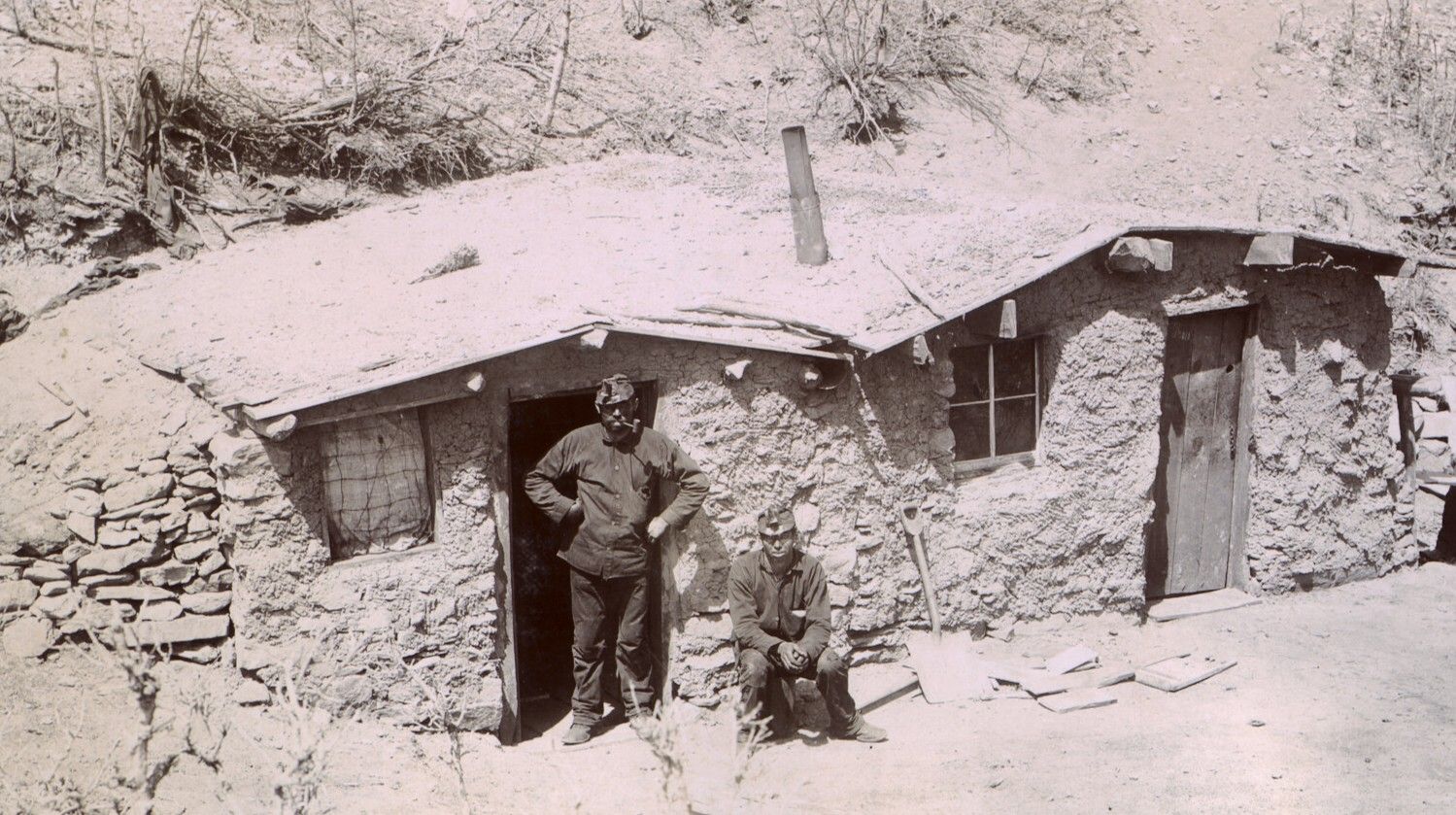
Mailly reports on a corner of a state under arbitrary military and vigilante law as the Western Federation of Miners engages in one of U.S. labor’s most consequential strikes.
‘Scenes at the Slave Camps About Trinidad’ by Bertha H. Mailly from The Worker. Vol. 13 No. 44. January 31, 1904.
THE COLORADO COAL STRIKE.
Armed Hirelings of Rockefeller Prevent Strikers from Entering or Leaving Their Miserable “Homes”–Brave Solidarity of Workers of All Nationalities.
TRINIDAD, Colo., Jan. 14. Engle, some three miles from Trinidad and farther up in the mountains, is typical of the mining camps owned by the Colorado Fuel and Iron Company, or the Rocky Mountain Coal and Iron Company, or whatever company it may please Rockefeller to christen his slave-driving industry of Southern Colorado.
The Engle mines usually employ, when working, about 200 men. Almost all of these men live in the company’s houses, on the company’s land. For these miserable shacks which contain each two or three tiny rooms, the kitchen so low that a man cannot stand upright in it, the men pay from $4 to $12 per month. Most of the houses have been built twenty years ago, and have never received a dollar’s worth of repair from the company. In a few cases men have leased land from the company and have built themselves more comfortable homes. They are now learning the fatal mistake of being prosperous enough to build houses, for they are standing fast to their union, quitting the camp and these home, with no probability of being allowed to return to them.
The camp, a large group of the company’s red shacks, the long red mule stable, the furnaces, the tipple, and wretched ádobe huts where the Mexicans live, lies in a peaceful hollow of the hills in front and near to the entrances of the mine-workings.
Rockefeller’s Hessians.
As you approach this camp to-day, you notice men walking to and fro and you do not need to go very close to see that each man is armed with a Winchester rille. You see these men in many places, on the road to the post-office, down in the hollows: yonder two surly Mexicans stand close to a little block-house, on the tipple, and even up above on the heights they walk back and forth, men who are a shame and disgrace to their kind, for they can be hired to shoot down fellow workers, men of their own class There are thirty-eight serving in two shifts, with, it is said, seven more added yesterday. These deputies receive $5 a day. With between thirty and forty at this one camp and not a load of coal turning the tipple since the strike was called, the company is not profiting much.
The “Dead-Line.”
The line marking the beat of these deputy sheriffs shows the edge of the company’s land, the famous and very real “dead-line.” Just in front of them, at intervals, are pine sticks set up, and nailed on a cross piece this sign:
“Notice.
“This is Private Property, and all persons are forbidden to trespass thereon or interfere with workingmen employed at the mine. The Rocky Mt. Coal and Iron Co.”
This line is drawn more closely each day. Men get in and they don’t get out unless they escape as from a prison. If they get out, they don’t get back. Last week men were allowed to come out to get provisions for their families at the local commissary of the union. Now it is with difficulty that little children sent out for food can get back.
In some mines passes for egress and ingress are granted by the superintendent. The following one is copied from originals possessed by the United Mine Workers of America, and issued at the mine of Itugby, not far from here.
“The Primrose Coal Company, 12, 26, 03.
“Allow Bearer to go out.
“P. Brennan, Supt.”
“The Primrose Coal Company, 12, 26, 03.
“Let Bearer come In.
“P. Breaunn, Supt.”
Does a state of war exist or not?
For the past two days these passes have been absolutely refused in Engle. The miners in all this part of Colorado have never been organized until this strike. A large part of them were Italians and Mexicans. Now at the meetings of the locals all business has to be carried on through Italian and Mexican interpreters as well as in English. Mother Jones spoke on the hillside here two nights before the strike was called. Another body of men called her “La Blanca Madre,” (Spanish for “The White Mother”) and on the morning of Nov. 9 not a man went into the mines,
Unwilling to Scab.
To-day the company is making desperate efforts to get men into Engle and at work. A press dispatch of Jan. 12 stated that the Engle mine was opened on that date with a small force. The following is the truth as told by one of three coal mines who escaped through the “dead line” of armed deputies.
“There was a carload of thirty of us brought from Virginia. Only four of us knew anything about coal mining. They swore to us there was no strike. When we got to El Moro and saw a man guarding the train with a gun we knew something was wrong and sent a telegram back to the second lot not to come. When we crossed the line of armed men at Engle, then I knew there was a strike and I was ashamed to lift my eyes. We did not go into the mines and that night three of us came out. There’s only one man in there that ever mined any coal. Fourteen more want to come out, but dangerous because of gas and if the inexperienced men go into them, they are afraid.”
The mines of Engle are particularly will surely be killed. And not a ton of coal is coming out of Engle. It is said one man is getting out enough to keep the furnaces going.
The woman who is now boarding these three escaped men just outside the camp, a slender girl in black, said to us: “If the company obeyed the laws as well as our boys, I’d not be a widow to-day. The law says you can’t have more than ten pounds of dynamite stored in one place, and they had hundreds and hundreds of pounds where my poor Jack was blown to pieces.”
The Union’s Demands.
The demands of the union in the present strike are as follows:
1. Eight hours to constitute a day’s work.
2. All wages to be paid every two weeks (now they are paid monthly) in United States money: all scrip systems to be abolished. Also, an increase of 20 per cent. on all contract and tonnage wages.
3. Two thousand pounds to constitute a ton.
4. All men working around or in the mines to receive just as much for the eight-hour day as for nine, ten or twelve-hour day.
5. For preservation of health and life, to be insured of a pure air supply.”
“Order Reigns in Warsaw.”
Several speakers went out from Trinidad to hold a meeting. The miners got together somehow from within and without the camp. The meeting broke up finally and the men crowded the bridge just this side of the dead-line in a body to go back into camp to their families. The deputies met them on the line, and refused to admit them. The speakers came and expostulated. “Bob” Lee, head deputy, an excuse for a man, who boasts of his descent from Confederate General Lee and “Light Horse Harry.” seated himself on a rock just across the line, got his gun easily into position and said:
“Now– –yez, cross that line if you want to.”
The sheriff of the county in Trinidad was telephoned for. He was busy in a saloon in Trinidad, and answering that the men could take care of themselves, and that he had not time to come, hung up the receiver. Two union men drove over in a buggy for him and forced him to come under the re minder that he was responsible for the lives of the men. He came, got the superintendent out, who identified the men as, “Tom, House No. 12,” “Tony, House No. 29,” etc., and admitted them.
And yet the citizens of Colorado are free and the miners have no grievances!
But the men of Colorado are awakening to a sense of their wrongs and they are fighting a splendid fight that should bring them the encouragement and assistance of every workingman and woman in the United States that has sympathy to give.
BERTHA HOWELL MAILLY.
The Worker, and its predecessor The People, emerged from the 1899 split in the Socialist Labor Party of America led by Henry Slobodin and Morris Hillquit, who published their own edition of the SLP’s paper in Springfield, Massachusetts. Their ‘The People’ had the same banner, format, and numbering as their rival De Leon’s. The new group emerged as the Social Democratic Party and with a Chicago group of the same name these two Social Democratic Parties would become the Socialist Party of America at a 1901 conference. That same year the paper’s name was changed from The People to The Worker with publishing moved to New York City. The Worker continued as a weekly until December 1908 when it was folded into the socialist daily, The New York Call.
PDF of full issue: https://www.marxists.org/history/usa/pubs/the-people-the-worker/040131-worker-v13n44.pdf

