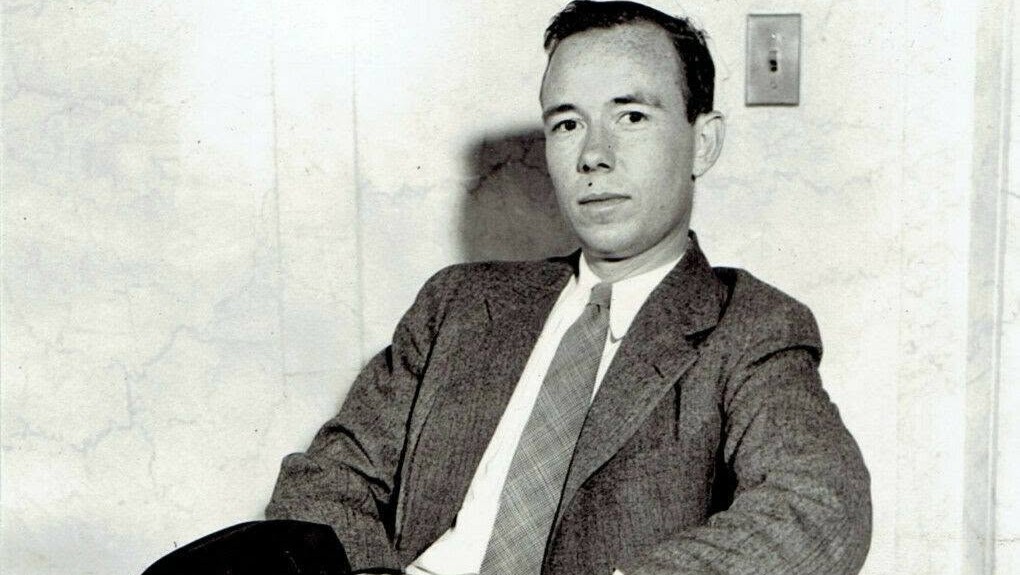
It is always a fight. Lamont is arrested in Jersey City, fascistic fiefdom of Democratic mayor Frank Hague for thirty years, as he attempts to challenge police violations of the most basic rights of workers to picket against the Miller Furniture Company.
‘Jersey Justice for Pickets’ by Corliss Lamont from New Masses. Vol. 12 No. 2. July 10, 1934.
THIS is the story of what happened to an orderly and law-abiding American citizen who went to Jersey City, on Wednesday, June 27, to carry on peaceful picketing before the Miller Parlor Furniture Company at 261 Orient Avenue.
First, let me give you some of the background. During the last few years the financial situation of Jersey City has become more and more precarious. Mayor Hague’s city government has been striving desperately to find new resources. And the versatile Hague conceived the bright idea of attracting to the city new business, which would yield much needed revenues through taxation, by promising employers that he would cut their labor troubles down to a minimum by preventing picketing and other such activities on the part of workers. The Miller Furniture Company was one of the corporations which took advantage of Boss Hague’s offer. This spring it moved to Jersey City from Brooklyn, breaking its agreement with the Furniture Workers Industrial Union, refusing to pay $2,200 in back wages, and locking out all union members. Accordingly, the Union began to picket the factory. At the same time Hague and his policemen proceeded to keep their promise to the employers, arresting all pickets on trumped-up charges and throwing them into jail. I was the sixteenth picket to have this honor. At about 9:45 Wednesday morning I started picketing in front of the Miller Company, I wore a sign reading: “The American Civil Liberties Union Tests the Right to Peacefully Picket in Jersey City.” In a nearby automobile, A.L. Wirin, counsel to the Civil Liberties Union, sat as an observer. Since the police have been arresting observers as well as pickets and had only the day before jailed Alfred Hirsch of the National Committee for the Defense of Political Prisoners for being an observer, Wirin’s strategy of insulating himself by means of an automobile was most wise. Even as it was the police tried to haul him in on some pretext or other, but failed. I walked quietly and alone up and down the sidewalk. Four or five persons gathered at the end of the block and watched me. There was also a lady on a nearby porch who seemed to take some interest. I did not say a word to anyone. Finally a man, who I think was an official of the factory, came around the corner and walked by me, muttering, “One of these days I am going to beat up one of these bastards.” I merely smiled, but will in all probability be accused at my trial of insulting this fellow.
At the end of ten minutes nothing had happened, though there was a policeman roaming around. He kept dashing in and out of the factory and I judge he was getting his orders. Wirin thought that perhaps Jersey City had changed its policy regarding pickets and decided we ought to go to the nearest station house in order to have the police department definitely commit itself. This we did, but the lieutenant in charge stoutly denied there had been any alteration in policy and said pickets would be arrested as usual. He was very surly and remarked, “You people are carrying this thing too far.” I want to make clear here that Wirin and I would have been only too glad to establish the principle of peaceful picketing without my going to the trouble, energy, and expense of arrest, jailing, and trial. The New York Herald Tribune, which wrote a most malicious account of the affair, tried to make out that I was just determined to be a martyr, yearning deeply for arrest as a “milestone” in my “career.” This was the Tribune’s oh so subtle way of attempting to cover up the basic labor issues involved. Of course, after what the lieutenant said, the only thing to do was to go back and continue picketing. We figured that the police radio car had not been available during my first spell. As soon as I began picketing the second time a police runabout drove up with two officers in it. I was still alone on the sidewalk, The police car drove up to the other end of the block and one of the officers got out and talked to someone out of my sight around the corner.
As the car came back in my direction a few people began coming around the corner, also toward me. It was as plain as day that the police had been collecting its crowd so that it could accuse me of causing some disturbance. The runabout stopped near me. “Hey you, come here,” said a tough-mouthed officer. I didn’t move, so he had to get out and come up to me. A crowd of about ten had now gathered. “I’m going to arrest you,” said the officer, “You have no right to do that,” I said. “Where’s your warrant?” “I don’t need one,” he answered. “Now, listen, young feller, don’t you talk back to me.” The crowd had now increased to around fifteen. It was perfectly orderly. “I am carrying on peaceful picketing,” I continued, “and I have a perfect right to do this under the New Jersey state laws and the United. States Constitution.” “You’re arrested,” declared the officer. And he took me by the arm and escorted me into the auto. The other officer then had a conversation with the radio mechanism and we drove off. I afterwards learned that the charge against me was that I “obstructed, impeded, and interfered in a public place with persons who were lawfully on said public place.” Let me repeat again that I was entirely alone until the police came and caused a crowd to collect. They took me to the station-house, frisked me, and searched me for concealed weapons. My old friend the lieutenant was in charge. His expression was very dour and pained as he booked me, took my address, and relieved me of my pen, pencil, and wallet. I said I thought it might be a good idea to count the money in the wallet. The lieutenant looked more pained than ever, but he counted it. Then I was transferred to a regular station wagon with its cage-like iron bars and driven through the streets of Jersey City. The arresting officer guarded me. I argued with him a bit. He claimed that they would be delighted to have us picket if there was a strike on. But there was no strike. I replied that a good many of the workers seemed to think there was one, and that in any case a complete lock-out of union members would seem to warrant picketing. The officer informed me that the “mob” which I had gathered together numbered seventeen men and five women.
We arrived at the main Jersey City jail about 10:45 and entered the building. There they took my name and address again. Then some official gave the order, “Take him up and strip him.” I felt somewhat uneasy over this order. They took me up in an elevator and handed me over to the warden. He proceeded to “strip” me, that is, to take away all my personal belongings, including spectacles, notes, and watch. I was permitted to retain a handkerchief. Then the warden ordered me to take off my necktie, my belt, my shoe-laces, and my garters. I asked why. He answered roughly: “You’re not here to ask questions. You do as you’re told.” I started to remove a shoe lace and naturally put the heel of my right shoe on the edge of my wooden chair. “Take your shoe off that chair,” shouted the warden. “You wouldn’t do a thing like that at home, would you?” I replied that that was exactly what I would do at home. I finally handed over the demanded articles of clothing and found out later that the idea was to prevent me from committing suicide.
I was whisked down to the courtroom and arraigned before a judge. He agreed to postpone trial for a week and set my bail at the absurd: and exorbitant sum of $1,500. All through this picket war the judges have been ordering ridiculously high bail to try and break the morale and the financial resources of the picketers. My counsel and I protested vigorously. While my counsel took steps to get the bail reduced, I was taken upstairs again. For the first time in my life I entered a regular jail block and was locked in a solitary steel cell as a prisoner. The cell was fairly clean with a hard wooden bench on which one could sit or lie down. No reading or writing materials are allowed to prisoners in these cells. They must stay in them 21 out of 24 hours during the day with absolutely nothing to do. I sat down and thought. I had seen the inside of jails portrayed in movies and have seen pictures of prisoners peering out between the bars of their cells. To be actually in that same situation myself gave me quite a shock.
Suddenly I heard a voice that I seemed to recognize. And it flashed on me that perhaps Alfred Hirsch had not been bailed out, as I had thought. “Hirsch,” I called out. “Yes–who is it?” he called back. “Corliss Lamont.” Then we had a loud weird conversation with our voices echoing down the corridor. We discussed the situation. He informed me that Schwarz of the Furniture Workers’ Union was in the cell next to him. Because they were both coming up for trial the next morning, they had decided not to go to the expense of getting bail. Since my trial was a whole week off, Hirsch advised: me to get bail, and get out as soon as possible. “The worst thing,” he said, “is that we have nothing to do.” Evidently their idea is to try and make the prisoner go crazy as soon as possible.
At about this time lunch was served. One of the prisoners cooperated with the guard in bringing around a cup of coffee, three pieces of white bread, and some sort of macaroni dish. They shoved these things through a little wicket in the door of the cell. I did not feel like eating. I sipped some of the coffee, let the macaroni go, and kept the bread for possible future use. I put it on the small wicket platform. Pretty soon the guard came by and ordered me to put it somewhere else. So I put it on top of one of the cell bars where it balanced nicely. I was simply trying to find a clean and sanitary place for it. Then the guard walked by again and told me to put the bread somewhere else. So I shifted it to the bench.
In about half an hour the guard came around with his keys, unlocked the door, and said, “Come on, 32.” I followed, thinking perhaps that my bail had arrived. I walked at a natural pace, but the guard seemed in an awful hurry. “Come on, come on,” he called back to me. I did not alter my pace and asked him if he expected me to do a 440-yard dash. When we got to the entrance of the cell block another guard stepped up and handcuffed my right hand to his left. I inquired as to where I was going. “Never mind, buddy, come along.” The elevator went down to the bottom of the building, we walked through a couple of rooms, and arrived at the fingerprinting department. I protested strongly against being fingerprinted. They said it was the law. I claimed that ordinarily only persons guilty of felonies were fingerprinted. First, they took the impression of the four index fingers; then of the thumb. They also weighed me, registered my height, and wrote down the color of my eyes and hair. The sergeant in charge said that perhaps I could get back my fingerprints through legal procedure in the courts.
I was locked in my cell again. At two o’clock, however, all prisoners were let out of their cells for a couple of hours and allowed to congregate in one of the corridors. Those who wanted to were allowed to few minutes to write a letter with pencil and paper provided by the guard. I wrote one letter, using the wall as a desk, We had to leave the envelopes unsealed so that the warden could censor the contents. There were about fifty prisoners altogether and I talked with some of them. A number had been hauled in on the outrageous “suspicious persons” ordinance permitting the Jersey City police to arrest anyone whose looks they don’t happen to like. They clap such persons into jail, set impossibly high bail like $2,500 or $10,000, and keep the prisoners locked up for ten days or even longer. I talked with a worker who had been arrested as he was quietly walking home one night. He was terribly bitter, wanted to know what the hell use it was to be decent, and intimated that his experience with Jersey City justice might turn him from a hard-working and law-abiding citizen into a criminal. I suggested that he turn his indignation to account in the cooperative working-class movement.
About 3:30 the guard came through and called out my number. We went back to my cell to get my coat and then went out to the warden’s office. “There they gave me back my things. They were in a great hurry and would not give me time to put back my shoelaces. I stuffed them into a pocket and went out the door. “Warden,” I said, “I will remember you for a long, long, time.” When I got downstairs, I found that my bail had arrived. I signed a document concerning it and then walked out. I was free, at least until my trial July 5.
I have written exactly what happened and perhaps it may be of some use to others who will go on the picket line at Jersey City and get jailed. My general impression was that I was treated like anyone else, but that it is the policy of the prison officials to humiliate prisoners as much as possible and try to break down their morale. The Herald Tribune attempted to give the impression that I expected special privileges. I neither asked for nor expected nor got special privileges. It is true that I offered vigorous objection at times. And it still seems to me incongruous that I and the other pickets who have been arrested for walking peacefully up and down a sidewalk a few minutes should be subjected. to what I have described. But as a matter of fact the treatment of all types of prisoners in America often approaches the barbarous. Our prison system is a medieval relic.
I want to make clear, finally, that my day in Jersey City was distinctly not a lark. Though the whole episode was over and done with in some six hours, I must admit frankly that it was for me a gruelling psychological experience, That is the simple fact and I make no apologies for it. But I feel that the effects of the experience will be all for the good. I have suffered no real harm and have received a tremendous impetus to fight with every bit of strength I possess against the stupid, cruel, and corrupt system which Hague’s Jersey City so well typifies today. And I am hopeful that this test case will serve in some measure to break through a near-fascist set-up in which the administration, the police, the courts, and the employers suppress with force and frame-up the most elementary rights of the workers.
The New Masses was the continuation of Workers Monthly which began publishing in 1924 as a merger of the ‘Liberator’, the Trade Union Educational League magazine ‘Labor Herald’, and Friends of Soviet Russia’s monthly ‘Soviet Russia Pictorial’ as an explicitly Communist Party publication, but drawing in a wide range of contributors and sympathizers. In 1927 Workers Monthly ceased and The New Masses began. A major left cultural magazine of the late 1920s to early 1940s, the early editors of The New Masses included Hugo Gellert, John F. Sloan, Max Eastman, Mike Gold, and Joseph Freeman. Writers included William Carlos Williams, Theodore Dreiser, John Dos Passos, Upton Sinclair, Richard Wright, Ralph Ellison, Dorothy Parker, Dorothy Day, John Breecher, Langston Hughes, Eugene O’Neill, Rex Stout and Ernest Hemingway, Artists included Hugo Gellert, Stuart Davis, Boardman Robinson, Wanda Gag, William Gropper and Otto Soglow. Over time, the New Masses became narrower politically and more journalistic in its tone.
PDF of full issue: https://www.marxists.org/history/usa/pubs/new-masses/1934/v12n02-jul-10-1934-NM.pdf

