The secretary of the Film and Photo Leagues, a branch of Workers International Relief, on the forms of film-making best suited to a revolutionary cinema and the discussion under way at the newly formed Potamkin Film School, named for the pioneering, young Marxist film critic who had recently died, Harry A. Potamkin. Includes a summary of a just-held Moscow conference planning for a Cinema Bureau of the International Union of the Revolutionary Theatres.
‘The Revolutionary Film–Next Step’ by Leo T. Hurwitz from New Theatre. Vol. 1 No. 6. May, 1934.
THE film movement in America has for some time been faced with the problem of what film forms are its true concern. The Film and Photo Leagues have up to now produced mainly newsreels. They are necessary because of the rigid censorship and the malicious distortion that the capitalist film companies use in their treatment of events relative to labor and labor’s struggles. These newsreels serve an agitational and revelational function to arouse the working class, and as a corrective for the lies of the capitalist agencies. A strike, demonstration or hunger march is shown with the full brutalities of the police, with the full heroism and militancy of the workers, without the distractive mocking comment of the bourgeois announcer.
Because newsreels are fractional, atomic and incomplete, the revolutionary movement has required a more synoptic form to present a fuller picture of the conditions and struggles of the working class. And so the synthetic documentary film has become an important form for film workers in the revolutionary movement a form which allows for more inclusive and implicative comment on our class world than the discursive newsreel. For this great and rich medium the bourgeois filmers have had little use, since they cannot face the truths that the documentary camera can report. Their lies are better served by a more closely supervised camera in a shadowed studio under the kind sun of California. Aside from a few reels on sports, some shorts of believe-it-or-nots, and the half-truth-half-lies of industrial and “educational” films, Hollywood has ignored the vast possibilities of the synthetic film document.
Another factor, besides its great effectiveness, has determined the preoccupation of the radical movie-makers with the documentary film. At this the radicalized time, with working-class as small as it is, it is almost impossible for economic and technical reasons to undertake the vast task of producing and distributing revolutionary dramatic films, which, in some ways, are capable of going beyond the document (as the synthetic document transcends the newsreel) in its width of scope, its synoptic approach, in its ability to recreate events and emotions not revealable to the camera in the document.
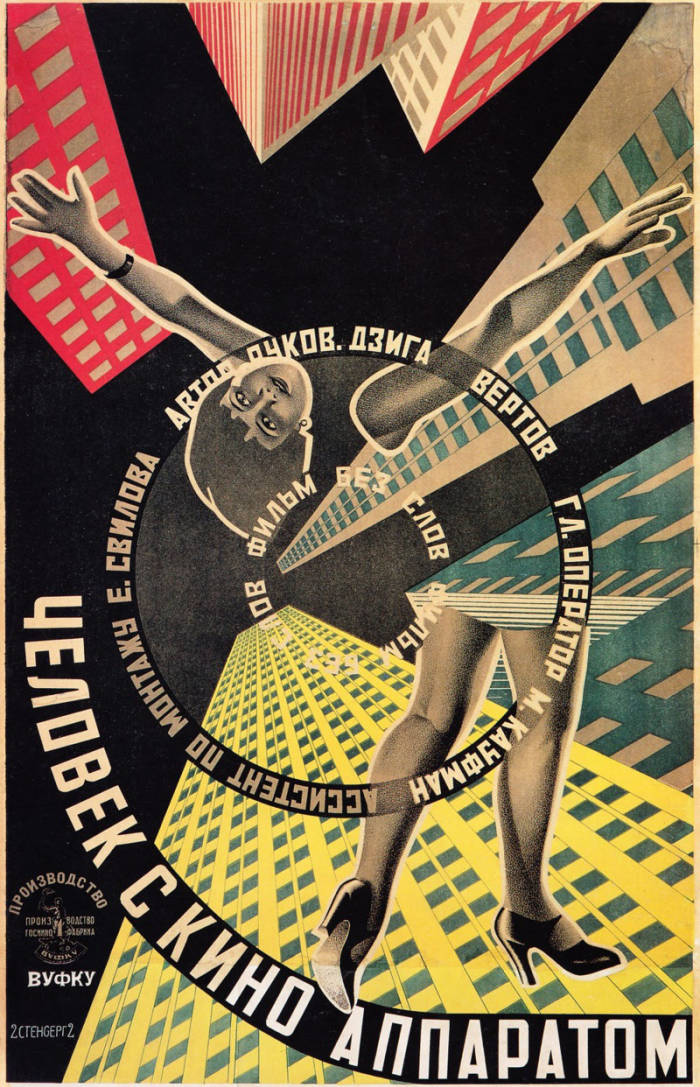
THE problems of documentary montage are very different from that of the dramatic film. The former may be called external montage, the creative comparison, contrast and opposition of shots, externally related to each other, to produce an effect not contained in any of the shots or, as Samuel Brody has well described it, “reality recorded on film strips and built up into wholes embodying our revolutionary interpretation of events”. For this type of cutting, “The Man With the Movie Camera” is the textbook of technical possibilities. The dramatic film presents the problem of what may be called internal montage, which is essentially a recreative analysis and reconstruction of an internally related visual event in terms of shots of film, to reveal best the meaning of the event. The documentary film embodies the reporting on film of actual events and the creative addition of these bits of cinematographed reality to render an interpretation of that reality. The dramatic film involves in its cinematography the interpretive breaking-up of the recreated reality, and, in its montage, the synthesis of these analysed elements to recreate the event on film from a given point of view.
Any acted sequence in an ordinary film will serve as an illustration of internal montage any direct succession of acts to render a dramatic event. An example of external montage may be taken from a recent newsreel compilation by the New York Film and Photo League. The newsreel shots are sure: President Roosevelt signing a state paper and looking up at the camera with his inimitable self-satisfied smile, and a shot of fleet manoeuvers–two shots taken in widely separated times and places and not essentially (but externally) related to each other. By virtue of splicing the shot of the warships just after Roosevelt signs the paper, and following the threatening ships of war, with the rest of the first shot (Roosevelt looks up and smiles), a new meaning not contained in either shot, but a product of their new relation on film, is achieved the meaning of the huge war preparation program of the demagogic Roosevelt government.
External and internal montage, as described here, are by no means mutually exclusive. Both may be used, and in fact have been used frequently to complement each other–sometimes with emphasis on the document as in Ten Days That Shook The World, sometimes with the emphasis on the recreated drama, as in The End Of Saint Petersburg.
A mixed form or the synthetic document and the dramatic is the next proper concern of the revolutionary film movement: to widen the scope of the document, to add to the document the recreated events necessary to it but resistant to the documentary camera eye–a synthetic documentary film which allows for material which recreates and fortifies the actuality recorded in the document, and makes it clear er and more powerful.
THE training of revolutionary film makers in America has come wholly from their experience in the newsreel and documentary film. What has been learned of the problems of shooting and cutting has been learned in the crucible of events, in preparing films of workers’ struggles to be used in turn as a weapon in these struggles. In order to study the problems of internal montage and to prepare for the making of the type of film indicated above, ten or twelve members of the Potamkin Film School, under the technical direction of Ralph Steiner, are working in an experimental group at the Film and Photo League. They have set themselves a series of problems, each involving the writing of a shot-by-shot continuity for the sequence to be filmed, photographing of the sequence and the final editing. Two problems have so far been completed. The first, to render the simple act of unemployed man entering his room after an exhausting day of job-hunting, sitting down, tired, worn and without hope. The second, a continuation of the first, the landlord entering the room to serve the tenant with a dispossess for non-payment of rent. This group works wholly with non-actors in order to duplicate conditions which will occur in making films later. The great task is to learn how to make the camera eloquent, how to make use of the natural acts of an untrained actor to serve the needs of the scenario.
It is too early to indicate the nature of the films which will be made along the lines indicated here. However, the plan is to develop this experimental group into a production group within the Film and Photo League for the purpose of making documentary–dramatic revolutionary films short propaganda films that will serve as flaming film–slogans, satiric films and films exposing the brutalities of capitalist society.
***
Program of the International Cinema Bureau
Summary of the Decisions of the Film Conference held in Moscow recently to plan a program for the Cinema Bureau of the International Union of the Revolutionary Theatre
Work Groups: (1.) The establishment of work-groups for theoretical propaganda struggle.
a) against bourgeois, fascist films;
b) for proletarian, revolutionary films!
c) for Soviet films.
Reference material: In these work groups reference material must be gathered for the critical expose of current bourgeois fascist films.
Short articles: This material must be worked into short articles and sent to press. The following work-methods are recommended: Collective analysis; discussions of the most popular bourgeois films. A comrade should be assigned to write reviews on the basis of the conclusions reached during these discussions. Also on the basis of these discussions a report on a number of typical films can be drawn up.
Public Discussions: (2) Suggestions of the International Bureau to be immediately carried out by appropriate methods.
a) These theoretical work-groups must organize open discussions on the popular films to which prominent individuals and comrades should be invited.
Criticism: b) The screening of a typical bourgeois film with an accompanying analysis. Before the screening a report or discussion of the general characteristics of bourgeois films and the refined and subtle psychological methods used to inject ideological poison therein and the great dangers involved. Also before and during the showing serious or satirical comment on the film exposing its hidden fascist propaganda.
Revolutionary Film: c) Showing a revolutionary film–with an introduction, when possible.
Bourgeois Newsreels: Showing of typical bourgeois newsreel also with analytical and critical remarks directed, towards the satirical expose of the concealed propaganda.
Documentary Films: e) Screening of documentary films. These must also be accompanied by a lecture. The social and political significance thereof and other facts must be conveyed.
Dramatized Documentary Films: f) Showing of dramatized documentary films. Many documentary films, which can be obtained, are such that with the minimum of inserted new shots which can be cut into the film, can be transformed into films with socio-political meaning and thus “neutral” films can be given a revolutionary point.
Montagefilms: g) Experienced comrades to make montage-films on various current political subjects out of film-library material. (Anti-War, Crisis, Unemployment, Socialist Construction, etc.) Also the insertion of text into newsreels makes very effective montage films.
Marxian Study Films: h) The making of films for workers’ schools which utilize documentary material and graphs to illustrate the categories of price and profit and clarify the forms of capitalist exploitation.
Mass Action: i) Organization of mass action against the fascist film by means of leaflets, boycotts (attendance strikes), sabotage, etc.
16mm Production: The most important problem is the production of our own 16mm films. Apparatus must be secured at least a camera and accessories to begin with. Should be gotten from the other cultural organizations to whom the great importance of this work must be explained. It should also be pointed out to these organizations that the making of films bearing on their own activities is extremely important–thus a film on the sports activities of the L.S.U. Also films for the W.I.R. or the I.L.D. Films for the revolutionary theatre organizations to take the place of backgrounds and sets.
Proletarian Newsreels: Proletarian newsreel-weeklies on the labor movement: strikes, demonstrations, proletarian life as found in reality and in contrast, the parasitic life of the bourgeoisie, exploitation, fascist parades, terror, etc. Such films with explanatory titles can become your first repertory. This must be carried out in efficiently managed fashion, of course. The existing police regulations and decrees must be studied and remembered. The film section can organize under the innocuous name of some club, and carry on showing on the “invited guests” method. It is certainly advisable to find a neutral name for your organization.
Very Important!
Films for the W.I.R.: When you have reached this point, when you can shoot films, you should place primary emphasis on the making of W.I.R. films. The W.I.R. is preparing a broad film activity and your material must and can be the essential documentary foundation thereof. On this point you may secure further directives from the local W.I.R. leadership.
The New Theatre continued Workers Theater. Workers Theater began in New York City in 1931 as the publication of The Workers Laboratory Theater collective, an agitprop group associated with Workers International Relief, becoming the League of Workers Theaters, section of the International Union of Revolutionary Theater of the Comintern. The rough production values of the first years were replaced by a color magazine as it became primarily associated with the New Theater. It contains a wealth of left cultural history and ideas. Published roughly monthly were Workers Theater from April 1931-July/Aug 1933, New Theater from Sept/Oct 1933-November 1937, New Theater and Film from April and March of 1937, (only two issues).
PDF of full issue: https://www.marxists.org/history/usa/pubs/workers-theatre/v1n06-may-1934-New-Theatre-NYPL-mfilm.pdf

