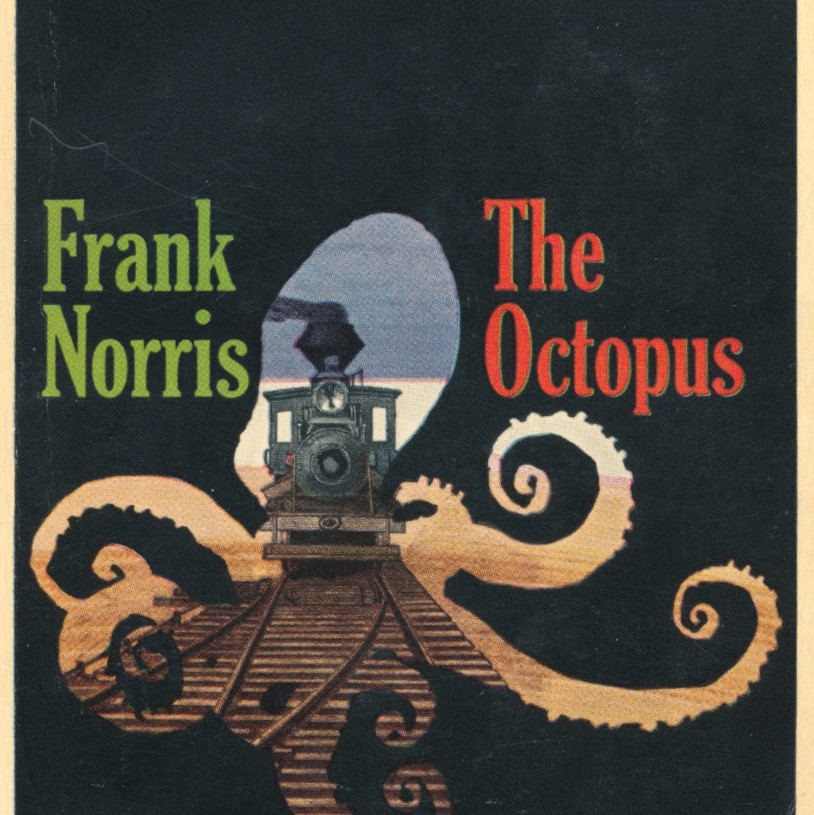
As a technology that was a catalyst for social change, few developments in human history equal the impact of the railroad. As such, it became a multi-layered, potent, literary and artistic symbol for a whole age. You will want to pick up Frank Norris’ ‘Octopus’, described by Calverton as the ‘definite beginning of an anti-bourgeois trend in our literature’ after reading this review.
‘The Railroad in Fiction’ by V.F. Calverton from The Daily Worker Magazine. Vol. 3 No. 194. August 28, 1926.
To quiet, agrarian souls the railroad came like an invader in the night. It was a spectre that threatened to overspread the land with disaster and destruction. A demon of smoke and steel, it screamed its way across continent, stopped only by ocean and sea. Its whistle foretold the fall of rustic civilization.
The locomotive, in brief, was, viewed as a leviathan, an octopus.
This was a social mood, not an individual caprice or poetic protest. In “The Octopus” Frank Norris gives it vigorous and vivid expression. Presley, in the early pages of the novel, epitomizes the attitude in a paragraph:
“Then, faint and prolonged, across the levels of the ranch, he heard the engine whistling for Bonneville. Again and again, at rapid intervals in its flying course, it whistled for road crossings, for sharp curves, for trestles; ominous notes, hoarse, bellowing, ringing with the accents of menace and defiance; and abruptly Presley saw again, in his imagination, the galloping monster, the terror of steel and steam, with its single eye, cyclopean, red, shooting from horizon to horizon; but saw it now as the symbol of a vast power, huge, terrible, flinging the echo of its thunder over all the reaches of the valley, leaving blood and destruction In its path; the leviathan, with tentacles of steel clutching into the soil, the soulless Force, the iron-hearted Power, the monster, the Colossus, the Octopus.”
The locomotive effected a revolution in the western world. It revolutionized production by accelerating transportation, and revolutionized ideas by increasing contacts and multiplying communications, and changing leisurely hamlets into bustling towns and cities. It announced the beginning of a new age.
Frank Norris’ novel, “The Octopus,” is devoted to the theme of the locomotive and the epic of the wheat. Norris was one of the first American novelists to conceive of life in terms of forces instead of individuals. There was something sentimental in Norris’ attitude, it is true, but there was at the same time something very powerful and something very accurate in his exaltation of forces over individuals. In an intuitive way, perhaps, he understood that it was man’s destiny to control these forces for his own salvation, but into his novels this intuition seldom crept. It was always the force of the locomotive, the power of the wheat that prevailed. Life for Norris was a sweeping epic in which man was but an inconspicuous, microscopical puppet. Yet there was about Norris’ work a proletarian sympathy and protest which, though not scientific or socialistic, invariably endowed his better work with a flash of beauty that was lacking in the prudish pastels of Howells. The conversation between two of the characters, Presley and Vanamee, about the former’s poem, called “The Toilers,” is illustrative of an attitude that was not characteristic of the bourgeois literature of the nineteenth century. Presley, whom we mentioned before, was a poetic type, hugging the soil as his inspiration; Vanamee, a mystic, in love with the magic of the wheat, is like an iridescent apparition of the endless plains.
“The moment seemed propitious. The stillness of the vast, bare hills was profound. The sun was setting in a cloudless brazier of red light; a golden dust pervaded all the landscape. Presley read his poem aloud. When he had finished his friend looked at him.
“What have you been doing lately?” he demanded. Presley, wondering, told of his various comings and goings.
“I don’t mean that,’ returned the other. ‘Something has happened to you, something has aroused you. I am right, am I not? Yes, I thought so. In this poem of yours you have not been trying to make a sounding piece of literature. You wrote it under tremendous stress. Its very imperfections show that. It is better than a mere Rhyme. It is an Utterance–a Message. It is Truth. You have come back to the primal heart of things, and you have seen clearly. Yes, it is a great poem.’
“Thank you,’ explained Presley fervidly. I had begun to mistrust myself.’
“Now, observed Vanamee, ‘I presume you will rush it into print. To have formulated a great thought, simply to have accomplished, is not enough.”
“I think I am sincere,’ objected Presley. If it is good, it will do good to others. You said yourself it was a Message. If it has any value, I do not think it would be right to keep it back from even a very small and most indifferent public.’
“‘Don’t publish it in the magazines at all events,’ Vanamee answered. ‘Your inspiration has come from the People. Then let it go to the People–not the literary readers of the monthly periodicals, the rich, who would only be indirectly interested. If you must publish it, let it be in the daily press. Don’t interrupt. I know what you will say. It will be that the daily press is common, is vulgar, is undignified; and I will tell you that such a poem as this of yours, called as it is The Tollers, must be read by the Toilers. It must be common; it must be vulgarized. You must not stand upon your dignity with the People, if you are to reach them.’
“That is true, I suppose,’ Presley admitted, ‘but I can’t get rid of the idea that it would be throwing my poem away. The great magazine gives me such-a-background; gives me such weight.
“Gives you such weight, gives you such background. Is it yourself you think of? You helper of the helpless. Is that your sincerity? You must sink yourself; must forget yourself and your own desires of fame, of admitted success. It is your poem, your message, that must prevail–not you, who wrote it. You preach a doctrine of abnegation, of self-obliteration, and you sign your name to your words as high on the tablets as you can reach, so that all the world may see, not the poem, but the poet. Presley, there are many like you. The social reformer writes a book on the iniquity of the possession of land, and out of the proceeds buys a corner lot. The economist who laments the hardships of the poor allows himself to grow rich upon the sale of his book.’
“But Presley would hear no further. “No,’ he cried, I know I am sincere, and to prove it to you, I will publish my poem, as you say, in the daily press and I will accept no money for it.'”
It is the vision of the wheat, too, that fascinates and inspires Norris. Wheat is no common thing for him. It is no common growth that is whipped into food for humans. It is a conception. It is a sweeping reality. It is the sustenance of a nation, of a world. It is a poem and a passion, a reality that is irresistible and overwhelming.
“There it was, the Wheat, the Wheat! The little seed long planted, germinating in the deep, dark furrows of the soil, straining, swelling, suddenly in one night had burst upward to the light. The wheat had come up. It was there before him, around him, everywhere, illimitable, immeasurable. The winter brownness of the ground was overlaid with a little shimmer of green. The promise of the sowing was being fulfilled. The earth, the loyal mother, who never failed, who never disappointed, was keeping her faith again. Once more the strength of the nations was renewed. Once more the Titan, benignant, calm, stirred and woke, and the morning abruptly blazed into glory upon the spectacle of a man whose heart leaped exuberant with the love of a woman, and an exulting earth gleaming transcendent with the radiant magnificence of an inviolable pledge.”
It is these two themes that course through the novel, the locomotive, and the wheat. The immensity of the wheat, after all, becomes a world–immensity only through the locomotive which can transport it from town to city and from city to nation. While “men perished, were shot down in the very noon of life, hearts were broken and misery, death and anguish spun like a wheel of fire,” the wheat remained, and its rushing roar down chute and channel continued “persistent, steady, inevitable.” The struggle with the railroad was similar. Man succumbed to it. The peasant-farmer was exploited and extinguished. The old virtues were converted into the new vices. The men of the Ranch had surrendered to the men of the Railroad, yet Norris never forgets to stress the fact that it had been “forces rather than men (who) had locked horns in the struggle.”
“Into the prosperous valley, into the quiet community of farmers, that galloping monster, that terror of steel and steam had burst, shooting athwart the horizons, flinging the echo of its thunder over all the ranches of the valley, leaving blood and destruction in its path…The ranches had been seized in the tentacles of the octopus; the iniquitous burden of extortionate freight rates had been imposed like a yoke of iron.”
Like the novels of the christian socialist school in England, led by Kingsley and Mrs. Gaskell, Norris’ novels, as we said in an earlier paragraph, evidence a certain sympathy with the proletariat. They are certainly not part of a proletarian art, which is an art created by the proletariat for the proletariat, or for all society. But they evidence a change from the literature of the bourgeoisie which had captured the literary citadel during the eighteenth and nineteenth centuries. Before the eighteenth century, literature had been the child of the aristocracy, and, as in the works of Shakespeare, had expressed the ethics and esthetics of the feudal nobility. Norris’ work marks the definite beginning of an anti-bourgeois trend in our literature.
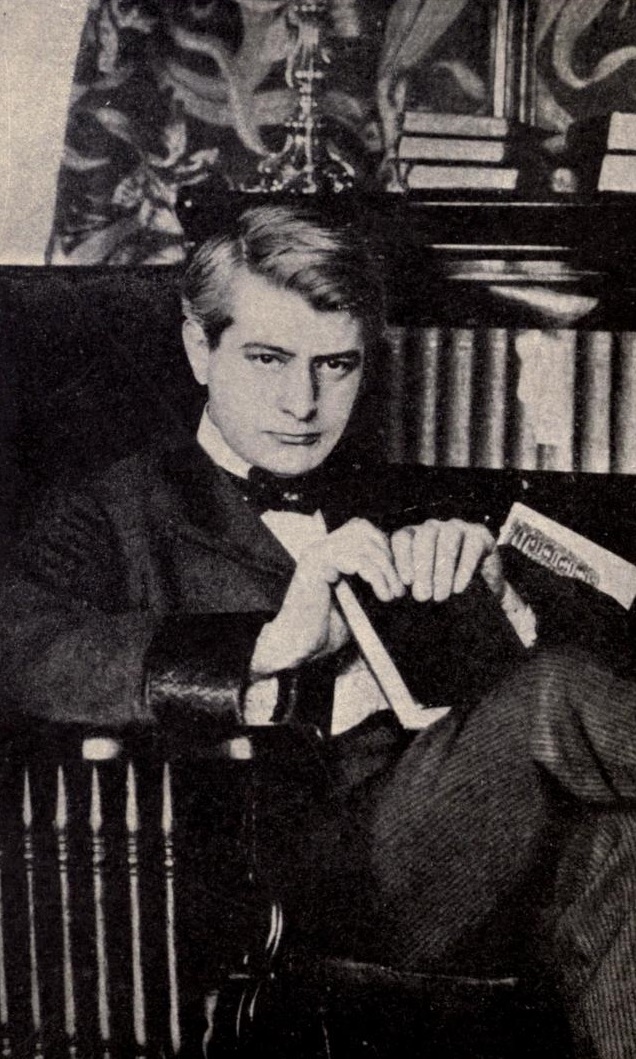
Norris’ work with its spirit of revolt grew out of the vast expansion of capitalism over the great western sections of the United States. The railroads had started as private companies, in bitter competition with each other, but in the struggle with the western ranchers and farmers, consolidation soon became expedient. The famous circular of January 2, 1889, issued by the three banking houses of Drexel, Morgan and Co., Brown Brothers and Company, and Kidder, Peabody and Company, and the notorious gathering at Morgans home, were the beginning of the “iron-clad combination” of railroad magnates that was to conclude the competition between the private companies. In the struggle for lands, congress invariably yielded to the railroad capitalists. The workmen were exploited, the farmers were tricked, the public,” as the petty-bourgeoisie christens itself, was swindled. It was a time when millionaires were made in the mad gamble of a night, when cunning became a virtue and deceit a crown. While this insane scramble for wealth went on, and workers were bent, broken and crucified in the process, William Dean Howells, the leading American novelist of the bourgeoisie, wrote quiet, sweet stories of the parlor antics of the newly rich, and, in his own words, averted ugliness by turning his glance to “the more smiling aspects of life (which) are more American.’ Frank Norris, on the other hand, detested this unreal sweetness and serenity, that prided itself upon the ostrich gesture. It was the smell of earth that haunted him. In him I was a desire to tell fact and not fiction. He hated the bourgeoisie, who desired relief in art and escape in fiction. He did not wish to write boudoir literature for decadents or saccharine tales for sentimental virgins. He did not wish to devote his talent to the art of the precious few. “No art that is not in the end understood by the people,” he wrote, “can live or ever did live a single generation.” Although Frank Norris’ novels may lack finish and want form, though they may suffer from crudity and melodrama and oftimes fail of that beauty which great art attains, there is in them the spirit of candor and that flare of revolt that are always moving and dynamic. And it is in the light of this that one can understand the sincerity of his cry:
“I never truckled; I never took off my hat to Fashion and held it out for pennies. By God, I told them the truth. They liked it or they didn’t like it. What had that to do with me? I told them the truth.”
The Daily Worker Saturday Supplement, later changed to a Sunday Supplement, of the Daily Worker was a place for longer articles with debate, international focus, literature, and documents presented. The Daily Worker began in 1924 and was published in New York City by the Communist Party US and its predecessor organizations. Among the most long-lasting and important left publications in US history, it had a circulation of 35,000 at its peak. The Daily Worker came from The Ohio Socialist, published by the Left Wing-dominated Socialist Party of Ohio in Cleveland from 1917 to November 1919, when it became became The Toiler, paper of the Communist Labor Party. In December 1921 the above-ground Workers Party of America merged the Toiler with the paper Workers Council to found The Worker, which became The Daily Worker beginning January 13, 1924.
PDF of full issue: https://www.marxists.org/history/usa/pubs/dailyworker/1926/1926-ny/v03-n194-supplement-aug-28-1926-DW-LOC.pdf

