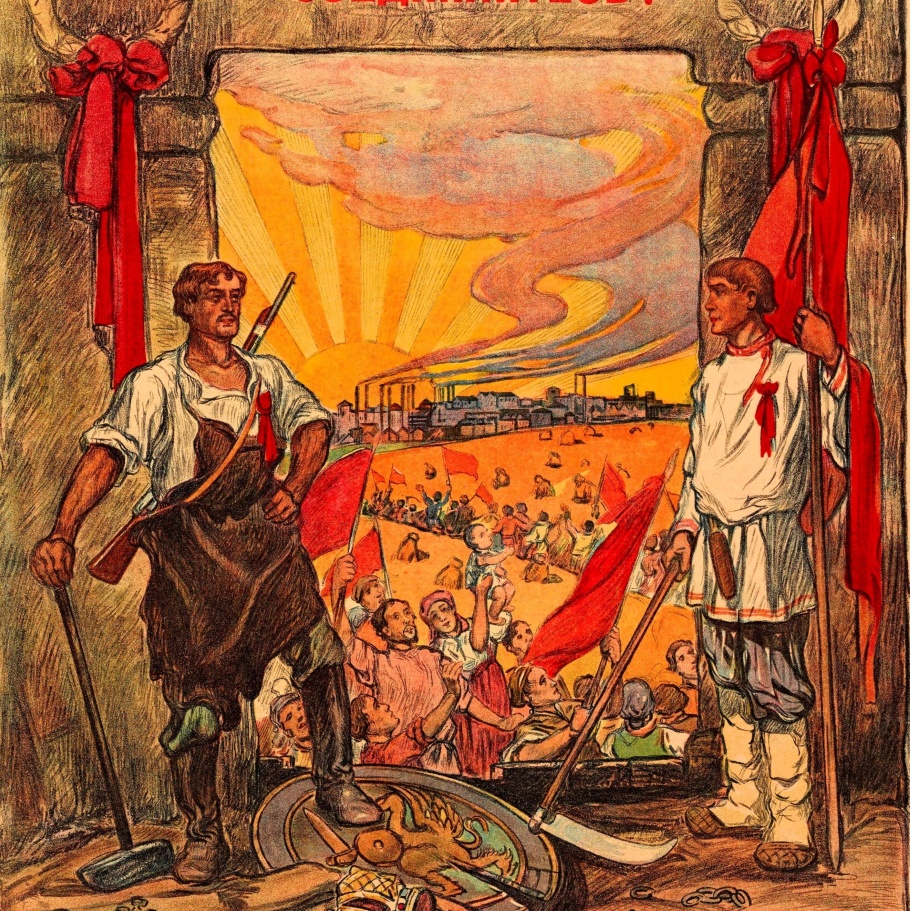
On the Newsstand, every day is a celebration of the Russian Revolution. Alexander Trachtenberg was a veteran of the 1905 Revolution, greets the Soviet seizure of power. A Menshevik in the R.S.D.L.P. who joined the movement here on his emigration to the U.S., Trachtenberg became a major figure in both the Socialist and Communist Parties throughout his life. A Yale-educated historian, he was central to the Rand School and its Labor Research Department, which he edited until 1920. Staying in the Socialist Party after the 1919 splits, he was a leader of the ‘Workers Council’ group which supported the Third International, not leaving until after the Party’s December, 1921 convention in which the right wing again won. They then joined the new legal Workers (Communist) Party. In the Communist Party. Tracthenberg is best known for his role as editor of International Publishers.
‘The Russian Revolution Is the First Real Social Revolution That Ever Happened’ by Alexander Trachtenberg from Truth (Duluth). Vol. 2 No.1. January 4, 1918.
Noted Russian Socialist Teacher and Economist Explains That Present Uprising of Russian People Cannot Be Classed With the Series of Former Revolutions That Resulted in the Existing Order of Society. But Is the First Whose Alms is To Sweep That Order Away.
It is the proper thing today in America to refer to the situation in Russia as an infinite bedlam; a vast territory, with 180,000,000 human beings, possessed of the devil and given over to the unreasoning rule of hysteria and chaos. It is a place, we are told, which has suddenly become detached from the natural laws that govern the evolution of nations, a country where disorder seems to be looked upon as the supreme virtue, and where revolutions may henceforth be expected daily, not because of any particular political aim to be attained, but because of some evil impulse to revolute.
Russia is not that kind of a place. There never was such a place and there never will be, and it will do no one any good to assume that there is.
Cause and effects still hold sway in Russia. None of the revolutions or the counter-revolutions which happened there are any less intelligible than our American Revolution or our Civil War. Americans, as a rule, do not grasp the meaning of these Russian uprisings–in the first place, because there has been such a successful effort to keep the explanation from them and in the second place because Americans are so commonly committed to the assumption that history is made by “great men.”
A New Family of Revolutions.
When the Czar was overthrown, America applauded. One of this country’s chief boasts was that she had no Czar and that act of revolution seemed neither anarchistic nor insane. But when Miliukoff was unseated a few weeks later America gasped. America had never thought of unseating her Miliukoffs, and the act could not be understood. For exactly the same reason the subsequent overthrow of Kerensky could not be understood for the same forces which placed Kerensky in command took that command away, and they are forces which have never functioned in history before.
The American idea of revolution Is the American Revolution; or at best, the French Revolution–the political change which occurred in the transition from feudalism to capitalism.
These revolutions, however, were not of the same family of revolutions as the one in Russia which began with the unseating of the Czar. For although the working people did most of the fighting in these revolutions, they were not, strictly speaking working class revolutions.
If the Russian Revolution is to be understood, it must be classified not with the series of revolutions which resulted in the existing order of society but as the first of new series whose aim it is to sweep that order away.
Even when Americans began to accept Kerensky they did not appreciate this fundamental reason for his selection. The general explanation given for his support was that he was the “strong man” needed in the particular crisis which Russia faced. The interests which were supporting Kerensky in his controversies with the Council of Workmen’s and Soldiers’ Deputies: were never under this delusion. To them Kerensky was merely the. choice of two evils, and they deserted him at the first faint chance to turn Russia over to more conservative rule. But the strong-man theory of history was so deeply rooted in the American mind that this conflict of economic interests could not be grasped. It was easier to look upon Kerensky “strong man” and Lenine as a “bad man,” and let it go at that. Then suddenly we became aware that the “bad man,” the “German spy” had overthrown Kerensky. Just how he did it we never took the pains to ascertain; in something the same way perhaps, the villain usually does such things on Broadway, by telling dirty lies about the hero to all the “good” people in the company–those good people, by the way, always being so dense and unsuspecting that they never fall to let him get away with it. Americans shuddered and wept while the melodrama went on, but they seemed to be convinced that it wasn’t real and that the villain would be punished in the last act. Such a view gets us nowhere. It explains nothing. It contradicts every proved scientific principle. It is the diagnosis of the dark ages, the verdict of superstition, the ipse dixit of those who either cannot or will not look the facts squarely in the face.
The facts are not hard to understand. Under the Czar the masses of the Russian people had become more than anti-Czar. They had come to antagonize the whole system of exploitation, including the exploitation of the working class by those who happen to own the land and capital of the world. Their first elections showed that the Russian mind was overwhelmingly Socialist. They had their differences in regard to tactics, but they were one in their ultimate aims. The Social Revolutionists concerned themselves mostly with the problems of the peasants and the land problem. The Social Democratic Labor Party concerned itself mostly with the problems of the industrial workers. There was no fundamental opposition between the two, nor between the two factions, of the latter party, the Menschevikis and the Bolshevikis.
New Russia vs. Old Diplomacy.
Bolsheviki does not mean bad man. It designated that faction of the party which was seemingly most impatient to put through the whole were more patient, more opportunistic, more practical, but not less radical, in their acceptance of the complete Socialist ideal. I was a Mensheviki. Leon Trotsky was neither. He belonged to a small group whose aim it was to bring the two factions into harmony. Lenine was accepted leader of the Bolshevikis.
These revolutionary parties had one interest in common with the more progressive capitalists of Russia. That was the overthrow of the Czar. Beyond that their aims were different. The capitalists wanted freedom to extend business and trade. They didn’t want to be hampered by stupid feudalism, but they were generally in favor of what is called an imperialistic program, and accepted the war as theirs.
The parties of the working classes had no interest in the imperialistic programme. They formed the rank and file of the soldiers, who had not even been consulted about the war and didn’t know why it being fought. To them it was the Czar’s war, and their only part in it was to fight or be shot. Now the Czar had been overthrown, and while they would fight a people’s war, if necessary, they would have to know just what they were fighting for. So they organized their Council of Workmen’s and Soldiers’ Deputies, who made demands upon the Provisional Government to demand from the Allies a statement of war aims and to initiate a movement for a general negotiative peace.
Miliukoff and Prince Lvoff ignored these demands. It had been the intention of the workers and soldiers to let these gentlemen run the Government, only making sure that a Socialist, Kerensky, had charge of the Department of Justice, so that their political prisoners would be freed and their life and liberty secured. But Miliukoff and Lvoff demonstrated that they had nothing in common with this voice, of the masses, so the Council forced them to resign and placed the Socialist at the helm.
Upon Kerensky, then, there fell a burden which would tax the resources of a superman. Russia’s worst enemy seemed to be German militarism; there must be no compromise with that The United States had just entered the war “to make the world safe for democracy.” That itself helped to stiffen up the Russian ranks. But how about the other countries? Was it certain that they did not have imperialistic or capitalistic designs? So the new Government, acting upon the mandate of the Council, appealed to all the Allies to restate their war aims–to come to a general agreement as to acceptable terms of peace.
The diplomats of the Allies denied their request.
Th United States then sent “fraternal” commission to Russia. We sent Elihu Root.
Failing to get any statement of war aims from the diplomats, the Council called for an international Socialist conference in Stockholm. The Socialist of the world agreed. The Allied Governments dissented. The Government which sent Root to Russia was first to deny passports to the elected Socialist delegates.
Where Kerensky Failed.
The Stockholm conference was said to be a German trick. In Russia they don’t believe that, and they don’t believe that the capitalists of England and America believed it. They think, rightly or wrongly, that international capitalism opposed such a conference, not for fear it would be a fizzle, but for fear it would be a success. They didn’t want the Socialists to have the prestige of bringing about peace, was the Russian conclusion. Such prestige might lead to social revolution in other countries, including Germany, and they would rather have the Kaiser keep his throne than to have him lose it to the Socialists.
Suspicion of the aims of the Allied Governments grew apace. And the democratic countries upon whom the Russian revolutionists had banked the most were always the first to oppose their revolutionary moves.
Kerensky still trained with the Allied diplomats but no doubt was expressed as to his aims. He was a tried Socialist a tried revolutionist. If he had an ambition to be dictator, it was for no personal aggrandizement. Thus he seemed to retain the support of the Workers and Soldiers, while distinctly not carrying on their programme.
The Russian troops had been fraternizing with the Germans, trying to stir up revolution across the border. Kerensky put a stop to that and personally led the first offensive.
Just what reward did he receive? The Korniloff counter-revolution. Korniloff, who stood for capital punishment, the return of the hated discipline in the Russian Army and the abolition of the colors committees! And the very day this. counter-revolution was launched it was hailed by the press in England and America as the solution of the Russian problem.
Bolshevikis and Menshevikis united to put down the revolution. But with each new development which I have recounted the ranks of the Bolshevikis grew and the ranks of the Kerensky followers dwindled. Kerensky had worked like a superman to keep up the war until such time as New Russia could come to complete agreement with her allies. In the struggle, however, he had not only alienated most of the Russian rank and file, but he had proved too radical for the western diplomats to fasten to.
Kerensky’s despairing interview, given out a few days before the Bolsheviki uprising, tells the story. It was a charge that the Allies had failed Russia and that Russia could do no more.
Council Represented Whole Nation.
Now as to the Bolsheviki uprising, what was it? Was it the case of a villain entering to bedevil the situation? Was it a case of sudden conversion of the masses to the economic theories of Lenine? It was neither.
From the time that Kerensky assumed command, the Council of Workers’ and Soldiers’ Deputies was the real governing body of Russia. Kerensky ruled by permission of the Council. From that body alone he had his real credentials. The Constituents Assembly had not yet been elected and the organization of the Workers and Soldiers was the nation’s only representative voice.
The Russian people wanted peace. They had not entered the war, as America did, by representative deliberation; but they did not want a separate peace. They wanted a general peace, and they wanted Russia to take the initiative in bringing it about. So far, however, the Russian Government had accomplished nothing to this end, and the representative of the Council of Workers’ and Soldiers’ Deputies who was sent to France to participate in the Allied Conference was not permitted to take his seat!
Supposed Kerensky Would Resign.
So Leon Trotzky introduced a resolution in the Petrograd Council urging upon the Government to take immediate, aggressive action toward bringing about a general peace.
This resolution was defeated in the Executive Committee of the Council. Trotzky carried it to the whole Council, comprising 2,000 members. There it was carried, and the Executive Committee, composed of Kerensky’s main backers, automatically resigned. By due of election, a new committee favoring Lenine’s and Trotzky’s attitude toward peace installed. It was assumed throughout Russia that this action was carried with it the downfall of the Kerensky Government. This Council was the recognized voice of the mass of the Russian people, and it was expected to exercise the powers it did exercise until the Constituent Assembly Was duly installed. Kerensky, who had persistently postponed the calling of the Constituent Assembly, had never challenged the power of the Council. But he did not resign, and so another Provisional Government was installed. There was no war and comparatively little disorder.
It does not seem possible to me that extended civil war result from such a situation. As far as the Socialist factions led by Lenine and Kerensky are concerned, it is a battle of ideas and not a conflict of interests, while the parties who do represent interests in opposition to the working class are too small numerically to wage successful war.
The only fighting opposition so far has not come from any democratic groups. It has come from the Cossacks whose heritage it has always been to keep down the revolution.
If we look at Russia as a mob of 180,000,000 people at the mercy day by day of the particular bad man who makes the biggest noise, we can only arrive at confusion and despair. But if we conceive of this as not merely a political revolution, but as one hitting at the very structure of modern economic and social life and paving the way to an entirely new order, the events take their place in most logical sequence.
Separate Peace Not the Aim.
The Czar interposed his stupid tyranny and they deposed the Czar. The progressive capitalists sought to set up a limited monarchy in his place, and they overthrew the government which made the attempt. They put a man of their own in power, with quite definite instructions as to what he should do. He failed to do it and they deposed him. Now they have given the same instructions to another group of representatives, and to all appearances these instructions are being carried out.
But the will of the Russian people is not and never has been to make a separate peace. They have held the belief that a temporary armistice would make it possible They do not believe the German people want to fight a Kaiser’s war any more than they wished to fight for the Czar. And even while their representatives are in conference with the German envoys, they are bombarding Germany by air with appeals to rise against the Kaiser.
They hope sincerely that the Germans will do this, and it must be remembered that they know more, about what is going on in Germany than any other nation on earth. All we are permitted to get here is the occasional despatch telling of mutiny in the German Navy or some overwhelming Socialist election like that in Leipsig, where the Independent Socialists, the Liebknecht group, polled 64 per cent, of the 78 per cent Socialist votes. But the Russians have been getting first-hand information. They have fraternized for months with the German troops, and they believe that the German people are ripe for revolution. One thing is certain. The Russian people, represented by the Council of Workers’ and Soldiers’ Deputies do not want a German peace. They said so to Miliukoff. They said so to Kerensky. They have said so to Lenine. Trotzky has given this message to the world and was only voicing the consistently stated will of the Russian people when he announced that, if the German Government stands in the way of a democratic peace, as promulgated by the Revolutionary Democracy of Russia, the Russian people will prosecute the war against the Imperial Government as it prosecuted the revolution.
Truth emerged from the The Duluth Labor Leader, a weekly English language publication of the Scandinavian local of the Socialist Party in Duluth, Minnesota and began on May Day, 1917 as a Left Wing alternative to the Duluth Labor World. The paper was aligned to both the SP and the I.W.W. leading to the paper being closed down in the first big anti-I.W.W. raids in September, 1917. The paper was reborn as Truth, with the Duluth Scandinavian Socialists joining the Communist Labor Party of America in 1919. Shortly after the editor, Jack Carney, was arrested and convicted of espionage in 1920. Truth continued to publish with a new editor J.O. Bentall until 1923 as an unofficial paper of the C.P.
PDF of full issue: https://www.marxists.org/history/usa/pubs/truth/1918/v02n01-jan-04-1918-truth.pdf

