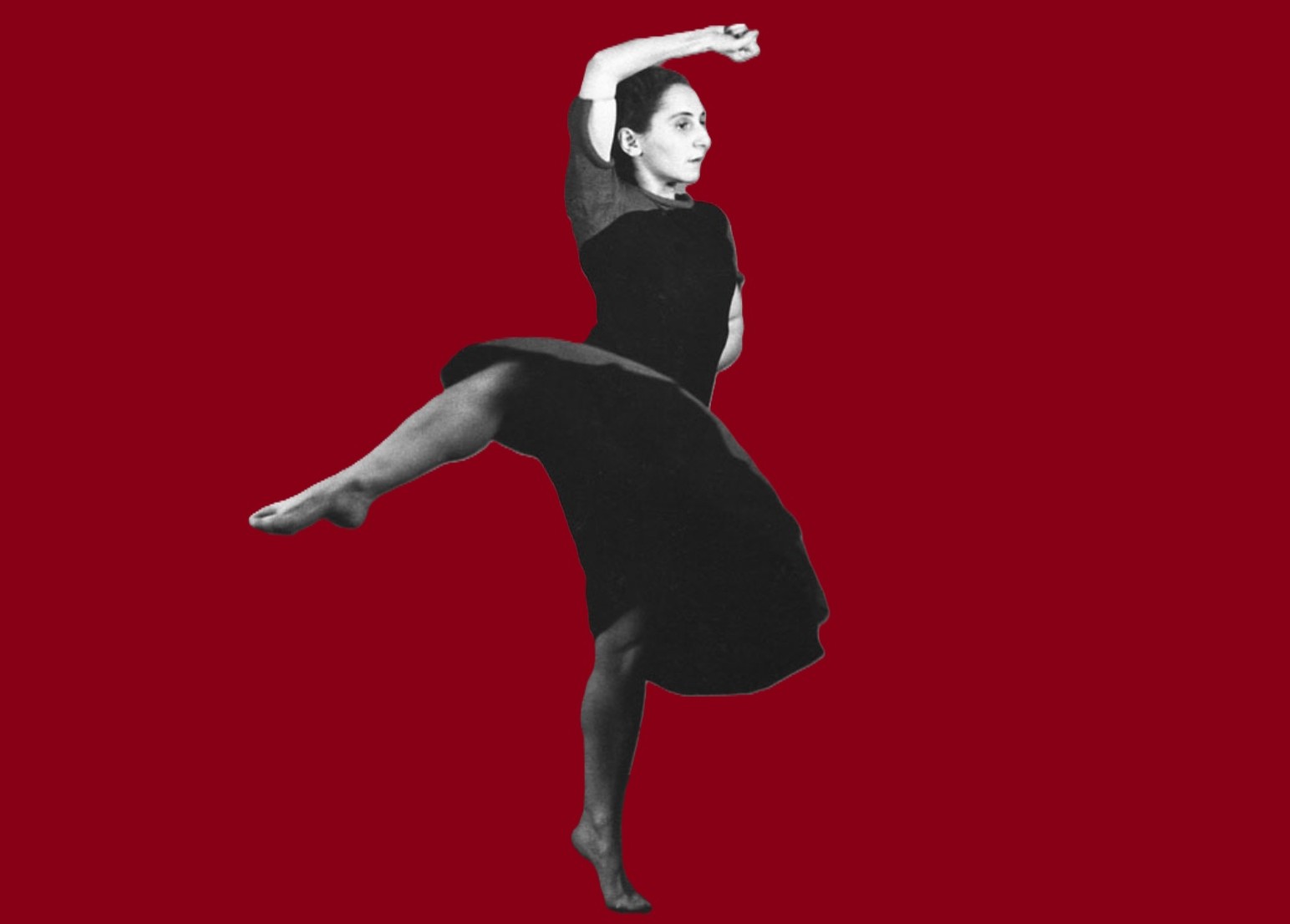
A key figure in the Workers Dance league and a leading force in the modern dance movement with a fascinating essay on her craft as she grapples with abstraction in a medium she wanted to appeal to broad masses of people. Evan is best remembered for her pioneering use of dance as therapy.
‘Her Chosen Theme: A Modern Dancer’s Credo’ by Blanche Evan from New Masses. Vol. 28 No. 5. July 26, 1938.
WE can’t deny it any longer. Perhaps musicians and graphic artists can bide their time until the public takes their works to its bosom, even a hundred years after their decease. But the work of a dancer, despite the noble efforts of dance notationists and the invaluable aid of the moving picture to preservation, must be accepted not only within her life, but within her not-too-old life. The modern dance, born of a rebellion against the romanticism of Isadora Duncan, against the eclecticism of Ruth St. Denis, and against the theatricalism of the Russian ballet, has not yet achieved any appreciable percentage of the audience enjoyed by any one of its predecessors.
No sincere artist prefers a small coterie of initiates to a wide mass audience. Any true artist works for humanity and desires to be understood by humanity. This is not to say that the modern dancer to be widely accepted should “give the public what it wants.” It is to ask, rather, “Why has the modern dancer failed to reach even that audience which supports good theater, good music, good painting? Why does the modern dance fail to hold the interest of that audience that loves the modern music of Shostakovich and the modern painting of Picasso?”
The glib talk that the modern dance must “return to the theater” is, in itself, superficial. The art form of the modern dance cannot arrive at its own fulfillment by means of borrowed finery. Besides, dance pageantry has not been the only form of the dance in the past generation that has held the interest of the world. Isadora Duncan stripped performance of all theatricality. She danced in a simple tunic against a one-toned cyclorama. Yet to thousands of people, the word “Duncan” recalls a thrill in the theater. There must be some chemical, present or lacking, in its own organic formula which to date has prevented the modern dance from becoming a really potent factor in the American concert field.
In a recent modern dance recital I attended, the first half of the program was devoted to a ballet, The Happy Hypocrite a Fairy Tale for Tired Men by Max Beerbohm. The ballet had very few program notes, but the characters were unmistakable: “ladies…captains…a naive country lass, looking for a husband with the face of a saint,” etc. The auditorium was not banked, but the people of the audience were interested enough to stand in their seats to enable them to get a better view; including John and his wife Mary, directly in front of me, who obstructed my own vision. They insisted on seeing what was going on on the stage. The second half of the program was devoted to a composition dealing with the broad personal philosophy of the choreographer: “the growth of the individual in relation to his fellows in an ideal state.” This was subdivided into “choreographic” titles: “Circular Theme…Variations…” etc., and these abstract subdivisions were interspersed with more concrete though still very general concepts: “Processional, Celebration,” etc. Despite the fact that the performance in itself was of the highest caliber, the interest of the audience lagged after the first five minutes. Eventually, a number of people left; John whispered to his wife, “Come, Mary, it is enough. Even when they explain it on the program, I don’t understand it.” Yet John and Mary had been concerned enough with the art of the dance to come to the recital in the first place to attend, as a matter of fact, a whole series, since this performance was only one of a season subscription of dance recitals.
It is an old–though whispered–complaint of modern dance audiences of those who are honest enough to admit it–“I don’t understand.” Too old and too frequent for us to accept any longer Martha Graham’s repeated refutation that an audience shouldn’t try to understand it should react. Of course, it should react, but obviously something blocks its power to react. And isn’t it time the modern dancer squarely faced the problem? Why should the same man who, as audience, had truly participated in the Happy Hypocrite suddenly find himself figuratively barred from the remainder of the performance? In his humility, he did not blame the artists but rather himself for his inability to react. From his remark, it was clear that he felt he could not react until he understood.
Understood what? Not every single movement of the dance, but at least the general intention of the composer. To this, he could find no clue. His inability to discover the connection between the program titles and the dancing on the stage seemed to prevent him from reacting. Had the dances been frankly abstract, Dance Symphony No. 5, let us say, John might have sat back and reacted to movement much as he would and does to abstract music. As it was, with the titles indicating a specific intellectual idea, he naturally sought the exposition of this idea in terms of dance–and this he could not find. Why? Because what was going on on the stage was not the translation of the literal idea into recognizable movement images, but rather the evolutions of an abstract design cemented with a cryptic content; the raison d’être remained a mystery. The sincerity of the composers, Humphrey and Weidman, is not questioned; besides, they are master craftsmen; in this instance, they had simply followed the main esthetic line of the modern dance: that of conceiving a generalized specific idea in abstract unrelated movement, thus leaving undefined in the final dance product the emotional and the intellectual core of the idea.
Isadora Duncan, too, danced personally and abstractly, but she made her appeal simply and directly to the emotional responses of her audience. The titles of her dances made no pretense of connoting anything specific. Her themes were purely emotional, treating of generalized joy, sorrow, the spirit of freedom, “the ultimate intensification of the feeling of life,” as Curt Sachs describes certain primitive dancing. Our modern dancers, on the other hand, as all our modern artists, are no longer satisfied to deal romantically with primitive emotions. They have turned to the expression of ideas and in so doing, they have shied away from a simple emotional appeal. But unlike our modern artists, they have feared the realm of the literal, so that they have also shied away from specification of material. Their chosen themes have been either broadly epic or personally introvertive, and in both cases of a very nebulous nature.
And where have the modern dancers turned for the source of their movement symbols? In the answer to this question can be found the reason for the impenetrable barricade now existent between the audience and the performer. The modern dance choreographers have not used the objective realities around them as have our painters. They have been content, in the main, to exploint an abstract vocabulary of technical movement which they have evolved within the last fifteen years, and which they originally created as a reaction to the flowing curves of Duncan and to the classic finery of the ballet.
True, there are times in the history of the arts when a new assertion of the powers of the art medium, to the exclusion of all else, is necessary. Such was the state of the dance in 1920, as it had been of painting twenty-five years earlier. And it seems that since then, the concern of the modern dancers has been not in the discovery of a new technique for the expression of ideas and emotions, as Stanislavsky of the Moscow Art evolved for the theater, but in the rediscovery of movement per se. In this they succeeded. They truly rediscovered body movement in its dynamic and stylistic potentialities; but however valuable this new kinesthetic may be, it cannot justify forever the unclear esthetic which they have built around it.
It was logical, perhaps, for the modern dancer to choose themes of a most general nature: of the sweeping philosophic beliefs and of the personal psychological twists of the composer. In both cases, she had no tangible responsibility to the audience for clarity. Themes chosen from the real objective world, themes of a more detailed nature, would have bound her to reality and to recognizability of movement, and would have demanded a more literal connotation of movement. This, in turn, would have hampered her in the free exploitation of her newly discovered vocabulary of “pure” physical movement. It is well to understand this. The net result, however, was a definite estrangement from the audience. In the exposition of these themes, with the avoidance of reality thematically and as a source for the movement symbols, no contact with reality was made, and in the final product, there were no communicable dance images offered to the audience. The audience could not fathom the artist’s specific-general-concrete-abstract interpretation of the theme, and was left to float on the wide open sea of the composer’s own mysterious ego-craft.
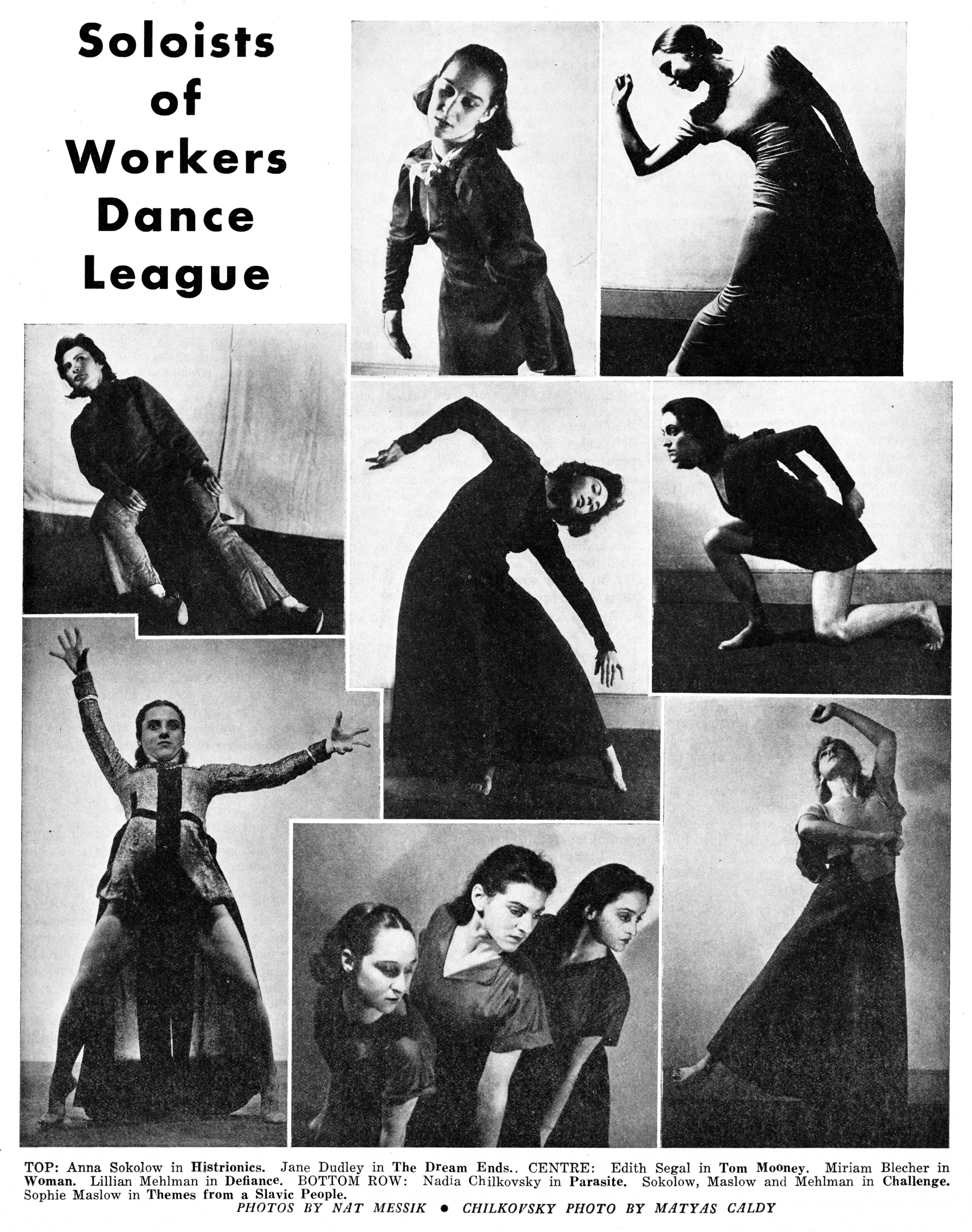
Yes, it is right to analyze and to understand; and the fact that the modern dancers continue to pursue this creative process leads one to analyze still further. What may have been an integral part of their fight to establish a new kind of physical movement, strong, and unafraid, of angularity and percussiveness, has become a philosophy of movement in its own right. The bourgeois love of the “pure” comes more and more to the fore, a definite hangover of art for art’s sake. You hear modern dancers say it. They write it, and they dance it. They have a horror of so-called “programmatic” dancing: uncompromising specification of thematic material; and they therefore have a horror of making movement images functional, realistic, and really directly interpretive of the thematic material. Yet they are aware of the necessity, artistically, and, in some cases, opportunistically, of dealing with the contemporary scene. The titles of the dances therefore have undergone a change. There is an increasing number of anti-war and anti-fascist dances. But the creative process of movement has not changed. An American Lyric, for instance, Martha Graham’s newest group composition, boasts a fine base for a dance script. “This dance has as its theme the basic American right–freedom of assembly”–so reads the program note. But again the movement symbols employed in the dance are not symbols expressive of the theme. They are the movements from the composer’s predetermined category of pure “kinesthetic,” detached and abstract and purely physical. The audience seems to remain emotionally unmoved and intellectually unsatisfied. And the same applies, I believe, equally well to the majority of the compositions of the “younger” modern dancers, who, it seems, have not yet divorced themselves from the creative thinking of their parent schools.
To the masses of common people, reality is mainly a composite of detailed specifications. And every telling work of art dealing with ideas (as our modern dancers wish to do), has been specific in its main content and, of course, in its use of detailed images. The implication has been general, in the sense of universal, but the particular work of art has dealt with one little kernel taken from the general mass. I could give any number of classic examples, but I prefer to speak in contemporary terms.
In the theater today, one of the best examples is to be found in the imagery employed by Marc Blitzstein in The Cradle Will Rock. He does not write a song about the vague demoralization of the poor. He writes a song called “The Nickel Under Your Foot.” And when you hear, “Maybe you wonder what it is, makes people good or bad…I’ll tell you what I feel, it’s just the nickel under the heel,” etc., the response is immediate. Specifically, you know what a nickel is, you know what a nickel can buy, and through this knowledge, you gather from the song that universally, for lack of “nickels,” the poor may become demoralized.
The modern dance has failed to register its implications, either universal or specific, with its audiences, because its content has been so blatantly general and its movement symbols so divorced from reality, having been molded around the particular psyche of the composer, rather than of the theme. “How can you compare the abstract medium of the dance, movement, to that of a song and words?” (Do I hear my colleagues chanting?) My answer is that Blitzstein might have written a general song: “The Demoralization of the Poor,” but he didn’t. He wrote a particular song: “The Nickel Under Your Foot.” Even our modern composers of supposed abstract music realize that the era of the “pure” is past. Their musical forms turn more and more to reality for their inspiration and more and more to collaborative functions with the other arts to enable them to find a more realistic sphere in which to work.
It is significant that in Hanya Holm’s Trend, a dance composition of an evening’s length, whose content deals with cataclysmic abstract forces of destiny, the most interesting sections, judging from audience reaction, were those few detailed parts of more or less specific characterization like “The Effete” and “From Heaven Limited”–so much more comprehensible, more real, more tangible to people than the major portions of the work like “The Gates Are Desolate.” What Gates? Who are Desolate? Why? Why does Martha Graham’s dance “Frontier” seem to get a warmer response than almost any other of her solo dances? Perhaps because when the curtain opens one sees what appears to be an impression of a pioneer woman, dressed accordingly–not a vague generality of womanhood. And furthermore, she’s sitting–in dance terms of course, and justly so–on an artistic representation of a fence. And she has her hand above her eyes, as if she’s looking across wide horizons. Communication in the dance rests, as in any other art, upon recognition, subconscious or otherwise, of the symbols used. This applies to the dance, as well as to music or writing. Upon this recognition depends the first spark of contact between artist and audience. And upon this spark depends the whole plane of receptivity of the audience.
This does not mean that the modern dancer must sacrifice the new range of body movement, her fruits of years of work, for communicable images. Nor does it mean that she must separate, as does the art of ballet, the content from the kinesthetic proper. (The art of ballet is built on a juxtaposition of pantomime and dance movement, depending on the virtuosity of the latter for its kinesthetic excitement, and on the pantomime for the clarity of its ideas.) But if she wishes to deal with ideas, she cannot simply turn her back on this element of recognizability. She must find and build a new technique, not of abstract movement, but of a means of communicating her ideas through movement. And especially if she wishes to appeal to the emotions by means of her idea–and the emotional is the usual channel of contact for the artist–she must then be so clear in her movement symbols that the audience will not waste one second of the time of the few short-lived minutes she is on the stage, to figure out her intention.
The words of Morris Carnovsky of the Group Theatre apply as well to the dancer as to the actor: “The greater the degree of frankness and simplicity of image…the greater instrument of the theater he becomes,” This does not imply, necessarily, that the dancer must be photographically realistic in her movement images. Again Carnovsky’s words are aptly applied to the problem of the modern dance composer: “The main principle of Stanislavsky was that of ‘spiritualized realism’ the truth, the truth, nothing but the truth. Now Vahktangoff admitted the possibility of falsehood–but only when justified from within. The Vahktangoff theater utilized fantasy and the grotesque in its development away from the earlier realism as a possible means of intensifying the emotional reality.” But “The problem is then to justify from the inner feeling this strange and apparently ‘unrealistic’ gesture emotionally. The great thing is to grasp the inner emotional reality, the poetic emotion…”; but, may I emphasize, the poetic emotion of the theme. Besides, it seems to me, the modern dancer has enough to do today with simply following the Stanislavsky line, with just finding “the truth, the truth, nothing but the truth”; with finding those “images…linked with other images in the consciousness of” their audiences, as Feuchtwanger has written of the writers’ problem. [NEW MASSES, June 21.] Really, if you are in search of reality, and of direct communication, the problem is the same whether you are writer, song-writer, painter, or dancer.
Such a search would undoubtedly mean at sacrifice of the “tried and true” choreographic methods, along with the change in artistic viewpoint. It might even mean a tendency toward literal pantomime–but only temporarily so. If the modern dance has any role to play historically in the art of the dance, it would seem to be the integration of a fresh, dynamic vocabulary, with a dance imagery derived from the particular subject matter of each new dance. The conservative critic is quick to write that since the modern dancer has failed to make her ideas clear in her dances, she should abandon the job, and return to the fold–just dance: move around, leap high, look beautiful. We who know the limitations of that art do not accept the advice.
There is no question that the modern dance has in its power the means to stimulate the interest and participation of wide audiences; after all, it is the form of dance that has arisen out of a real need of change and of rebellion. But as long as its achievements remain of the craft alone, it will remain for the craft alone: for an audience, a small one at best, and that chiefly drawn from the girls’ colleges where the modern dance is now taught. That world does not represent the masses of the people, though our modern dancers seem so involved in their immediate artistic and economic problems that they really seem to lose their sense of proportion in this respect. Nor is the situation helped by the fact that the cosmopolitan critics of the dance, left and right, are equally involved in this small petty “inside” world of the dancer, and of the dance, and not enough in the world of the masses.
“I believe that a work which has any claims to being a work of art must get the recognition of both the connoisseurs and the masses.
What satisfies the masses but does not satisfy the expert is created from materials which are too shoddy, and is, therefore, without the element of permanence. A work of art which moves only the experts but not the masses does so exclusively because of its form and not its content, and is therefore also ephemeral. Only that work of art can have any claim to permanence which moves both the masses and the connoisseur.” Feuchtwanger’s words should mean much to the dancer, especially when she realizes that the “claim to permanence” of a dance must be established in the fleeting moments of a single performance, sometimes of three or four minutes.
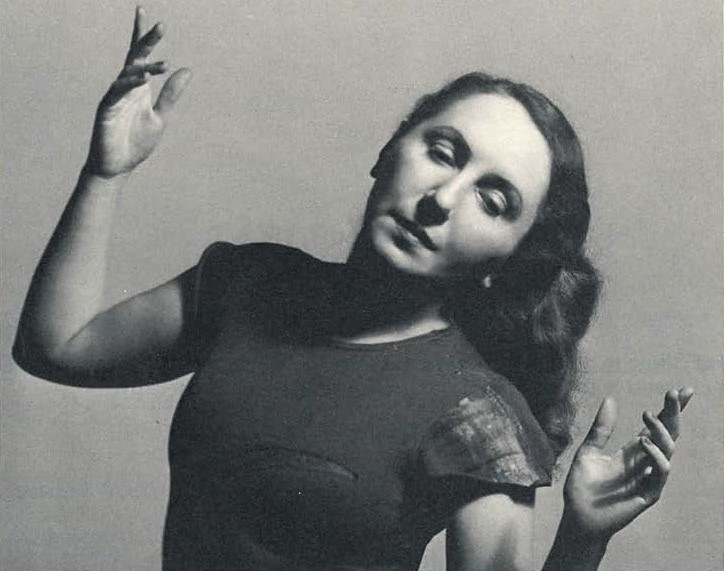
We, of the craft, recognize the greatness of the new impetus to body movement the leaders of the modern dance have evolved. But the world is not interested directly in the craft of the arts. Nor does Toscanini expect the layman to sit at his concerts with a score in its collective lap. Their contribution for people will become tangible only when it becomes a channel for a communicable form, for clear ideas clothed in clear emotions. To achieve this, a departure seems necessary from rigid technical vocabularies and psychic imagery, with a new regard and a replaced emphasis on the thematic connotation of movement. How to transmute reality into dance movement (not into pantomime), becomes a new field of creative activity for the modern dancer. The “inherent dualism” between “abstract movement and pure expression” which, writes Lincoln Kirstein, “can never seem to be resolved even by judicious combination,” may yet be resolved.
It seems to me, the answer lies in more particularized themes (which is why my own dances have changed in the past few seasons from abstractions like Resentment and Awareness to specifications like An Office Girl Dreams and Slum Child). With such a particularization there would occur an automatic departure from the monotonous costuming of the modern dancer–the consistent variety of modern-dance-negligee, ankle length, limited in variation almost to odd color combinations and with this, the invariable hair comb of the modern dancer, her consistent neglect of the use of head-dress, and, in general, her lack of completion in costume.
The sum total perhaps would be described as a pilgrimage “back to the theater.” But not for its own sake. Rather would it be a jubilant march: exeunt from the shrouded psyche of herself and of her craft into the light of her chosen theme.
PDF of full issue: https://www.marxists.org/history/usa/pubs/new-masses/1938/v28n05-jul-26-1938-NM.pdf

