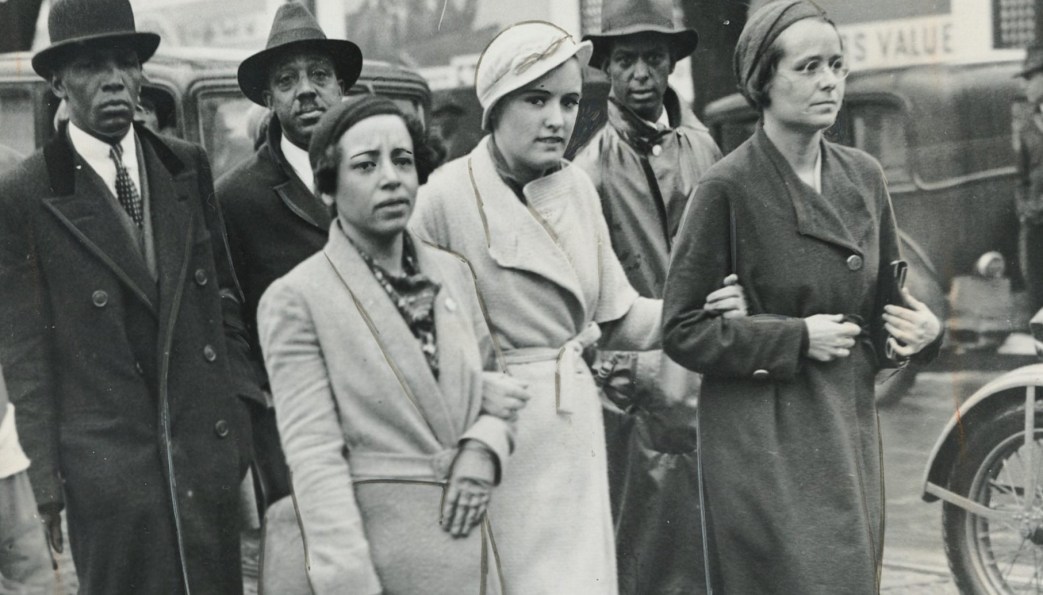
Louise Thompson on an iconic moment of the most important civil rights campaign of the 1930s. Here reporting as Secretary of the National Scottsboro Action Committee on the National March on Washington D.C. in support of the Scottsboro defendants on May 8, 1933. A mass Black and Communist led interracial convergence on the capital of Jim Crow U.S.A.
‘And So We Marched’ by Louise Thompson from Working Women. Vol. 4 No. 4. June, 1933.
On May 8th, Washington, D.C., witnessed an historic event. Five thousand Negro and white men, women and children marched behind Mrs. Janie Patterson and Ruby Bates through the streets to demand of the President–Franklin D. Roosevelt–the immediate release of the Scottsboro boys and complete equality for Negroes.
May 8, 1933, will be a landmark in the growing solidarity of the Negro and white masses. Janie Patterson and Ruby Bates, the vanguard of the marchers, are the living symbol of that increasing unity. The mother of the innocent Haywood Patterson, who has been condemned to die, arm in arm with one of the girls involved in his first conviction, Ruby Bates. She is a southern white worker who has come to realize the vicious character of the frame-up of the boys and is willing to risk even her life by going into Alabama in order to help free them.
Marchers from New York and New Orleans, Detroit and New Jersey, Richmond, Buffalo and other points brought the fight for the Scottsboro boys to the very heart of the nation and the many women who followed them, Negro and white, grandmothers and mothers, children and students were learning their lesson well. Time and again on the trip, it had been the women who scoffed at hardship, demanding the right to share difficulties with the men.
These were brand new faces. For most it was their first march. They were testing their own strength for the first time–the strength of unified mass protest of workers in the realization of their own power. They poured into Washington by the thousands and gathered in the highway made famous by the Hunger March last December.
The call came to leave the busses and assemble along the road for the march. A mighty cheer went the length of the line. The march was to begin at last! The cold rain, the hostile police were forgotten. This was their day and nothing could stop them. Banners and signs were quickly raised. “The Scottsboro Boys Shall Not Die,” “We Demand Equal Rights For Negroes,” “Free Tom Mooney, Angelo Herndon and the Scottsboro. Boys.”
As the marchers circled the White House, their chosen delegates left the ranks to present the Bill of Civil Rights and 200,000 signed petitions demanding the release of the Scottsboro boys to the Chief Executive. Five thousand Negro and white workers representing thousands of other workers, waited anxiously to know what the President would say to a bill which would exact strict enforcement of the 13th, 14th, and 15th Amendments to the Constitution and their demand for release of the Scottsboro boys.
But the President refused to see their delegates. He was in conference with foreign diplomats and was deaf to the appeals of America’s own people. Realization of the insult given them brought a response of disgust from the marchers which must have been heard in the conference room from which they were excluded. They were indeed “forgotten men” and by the President who had coined the phrase.
Vice-President Garner, Speaker of the House Rainey and representative Oscar De Priest, the only Negro congressman, were waited upon by other march delegations. But their non-committal acceptance of the marchers’ demands and their unwillingness to take any stand on either the question of release of the Scottsboro boys or of full equality for the Negroes of their own country, brought to these true representatives of the people, the marchers, the realization that they themselves were the only ones interested in the solution of their own problems.
May 8th also marks a tremendous step forward toward liberation for the Negro people of the United States. It has made the white workers see more clearly that the struggle for equality for the Negro, is also his fight for freedom from exploitation. Both are realizing that apart, neither can be free.
The National Scottsboro Action Committee which sent out the call for the march, working in co-operation with the International Labor Defense, counts the march a tremendous achievement as a beginning of a broad united front campaign around these issues. The march is, however, only a beginning of the intensified fight for the freedom of the Scottsboro boys.
“The Scottsboro Boys Shall Not Die!”
“Long Live the Solidarity of Black and White Workers!”
The Working Woman, ‘A Paper for Working Women, Farm Women, and Working-Class Housewives,’ was first published monthly by the Communist Party USA Central Committee Women’s Department from 1929 to 1935, continuing until 1937. It was the first official English-language paper of a Socialist or Communist Party specifically for women (there had been many independent such papers). At first a newspaper and very much an exponent of ‘Third Period’ politics, it played particular attention to Black women, long invisible in the left press. In addition, the magazine covered home-life, women’s health and women’s history, trade union and unemployment struggles, Party activities, as well poems and short stories. The newspaper became a magazine in 1933, and in late 1935 it was folded into The Woman Today which sought to compete with bourgeois women’s magazines in the Popular Front era. The Woman today published until 1937. During its run editors included Isobel Walker Soule, Elinor Curtis, and Margaret Cowl among others.
PDF of full issue: https://www.marxists.org/history/usa/pubs/wt/v4n04-jun-1933-WW-R7524-R2-col-cov.pdf

