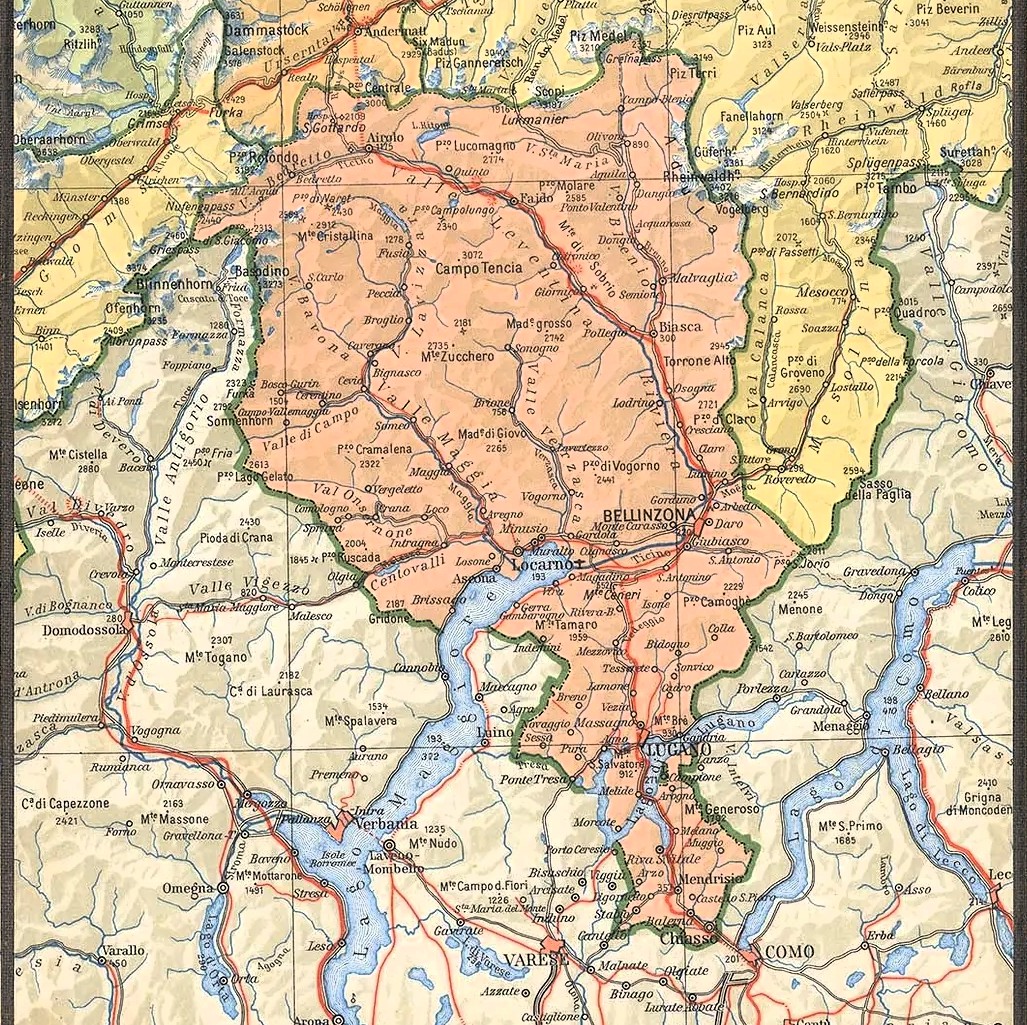
The Swiss ruling class has never been ‘neutral’ in its interests. How Italian fascism impacted the southern border Ticino canton, surrounded on three sides by the Italian state and home to many refugees from, and spies for, Mussolini’s Blackshirts.
‘Switzerland and Italian Fascism’ by M. Bodemann from International Press Correspondence. Vol. 9 No. 7. February 8, 1929.
The fight against Italian fascism is today of front-rank importance for the international proletariat. The Swiss working class is particularly interested in it. It feels the pressure of the fascist regime both in the economic and the political sphere. This applies particularly to the Southern portion of the country, the Canton of Ticino, where the Italian language is spoken. The fascists have repeatedly emphasised in their programmatic declarations and writings that Ticino really belongs to Italy and that they demand its incorporation in the “great” nation.
Fascism has succeeded for the time being in creating in Ticino a close network of organisations of Italian fascists. They have formed not only political but also the trade union organisations. The whole Canton is filled with Mussolini s spies. These follow step for step the activity of the Italian anti-fascist workers, who a e very numerous there.
Any worker who is active politically or in the trade unions is deprived of his permit to cross the frontier, and must therefore starve, along with his family, as he receives no further permission to leave the country. The pressure of the fascists in Ticino is such that wages there are partly so reduced that they amount to on y a third of those received by workers engaged in the same occupations in the towns in the rest of Switzerland. In Ticino, where the international capitalists go to recuperate, the workers have no bread with which to feed their families.
The working population in town and country endeavour to escape the pressure of fascism by emigration or by obtaining work in other parts of Switzerland.
But in the other parts of Switzerland the fascists, under the benevolent toleration of the authorities, carry on a very lively activity. In recent times the workers have repeatedly had to prevent public demonstrations by the fascists. Espionage work and the withdrawal of passports by the fascist Consulates is taking place everywhere. The workers in the building industry in particular feel the effect of the activity of the fascists. Any Italian worker who wishes to go abroad as a season worker must first sign the Italian labour agreement, which provides for longer working hours and lower wages. The employers in Switzerland are very grateful to the fascists for this and prefer Italian workers. It is almost impossible to draw these workers. into the trade union movement, as they have their families in Italy and have to reckon not only with the deprival of their passports but also with brutal measures on the part of fascists on their return to Italy.
The Communist Party, the Workers’ Defence Corps, the Anti-Fascist Alliance and the Red Aid have decided to carry out on Easter in Ticino a great demonstration, a Red Day The Red Day is to be not only a fierce challenge to fascism, but the class-conscious workers of the rest of Switzerland will thereby show to the workers in Ticino that they are prepared to help them to shake off the fascist yoke. Ticino was also chosen as the rallying centre in order to express on the frontiers of the Italy of Mussolini brotherly solidarity with the suppressed Italian proletariat The class-conscious workers of Switzerland the entire working population of Ticino have eagerly welcomed this decision.
The bourgeois and social democratic press at first simply reported the decision to hold the Red Day without making an comment. In the Italian press there set in a great campaign against the Red Day The fascists are demanding that it be prohibited. It is urged that Switzerland, as the seat of the League of Nations, cannot permit that a demonstration again t a friendly nation be held on its frontiers. And finally, they threaten that if the Swiss authorities do not forbid the demonstration, that they, the fascists, will themselves maintain order in the Ticino.
In face of these threats the whole bourgeois groveling and demanding the prohibition of the Red Rally, the social democratic newspapers have otherwise shown themselves to be willing helpers of reaction and of fascism Of course, they claim to be against its prohibition bet they seek to make the demonstration ridiculous and describe it as a means of aiding the fascists, etc.
The government has now announced through the press hat it will prohibit the demonstration. It has further announced that it will proceed not only against every demonstration in Ticino itself but will prevent the departure of demonstrators from the railway stations in the interior of Switzerland: Basle, Zurich and Schaffhausen. The Federal railways have received instructions to refuse to grant extra trains and other facilities.
This intended prohibition shows very clearly that the Swiss bourgeoisie and its government do not venture to conduct an independent policy with regard to Mussolini. As already in at whole number of cases, also in this case the Swiss Federal Council has shown itself to be a lackey of the murderers of Maleotti and Sozzi. The intended prohibition stands in sharp contradiction to the provisions of the Constitution. But this does not trouble the government of the oldest democracy in the least.
The class conscious workers are making ready for the Red Rally in Ticino in spite of the intended prohibition. At numerous protest meetings they are expressing their determination to conduct the fight against fascism with all means and stigmatising the miserable role of the Swiss government, which is acting as the agent of the murderous regime of Mussolini.
International Press Correspondence, widely known as”Inprecorr” was published by the Executive Committee of the Communist International (ECCI) regularly in German and English, occasionally in many other languages, beginning in 1921 and lasting in English until 1938. Inprecorr’s role was to supply translated articles to the English-speaking press of the International from the Comintern’s different sections, as well as news and statements from the ECCI. Many ‘Daily Worker’ and ‘Communist’ articles originated in Inprecorr, and it also published articles by American comrades for use in other countries. It was published at least weekly, and often thrice weekly. Inprecorr is an invaluable English-language source on the history of the Communist International and its sections.
PDF of full issue: https://www.marxists.org/history/international/comintern/inprecor/1929/v09n07-feb-08-1929-inprecor.pdf

