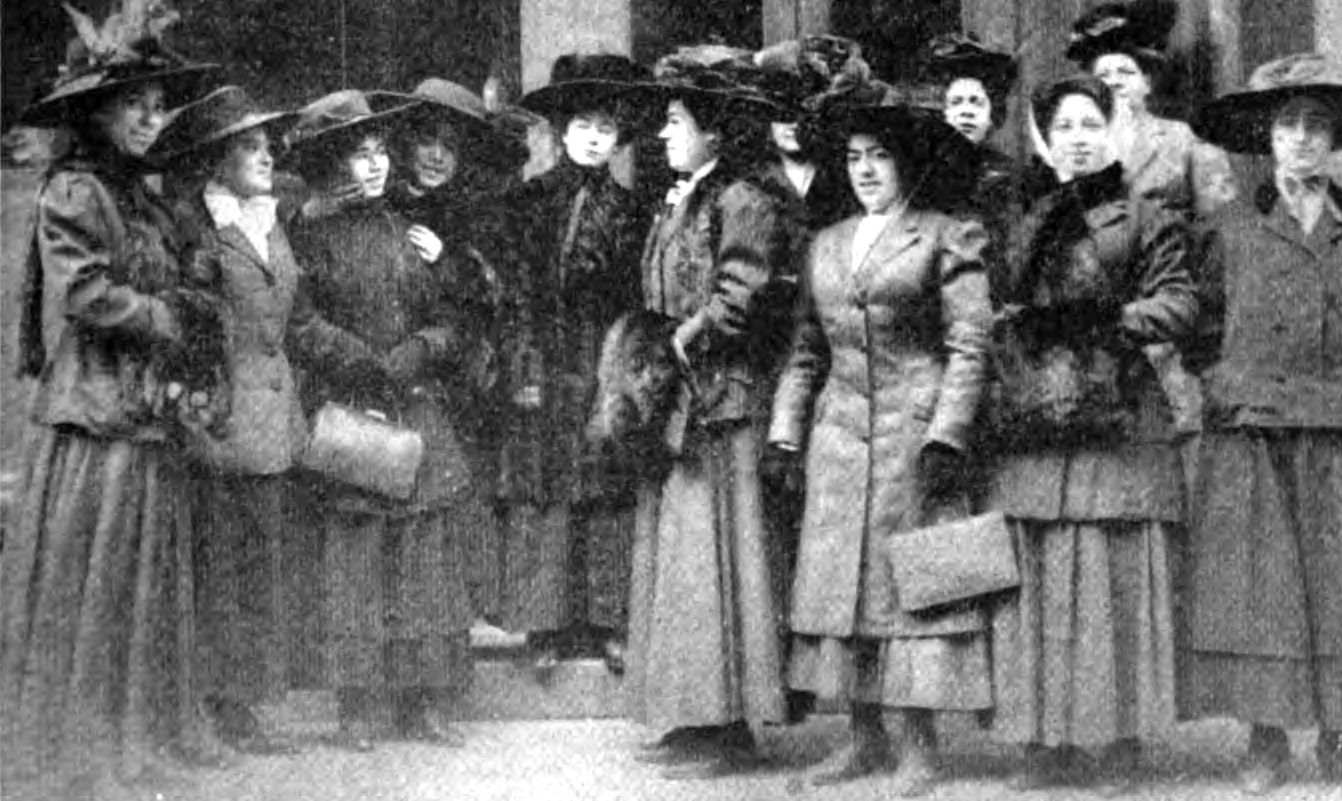
Inspired by the rising of garment workers in Chicago and New York City, seven thousand Philadelphia waistmakers, largely women and largely Jewish immigrants, walked of the job for the union as the wave of workers’ action in the industry continued. Here, the powerful streetcar union of Philadelphia and he city’s suffrage movement pledge to help.
‘Wholesale Arrests of Waist Strikers in Philadelphia’ from The New York Call. Vol. 3 No. 11. January 11, 1910.
Special Officers Create Riot as Excuse for Police
GREAT MEETING SUNDAY
President of C.L.U. Accuses Big Boss of Using Orphan Asylum as Scab Supply Station.
PHILADELPHIA. Jan. 10. Many arrests followed a small riot which took place today in front of the big shirtwaist factory of M. Haber & Co., 220 South 5th street, following an attack by the factory special officers on the striking girls who were picketing the vicinity. Police Lieutenant Hearn, of the Third District, participated in the mix-up.
Among those arrested were Fannie Weintraub, Della Fried, and Annie Tollop at 13th and Arch streets; M. Cabbler, Rose Grats, Pauline Volnin, Dora Krichefusky, and Mary Goldberg at 6th and Arch streets, and Leda Shore, at 9th and Walnut.
Others arrested during the day were Kate Silverman of 1519 South 4th street, and Kate Toup of 1238 South 6th street who were arrested near Rand Bros. and fined $5 by Magistrate Scott, and Freda Kaplin, who was arrested near the factory of Kaufman & Harris, and was held in $500 for further hearing, on the charge of assault.
Support Enthusiastic.
The whole working class of Philadelphia is taking up the struggle of the wallet makers, and they have every reason to be exceedingly sanguine of success. Money is pouring into their treasury as fast as it is being paid out in benefits. Checks and purses ranging in amount from $100 to $500 are being received hourly by Mrs. Robins at the College Settlement. Abe Rosenberg, the strike leader, received $261 from the Silk Shirtwaist Makers on Saturday night. The Cloak Makers sent $75. One hundred dollars was received from the Woman’s Club in Harrisburg where Morris Haber has another factory, and is doing much of his work. The University of Pennsylvania students sent $150 to Mrs. Robins, and Mrs. Rose Pastor Stokes subscribed $100 to the fund for the relief of her Philadelphia sisters.
The greatest surprise, however, was the receipt of a check of $500 from “a prominent Pittsburg financier.” Who the donor of this amount was could not be learned, as the sender made it incumbent upon the recipients not to divulge his identity.
Assembled in Labor Lyceum Hall, where they received word to desert their machines with the union just three weeks ago, the striking shirtwaist operators held an enthusiastic meeting last night, listened to addresses of encouragement from many labor leaders, and received pledges of support from representatives of many movements. The stage was filled with all the more important members of the Central Labor Union, and beside the speeches of the latter, one of the principal talks of the evening was by Mrs. Alberta M. Goudiss, who brought the good wishes and offering of moral and financial support of the Pennsylvania State Suffrage Association.
Murphy Challenges Haber.
Abraham Rosenberg, president of the strikers’ union and director of the present struggle for more wages and better working conditions, presided.
John J. Murphy, president of the Central Labor Union, created a sensation at the meeting by reiterating the charges that Morris Haber, of 220 South 5th street, was filling his shop with children from the Hebrew Orphans’ Home, an institution of which Haber is president. Murphy said:
“I understand that Haber denied that he was filling his shop with these orphans. I dare Haber to come to me and say that I tell an untruth. I challenge Haber to have a conference with me with the newspaper men present. I do not hope that he will accept, because he knows that I am telling the truth, and he knows that he is guilty of other things that I would then make public. I repeat my charges and defy Haber to meet me with a denial.”
Murphy declared that the police who were stationed around the shirtwaist factories were receiving many shirtwaists from the manufacturers. He termed this “just another form of their apple-cart and peanut larcenies.” He warned the girls against settling unless they received all that they asked for, and pointed to the streetcar men, who, he said, had given in too soon. Moreover, Murphy hinted very broadly at another strike by the carmen’s union. Peter Driscoll, president of the carmen’s union, another speaker at the meeting, likewise declared that “unless the Rapid Transit Company became fairer in their treatment of their employes, there would be another strike.”
Haines D. Albright, who has offered his legal services to the strikers: Edward Keenan, of the Machinists’ Union; Hugh Frayne, of the American Federation of Labor; Dr. A. Jaffe, who has bailed out arrested strikers for two weeks past: Morris Levinson, of the strikers’ executive committee, and I. Darnblum, also spoke.
Suffragists Very Active.
Mrs. Goudiss officially represented the Pennsylvania State Suffrage Association, and congratulated the strikers on their apparent success. In part she said:
“As advocates of the necessity of votes for women as a means of protection in industrial life the woman suffragist feels that it is only fitting that she should support the woman worker in her present battle for better conditions of work and a living wage. What we can do now is done for the cause of womanhood and its consequence will be felt by our children and our children’s children.”
On Wednesday evening the Pennsylvania State Suffrage Association will hold a mass meeting for the benefit of the strikers. Mrs. O.H.P. Belmont, of New York, will be present and Miss Milholland and Francis Squire Potter, corresponding secretary of the National American Woman Suffrage Association, will be among the speakers. This meeting has been called to arouse public sentiment as to the condition of women workers and to raise funds for the present strike. If it is found necessary the suffragists will open temporary headquarters in order to aid more effectively in the struggle.
“I am glad that I was able to accept your invitation to be present tonight and I am also glad to be able to bring to you greetings and good wishes from the Pennsylvania State Suffrage Association. Mrs. Rachel Foster Avery, the state president, would have been with us except for important business that called her to Washington until Tuesday next. Upon her return she will do all she can to aid your cause.
“Aroused by the numerous arrests of the past week, the association which I represent thought it time to offer its assistance, and Mrs. Avery authorized me to obtain legal advice and ask for bail from some of our friends. With the assistance of Miss Mary Winsor, of Haverford, I was able to secure the services of the eminent lawyer. Thomas R. White, who is now acting in co-operation with other attorneys who generously offered their assistance.”
Ida Mayerson, one of the brightest girls in the ranks of the strikers, has been delegated to speak before the Central Federation of Labor in Washington tomorrow and on Wednesday. Miss Mayerson is a most remarkable young woman and can talk clearly and forcibly. She was selected to make this most important trip and intrusted with this responsible mission on account of her enthusiasm and charming personality.
At least half a dozen young women prominently identified with “society,” and some of them equally active in woman suffrage circles, will enlist as pickets in the waistmakers’ strike today.
Rich Young Women Aid.
Misses May W. Sherrick and Anne Young will be assigned places in various parts of the city, and Miss Constance Biddle will return to this city and resume her arguments with non-union waist makers at the Haber factory. Mrs. Robins declined to make known the names of the other young women who will thus aid the strikers, saying that Miss Biddle was the chief of the squad, and she alone knew the names of her co-workers.
Miss Mary McMurtrie, of 1104. Spruce street, who is a member of one of this city’s oldest families, and prominent in society, has promised to go ball for the strikers when illegally arrested. She said yesterday:
“I have always been opposed to unjust condemnation, and have promised to go ball for any who are illegally arrested in this strike.”
Miss Mary Winsor, of Haverford, corresponding secretary of the Women’s Suffrage Association, is another member of society to become interested in the strikers, through her connection with the suffrage movement.
The New York Call was the first English-language Socialist daily paper in New York City and the second in the US after the Chicago Daily Socialist. The paper was the center of the Socialist Party and under the influence of Morris Hillquit, Charles Ervin, Julius Gerber, and William Butscher. The paper was opposed to World War One, and, unsurprising given the era’s fluidity, ambivalent on the Russian Revolution even after the expulsion of the SP’s Left Wing. The paper is an invaluable resource for information on the city’s workers movement and history and one of the most important papers in the history of US socialism. The paper ran from 1908 until 1923.
PDF of full issue: https://www.marxists.org/history/usa/pubs/the-new-york-call/1910/100111-newyorkcall-v03n011.pdf

