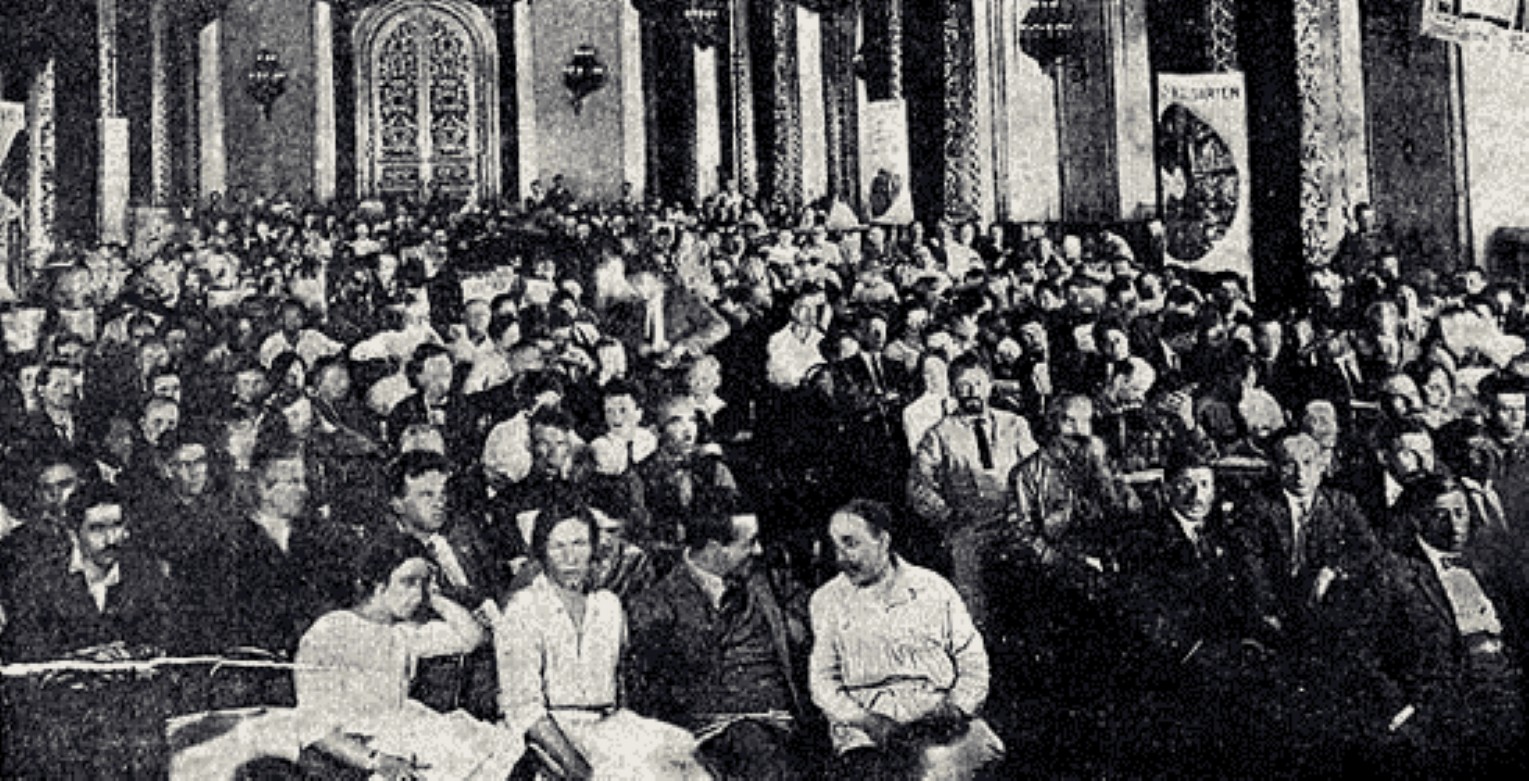
Another of the major documents from the Comintern’s Fifth Congress held in Moscow over the Summer of 1924 from a proposal put forward by the Secretary of the Profinten, Solomon Lozovsky, and debated by the delegates.
‘Theses on Tactics in the Trade Union Movement’ from Communist International. Vol. 2 No. 7. December, 1924.
(From a Theses by A. LOZOVSKY)
I. The Turning Point in the Labour Movement.
The characteristic features of 1924 are:
(a) The general and comprehensive retreat of the workers has ceased;
(b) A workers’ offensive is taking place in some countries and industries, while in other countries the workers are resisting all attempts to force down conditions of labour.
(c) International reformism has consolidated more than ever its connection with the ruling classes and is bringing political as well as economic blacklegging into play, and is thereby doing its best to sabotage independent labour action.
(d) The Amsterdam International stands revealed as an Entente and imperialist organisation (supporting Ruhr occupation, Experts’ Report, etc.); within it there is a minority, which has not yet assumed a definite form, but shows great dissatisfaction with the old policy.
(c) The discontent of the workers and of the lower middle class in some countries (Great Britain, France, Denmark) has led to the substitution of the old reactionary governments by semi-Socialistic, pacifist governments, which are pledged to carry out the old bourgeois policy under a new banner.
(f) The moral, political, organisational and financial decline of the reformist trade unions, which has robbed them of their influence over the masses, was accompanied by the growth and development of revolutionary unions and minorities which began to play an increasingly important role, not only in the political, but also in the economic actions of the proletariat.
(g) The importance of the Comintern and of the Communist Parties in the world trade union movement has increased considerably.
All this has made the Profintern, which at first was merely an international propaganda committee, a real world organisation of revolutionary unions.
(h) This being so, the reformists are making a terrific onslaught on the revolutionary trade unions (expulsion of Communists, organisation of anti-Bolshevik sections, intensification of libelous campaigns, etc.), while the Amsterdam International does its share in the matter of taming the revolutionary trade unions.
(i) As the higher organs of the reformist trade unions develop into a weapon of fascist reaction, in some countries (Germany) a tendency arose to demand a change of tactics on the part of the Comintern i.e., to leave the old trade unions and to form new organisations.
These fundamental points must be borne in mind, if we wish to adopt a definite policy in the trade union movement which is to guide us in the future.
II. The Fight for Unity.
The fight for unity in the world trade union movement has occupied a very prominent place in all the activities of the Comintern. This is the case, not because the Comintern makes a fetish of organisation, but because it is convinced that by fighting for unity within the trade unions, Communists are extending the sphere of influence of the Communist Parties and of the Communist International, while keeping all the time in contact with the masses. The fight for the unity of the trade union movement is the best means and method of capturing the masses.
That is why the Comintern and the Communist Parties adhering to it must not allow anything to interfere with the lines they have adopted on this question. The old slogans of the Comintern—Capture and not Destruction of Trade Unions, Opposition to Desertion of Trade Unions, Efforts to bring back into the Unions those who left them, Fight for Unity—are still in force and must be put into practice with the utmost determination and energy.
This does not only apply to countries where the overwhelming majority of revolutionary workers belong to reformist trade unions, but also to countries with parallel reformist and revolutionary trade union centres (France, Czecho-Slovakia). Communist Parties must on no account allow reformists to get the monopoly of the fight for unity, for they demoralise and disorganise the workers’ movement while paying lip service to unity. In the fight for unity it is also the duty of Communists not to allow expelled and unorganised workers to become scattered, it is essential to keep them together and to organise them for the future fight against capitalism and reformism. But even in that case, the task of re-establishing unity devolves mainly on expelled trade unionists and parallel organisations.
Ill. The Amsterdam International and its Left Wing.
Our attitude to the Amsterdam International as defined by former congresses, remains in force. The Amsterdam International, as represented by its supreme organ, is a bulwark of international imperialism, an organisation which reflects very vividly the conservatism, backwardness, national narrow-mindedness and bourgeois-imperialist frame of mind of sections of the working class more exposed than others to the corrupting influence of the bourgeoisie. Opposition to the Amsterdam International and its theories and practices is now as before, one of the main tasks of the Comintern and its sections. Ruthless exposure of the lackeys of capitalism, war to the knife against this bulwark of bourgeois-capitalist and fascist reaction—such is the slogan of the near future.
There are two things which we must never leave sight of in our fight against the Amsterdam International: (a) that millions of proletarians belong to the Amsterdam trade unions; (b) the appearance of a left-wing in the Amsterdam organisation which has no definite form and is politically unstable.
The fact that there are millions of workers in the ranks of the Amsterdam International, should act as an incentive to Communist Parties to intensify tenfold their efforts in the fight for the emancipation of these workers from reformist illusions. In a matter of this kind, it is not enough to carry on agitation and propaganda. The progress of the emancipation of the workers from the reformist illusions will depend on the measure of Communist influence on the economic fights of the working class. Economic conflicts provide splendid opportunities for the application of united front tactics, for in such conflicts it should not be difficult for Communists to expose the fascist strike-breaking role of the reformist leaders.
The left wing of the Amsterdam International has no clear programme and tactics. Furthermore, composed as it is of several tendencies, it does not even attempt to work out any sort of platform. Their attitude towards the question of their relations to the Russian Trade Unions is in a state of germination. Meanwhile, the left-wing does not differ considerably from the right-wing on fundamental political questions (reparations, conclusions of commission of experts, colonial policy, coalition with the bourgeoisie, etc.).
The fundamental and root deficiency of the left-wing is that its leaders wish to “reconcile” reformism and Communism and hope to find a middle course between these deadly enemies. Its inconsistency, political vagueness, and half-heartedness were amply demonstrated at the Vienna Conference of the Amsterdam International. The left-wing at that time reflected a serious movement among the masses, especially in Britain, a movement of dissatisfaction against the old policy and desire to find a way out of the blind alley of reformism. It would be a great mistake if we adopted an uncritical attitude towards the activities of the left-wing and if we remained silent to its inconsistencies, political vagueness and half-heartedness.
Communists and trade union organisations under their control must propose to the Amsterdam International to form joint organs of action against bourgeois capitalist reaction. Those proposals must be made whenever there is an opportunity for joint action and demonstrations against the programme and tactics of the Amsterdam International. Communists must insist that the left elements within the Amsterdam International who advocate the desirability of an agreement with the revolutionary unions, should show in practice that they mean business when they talk like this. Our support of this left-wing will be commensurate with its readiness to make common cause with us in our actions and demonstrations. Communists must not forget that the left-wing of the Amsterdam International desires to save this International not by repudiating the old tactics, but by introducing minor alterations into these tactics. The task of the Communist Party consists in bringing pressure to bear on separate sections of the Amsterdam International through the trade unions which are under their influence.
IV. The Fight for Unity in the International Trade Union Movement.
The work which the Profintern carried on for four years has resulted in the consolidation and unification of all revolutionary elements of the world trade union movement into one world organisation. The monopoly of the Amsterdam International is a thing of the past. The task of the Comintern and of the Communist Parties is to fight energetically for a still greater unification of the revolutionary trade unions, to rally them to the banner of the Profintern and increase Communist influence and Communist leadership in the Red Unions in all countries. This can only be achieved, if on this field too, the fight for the unity of the trade union movement be carried on systematically. The ideological political crisis which is reaching a climax in the Amsterdam International, the rise of a left-wing, which aims at the establishment of a united front with the left revolutionary unions, and the growth of revolutionary ideas in the British trade union movement, give the Communist International and the Communist Parties of all countries an opportunity to carry on a successful and decisive fight for the re-establishment of unity in the international trade union movement.
This unity could be re-established through the convocation of an international unity congress in which all trade unions adhering to the Amsterdam International and to the Profintern would take part on a basis of proportional representation. Such a congress would be a gigantic step forward in the direction of gathering all our forces for the fight against the bourgeoisie. The creation of a united International on the basis of freedom of agitation and strict discipline in all actions against the bourgeoisie should lead to the dissolution of the existing parallel Internationals (the Profintern, the Amsterdam International). Until we have succeeded in our efforts to re-establish the unity of the international trade union movement, the Communist International and the Communist Parties must continue to support and help the Profintern and all organisations adhering to it.
V. The Weak Points of our Work.
Although great and important work was done by all Communist Parties on the trade union field, we must admit that during the last two years there have been features in our work, against which we must put up an energetic fight. The weak points of our work in the trade union movement are as follows:
1. The absence in many countries of Communist fractions and the construction of these fractions (wherever they exist) from above.
2. The failure to form fractions in organisations under Communist leadership, or under the leadership of organisations akin to us.
3. The failure to form fractions in reformist unions, where parallel revolutionary organisations exist (France).
4. A lack of discipline among Party members, who allow themselves to be guided by their own impressionist views, hence desertion of trade union and elaboration of their own trade union policy regardless of the decisions of the Party and of the Comintern (Germany).
5. The supercilious attitude of the Parties towards revolutionary trade unions formed parallel to reformist unions (America, Belgium, Holland) instead of systematic leadership of these revolutionary workers and their training in the spirit of our fractions.
6. Abstract propaganda inside trade unions instead of intensifying oppositional fight against reformists on the basis of the everyday demands of the working class.
7. Lack of attention, with a few exceptions (Germany) to the formation and work of factory and workshop committees, and inability to take advantage of economic actions of large masses to form factory and workshop committees.
8. Half-hearted opposition to craft tendencies and prejudices, which are still firmly embedded in the minds of even revolutionary workers.
9. There is much to find fault with in the general political and party preparation for trade union and factory councils, congresses and conferences at which Communists put in only an occasional appearance.
10. Unnecessary nervousness with regard to the attempts of the reformists to cause splits, failure to make a proper political use of individual and especially of mass expulsions from trade unions.
11. Failure fully to recognise that factories, factory and workshop committees and trade unions are the natural field for the organisation of workers’ united front.
12. Failure to fully appreciate the significance and the role of trade union work, and hence lack of attention to this work on the part of the Party press. The central organs of local parties do not devote enough space to trade union questions. The absence of trade union agitation and propaganda literature.
All the above-mentioned weak points can be observed almost in all countries in varying degrees. And it must be said that the weakest point and the main cause of our deficient work within the trade unions—is the absence of, or the embryonic state, of party nuclei in factories and other enterprises. The formation of Party nuclei in factories and other enterprises is the pre-condition for the creation of fractions from below, the intensification of Party activities within the trade union movement and for the adoption of a common line of action in all the stages of trade union organisation.
VI. Our Immediate Tasks.
1. The main tasks of all Communist Parties is the formation of fighting fractions in factories on industrial and general trade union lines and the intensification of Communist control over the activities and work of individual members, and especially over trade union fractions.
2. The centre of gravity of our work must be in the midst of the masses in the place of their employment; hence, necessity to form factory and workshop committees, wherever they do not exist, and to revolutionise and intensify the work of the already existing factory and workshop committees. We must do our utmost to make factory and workshop committees take an active and energetic part in all economic actions, acting wherever it is necessary, against reformist trade unions when these make common cause with the employers.
3. It is absolutely necessary to every Party to raise and solve the question of fighting organs for the control and leadership of economic actions. This is of special importance, where revolutionary workers are in reformist unions anil where the issue of economic actions depends on the secret negotiations and compromises of the trade union bureaucracy.
4. It is necessary to amalgamate in every country all the independent revolutionary unions, as well as the unions of the expelled trade unionists. Having amalgamated them, we must connect them through the Committees of Action with the opposition inside reformist organisations.
5. We must fight more energetically against the treachery of the trade union leaders, making their treacherous actions a subject of discussion in all enterprises and factories. We must popularise among the masses the slogan “Out with the treacherous bureaucrats from the ranks of the proletariat.”
6. Wherever the trade union movement is split, it is essential to carry on systematic work among the masses for the re-establishment of trade union unity by means of the convocation of a general trade union unity congress on the basis of proportional representation and freedom of ideological action. The slogan of the re-establishment of the unity of the disunited trade union movement for the sake of unity of action of workers of all tendencies against capitalism, must be our main slogan for the near future.
7. Wherever the desertions of trade unions have become more acute as a result of the political and economic strike breaking methods of the trade union bureaucracy, the Parties must carry on an energetic fight against these defeatist and passive tendencies. Ruthless war must be declared against Communist desertions from trade unions. The fight in these countries must be carried on under the slogan: “Back to the trade unions.”
8. We must work energetically for the organisation of the as yet unorganised workers for the purpose of drawing them into our fight. It would be a mistake to create new organisations for the unorganised; the natural rallying point for all unorganised workers, including those who for some reason or other left their trade unions, are factory and workshop committees, Committees of Action in times of demonstrations, etc. The work connected with the unification of the unorganised, must aim at bringing them back into the trade unions and in converting workers who are dissatisfied with the trade union’s policy, into active fighters against the trade union bureaucracy.
9. It is essential to pay special attention to the organisation of workers engaged in branches of industry likely, to play a decisive role in the working class struggles for power (transport, the mining, metal and chemical industries, electricity, gas, etc.). The success of Communist work in the trade unions will be commensurate with Communist success in the matter of linking up and organising the above-mentioned important branches of industry.
It is essential to proceed with the formation of mixed committees (French-German, German-Polish, German-Czecho-Franco-Italian, French-German-British, Anglo-Russian, Russo-Polish, etc.). These mixed committees must organise joint parralled actions in the various countries. Such mixed committees can play a very important part in the revolutionary movement, if the Parties will pay the necessary attention to the organisation of these committees and to the selection of the members of these international and interstate organs of the revolutionary fight of the proletariat.
11. The Communist Parties of countries whose bourgeoisie exploits colonial and semi-colonial peoples, must pay special attention to the growing trade union movement in the colonies, first of all, for the purpose of emancipating these young trade union organisations from nationalist ideology, and secondly, for the purpose of freeing them from the domination of the imperialist policy of the trade union bureaucracy of the fatherland.
12. In countries where, under the banner of trade union independence and autonomy, a policy is carried on which is hostile to Communist parties and Communism, it is essential to intensify our work among the masses which must be made to realise the anti-proletarian character of this slogan, and make closer collaboration with trade union elements which identify themselves with the decisions of the Profintern congresses. Opposition to anarcho-syndicalist demagogy and confusion of ideas is the foremost task of the Communist Parties of these countries.
13. To be successful in our fight, we must know our enemies. Therefore, Communist parties in conjunction with trade unions, must take a careful study of employers’ organisations and of their internal organisations, as well as of the organs created by them and of the methods they use for the corruption and disintegration of working class organisations. The employers have many agents among the workers. Communist parties and revolutionary trade unions must organise their own secret agencies, in order to be well informed about the forces and the power of resistance of our class enemies.
14. All Communist parties must establish a close connection between the trade unions and members of these unions serving in the army. The anti-militarist work of the Communist parties would greatly benefit by the establishment of special organs and funds forming a link between the soldiers and the respective trade unions. Special efforts must be made to link up the seamen’s organisations with the sailors of the navy.
VII. Concluding Remarks.
The Fifth Congress of the Communist International, while endorsing all the decisions of former Comintern Congresses, on the tasks of Communists in the trade union movement, draws the attention of all Communist parties on the exceptional importance of work in the trade unions. There must be no hesitation on this question. They play an important part at the time of Social-Revolution, for they will be entrusted with the important task of social construction, when they will have become, after the victory of the proletariat, organs of proletarian dictatorship. It is, therefore, essential to continue to work on the lines laid down by our congresses. Capturing of trade unions is tantamount to capturing the masses. All Communist parties have made great strides forward in this direction. We must continue on this path in spite of the treachery of the trade union bureaucracy and in spite of temporary defeats and vacillations on this question. This is a vital question for the social-revolution. For this reason the Fifth Congress of the Communist International urges its sections to keep faithfully to the decisions which were made and to persist in their work within the trade unions, until the masses are on our side.
The Fifth Congress urges all Communists to stand up for the principles described above at the forthcoming Third Congress of the Profintern.
The ECCI published the magazine ‘Communist International’ edited by Zinoviev and Karl Radek from 1919 until 1926 irregularly in German, French, Russian, and English. Restarting in 1927 until 1934. Unlike, Inprecorr, CI contained long-form articles by the leading figures of the International as well as proceedings, statements, and notices of the Comintern. No complete run of Communist International is available in English. Both were largely published outside of Soviet territory, with Communist International printed in London, to facilitate distribution and both were major contributors to the Communist press in the U.S. Communist International and Inprecorr are an invaluable English-language source on the history of the Communist International and its sections.
PDF of full issue: https://www.marxists.org/history/international/comintern/5th-congress/v02-n07-dec-1924-jan-1925-CI.pdf

