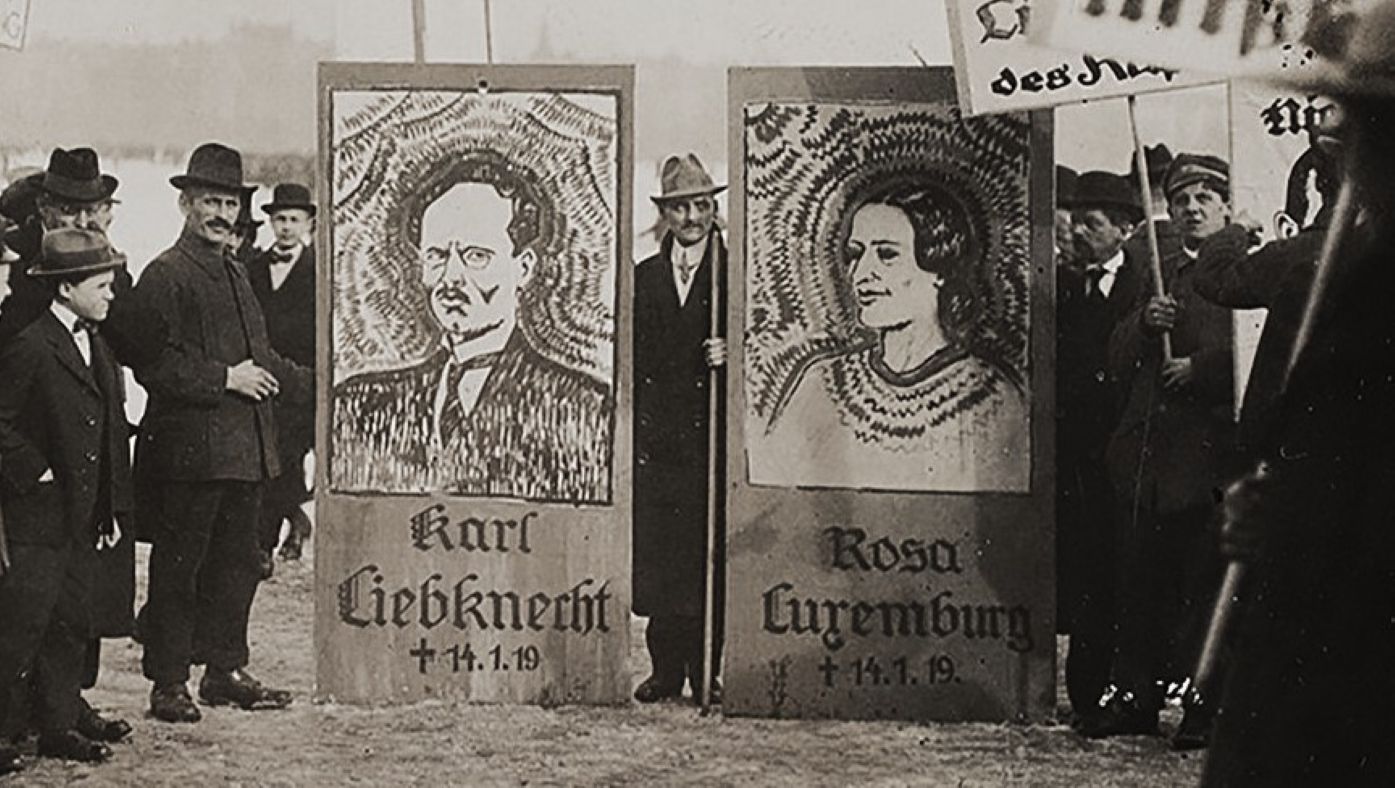
Following the murder of his comrades in January, 1919 Ernst Meyer would for the rest of his life pay tribute to his comrades Rosa Luxemburg and Karl Liebknecht, contextualizing their struggles for the current day. Here, he writes on the eighth year.
‘To the Memory of Rosa Luxemburg and Karl Liebknecht’ by Ernst Meyer from International Press Correspondence, Vol. 7 No. 5. January 13, 1927.
In the year in which the proletariat of the Soviet Union celebrates the fact of its tenth year of victory, the proletariat of Germany thinks of the eighth anniversary of the still unavenged murder of its leaders Karl Liebknecht and Rosa Luxemburg. The fact of the divergent course of the Russian and of the German revolution again and again raises the question as to the causes of this divergence.
The objective situation for Germany in the Winter of 1918/19 was acutely revolutionary. Everything which the master of insurrection, Lenin had indicated as the necessary premises for a victorious revolution was present: The disintegration and splitting of the bourgeoisie, strong sympathies on the part of the petty bourgeoisie with the proletariat, spontaneous mass movements etc. But what was lacking in Germany was a strong Communist Party, firmly welded together, capable of taking advantage of the revolutionary ferment of the masses for a systematic preparation of insurrection. The leadership of the Spartakusbund, before all Rosa Luxemburg, estimated the situation absolutely correctly and soberly, as is sufficiently proved by the report of Rosa Luxemburg at the foundation Party Conference of the C.P. of Germany at the end of December 1918 But the supporters of the C.P. of Germany, which was only established as an independent Party shortly before the January days of 1919, represented in its majority unclear and wrong conceptions, which found expression at the Foundation Conference in decisions which were fatal for the destiny of the revolutionary movement of Germany.
In spite of the fact that the Bolsheviki already had behind them the experience of the first Russian revolution, with them the preparation for the victorious social revolution lasted nine months after the overthrow of Tsarism in February 1917. The Spartakusbund, on the other hand, was by the January fights of 1919, two months after the overthrow of German imperialism, already involved in the decisive struggle for power. In January 1919 many supporters of the Spartakusbund forgot all the tasks of a revolutionary Party for winning the broad masses.
The Bolsheviki, in 1917, not only took part in the elections to the Constituent Assembly, but even demanded the convocation of the Constituent Assembly, in spite of their slogan: All power to the Soviets! The Spartakusbund, on the other hand, decided, against the will of its leaders, to boycott the elections to the National Assembly.
The Bolsheviki, precisely in the year 1917, carried on intensive work in the reformist trade unions in order to implant there their revolutionary ideas. The newly-formed Communist Party of Germany on the other hand almost completely neglected this work and played with the idea of splitting the trade unions.
Whilst the Bolsheviki, by means of systematic quiet work created a point of support in the army and with the help of these positions prepared the armed revolt according to a carefully worked out plan, the young C.P. of Germany contented itself with a broad agitatory activity and the letting loose of the enraged masses in spontaneous outbreaks of fury in local and provincial fights, which flared up one after another and were crushed.
The counter-revolution was able to crush the heroic Spartakus struggles all the more easily as the Social Democracy came forward consciously on the side of the counter-revolution, and was in fact its leader. The social democratic workers were also seized by the revolutionary waves, but they did not understand the great historical importance of the decision of the question: Democracy or Dictatorship. By the refusal to take part in the elections and by the neglect of trade union work, the C.P. of Germany abandoned the important and, in the situation then obtaining, indispensable means for propaganda and for winning the broadest masses. These failures had as a result that the C.P. of Germany was unable to break away from the Kautskyist leadership of the Independent Socialist Party those revolutionary minded Left I.S.P. workers who were thoroughly in agreement with the demand for the dictatorship, and to unite them organisatorily with the C.P. of Germany.
The vacillations of the social democratic workers were increased by the ambiguous role of the leadership of the Independent Socialist Party, which, from Hilferding to Rosenfeld, propagated a compromise between bourgeois democracy and proletarian dictatorship and, in the decisive moment, withdrew from the revolutionary struggle, thereby strengthening the counter-revolution which was proceeding to the offensive.
Within a few months the young C.P. of Germany, under the leadership of Rosa Luxemburg and Karl Liebknecht, would have overcome its shortcomings and thereby rendered possible the victory of the proletarian revolution. The counter-revolution therefore planned beforehand to behead politically the young C.P. of Germany by the murder of Karl Liebknecht and Rosa Luxemburg and to bring confusion into the ranks of the Communist movement. The “Vorwärts” knew quite well what it was about when it published the most vile calumnies and the vilest songs of hate and did not in any way oppose the open provocations to murder the two Spartakus leaders. At the same time the counter-revolution which was enraged over alleged acts of violence of the Spartakists, again and again provoked bloody collisions with revolutionary workers who regarded the political and organisatory strengthening of the C.P. of Germany as their immediate aim,
The benefit still remaining from the January fights is, apart from the political lessons, the example of revolutionary courageous self-sacrifice and proletarian fidelity of the fighting workers and their heroic, leaders. Rosa Luxemburg and Karl Liebknecht could rightly declare in their last article on the very day of their death, that the “defeat” of the revolutionary working class was not a defeat but an enduring advantage for the cause of the proletarian revolution. Rosa Luxemburg, by herself pointing out the failures and weaknesses of the leadership and the contradictions of the whole movement, at the same time pointed out the way in which the imperishable self-sacrifice of the proletarian fighters can and must be made use of in a new revolutionary situation in order to obtain lasting victory.
The bourgeoisie and the Social Democracy can be certain that the proletariat of Germany will not forget these lessons.
International Press Correspondence, widely known as”Inprecorr” was published by the Executive Committee of the Communist International (ECCI) regularly in German and English, occasionally in many other languages, beginning in 1921 and lasting in English until 1938. Inprecorr’s role was to supply translated articles to the English-speaking press of the International from the Comintern’s different sections, as well as news and statements from the ECCI. Many ‘Daily Worker’ and ‘Communist’ articles originated in Inprecorr, and it also published articles by American comrades for use in other countries. It was published at least weekly, and often thrice weekly. Inprecorr is an invaluable English-language source on the history of the Communist International and its sections.
PDF of full issue: https://www.marxists.org/history/international/comintern/inprecor/1927/v07n13-feb-10-1927-inprecor-op.pdf

