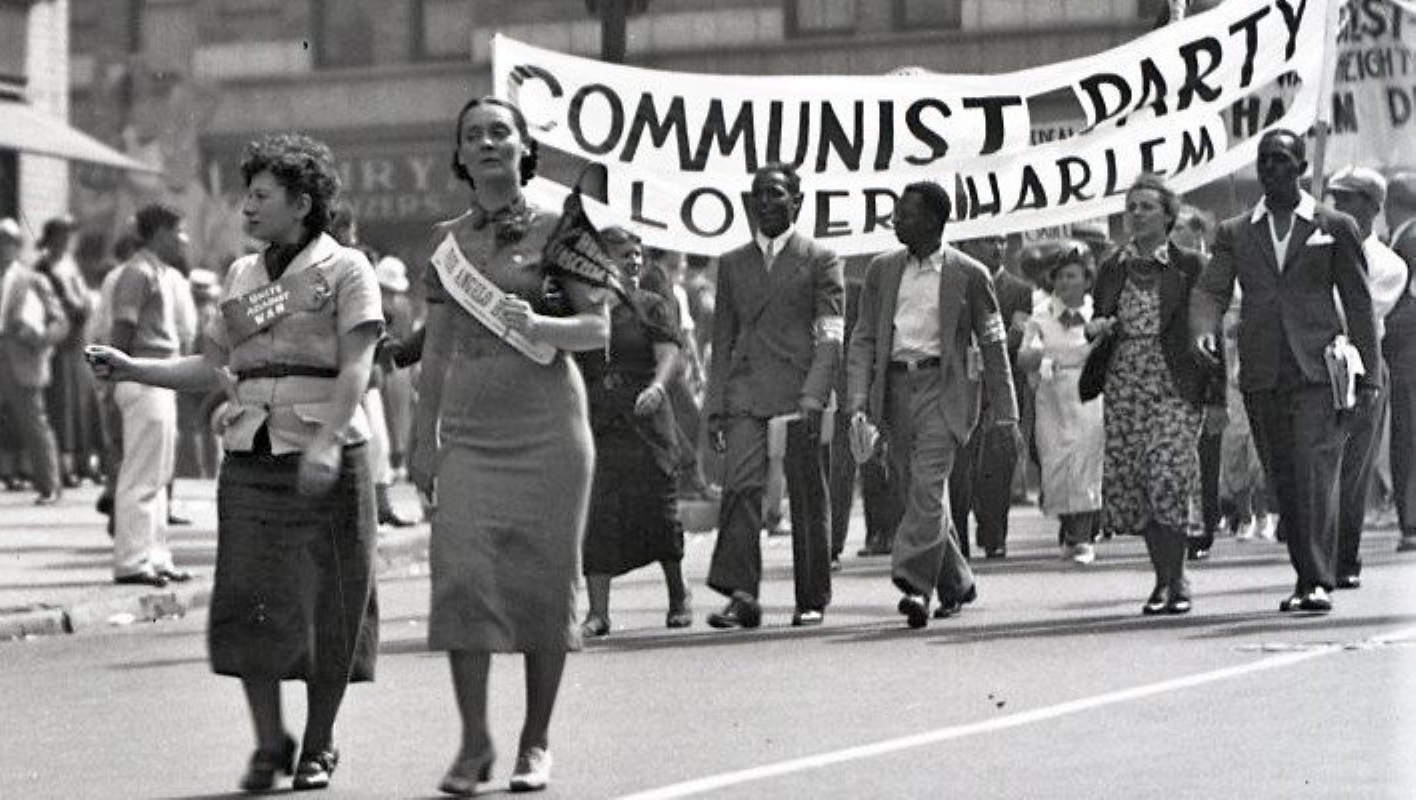
An important document in evaluating the Communist Party’s positions and efforts organizing Black workers during the first half of the 1930s in this critique from a leading Black cadre of the period. Born Benjamin DeWayne Amis in Chicago in 1896, B.D. Amis was active in the N.A.A.C.P. before joining the C.P. in the later 1920s. Moving to New York, and wrote extensively for the Daily Worker, active in the leadership of the American Negro Labor Congress, then in 1930 Secretary of the replacement League of Struggle for Negro Rights, and editor of The Liberator. There he also be involved with the I.L.D. and the Scottsboro, Angelo Herndon and Mooney defense campaigns. An important secondary leader of the Party, he would move to Cleveland as District Organizer (6). He would travel twice to the Soviet Union in the mid-30s, spending almost two years there, where he studied and wrote for the R.I.L.U.’s Negro Worker and worked for the International Trade Union Committee of Negro Workers. Returning to the U.S., he would focus on labor work as Field Organizer for the Steel Workers Organizing Committee from his base in Philadelphia, where he was also head of the city’s large National Negro Congress. At the end of the 30s he would be instrumental in organizing Black service workers into Local 758, Catering Industry Employees Union of the A.F.L.’s Hotel and Restaurant Employees and Bartenders International Union serving as its Secretary-Treasurer. Remaining active his long life Amis died in 1993 at nearly 97.
‘How We Carried Out the Decision of the 1930 C.I. Resolution on the Negro Question in the U.S.’ by B.D. Amis from Communist International. May 5, 1935.
THE resolution of the Communist International on the Negro question in 1930 gave additional clarity to the American Party as to the work to be done in order to win an important ally to the American proletariat. This resolution is of tremendous importance to the American labor movement as well as to the international working class movement. It is a clear application of Lenin’s teachings on the national question. It clearly defined the role of the Party in the struggle for equal rights of the Negro toilers and the right of the Negroes in the Black Belt to self-determination. Among the important tasks elaborated upon are the following:
“The struggle for the abolishment of all forms of economic and political oppression of the Negroes, as well as against their social exclusion…
“A relentless struggle in practice against all manifestations of Negrophobia….
“Energetic recruiting of the Negroes into the T.U.U.L. and revolutionary trade unions…
“Struggle for the right of self-determination in the Black Belt…”
These four basic points were further concretized in the Fourteenth Plenum Resolution of the Central Committee of the C.P.U.S.A., in April, 1932. The attention of the whole Party is sharply called to:
(a) A popularization of the full Communist program on the Negro question in connection with the partial struggles on every-day demands and events, which must be intensified.
(b) Thorough popularization of the solution of the national question in the U.S.S.R.., socialist construction in the autonomous Soviet Republics, mobilizing the broad Negro masses for the defense of the Soviet Union.
(c) Broadening the recruiting of Negro workers into the Party and trade unions, making the trade union movement real channels of Negro work.
(d) A broad campaign within the Party, as well as in the mass organizations, against white chauvinism and all forms of Jim-Crow practices, ruthlessly exterminating within the Party, not only the open, but also the half-hidden and conciliatory forms.
(e) Carrying out some concrete measures guaranteeing the next period for a real beginning of penetrating the Black Belt, building the Party and mass organizations (first of all, trade unions) for work among the Negroes in the Black Belt.
The Negro masses are an important ally of the American proletariat. The struggle of the Negro masses for national emancipation is a direct blow against the ruling class and is indubitably bound up with the proletarian class struggle. Lenin has clearly formulated for us the direct connection between the proletarian struggle and the national liberation movement. The peculiar oppression of the Negroes (social antagonisms, remnants of slavery) makes it imperative that the struggle for partial demands (equal pay, against wage cuts, for unemployment insurance, adequate relief, etc.), and for equal rights (the abolishment of all forms of economic and political oppression, social exclusion, insults and segregation) must be widely developed to correspond to the basic revolutionary demands (confiscation of the big landed estates, establishment of State unity in the Black Belt, and the right of self-determination). These demands must be brought forward in a popular manner to the white workers and especially among broad strata of the Negro people. When sufficiently popularized to the Negro. masses the slogans around these demands become the fighting demands of broad masses of Negroes in bitter struggle against the imperialist oppressors of the American workers and toilers.
Let us examine how well the Party has been able to organize the resistance and indignation of the Negro masses against the profound effects of the economic crisis, the growing reaction of the bourgeoisie, accompanied by a new unparalleled torrent of lynchings.
In the 1930 resolution of the C.I. on the Negro question, it is stated:
“The Communist Party of the United States has always acted openly and energetically against Negro oppression, and has thereby won increasing sympathy among the Negro population. In its own ranks, too, the Party has relentlessly fought the slightest evidences of white chauvinism and has purged itself of the gross opportunism of the Lovestoneites.”
Since the above was written, the Party has reached varying successes on the two fronts of work. Beginning with the Yokinen trial of white chauvinism, theoretical clarification has been further extended and there have been some very serious, practical measures taken to apply in life the correct political line. The Yokinen trial demonstrated the stubborn determination of the Party to burn out of its ranks the influence of bourgeois ideas on the Negro question, and particularly the open and concealed forms of white chauvinism. Through this act, the Party was brought boldly before the Negro masses as the only organization leading a real struggle for equal rights of the Negro toilers, to smash the barriers of segregation and Jim-Crowism, to expose the hypocritical “friends of the Negroes”, and to struggle against all expressions of Negrophobia. The influence of the Party was more firmly established. A powerful challenge to struggle for equality and emancipation of an oppressed nation was hurled into the face of the bourgeois imperialists and their agents.
The Party took practical steps to develop an international struggle around the Scottsboro case. The four years of bitter struggle in this outstanding case of national oppression have clearly demonstrated the correctness of the line of the Party.
The Camp Hill and Tuscaloosa struggles of the sharecroppers threw momentary alarm into the slave-driving landlords. The heroic struggles of the unemployed (Chicago, Cleveland, etc.), and the participation of Negro workers in strikes (mining, steel, food, needle), led by the revolutionary trade unions, won greater sympathy for the Party, as well as strengthened the unity of Negro and white workers.
The Party has established organizations in the South. The creation of a sharecroppers’ union of several thousand is an advance in the building of organizations of struggle in the Black Belt. Although our Southern organizations are weak, they are, nevertheless, becoming a more known force to the Southern Negro toilers and white workers.
The struggle against national oppression and its counterpart, lynching, produced courageous actions in Baltimore, Philadelphia, New York, Chicago, Detroit, Pittsburgh, Ohio, Minnesota and many other places. These struggles increased the influence of the Party considerably, and also gave to the Party Negro comrades who are daily proving their devotion to the class struggle and to the Negro liberation movement. There has been a steady promotion of these new cadres in the Central and District leadership.
For the third time within the two-year period, 1930-1932, the white ruling class received a terrific shock when the Party chose a Negro comrade, James W. Ford, for the Vice-Presidential candidate, the running mate to William Z. Foster. This was an historic event, an action never known to American history. It was not a sensational vote-catching scheme, but a significant task to “clearly and forcibly bring forth the fundamental position of the Communist Party, and those workers who support the Communist Party, on the Negro question” (Nominating Speech of Clarence Hathaway).
The 1930 Convention of the American Negro Labor Congress in St. Louis, at which time the League of Struggle for Negro Rights was formed, the republishing of the Liberator, drawing into this work Negro and white comrades, the editing of the Southern Worker, the All-Southern Scottsboro Conference in Chattanooga, were steps which started to open up a vast field for work. The “Free the Scottsboro Boys” March to Washington, D.C., set in motion new masses of Negro and white toilers under our leadership which before had remained passive or under the influence of the reformists. All of these events, plus the theoretical clarity expressed not only in resolutions but also in a number of articles written by leading white and Negro comrades, sharpened the struggle for Negro rights, added to the prestige of the Party and increased the quantity and quality of work.
At the same time, the Party is training Negro workers to develop the hegemony of the proletariat in the national revolutionary movement and for general Party work. These advances, although insufficient in themselves, prove the tremendous power of our program and the ability of our Party to carry into life the Leninist program for solution of the national question.
II. METHODS OF WORK AND THE UNITED FRONT TACTIC
While intensifying the struggle against white chauvinism, the Party brought more clarity into the struggle against bourgeois nationalism and expressions of these tendencies revealed in some Negro comrades. These manifestations (in a few Negro comrades) appeared because of bourgeois and petty-bourgeois influence and unclarity on the Leninist methods of solution of the national question. These comrades, seeing mainly the fast Leftward movement of the Negro masses on the one hand, and the slowness of the Party in more quickly organizing the movement on the other hand, expressed tendencies of distrust in the application of the line of the Party. Such tendencies are a hindrance to developing Bolshevik fire and decisiveness to burn out of our ranks the main danger—white chauvinism.
As the forces of revolution rally the masses to struggle against imperialist oppression, the forces of counter-revolution employ every conceivable method, ofttimes the most subtle measures to turn the tide in their direction. Because of the sharpening class struggle some of these bourgeois ideas, in one form or another, have crept into the Party. But a strict application of the Leninist line has defeated at every turn every expression of this alien ideology.
The struggle against Negro bourgeois nationalism is becoming more complicated as the class differentiations among the Negroes develop. During the Scottsboro campaign these class differences have become more pronounced. The national reformist leaders in the N.A.A.C.P., the Urban League and the Garvey type have increased their activities. Against these people and their ideology the Party has the task especially to prepare Negro comrades to become the main forces to lead the attack and exposure of this ruinous ideology. Fully- equipped with Leninist theory a successful struggle can be waged on this front.
Among the outstanding actions led by the Party in the fight against the daily persecutions of the Negroes, and linking up the struggles for the partial needs to their basic revolutionary demands, is the Scottsboro campaign. The Scottsboro trials typify the iron yoke of oppression and the long years of subjection and humiliation of the Negro nation. This campaign demonstrated the growing unity of the Negroes and white workers, and an awakening that is taking place among sections of the advanced white workers and of their duty to march “at the head of this struggle”. It was the source of a broadening movement against the denial of democratic rights (right to sit on the jury in the South, etc.). Also, this act of national oppression gave the opportunity to apply Bolshevik methods to work, to combine the legal struggles with the extralegal actions, as well as to test the ability of the Communists to build up a united front from below, exposing the betrayers, national reformist and white liberal “friends of the Negroes”. The Communist Party came out as the only political body fighting for the daily interests and ultimate demands of the Negroes. We correctly issued the united front call to the Negro people, white workers and all who are sincerely opposed to Negro persecution to join with us on the single issue, to save the lives and liberty of the Scottsboro boys. In the application of the slogan, much opportunism sprang up.
Chief among these errors were: a narrow sectarian limitation of the struggle, that is, a failure to link up consistently the struggle for the special every-day needs of the Negro masses, with the struggle to save the boys, thereby drawing in larger masses, and a failure better to politicalize the struggle, to raise it to higher levels by bringing in the basic revolutionary demands. In this mass movement the Negro people, in numerous demonstrations, meetings, conferences and marches with white workers, have shown their indignation. This deep ferment broke out among the sharecroppers in Camp Hill and Tuscaloosa against present-day slavery conditions. Spontaneous outbursts in the cities, the developing upsurge among the sharecroppers, agricultural laborers and poor farmers showed the growing elements of a national revolutionary movement. For the first time the Negro proletariat and the semi-proletariat in the town and country, the agrarians, began to enter the arena of political struggles under proletarian revolutionary leadership.
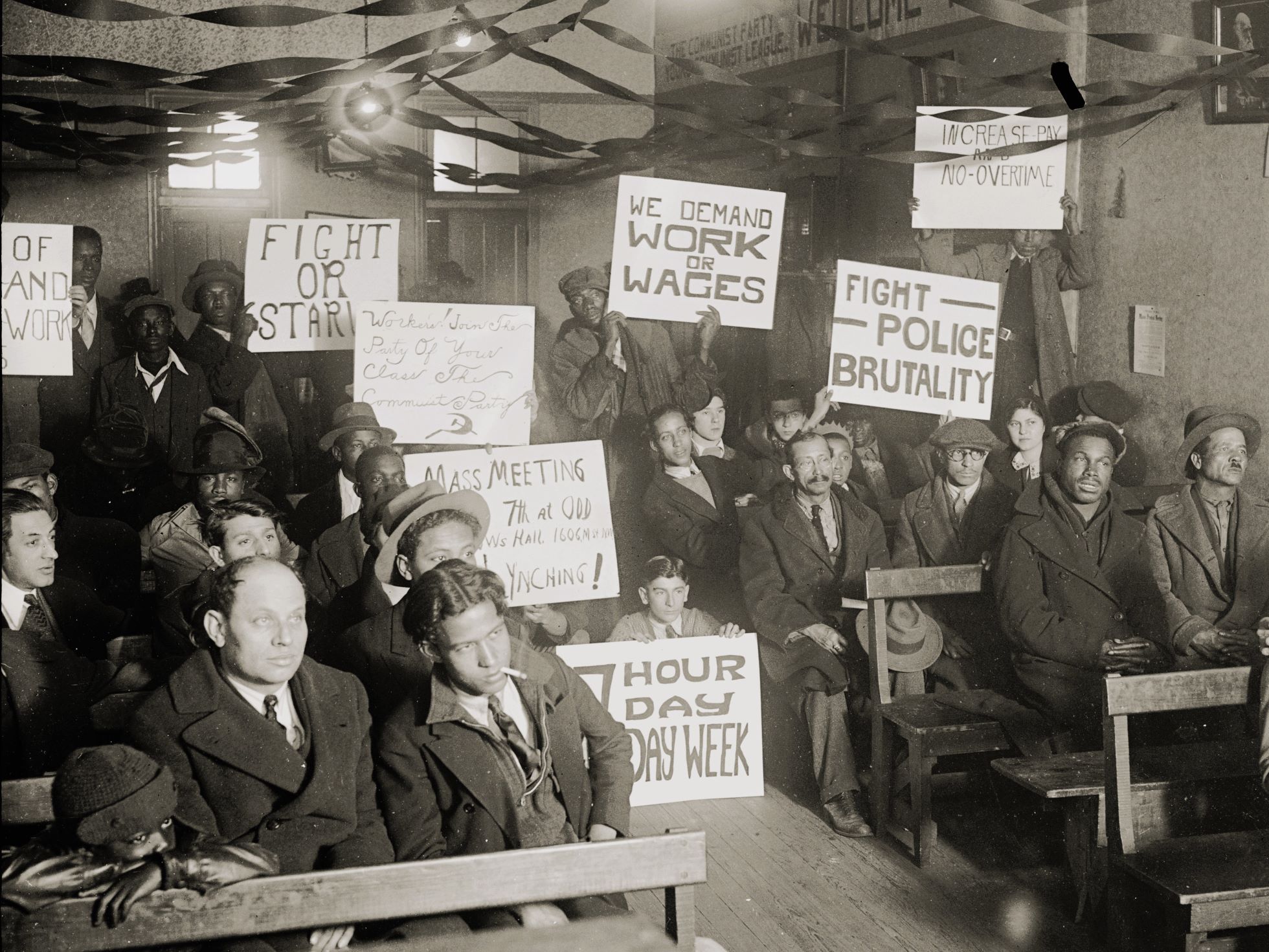
But our Party was not able sufficiently to organize this mass resentment and develop the movement into a stubborn, broad, mass movement of all toilers against national oppression. This act had stirred larger masses of Negroes than any other in the recent period. Lenin stated on the national question: “Every act of national oppression calls forth resistance on the part of the masses of the population, and the tendency of every act of resistance on the part of the oppressed peoples is the national uprising”. Our failure to carry this Leninist concept into life hindered the mass movement from developing into higher forms of struggle.
Closely connected with this weakness was the failure to utilize organizationally the mass resentment of the Negroes in the Black Belt. Few white Southern workers were drawn in to support the struggle and build up solidarity. Joint struggles of black and white workers, although difficult to organize, did not take on the form that would cause the Southern landlords and capitalists to tremble before the united mass power of the enraged Negro people and white workers.
In the beginning of the united front, insufficient differentiation was made between the Negro reformists and the Negro masses. There was a tendency to lump them together, to receive the misleaders with open arms, refraining from criticizing their traitorous policy and tactics. The role of Negro reformism and its alliance with the imperialist oppressors were greatly underestimated. The difference between the national revolutionary tendencies among the Negro masses against the white ruling class, as against the inherent class collaborating policies of the Negro reformists with the white bourgeoisie, was not made clear. Thus we fell into the error of a feeble exposure of the “Left” demagogic maneuvers of the “Left” reformists of the type of Pickens, allowing them to spread poisonous venom among the Negro masses.
The legal aspect of the case is of great importance, insofar as it is connected with the mass actions. Our revolutionary methods of struggle are distinct from the sole parliamentary methods of the reformists, such as the National Association for the Advancement of Colored People. Deep parliamentary illusions of long practice among the Negroes had to be exposed, as to the futility of this only form of struggle. But it can be stated openly that the weakest link in the movement is precisely our inability consistently to carry on mass actions, raising each succeeding one to a higher level, in conjunction with the court proceedings. Ofttimes, we found ourselves lagging at the tail of the spontaneous movement (Harlem unorganized demonstration, after the reversal of the Patterson death decision) and the Negro reformists. The development of powerful mass actions did not always proceed alongside of the legal struggle. Frequent ebbs in the campaigns not only proved a hindrance to deepening and widening the struggle, but left open the door to the misleaders and the betrayers to facilitate the carrying through of the plan of the landlord lynchers.
Consequently, Leibowitz, a politician and a careerist, together with the most reactionary Negro reformists took advantage of this weak link, confusing the masses as to the role of the mass organization, the I.L.D. This creates a very serious danger: (1) that the deep-rooted legalistic illusions among the Negro masses will be strengthened; (2) that Leibowitz will become a national hero of the Negro people, thus laying the base for a political trap to catch Negro votes for the Democratic machine and turn their revolutionary indignation into harmless channels; (3) that the absence of genuine revolutionary vigilance and mass actions will give the bourgeoisie the opportunity to seize the occasion as the time to carry through their bloody plans. To allow this to happen will be tantamount to building up a wall between us and the Negro people. It is running away from the struggle and retards the progress of the national revolutionary struggle for liberation of the Negroes.
An inexcusable blunder occurred in the course of building up united front actions in Harlem (Father Divine’s religious followers). A comrade (see Daily Worker, April 9, 1935, article on Harlem by O. Johnson), in a most careless manner branded this preacher without concrete evidence as a racketeer, classifying him with gangster racketeers, ignoring a more tactful approach to this person who has under his influence thousands of sincere Negroes who are seeking a way out and who have demonstrated with us against war and fascism. Such a blunder drives a wedge between us and the masses and confuses our theoretical program because of bad practice. Before we can sufficiently enlighten his followers of the futility of religious ideology and of the correctness of our program and the need for a united struggle against worsening conditions, they are driven away from us. This is not convincing the masses. It is name calling. Through organized educational scientific anti-religious propaganda we seek to rid the masses of their religious prejudices. We must carefully avoid any offense that will strengthen religious fanaticism. (See The Communist, April, 1935, “Religion and Communism” by Earl Browder.)
These mistakes in the united front tactic appeared in enlarged forms in other cases (Herndon, Lee, Armwood, Camp Hill and Tuscaloosa) where the struggle, as far as the united front is concerned, assumed more of the character of a protest (letters from delegations) campaign from the North, and mainly a legal battle in the South. No doubt, a most difficult task in this work was to extend the united front. In the All-Southern Conference in Chattanooga and in many local conferences (Baltimore, Chicago, New York, etc.), the Communist workers have penetrated into new organizations, have brought new workers under our influence to accept revolutionary methods of struggle, and in general have made inroads among the Negro masses that at times seriously threatened the reformist leadership of some organizations. But the most important day-to-day work down below, visiting contacts, further explaining our policy und tactics, and creating out of these new conditions, live factors which help to determine the course of events, for participation in the struggle was lacking. Only in a few places did we build a permanent foundation among the masses, making it highly difficult for the false leaders to use the indignation of the masses in the interests of American capitalism.
At the same time the Scottsboro case and its significance to an aroused Negro people threw consternation among the reformists.
III. ROLE OF BOURGEOIS NATIONALISM
The Negro reformists have established a base for themselves upon the suffering and humiliation of the Negro masses.
Utilizing this untold misery to further their selfish purposes to attain a few privileges as a reward for muzzling the Negro liberation movement, they have been able to establish, with the help of white liberals, through deception, maneuvering and petty politics, a considerable influence among the Negro people. Through their organizations, the press, the churches, they have heaped their venom upon the masses, using these and other mediums as centers of propaganda. The character of this propaganda is to strengthen the parliamentary illusions, to turn indignation into harmless channels, and to strengthen the insecure position of the reformists, thereby lending a hand to prop up tottering capitalism.
The leaders of N.A.A.C.P., the Urban League, the Garvey movement, the politicians, the preachers, have under their influence thousands of Negroes. The press (among them the Chicago Defender, the Pittsburgh Courier, Afro-American, Amsterdam News, Atlanta World, etc.), is read by millions of Negro toilers. This press is not only the mouthpiece of many of the national reformist organizations, but is generally depended upon to give that policy which is agreed to by the white “friends of the Negro people”, in collaboration with the reformist Negro leaders.
The segregation areas in the metropolitan centers are the prey of the politicians (black and white) and the source of blood money gotten through extra-high rents, added prices of foodstuffs and through other means of robbery. The segregated areas and the system of Jim-Crowism are the sources of a special form of national and social oppression. “The origin of all of this is not difficult to find: this Yankee arrogance towards the Negro stinks of the disgusting atmosphere of the old slave market. This is downright robbery and slave-whipping barbarism at the peak of capitalist ‘culture.’” (C.I. Resolution, October, 1930.) Out of the segregated and Jim-Crow areas has grown a small Negro capitalist class.
The ranks of the few small capitalists have been thinned by the crisis. Negro banks and insurance companies have crashed, as well as have other small enterprises. At the same time, the white imperialist masters, due to their own crisis, have demanded more from their Negro servants in crushing with greater speed and greater demagogy the rising upsurge among the Negro people.
The broadening influence of the Party, with its program for national emancipation of the Negroes, has helped to make the shaky position of the reformists and small capitalists far more unstable. Consequently, there developed out of this situation of growing crisis within the camp of the reformists two definite currents, i.e., (a) a camp which apparently moved Leftward; (b) another which resorted to a more open reactionary policy. In between these two camps were the “centrists”, whose role was less effective, due to their minority and vacillating position. Their spheres of influence are limited and their policies are determined by the politicians and landlord capitalists whom they thank for their existence.
The sweeping effects of the crisis, the tightening of the yoke of oppression upon the toilers, the growing reaction of the bourgeoisie and especially the intensified lynch drive against the Negro people, have created wide discontent among broad masses of Negroes. The bourgeois imperialists have great need for their lackeys, the Negro reformists, to give assistance in attempts to quell this growing upsurge.
As the mass movement developed, gathering momentum among the toilers, black and white, the Negro reformists were forced to state their position. Fearing the wrath and the indignation of the aroused masses, and threatened with the loss of their leadership, these reformists made demagogic maneuvers in face of the mass demands.
The character of these maneuvers was in pretending to join the united front with Party and other revolutionary organizations, to “catching” up to the tail of the mass movement, pretending to lead it, in order to stop it. For example, the Amsterdam News and a few “leaders” who sensed the mood of the masses and their demands for a march to Washington, D.C., to present a bill of rights and to demand the release of the nine Scottsboro boys, attempted to lead the march into avenues away from genuine struggle. The alertness of the Communist workers thwarted these treacherous actions.
But oft-times these maneuvers, cloaked with “Left” phrases, caught us unawares. An expression of the wrong policy is the headline in the Daily Worker of April 15, 1933, “Labor Defense Welcomes N.A.A.C.P. Offer to Aid Scottsboro Boys’ Fight.” The chief error here is that after the N.A.A.C.P. had conducted a most shameful and slanderous attack upon the real defenders of the boys, after cooperating with the lynch courts in hiring the K.K.K. lawyer to represent them at their first session, after using every foul means and treacherous acts to take the case away from the I.L.D., the Daily Worker, in this headline, brushes aside in one sweep all of the fundamental points at issue and gives the implication that there is a basic change in the policy of these reformists.

The appeal of the Party and the revolutionary organizations over the heads of the leaders of the N.A.A.C.P. to their rank-and-file followers, and the acceptance by a number of the latter to join the struggle, was the determining factor in causing this action of the leaders. The wrong policy tended to strengthen the weakening position and influence of the Negro reformists over the masses, bolstered up the waning illusions of the Negro people in the reformist methods of leadership, instead of driving a deeper wedge between them and the rank and file, thereby drawing the latter closer to us. Our comrades did not fully understand the tactics of the reformists. In order to betray the mass movement, arousing less suspicion from the masses, these traitors, who form the chief barrier to victory to save the boys, quickly decided to get into the movement again. The source of this error of our comrades may be linked with a letter in which it is stated that they (our comrades) “greeted” the N.A.A.C.P. leaders for “their changed attitude” and for their “effective defense” in the Crawford case (Crawford was a Negro worker wanted on a frameup charge in the Virginia courts, from which he had escaped to the North. He was later returned to Virginia and given a life sentence, although maintaining his innocence.)
To enter into a united front with these “leaders”, and to fail to show to the masses every false action of theirs that leads to the defeat of the mass movement, is the worst kind of opportunism. It is giving them an additional weapon to use against the mass movement.
Slavishly cringing to the demands of the imperialist masters, the N.A.A.C.P., Tuskegee Institute officialdom, the Pittsburgh Courier and individuals of the type of Kelly Miller, employed every conceivable foul tactic to sabotage, not only the struggle to free the boys, but the developing Negro liberation movement. The N.A.A.C.P. in its organ, The Crisis, writes: “When we hear that eight colored men have raped two white girls in Alabama, we are not the first in the field to defend them. If they were guilty and had a fair trial, the case is none of our business”. Again, an official, W. Pickens, of the same organization, at a crucial moment in the developing mass movement, pleaded in a provocative speech in Chattanooga, to the Southern lynchers to take action against the rising upsurge and its leader, the Communist Party.
The Tuskegee Institute officials readily called the official Alabama lynch leaders, the police, to finish the murder of a Negro worker who had been set upon by the hounds of reaction at a meeting of the sharecroppers, protesting against brutalities.
The Pittsburgh Courier announced to the world that the boys were “rapists”, thus encouraging the attempted lynching. The lynchers were upheld, the indignation of the Negro people was condemned, and the Party was slandered and accused of “certainly menacing good race relations”.
Undoubtedly, superseding these attacks upon the Party, is the infamous Negro, Kelly Miller, a type of Hamilton Fish and “Red-baiter”. He is the supreme aper of his white master propagandists. In the most disgusting servile manner, he admonishes the Negroes to submit to persecutions, lynching and every evil born in the womb of brutal American imperialism. This agent of American imperialism writes: “All that the Negro has or may hope to have in this land grows out of his loyalty to this country’s ideals—because he loves what it loves, and hates what it hates”. Further, he states: “The remedy for the just grievances of the Negroes lies in the observance of the Constitution, not in its destruction…In his present state of helplessness he cannot match wrong with revenge or overcome evil by reprisal”.
These tendencies among the Negro agents of American imperialism are further expressed in an article in the New York News and Harlem Home Journal, which calls for a “leader” for the Negro people. This plea states: “Colored America needs nothing so much at this time as a Mahatma Gandhi”. But why do they take Gandhi, the Indian national reformist agent of British imperialism, for their model? Because he has set the example for the reformists the world over of how to betray the struggles of the oppressed peoples; he is giving faithful service to British imperialism which is attempting to drown in blood the liberation struggles of the Indian people.
Faced with an upsurge among the Negro people who are demanding jobs and bread, ex-Congressman DePriest, Negro millionaire, opened a tirade against the foreign-born workers. This misleader of the Negro masses supports legislation against the foreign-born and the attacks and proposals of the Fish Committee against militant labor. He has repeatedly stated that the foreign workers are depriving the Negro workers of jobs and bread. This demagogy had a two-fold purpose: (1) to conceal the opposition of DePriest to a “relief” bill before Congress; (2) to turn the anger of the Negro masses away from the real enemy, the cause of their impoverishment, and toward their class brothers.
The campaign of the Party to expose the “New Deal” and its N.R.A. codes has been systematic and continuous, but not without weaknesses. The Negro people are the worst sufferers under the “New Deal”.
True to their class relations, the bourgeois reformists have supported the N.R.A. Here and there, half-heartedly pointing out violations and discriminations of the Act, they have justified these practices because “we believe in the President’s program. If honestly carried out, it will produce in this country a growth of prosperity that will be effective in application to all citizens alike.”
Just as the Socialist Party leaders have hailed the N.R.A. as “state capitalism, a step toward socialism”, so have the bourgeois Negro reformists accepted it as an act of the “Almighty” which, if given a “fair” chance, will “cure many evils”.
In this connection, it is important to note that the Socialist Party is giving whole-hearted support to the Negro reformist activities. The toothless “anti-lynching” bill presented to Congress has grouped around itself such organizations as the N.A.A.C.P.; the Urban League and the Socialist Party. The Socialist Party vies with the national reformist organizations in their attack against the Party, upholding the lynch verdicts of the Southern courts, calling for reliance on the organs of class oppression and assailing the Communist tactics as responsible for the “action of the Alabama Supreme Court in confirming the conviction of the Scottsboro boys”. (New Leader, April, 1932.)
Generally, the Party has conducted a systematic exposure of these slimy people. But, in the face of such betrayals, we did not always penetrate deeply among the masses. The exposures remained too much at the top. Secondly, we are still in the process of training our lower cadres in the Bolshevik methods of unmasking and isolating such enemies. Thirdly, not enough has been written in popular pamphlets and newspaper form to enlighten the toilers of the source of national reformism, its subserviency to the bourgeois imperialists, where it leads to, and how to fight against it. Weaknesses in building a united front, the failure quickly to feel the moods of the masses, and, according to the given situation, throw our machinery into motion, becoming the conscious day-to-day fighters for their everyday needs, and insufficient understanding by the body of the Party of the class relations of the Negro reformists, constitute other serious obstacles.
The May resolution of the Political Bureau on the Scottsboro struggle, pointing out the line of struggle against the bourgeois-nationalists and social-reformists, states:
“The main battles to protect the lives of the nine innocent Negro boys, the lives and interests of Alabama sharecroppers and the interests of the unemployed in centers of Negro population, are necessarily fought in the first place against this corrupt group of leaders; it is necessary to set in motion masses of Negroes which, traditionally under their influence, are held chained by them to support the system of imperialist oppression. Any judgment of success in these campaigns, therefore, must center around questions of winning the masses to action against the opposition of these forces, and in action (while conducting a ideological struggle) winning these masses for their influence.”
To speak of struggling against the Socialist Party leadership and the Negro reformists without the mass support of the white and Negro toilers to support the struggle, and without properly showing the relations between the two and the road they lead to, is an empty phrase.
Insufficient work has been done to expose the Negro reformists in their support of the “New Deal.” Aside from the fact that very little has been written on the subject, our speeches, in the main, did not convincingly underscore this important point. The result is that the whole fight against the “New Deal” is considerably weakened, and the Negro reformists, with little interruptions, continue to spread their doctrine of “faith, hope and charity”, making more difficult the struggle to build up the broadest united front against the “New Deal”.
IV. THE STRUGGLE TO WIN THE MASSES
Our organizational weaknesses can be seen in the present strength of the Liberator and the League of Struggle for Negro Rights. Both remain weak organizations, with little mass base and mass influence among the Negro people, in spite of decisions as far back as 1928, to transform these national liberation weapons into popular organs with a mass base among the Negro toilers, and particularly in the South. They do not reflect the life and daily struggles of the Negro masses. Confusion as to the role of the L.S.N.R., and liquidatory tendencies among some Negro comrades (both are now corrected) did for a time seriously retard any growth in the two institutions. They are too much patterned after the Party and the Daily Worker. In districts where the Party has led mass struggles for Negro rights, the two organs have not been built. There remains unclarity of the special role they can serve among the Negroes. They must give an answer to every important statement in a clear, concise manner, and expose every move of the Negro reformists and their press, at the same time putting forward convincing concrete proposals that will win the support of the masses.
Recruiting into the Party and other mass organizations (excluding, to a degree, the I.L.D.) has not been systematically planned. In fact, the gap between our ideological influence and our consolidated strength is closing altogether too slowly. The weaknesses in this field reflect in exaggerated forms the whole weaknesses of the Party, especially to root itself among the basic proletarian workers, to concentrate on decisive sections. In the South, where the mass indignation of the Negroes reached its highest expression of resistance, the Party made gains in no commensurate with the undercurrent of deep ferment. The quickest way to overcome this situation is the live application of our political program for Negro liberation in the daily economic struggles, seizing each action which arouses the Negro people, raising the struggle around the action to a higher political level. This means to inject at every opportunity our program for national emancipation, a systematic linking up of the revolutionary slogans with the partial demands, and to popularize intelligently the solution of the national question in the Soviet Union. Our, perspective can be none other than to develop a broad movement of all toilers.
In the unemployed field, of struggle against the discrimination in giving relief to Negro workers and against evictions, we registered some very good actions. But the temporary gains (Chicago, Cleveland, etc.) suffered because of a light attitude to the follow-up of the good beginnings and hidden tendencies of satisfaction with small victories. The response of the Negro unemployed to the first and second national hunger marches, to the numerous state marches, and to local demonstrations, their participation in the general class fights, their endurance and application of discipline, and their desire to unite with the white proletariat in struggle, prove the tremendous reservoir of revolutionary force with which the white proletariat must cement an alliance in the struggle for unemployment insurance and immediate relief.
The increasing desire of the workers for trade union organization and the work of the T.U.U.L. in influencing this sentiment, especially on the Negro field, has caused the A. F. of L. officialdom to consider trade union work among certain sections of the Negro workers. However, we have not taken up sufficiently the leadership to establish a broad sentiment inside the A. F. of L. unions for the general admission of Negro workers into all unions and to fight for their rights. Nor have our unions become the broad economic struggle organizations embracing important sections of the Negro proletariat. The A. F. of L. has practically kept its doors closed to organizing the Negroes except into a few Jim-Crow locals. In mining, auto and steel, a very small minority of Negro workers have membership in locals together with white workers. This leaves a fertile field. But every weakness of the Party, every Right opportunist deviation, expressed in the trade union work, is multiplied in the trade union work among the Negroes. Only recently is there a small sign of the beginning of overcoming this opportunist underestimation. The underestimation of this work can be seen in the failure of our unions and comrades to bring forward consistently the special demands for the Negroes, to carry on a fight for the realization of these demands; to mobilize the membership of the unions to lead such a struggle against all forms of segregation and discrimination on and off the job; to beat back the carriers of the ideology of the A. F. of L. bureaucrats among the white workers, and to wage continuously an enlightenment campaign on the Negro question inside the union as well as outside.

It should not be necessary to emphasize that the Communist leaders in the unions should be the first to lead in clarifying all these questions through articles, discussion talks, unmasking every idea that is alien to the interests of the working class, and by concrete examples explaining the purpose of this ruinous ideology which constitutes a block to building mass fighting unions and divides the workers into different camps.
Under the cloak of keeping the workers solid under our leadership to win their main demands from the boss and not to unfold too much of our program at once, some union leaders in the coal strike of 1931, in the Warren steel strike, and in strikes of needle trades workers, have capitulated to the more backward expression of the workers in failing at the beginning of the struggle (although this work should be done just as thoroughly when there are no strikes) to include special demands for Negroes, special leaflets, special meetings explaining the position of the union toward the Negro workers, etc. Leaflets have been printed which did not include special demands for Negro workers. In the Warren strike it required convincing arguments before the union leaders in the strike committee raised the questions of including special demands for Negro workers. The argument against this question was that there are only a very small number of Negro workers in the plant.
In certain needle trades shops controlled by our Union, it is permitted to allow the jobber to underpay Negro workers. Knowing this to be a fact, and that our union was slow in taking up the fight against such gross discrimination, one of the union leaders, when asked how is the union struggling for equal rights of the Negroes made the statement: “There is no discrimination against Negro workers in the shops under our control”.
Many Negro miners took an active part in the coal] strike. Some of these workers were placed on responsible committees of the union. Surely, this was a demonstrative act, showing in real life the basic difference between our T.U.U.L. and its revolutionary unions and those of the reformists. But consistent day-to-day guidance and help were not given to these newly-won fighters. They were not drawn into the real life of the union, they were left alone, so to speak. The weakness here is not confined solely to a policy of isolation, but a failure to convince the workers of the fundamental difference between the revolutionary union and the union of the Lewis machine. His class consciousness was not deepened; he did not feel the close ties that should interlock his interests with the activities of the union. The Party fraction in the union was not a vigilant committee, watching the interest and development of the worker, giving him the necessary help.
In the needle trades union, the errors in the Negro work can be attributed to great unclarity on the national question and the deep-rooted hangovers of past traditions of labor bureaucracy. This condition has led to open acts of white chauvinism. In the attempt to cover up this wrong line and lack of energetic work, some of the union leaders used as an excuse the shortcomings of a Negro comrade organizer who, though sincere, was very confused and weak on the Negro question. Consequently, it was not until the Party, in a series of meetings, with the fraction, explained and clarified the line, and sharply criticized the comrade, that the situation began to change.
The deepening interest of the Negro workers in the policies of our union is attested by the following facts: In the Penn-Ohio strike, Negro workers demanded to know the position of the union on the Scottsboro case. During the strike of a metal plant, in Cleveland, the Negro workers asked the same question: “Is this the union that fights for the Scottsboro boys?” When our union leaders spoke and showed the close connection between the strikers’ struggle and the struggle around the Scottsboro case, and declared the solidarity of the union to the struggle to help free the boys, the confidence of the Negro miners and metal workers in the respective unions (N.M.U. and S.M.W.I.U.) was strengthened. Also, it brought new strata of white workers into the struggle for Negro rights, thus establishing more unity in the struggle of black and white workers against the common enemy. This shows the importance of correct day-to-day work, and how necessary it is to link up the strike struggle with other campaigns and demands, thereby raising the struggles to higher levels.
The N.R.A. codes, in regulating wages in industries, either excluded Negro workers or fixed a differential, which meant lower wages. In some instances, the differential is from 25 to 50 per cent. Around such flagrant issues of discrimination, sanctioned by the government, our union could have built a mass base among the Negro proletariat, providing they had led a systematic and energetic fight for the equal rights of the Negroes. Failure to take advantage of this situation, to mobilize the entire union membership to struggle for equal wages and the rights granted to white workers, plus the additional rights that all workers are struggling for, lies with the Communist leaders in the unions. Here was an opportunity not only to expose the A. F. of L. bureaucracy, which endorsed this practice against the Negro workers, but also to show the close cooperation between the government and the A. F. of L. officialdom.
The underestimation of the role of an important ally in the struggle on the trade union field weakens the fight against the bureaucracy and delays the building of bridges to broad, decisive sections of workers in industry. The struggle against this opportunism is assuming sharper forms; the incorrect methods of work and especially the practices regarding work among Negroes, brought over from reformist unions, still remain, in spite of many resolutions and clarification speeches. The fast moving events, the rising strike struggles, growing opposition to the A. F. of L. and government policies, demand that our unions and comrades jump from this period of lagging behind into bolder and better campaigns, organizing and leading mighty class battles, to build up the broadest united front of black and white workers for a sharp struggle against the degrading of their conditions. This is a necessary step to break the hold of the A. F. of L. officialdom upon a million workers; it is necessary to organize the large reservoir of the unorganized. It is a precondition to the building of mass revolutionary unions, the gateway to decisive sections of workers, a necessary base for our Party.
At the first national conference of the farmers, there attended Negro sharecroppers, fresh from the struggles in Tallapoosa County. These croppers and poor farmers braved the greatest difficulties to come to declare their solidarity with the struggles of the Northern and Western poor farmers against sales, foreclosures and inadequate relief. Their presence was a concrete expression of their willingness to fight side by side with the poor dirt farmers against the monopolies, the banks and insurance companies. These fighting representatives of the Sharecroppers’ Union came with invaluable experience of struggle against the landlord-capitalists. The poor white farmers present enthusiastically greeted and accepted them. Here could be seen the opportunity to bring together these two struggling groups. But the croppers were not fully utilized. They were left off the National Farmers’ Committee because the terror in the South against the croppers is very fierce. This opportunist retreat before the difficulties did not allow our comrades to consider seriously the militancy of broad sections of Negro croppers, their willingness and readiness to struggle, and the deepening consciousness of the utter necessity of bitter struggle to better conditions, taking root among important sections of Negro poor farmers and sharecroppers. They passed over the opportunity to cement a firm tie between the struggles of the poor white farmers and those of the Negro sharecroppers. Underestimation and opportunist fear, tendencies to hide the face of the croppers, prevented creating a deep, conscious expression of fighting solidarity among the white farmers. The sharecroppers expected concrete help from the white farmers. They looked forward to an alliance, realizing that this is a useful weapon, especially when formed with the Southern poor white farmers, to hinder the landlord-capitalists in mobilizing sections of the town and country poor against the Negro croppers. Failure to accomplish these things prolonged the breaking down of barriers of distrust for whites and left the two most important sections of poor farmers only partially united to resist the offensive of the government and landlord-capitalists.
The Daily Worker, the proletarian paper, is the leader in its field in the struggle for Negro rights. It has won the admiration of the Negro masses for its manner of conducting the Scottsboro campaign; its exposure of the Welfare Island Negro murder, and lynchings, discrimination of all kinds (unemployed relief and C.W.A. jobs), etc. In the South the penalty in some sections, if caught reading the Daily Worker, is long-term imprisonment. Yet, sections of the Negro town and country poor accept this organ as their militant leader. It has made tremendous progress in winning increasing sympathy among the Negroes.
To give the paper a real mass base among the Negro population shortcomings must be overcome in the direction of: (1) making the paper more of an organizer in the struggle for Negro rights; (2) combatting the occasional infiltration of white chauvinist ideology; (3) continuity and consistent carrying through of campaigns; (4) more simply written and basic theoretical articles, explaining point by point the Communist position on the Negro question.
Because the Daily Worker has penetrated and can penetrate places where, under the present conditions, it is impossible to send or keep organizers, it is imperative to realize that the role of the paper as an organizer of the liberation struggle is a very important one. How to organize committees to struggle against the capitalist offensive and Negro reformism, how to struggle against lynchings, etc., are questions which, when concretely answered in relation to their organizational phase, will speed up the whole Negro liberation struggle.
To carry out this task, we must guard against going “one step forward and two steps backward”, by allowing the filth of white chauvinism to filter into the paper, i.e., one incident each in both Mike Gold’s and the Health columns. Such infiltration shows a lack of control and great unclarity on the Negro question by the writers. Bolshevik control and check-up on all the articles can entirely eliminate the filtering in of alien ideas and prevent such confusion in the process of giving greater clarity.
In the columns of the feature writers, all too seldom, is the Negro question discussed. When these writers have taken up the question, our position has not always been clearly brought out and frequently has been blurred over or treated in a general manner. It goes without saying that these columns should be used as the springboards for conducting a broad popularization campaign as well as the medium through which we bring our program to new strata of people.
At times, the immensity of important political and economic campaigns submerge temporarily or partially the struggle of the Negro people. Continuity and coordination, the selection of the proper articles at the proper time, the proportioning of space, etc., all come under the heading of control. The progress and improvement in quantity and quality of the paper in the past year are proof of the ability of the staff to overcome, within the shortest possible time, these shortcomings.
V. POPULARIZATION OF THE SLOGAN: RIGHT TO SELF-DETERMINATION
Through the medium of clarification of the Leninist conception of the solution of the national question and the practical steps taken, the Party has been able to begin to popularize among the Negro people the slogan of the right of self-determination for the Black Belt up to the point of separation. But this beginning is very small. Self-determination has not been explained in detail, as to the benefits that the Russian workers and peasants obtained after the October Revolution. This slogan raises the question of power, the way out for the Negro people in the Black Belt. Only the realization of this slogan can guarantee the securing of equal rights for the Negroes.
Self-determination means the overthrow of the landlord-capitalist class rule in the South. It is a basic fundamental slogan of national rebellion. It is a slogan that expresses the basic demands (land, equality and freedom) of the Negro people.

“First of all, true right to self-determination means that the Negro majority and not the white minority in the entire territory of the administratively united Black Belt exercises the right of administering governmental, legislative and judicial authority. At the present time all this power is concentrated in the hands of the white bourgeoisie and landlords. It is they who appoint all officials, it is they who dispose of public property, it is they who determine the taxes, it is they who govern and make the laws. Therefore, the overthrow of this class rule in the Black Belt is unconditionally necessary in the struggle for the Negroes’ right of self-determination. This, however, means at the same time the overthrow of the yoke of American imperialism in the Black Belt on which the forces of the local white bourgeoisie depend. Only in this way, only if the Negro population of the Black Belt wins its freedom from American imperialism, even to the point of deciding itself the relations between its country and other governments, especially the United States, will it win real and complete self-determination.” (C.I. Resolution, 1930.)
Therefore, in the Scottsboro case, in the struggle of the sharecroppers in Camp Hill and Tuscaloosa, it is the task of the Communists boldly to popularize this slogan and to organize around it mass actions of Negro and white workers in strikes, tax boycotts and demonstrations. Such a stirring up of the masses into mighty actions of struggle for their demands is the beginning of an important political change in the level of the struggle for liberation. This slogan, when understood, will fire the revolutionary potentialities of the Negro masses.
“If once thoroughly understood by the Negro masses and adopted as their slogan—it will lead them into the struggle for the overthrow of the power of the ruling bourgeoisie, which is impossible without such revolutionary struggle.” (C.I. Resolution, 1930.)
With greater Bolshevik decisiveness and determination, the Party can free itself of these shortcomings in the work in the Negro field. The good beginnings are proof of the unlimited possibilities of developing a powerful mass movement for Negro liberation, utilizing every repressive act aS an opportunity to organize the mass indignation of the Negro people. The Party has the task to deepen the Negro liberation struggle, to raise it to higher forms of political mass fights, to broaden and extend our ideological and organizational base in the Black Belt, to continue energetically to develop Negro cadres and maintain a constant fire against all forms of Negrophobia.
The Party must lead the Negro liberation struggle. It is the organized detachment of the struggling Negro masses and is responsible to imbue the Negroes “with the spirit of discipline and method of fighting, with the spirit of organization and perseverance.” (Foundations of Leninism—J. Stalin.) Therefore, the tasks laid down in the 1930 C.I. Resolution and concretized by the Fourteenth Plenum of the Party, and the tasks put forward in the Open Letter remain in full force.
The Eighth Convention of the Party has further elaborated upon these tasks. Again greater emphasis and clarity were given. The struggle on two fronts, the struggle against all forms of white chauvinism and against Negro bourgeois national influences and national reformism, was placed before the Party with Bolshevik preciseness. Especially was the struggle against all shades of Negro bourgeois nationalism explained in great detail, a subject which cannot be dealt with in the scope of this article and which requires separate discussion. The Convention demanded a quick turn in the trade union work among the Negro proletarians as well as the rapid increasing of our organizational strength. The Convention registered achievements, but they only revealed the tremendous possibilities and the vast field for work.
These tasks are very essential. The Negro people, an important ally of the proletariat, in revolutionary struggle for the right of self-determination, form another attacking force against the exploiters and oppressors of the workers and toilers. Every revolutionary action, aimed at the heart of American imperialism, whether it has its source among the revolutionary proletariat, developing the struggle for power, or whether it is a stubborn upsurge among the poor farmers, or a national revolutionary movement among the oppressed Negro masses, weakens the foundations of the imperialist oppressors and becomes significant in hastening their downfall.
History has placed before our Party the task of leading this movement and to prepare the workers and toilers for the decisive struggle. This is not an impossible task. The best proof is the Soviet Union. The Negro people want complete freedom. Our Party and the Negro Communists are subjective factors which determine, to a large extent, when the heavy yoke of oppression will be broken. The way out for the Negro people is the revolutionary way.
“It is likewise necessary, first, to explain constantly that only the Soviet regime is able to give the nations real equality, by uniting the proletariat and all the masses of workers in the struggle against the bourgeoisie; secondly, to support the revolutionary movement among the subject nations (for example, Ireland, American Negroes, etc.), and in the colonies.” (Theses of the Second Congress of the C.I. on National and Colonial Questions.)
To correct these shortcomings quickly in the practical work helps to bring us nearer to bigger battles. It means the carrying out of the Leninist line on the Negro question, the carrying out of the decisions of the Communist International and the Central Committee of the C.P.U.S.A.
The ECCI published the magazine ‘Communist International’ edited by Zinoviev and Karl Radek from 1919 until 1926 irregularly in German, French, Russian, and English. Restarting in 1927 until 1934. Unlike, Inprecorr, CI contained long-form articles by the leading figures of the International as well as proceedings, statements, and notices of the Comintern. No complete run of Communist International is available in English. Both were largely published outside of Soviet territory, with Communist International printed in London, to facilitate distribution and both were major contributors to the Communist press in the U.S. Communist International and Inprecorr are an invaluable English-language source on the history of the Communist International and its sections.
PDF of full issue: https://www.marxists.org/history/international/comintern/ci/vol-12/v12-n09-may-05-1935-CI-riaz-orig.pdf

