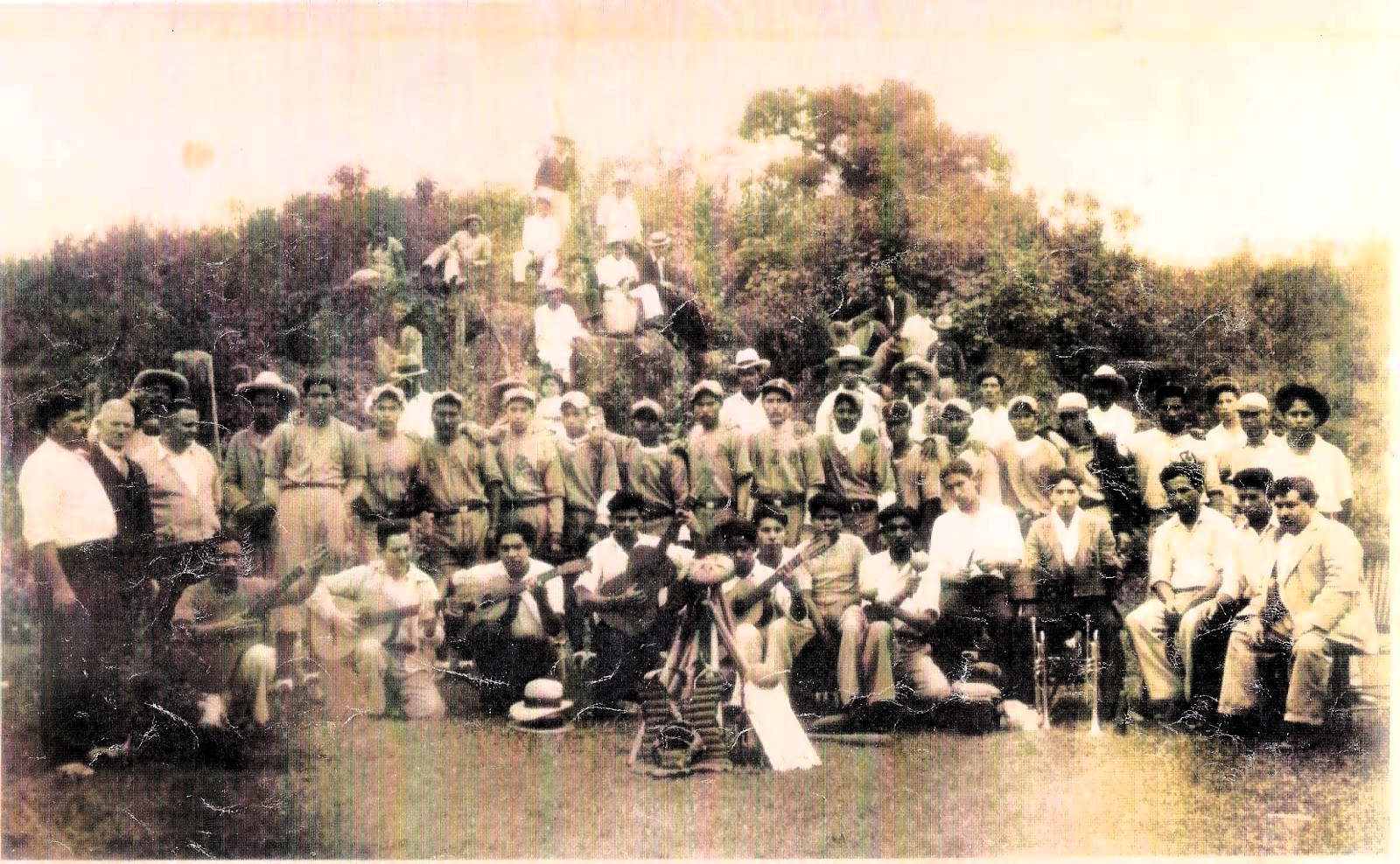
One of the most storied sites for Mexico’s militant working class was the San-Bruno textile plant in Xalapa, place of a massacre of workers on August 28, 1924. By the late 1920s, the Communist Party had become authoritative among the factory’s radical workers. A look at the C.P.’s nucleus, from modest beginnings to leadership.
‘The Work of a Mexican Factory Nucleus and its Result’ by J. Gomez from International Press Correspondence, Vol. 12 No. 27. June 16, 1932.
About 300 workers are employed in the “San-Bruno” textile factory, in the town of Jalapa, Mexico. This factory is the largest enterprise in the town, Prior to the establishment of the Mexican Unitarian Confederation of Labour, the workers were organised in the reformist trade union, affiliated to the local reformist trades council, and to the reformist trade union centre. Ever since 1927 the town committee of the Party has been paying special attention to the work in this factory. Support and help was given by the Party groups of the nearest factories to three Party members employed in the “San-Bruno” factory; individual comrades from the town committee were also attached to them. In the struggle against the reformist leaders of the trade union and of the local federation, a small group of Party members soon established its authority among the “San-Bruno” workers.
In 1928, the trade union of the “San-Bruno” textile workers decided to disaffiliate from the trade union centre, and joined the Unitarian Confederation in the beginning of 1929.
However, in spite of favourable conditions for the organisation of a Party nucleus, the C.P. town committee kept putting off its organisation. This kind of underestimation of prompt organisation of Party nuclei still prevails in a number of other town and provincial Party committees in Mexico.
However, in the beginning of 1929, the Party group in the “San-Bruno” factory was already fairly large and, at the instance of the central committee of the C.P. the Jalapa town committee formed a Party nucleus in the factory. Since its formation the Party nucleus has done a good deal of work; it has firmly established its influence among the workers, has secured leadership in the trade union, has added considerably to its ranks (about 20 per cent. of the total number of the factory workers belong to it now), has considerably strengthened the Y.C.L. nucleus, and from being a small Party group, has become the largest Party organisation in the town.
The unity of the workers led by the Party nucleus, their indomitable revolutionary spirit, their will to fight, compel the employer to accede to the workers’ demands. A school for the workers’ children has been opened at the expense of the employer, thanks to the energy of the revolutionary trade union.
During the three years work of the nucleus, and through its agitation and propaganda, the political level of the “San- Bruno” workers has been considerably raised. On the international revolutionary days (August 1st, November 7th, January 21st etc.) the workers down tools for one, one and a half or two hours. The “San-Bruno” workers take an active part in all demonstrations and meetings organised by the Party town committee or by other local or by other local revolutionary organisations (Unitarian Federation, I.L.D. etc.). The same can also be said about their participation in the movement of the Jalapa unemployed.
The following incident gives an idea of the political activity of these workers: in May 1931, the general workers’ meeting decided to expel the reformist leaders from the trade union and to demand their removal from the factory because of their non-appearance at the May Day demonstration. The employer was compelled to carry out this demand owing to the persistence of the revolutionary trade union and its decisive influence among the workers.
After a little while, the reformists decided to get again into the factory, having made sure of the support of the authorities and of the employer. The workers refused to let them enter the factory; they shut the gates and, remaining inside declared a protest strike. The factory was besieged by troops. For two days no one was allowed to either enter or leave the factory. In fact, the strike became a hunger strike, directed against the reformists, the authorities and the employer. In two days time the strike was won by the workers: the nucleus and the local C.P. committee mobilised the wives of the workers (organised in the “Rosa Luxemburg”, Women’s Labour Organisation in the factory) and women workers in other factories, and these women carried out a big agitational campaign among the soldiers who were besieging the factory. There was fraternisation between besiegers and besieged. The Governor had to order the withdrawal of the troops and give up the idea of forcibly “installing” the expelled reformists in the factory.
But struggle against reformist influence must not make the nucleus forget the rank and file members of the reformist trade union employed in the factory. There must be comradely relations between the Communists and these workers; efforts must be made to win them over to the side of the revolutionary trade union and Communist Party. For this purpose the “San-Bruno” nucleus might reorganise itself, forming Party groups in the departments headed by a Party organiser. Wherever the formation of Party groups is impossible, Party organisers should be at least appointed, care being taken that all the departmental units should work under the leadership of the factory nucleus bureau. This will render it possible to react better to all questions that concern the workers of the given department, and to bring them more effectively under the influence of the Party. This will bring the Party organisation still nearer to the factory workers, and will give an opportunity to extend and deepen the political influence of the C.P. among the workers.
The “San-Bruno” nucleus is still working without paying heed to the most important rules of conspiracy. The workers must be constantly aware of the work and activity of the nucleus, but there is no necessity for every one to know the composition of the nucleus, and who the leaders are, for in capitalist enterprises the nucleus is always and everywhere, under any conditions whatsoever, an underground organisation. It is of course unavoidable to keep quite secret the adherence of some of the Communists to the C.P. The reorganisation of the nucleus on a Party group basis will also have а considerable bearing on conspirative work, for instance, it will give an opportunity–in case of need—to organise small meetings of Communists–groups of 7, 8 or 10 people.
Despite favourable conditions, the nucleus does not yet publish a factory newspaper of its own. It is up to the nucleus to make a beginning as soon as possible with the publication of a small newspaper (printed or typewritten), and to establish around it a strong body of worker correspondents, not only from Party ranks, but also from the midst of non-Party workers.
Though the nucleus must lead all the work in the factory, it must not take possession of all the leading posts, it must, on the contrary, promote in every possible way to the leading trade union organs, non-Party activists, supporting them in their work, and preparing out of them the cadres for the Party.
Finally, in the midst of its work in the factory, its agitation and propaganda, so as to get all the factory workers under its political influence, the nucleus must also carefully study the composition of the workers with a view to approaching differently the different strata. It is of particular importance to pay considerable attention to special work with those who are closely connected with the countryside. Indian workers especially must be approached with great circumspection.
International Press Correspondence, widely known as”Inprecorr” was published by the Executive Committee of the Communist International (ECCI) regularly in German and English, occasionally in many other languages, beginning in 1921 and lasting in English until 1938. Inprecorr’s role was to supply translated articles to the English-speaking press of the International from the Comintern’s different sections, as well as news and statements from the ECCI. Many ‘Daily Worker’ and ‘Communist’ articles originated in Inprecorr, and it also published articles by American comrades for use in other countries. It was published at least weekly, and often thrice weekly. Inprecorr is an invaluable English-language source on the history of the Communist International and its sections.
PDF of full issue: https://www.marxists.org/history/international/comintern/inprecor/1932/v12n27-jun-16-1932-Inprecor-op.pdf

