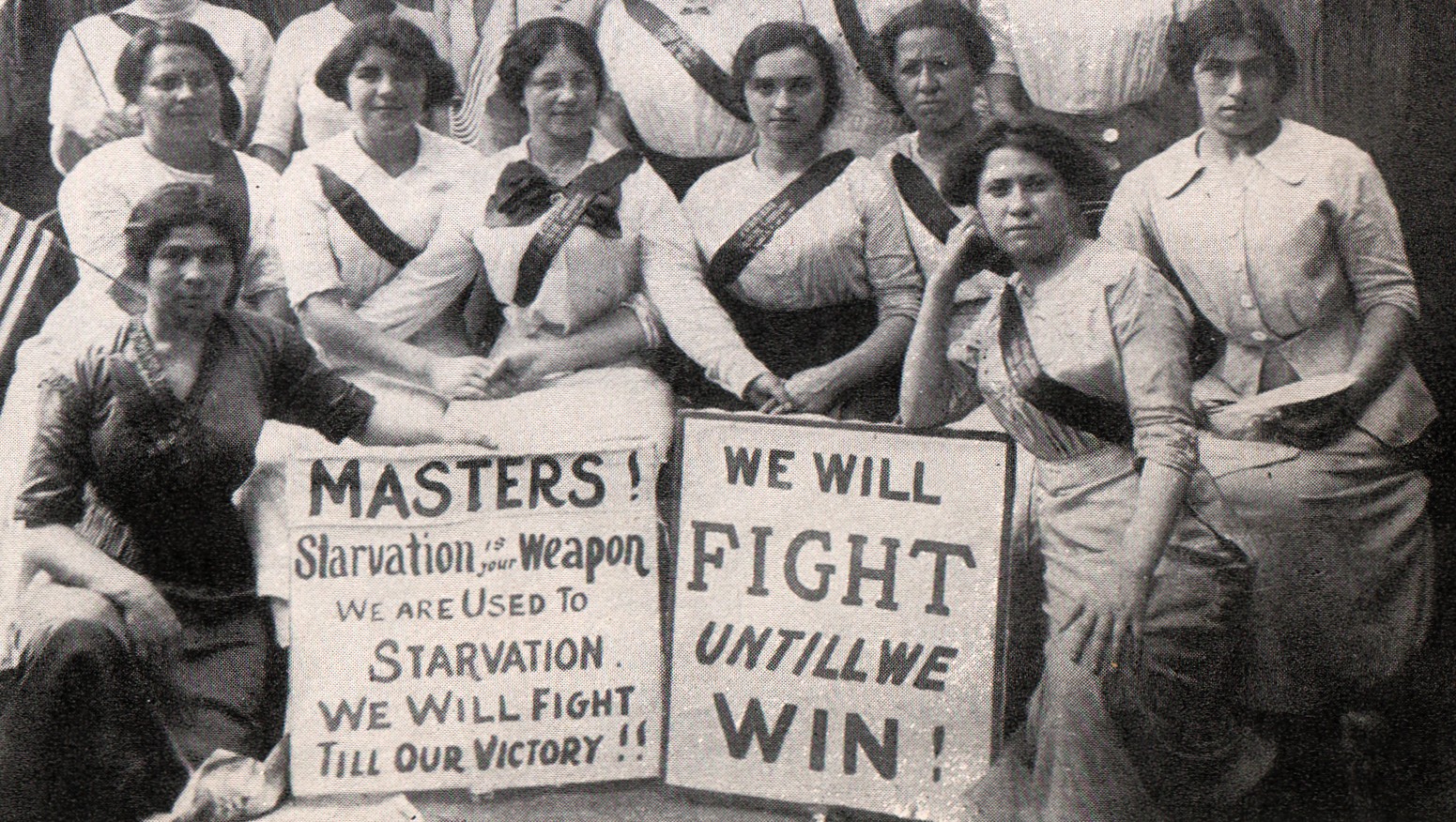
Wolfson with a precise mid-1920s overview of women in the workplace, where they are organized, and why gathering information is difficult. Theresa Wolfson, born in 1897, was a ‘red diaper baby’ who was a member of the Inter Collegiate Socialist Society in college, eventually getting her doctorate in economics (attending schools such as Adelphi, Columbia, and Brookings) in 1926. She devoted her life to educational and research work for the labor movement, particularly for women workers. She was the Education Director for the International Ladies’ Garment Workers’ Union and taught at Bryn Mawr and Brookwood Labor College, later at Brooklyn College for decades, writing frequently and long a member of the League for Industrial Democracy.
‘Where are the Organized Women Workers?’ by Theresa Wolfson from Justice (I.L.G.W.U.). Vol. 7 No. 26. June 26, 1925.
During the last ten years, the question, “Are women organized?” has come up again and again. The movement for special legislation for the woman worker, which has arisen in every industrial state in the country, received its strength and impetus from two factors. The woman worker has been, and still is, one of the most exploited elements in industry. Secondly, the woman worker has been considered “unorganizable.”
The investigations of the Federal Women’s Bureau, the National Bureau of Economic Research, the Russel Sago Foundation, the Consumer’s League, and various other research organizations have been unanimous in their findings that woman’s wages are pitifully low, that her working conditions are generally poor, and that her opportunities for advancement are extremely limited.
Recently the first part of the question as to whether women can be organized has been answered by a statistical study, telling where they already are organized. The National Bureau of Economic Research published a study of the “Growth of Trade Unions in America,” with a special chapter devoted to the topic of “Women in Trade Unions.” Mr. Leo Wolman, who is responsible for the study, collected from the various international unions the approximate number of women in their membership. This information, which, by the way, was extremely difficult to secure because of the policy of most unions not to separate membership by sexes, he contrasted with the results of a similar study which he made in 1910. The resulting information thrown out a challenge to current ideas. There is apparently an increasing body of women workers who are members of trade unions. They have wrested for themselves not only higher wages and better working conditions than their unorganized sisters, but also greater protection for themselves and their jobs.
Where are the organized women workers? In 1920, twenty-one per cent of the total female population of the United States was employed in industry. Of the eight and a half million women in industry, Mr. Wolman estimated that one-fifteenth, or approximately 396,900 women are organized in trade unions in the United States.
When this figure is compared with the number of organized women in England or Germany, it seems very small indeed. And when it is compared with the number of women who are in industry in the United States, it seems like nothing more than a drop in the bucket–but it marks a fivefold increase of woman membership in American trade unions in the ten years from 1910 to 1920!
More than half the gainfully employed women work in professional, domestic and personal services, and clerical occupations. On the other hand, the largest percentage of organized women are to be found in the needle trade unions. The fact that the occupations employing the most women are the least organized lends itself to interpretation. Mr. Wolman attempts to explain this fact by the statement that even the men employed in these occupations are unorganized. Since a very small per cent of the men are employed in these occupations, and since both domestic service and clerical occupations have long been considered “women’s Jobs,” it would seem that other explanations are necessary than those given by Mr. Wolman. It is in this group of occupations that all the traditions of what a woman can do, and why she works, are to be found. The peculiar isolation of the domestic worker plus the fact that the work in traditionally “woman’s” is undoubtedly chiefly responsible for the lack of organization. Where men are employed in most of these occupations they enter as “intruders”–regarded in the same fashion as women workers who enter manufacturing and mechanical industries.
The needle trades and particularly the clothing industry, are responsible for forty-two per cent of the total number of women organized in trade unions. This marks a tremendous increase in organization among women in these occupations, for in 1910 only eleven and two-tenth per cent of the women working in the clothing industry was organized.
The organizations having the next largest group of organized women are the Boot and Shoo Workers, the Textile Workers, the Railway Clerks and the International Brotherhood of Electrical Workers (particularly the Telephone Operators Department). This group of unions were responsible for approximately thirty-three per cent of the total number of organized women, (Since 1920 the Amalgamated Textile Workers’ Union has practically disbanded and the Telephone Operators’ Department of the Electrical Workers’ Union has lost the larger part of its membership as a result of the great telephone operators’ strike of 1921.) It is Interesting to note that whereas the Railway Clerks’ Union claimed about sixty-two women members in 1910, in 1920 Its women membership was reported as being thirty-five thousand. The influx of women into an industry which fifteen years ago was considered a “man’s” industry is an interesting index of the changing sex, as it were, of the occupation, with changing processes.
The printing and publishing industries comprise the next best organized industries as far as women are concerned. The International Brotherhood of Bookbinders, the Printing Pressmen, and the International Typographical Union had eleven and six-tenth per cent of the total number of women engaged in the industry organized in 1910. In 1920, Mr. Wolman estimated that twenty-five per cent of the women were organized in these unions. Organized wo men are to be found in the pottery industry, in the food industries, in cigar and tobacco manufacturing, and in the paper and pulp industry. The extent of organization, however, is very small and has shown a very small increase since 1910.
The few professional unions, like the Actors, the Federation of Teachers, the Federation of Musicians, and the Bookkeepers and Stenographers’ Union have a comparatively large women membership in proportion to their total membership, though extremely small in proportion to the total number of women engaged in the professions.
In surveying the field of organization among women workers, it is evident that, with the exception of clothing industry, where women are more or less predominant, as far as numbers are concerned, women are organized in those industries having comparatively strong unions of men workers. In other words, there are practically no women’s unions in the United States. This lends itself to an interpretation, but since Mr. Wolman undertook a statistical study only, he makes little analysis of the figures he has gathered.
There are disadvantages in making a statistical study in the labor movement. Most trade unions keep no statistics, certainly do not separate what figures they keep, by sexes, or by industrial centers. On the other hand, statistics alone do not tell the entire story of women in trade unions, The organization of women workers, like the organization of men workers, is most successful in large Industrial centers. There is no way of estimating, statistically, the percentage of organized women in these industrial centers to the total number of women employed. For this reason we are unable to estimate the real strength of the small nucleus of organized women. Concentrated in cities like New York, Chicago, Philadelphia, Boston, they may be a definite factor in pulling up the wages of the unorganized women in the city. Spread thin over the vast country, they may have no influence at all upon the economic status of the eight and a half million working women of whom about three and a half millions are employed in industries. However, these are questions which will someday be answered by the trade union movement itself.
The weekly newspaper of the International Ladies Garment Workers Union, Justice began in 1909 would sometimes be published in Yiddish, Spanish, Italian, and English, ran until 1995. As one of the most important unions in U.S. labor history, the paper is important. But as the I.L.G.W.U. also had a large left wing membership, and sometimes leadership, with nearly all the Socialist and Communist formations represented, the newspaper, especially in its earlier years, is also an important left paper with editors often coming straight from the ranks radical organizations. Given that the union had a large female membership, and was multi-lingual and multi-racial, the paper also addressed concerns not often raised in other parts of the labor movement, particularly in the American Federation of Labor.
PDF of full issue: https://www.marxists.org/history/usa/pubs/justice/1925/v07n26-jun-26-1925-justice.pdf

