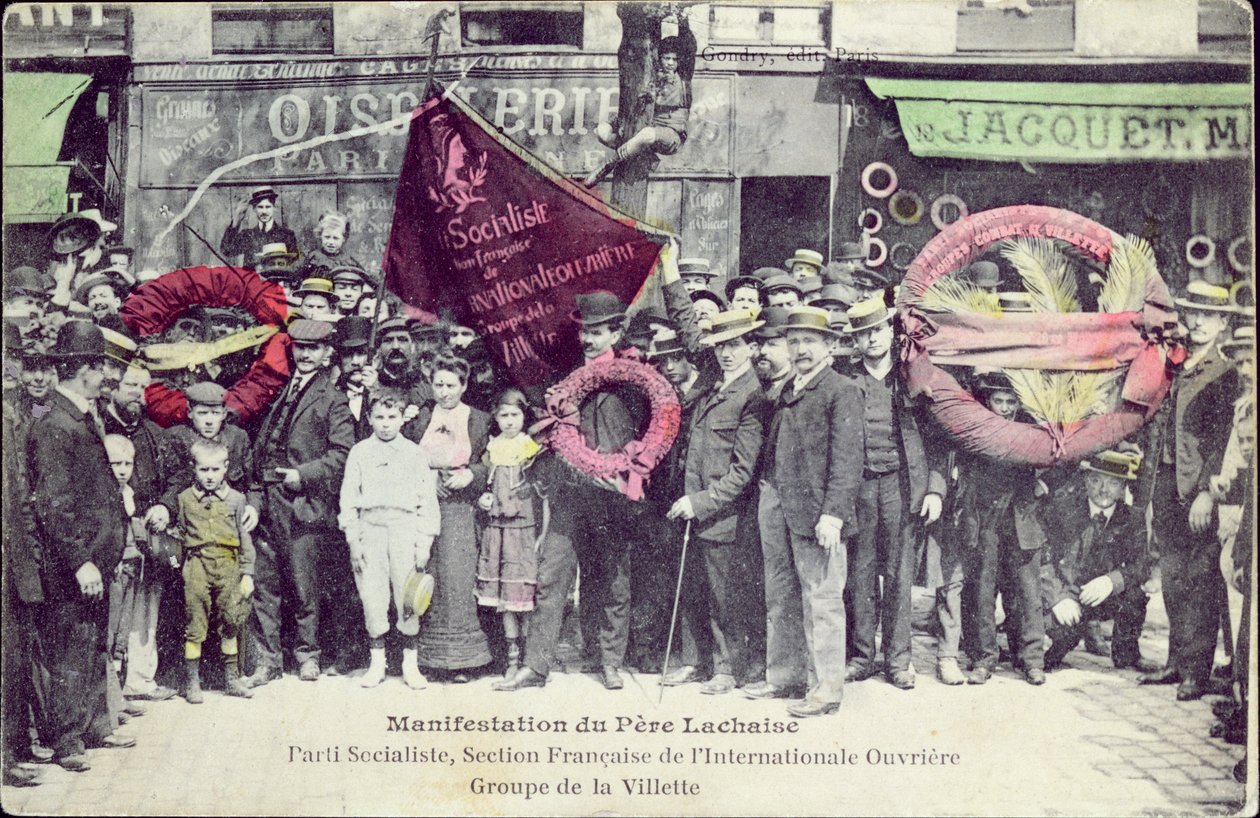
Another of Paul Louis’s fine pre-war series introducing U.S. Socialists to the movement in France where, as this articles make clear, the pressure to form cross-class blocs with bourgeois forces, especially with that country’s historically strong Radical tradition, gas been a constant danger for the pursuit of independent class politics; that essential emancipatory process whereby the working class transforms from a class acting ‘of itself’ to one acting ‘for itself.’
‘Socialist Party and Republican Bloc in France’ by Paul Louis from New Review. Vol. 1 No. 21. October, 1913.
The question of the relations between the Socialist party and the diverse factions of the anti-Socialistic Republicans is, one may say, a permanent issue in France. It never entirely disappears from view, but there are moments when it is of especial interest to the public, and particularly the proletariat. At the present moment it again occupies our interest to a rather unusual degree.
In the radical wing of the Republican party, the governing party, there have always been men who, either from personal conviction or electoral expediency, have looked with favor on making advances to the Socialists. Likewise among the Socialists there have always been some who for identical reasons were inclined to accept concessions from the Republicans. At the present writing, those “on both sides of the barricade,” to adopt a favorite expression of M. Clémenceau, who have constantly preached this alliance, are renewing the assault. In their opinion the circumstances are too favorable to let them slip by without at least an attempt to exploit them in the interest of their pet notion.
How is this renewed enthusiasm to be explained? What are the objections so often and so victoriously raised against this policy of entangling alliances, so decisively condemned by past experience?
It is well known that France, in addition to the Socialist, the Radical, and the Moderate Republican parties (the last, moreover, nominally divided into two wings), has also several factions which we ordinarily refer to as the obsolete, the reactionary parties. Here we find, for instance, the Clericals “of popular action” who occasionally profess reconciliation with the republican form of government. No one is any longer fooled by such professions. The past has shown that this group is of a distinctly “confessional” character, blindly following the dictates of the Holy See, and ready to support with eagerness any monarchistic venture. Then come the monarchists proper with one or two labels, the Royalists with their dream of the Duke of Orleans on the throne–with or without a parliament–and the Bonapartists nursing their ideal of a Caesarian restoration. Neither the Bonapartists nor the Royalists–nor, for that matter, the Clericals themselves,–form a serious menace to progress, for none of them has any deep roots in the masses. The French people has not yet forgotten that the Bourbons came back in 1814-15 in the baggage wagons of the foreigners, and that in 1848 the Orleanist monarchy succumbed because it denied universal suffrage. It still remembers that the First Empire led to Waterloo, the Second to Sedan, in each case bringing territorial losses. Clericalism never gains enthusiastic adhesion in a country whose culture is essentially secular and whose innate scepticism protects it from the domination of the priest.
But these three parties (Bonapartist, Orleanist, Clerical), powerless and almost inoffensive in themselves, become dangerous when, quite outside of their own circles, restricted both in electoral power and in influence, they obtain more or less effective support. They become actually prominent when they lend the assistance of their organizations to the “Tricolor” Republicans, as Marx called them, that is, to those Republicans who use all their wits to counteract the proletarian propaganda and to maintain the privileges and the influence of the bourgeoisie. That is where we find ourselves at present: the Republican party has formed a new alliance with the retrograde “obsolete” factions; the fusing element has been a common fear, a common hatred of Socialism and Syndicalism.
It is now exactly eight years since the political and social reaction, bold enough now to dispense with all hypocrisy and disguise, has been in complete control of France. It took possession of the country the moment all the old divisions of opinion fell on the apparent, if not the definitive, settlement of the religious question. The mass of the Republican party changed front: the religious problem gave way to the social question. The resulting divisions in the French people did not correspond necessarily to those of yore. Proletarians and bourgeois, especially petty bourgeois, had been able to march shoulder to shoulder in the fight to free laic society from Roman tutelage, to abolish the church budgets, to drive out the congregations, and give back the schools to purposes of education. Now, however, the proletariat and the bourgeoisie were to part company. The proletariat was determined to shake off the shackles of bourgeois domination. The bourgeoisie had climbed into power in the middle of the nineteenth century and the consolidation of the parliamentary system was the monument to its triumph. It was not willing to see itself dethroned by the working masses. In its own defence the bourgeoisie resumed the tactics that had succeeded in 1848, and in 1871 after the temporary triumph of the Commune. It attempted to fuse all conflicting factions, Free-Thinkers and Clericals, Monarchists and Republicans. The issue was to preserve the present social order against those who were determined to erect a new one on its ruins.
This coalition, of course, was not a perfect one. I mean that it was not inherently permanent and defections were constantly taking place beneath an apparently unified surface. I mean also that a certain number of advanced Republicans, although anti-Socialistic at heart, refused to follow to the extreme those conservative Republicans who were bent on combining all the forces hostile to Socialism. Such men, tossed back and forth between the Socialists and their opponents, were trying to mix oil and water. They succeeded only in leaving the path unobstructed to the forces of repression and reaction.
I cannot rehearse all the details of the struggle during these past eight years. Whether the cabinets were headed by Clémenceau, by Briand, by Caillaux or by Barthou, these years have been featured by repeated acts of oppression on the working class as a whole, by reiterated threats and by brutal acts against the syndicats (labor unions), by an exaltation of Nationalism and Imperialism which tended toward deafening every anguished cry from the multitudes in the uproar of chauvinistic acclamation, by the defeat of reforms solemnly promised, whether of fiscal or of labor improvement, by the undertaking of foreign expansion such as the Morocco enterprise. In every case the working class, organized either politically or economically, has tenaciously given blow for blow, always bent on increasing its offensive power. The figures of membership which the Socialist party and the Federation of Labor now present, bear eloquent witness to the fact that the struggle has not been all in vain.
But while this offensive movement was gaining in momentum, governmental repression, sustained by the Moderates, by the Radical majority, by the Clerical and Monarchical coalition, became more and more severe.
I have already laid bare in the NEW REVIEW the forces that conspired to effect the election of M. Raymond Poincaré to the Presidency of the Republic. That election had as a direct result the forming of the Barthou Cabinet, which adopted as its fundamental program the reestablishment of the three years’ military service. This meant the substitution of the idea of the “professional army” for that of the “national army” such as the Socialists have been demanding, including also all the material and moral evils which the increase of militarism entails. Naturally objection was raised in the working class and in the working class alone. The numberless meetings organized in Paris and in the provinces by the Socialists and the unions, the vast petitions set in circulation, especially the unrest developing in the barracks against a policy which confined the soldiers under the colors for another year, brought the will of the public authorities to an orgasm of violence. A bill was introduced in parliament to suppress the General Federation of Labor (C.G.T.) and to subject to constant restraint and menace the trade and industrial unions, by authorizing the government to intervene in the mechanism and administration of such organizations. This was the most violent, the most bare-faced intrusion that could well be imagined into the existence of proletarian organization; it was an attack on liberty fit to inflame every friend of liberty. To facilitate the work that would follow the passage of this law, the government organized a general system of arbitrary arrests among the secretaries of the unions.
Premier Barthou, who had charge of all this repressive activity, was all the more vigorous against organized labor in that the proletariat represented the only power capable of thwarting his policy of retrogression. He was especially anxious to fix public attention on the war he had begun on the C.G.T. and the allied groups, in order the better to divert attention from the financial crisis, that old bugbear which haunts every strongly militarized state in Europe, but which is nowhere else so conspicuous as in France. The cost of colonialism, imperialism and militarism is so enormous in France, it has increased so astoundingly in recent years, that the annual deficit rises to 700 millions of francs (about $140,000,000), while the normal revenue reaches 4,700 millions (about $940,000,000). Furthermore these 700 millions take no account of the exceptional provisions for armaments which must be made in answer to similar expenditures covered in Germany by an extraordinary war tax. Of course, the French government can have recourse to loans, but its bonds are already 17 francs below par and to borrow is always a confession of embarrassment. In any event, the deficit will reappear the following year with no less amplitude. Doubtless the Barthou government, like that of Germany, can fall back on the stored up wealth of the bourgeoisie, but revenue has been traditionally raised in France by indirect, never by direct contribution; with the result that, all practical solutions of the problem having been put aside or postponed, the deficit remains and grows ever larger. The repressive policy of the present cabinet is thus a device to excuse, through its energy against the foes of the social order, its ineptitude, its sloth in the face of financial disaster. The upper and middle bourgeoisie has fallen blindly into line. The official republic is just as violent in its opposition to the proletariat as was in former years the Empire or the Monarchy of July. The obsolete factions have been unable to contain their joy at the prevalence of this absolutism, this Caesarism operating under the label of democracy. That is why new life has been given to the idea of a reconstruction of the Republican “bloc”, which would bring together the Socialists and the Radicals who still proclaim their fidelity to their ancient doctrines, their belief in a government of the people, by the people, for the people.
This “bloc” was actually in operation from 1899 to 1905. It lasted from the advent to power of Waldeck-Rousseau down to the time when the Socialist party accomplished its unity. It is worth while to glance at a few episodes of the history of Socialism in France.
When, toward the end of 1898, nationalistic jingoism was threatening republican institutions in France and there was some ground for fearing a coup d’état by the generals of the army, the Socialist organizations, traditionally disunited and in five discordant factions, formed a vigilance committee which became one of mutual co-operation to take any measures necessary to defend public liberty. Some months later, in June, 1899, the Waldeck-Rousseau cabinet was formed of members from the different republican groups. The portfolio of commerce was entrusted to an eleventh-hour Socialist, M. Millerand. Precisely because the Socialists had always been divided, they had never considered the question of participating in the executive authority of a capitalistic regime, but it at once became obvious that such participation was incompatible with the principles of International Socialism. The advent of M. Millerand to the cabinet provoked a great crisis in the party. One faction of the Socialists followed him. Others, notably the Guesdists and the Blanquists, declared the alliance broken and reserved their liberty of action; and in fact, whenever the government sided against the working class by sending troops to interfere in strikes, they attacked the government without mercy. To justify their attitude, the “ministerial” Socialists pointed to the perils that threatened free institutions, the necessity of quelling Clericals and Caesarians, the possibility of obtaining, when opportunity offered, reforms for the working class. The anti-ministerials retorted that the bourgeois government, whether or not a Socialist were part of it, would always be driven to proletarian repression, that by such collusion Socialism would lose its reputation, abolish its reason for existence and proclaim its own treason in letting itself be spattered with the blood of repressed workers.
One group of Socialists not only clung to its policy of participation in power, but when M. Millerand retired, it became more ministerial still under M. Combes, who succeeded to the premiership of Waldeck-Rousseau. The Republican “bloc”, that is to say, the alliance of this faction with the other groups hostile to the Church and the monarchists, had been consolidated. It was no longer a question simply of crushing Caesarism, already vanquished and reduced to impotence; it was a question rather of sustaining a policy of secularization, which was to begin with the dissolution of the congregations and end with the separation of Church and State. The uncompromising Socialists, those faithful to Socialist doctrine, did not deny their support to this policy, but they held that such conditional and intermittent support did not prevent them from attacking the Combes ministry whenever it entered the fight against the working class. The Socialists who had earned the title of “reformists” had concluded with the radicals an almost permanent compact, which found expression in the Delegation of the Lefts. This Delegation of the Lefts was a committee to which all the groups participating in the bloc sent representatives with full authority, and this caucus determined the policy of the whole bloc. Since the government accepted the suggestions of this committee, where in fact it found only friends, this Delegation came in the last analysis to direct the whole governmental policy. The trend taken by Reformist Socialism in such an atmosphere is obvious. It was at this time that a Socialist favorable to the bloc became vice-president of the Chamber, thanks to Radical votes.
Looking back over ten years, it becomes apparent that the bloc has done absolutely nothing for the working class. The proletariat was harassed under the Combes ministry as under those before it. The only result has been that the policy of certain Socialists has aroused in labor union circles a feeling of distrust that has produced a lasting fissure in the party. Moreover, if the bloc brought half of the Socialists in France into better relations with the Republican bourgeoisie, it in reality created between that half and the rest of the Socialists an abysmal gap. Socialism now gave the spectacle of lamentable discord. The most painful polemics began between its members. The accusations that were passed back and forth effectually sterilized all propaganda. Increase in Socialist party membership came to an end. The time had come for the abolition of the Republican bloc and the formation of the Socialist bloc, that is, of Socialist unity. This was the labor accomplished by the international congress of Amsterdam in August, 1904, and the national congress of Paris a few months later.
It is not my intention to repeat here the historic debates that characterized these two assemblies. It is well known that the congress of Amsterdam condemned the French Reformists and all alliances with the bourgeois parties, at the same time sustaining the principle of the class struggle. The French Reformists had the alternative of yielding or of leaving the International. With great loyalty they adopted the former course. The unity program adopted at the Paris congress did not, of course, exclude the policy of the Reformists, but it proclaimed the hostility of Socialism to the present State. There was uniformity of sentiment on the following points: 1, Socialism must offer permanent and fundamental opposition to the bourgeoisie; 2, the struggle of Socialism is a class struggle; 3, the Socialist deputies in parliament must reject compromise and form a solid block against all the bourgeois factions of whatever color. This was the end of the Republican bloc, and in fact, before the solemn adoption of the unity platform, the bloc had been shattered, dismembered by the pressure of circumstances.
This, nevertheless, is the bloc that some would like to resurrect at present. Last April a cautious and timid movement in this direction was begun in the ranks of the Radicals and among certain ones of the Socialists. One can easily understand the desire of certain Radical leaders to return to this antiquated policy, of which the best thing that can be said is that it no longer corresponds to the present need. Their problem, of course, is simply to overthrow the persons now in power and then to carry out in their places an exactly similar program. Conspicuous among such men is M. Caillaux, who was President of the Council in 1909 and who, a faithful follower of his predecessors, continued their policy of repression against the labor unions. It is unfair to ask of a Premier of bourgeois convictions to desert the defence of the bourgeoisie and blaze the trail for advancing Socialism. M. Caillaux, for that matter, is neither better nor worse than those before and after him. He is simply the “business man.” His conception of the “affairs of France” is limited to financial matters to be run with a view to the prosperity of High Finance. He was, as he still is, at the head of various private interests of some magnitude and his official authority would be a splendid asset to these interests. Other ex-ministers, such as M. Messimy, are in favor of the bloc. M. Messimy was one of those who tried to fix on the Socialists and Syndicalists the responsibility for the propaganda in favor of army desertions. One should not interpret the interest of such men in the bloc as an intellectual evolution on their part resulting in sympathy for our ideas. They are looking simply for a return to power up any ladder that happens to be convenient.
Add to this the fact that the legislative elections take place in May, 1914, that is, within a few months. Already the candidates are selected. In 1910 many Radicals got their places only with the support of more or less Socialist votes. These men would like to be sure of retaining this support as a means to keeping their seats. They hope that the restoration of the bloc would free them, even in the primaries, from all Socialist competition.
These men would be the real, in fact the only, beneficiaries of the proposed coalition. Their enthusiasm for it is quite intelligible.
But why should any Socialist ever think of joining in such a scheme? There are some, who as a matter of doctrine believe that Socialism will never get anywhere on its own feet, and in consequence, that it ought to avail itself of any crutch useful to its cause. They assert that at the present moment the Radical party is divided into ministerials, in favor of proletarian repression, and anti-ministerials, hostile to such repression. Why not join hands with the latter? This statement has a poor foundation of fact. The anti-ministerials of to-day are the ministerials of yesterday, when they scrupulously followed the present policies of repression. Other Socialists, again, have a direct personal interest in a renewed alliance. They are the deputies who in 1910 were elected with the aid of Radical votes, and as candidates hope again to win over a certain portion of the petty bourgeoisie. But surely these personal considerations are secondary, even admitting out of fairness that such partisans of the alliance with the bourgeoisie really have at heart the progress of the working class. This bloc is none the less a combination to be avoided, as it is in fact ridiculed by the majority of the party.
Here are, in brief, the reasons against it:
1. The doctrine of International Socialism has not varied. It still rests on the principle of the class struggle, and the moment this principle is admitted no permanent pact can be made between the Socialist party and the parties of social conservatism. It is true that in certain countries the Socialists have come to an understanding with the Radicals to bring about some common measures. Such, for example, was the case in Belgium where Socialists and Liberals combined to effect educational reform and universal suffrage. The same situation is about to arise in Holland, where the same problems are in the foreground. But in neither of these cases did the Socialist party so compromise itself as to paralyze its opposition to the social system of capitalist domination. That is why, in Germany, while the Radicals were voting for the increase of armaments, the Social-Democrats fought it to the last ditch. The temporary and specially conditioned fusions concluded in Germany, Belgium and Holland in no way constitute deviations from the attitude necessarily imposed by the essence of the Socialist movement. In France, on the contrary, they ask of the Socialists who participate in the bloc support for such and such government measures. The Socialists would have to assume responsibility for these measures and they would be forced by a rigorous destiny to take a position against the working class. We must bear in mind that in France, at the present time, the social question is the only criterion for the classification of parties. In this respect France occupies a unique position in Europe, for everywhere else political or religious questions share the spot light with the social question.
2. The formation of the bloc could be brought about only at the expense of Socialist unity. It is clear that if to-morrow a majority could be scraped together in favor of a return to alliances with the Radicals, a multitude of elements, at once the most earnest and active in the party, would bolt and form another organization which could more justly claim the title of International. Unity has won its spurs. No one is going to think seriously of deserting it.
3. In past years when the Socialists lent their support for longer or shorter terms to the bourgeois Republicans, it was because the democratic form of government was threatened by–in a sense external dangers. Bonapartist Caesarism or Monarchical Clericalism was delivering most disturbing attacks on the Republic. Socialism accordingly was conscious of the fact that it can be only republican in form, that in harmony with the brilliant demonstration of Marx, social antagonisms are best developed in a republic. It therefore stood ready with its disinterested assistance to put to rout the champions of an obsolete past. Its assistance unfortunately was doubtless only too disinterested, for its courtesy was only too often repaid with atrocious acts of repression aimed at the proletariat.
To-day, however, the danger is not external, but internal. To-day we find these same Republicans in alliance with the Bonapartists and the Catholics to defend the capitalist system, to repress the workers and keep them in subjection. It is these same Republicans now in power who, under the cover of republican forms and picking up all the weapons of Caesarism, are redoubling tyrannical aggressions against the unions and are everywhere enkindling an arrogant and fictitious nationalism. One cannot imagine an issue on which the two parties could unite.
If perchance there be among the Radicals a few far-sighted men with decency enough to repudiate the treacherous violence of their party and with some enlightenment in the direction of social transformation, they are quite free to give their support to the Socialist candidates, to choose our candidates in preference to those of our opponents. We meanwhile will keep clear of all entanglements.
To contract an alliance with one or another of the bourgeois factions would be to betray the proletariat by playing the cats-paw in certain jobs which the Socialist conscience repudiates. It would be to paralyze for the future all Socialist growth. The examples of the past are before us. As long as the old bloc subsisted, the Socialists who had a part in it were always confronted by two alternatives: either to break the alliance or to approve and justify measures of coercion against their striking brothers. If Socialism were to renew such contracts, impossible of execution, it would not only be acting with fraudulent disloyalty, but it would also discredit itself with the proletariat. It would be mating with individualistic anarchism and would lose all efficiency for long years to come.
Let the Republican bourgeois make any promises they see fit. French Socialism, with good sense born of bitter experience, will reject any advances towards an alliance with them.
New Review was a New York-based, explicitly Marxist, sometimes weekly/sometimes monthly theoretical journal begun in 1913 and was an important vehicle for left discussion in the period before World War One. In the world of the Socialist Party, it included Max Eastman, Floyd Dell, Herman Simpson, Louis Boudin, William English Walling, Moses Oppenheimer, Walter Lippmann, William Bohn, Frank Bohn, John Spargo, Austin Lewis, WEB DuBois, Maurice Blumlein, Anton Pannekoek, Elsie Clews Parsons, and Isaac Hourwich as editors and contributors. Louis Fraina played an increasing role from 1914 on, leading the journal in a leftward direction as New Review addressed many of the leading international questions facing Marxists. The journal folded in June, 1916 for financial reasons. Its issues are a formidable archive of pre-war US Marxist and Socialist discussion.
PDF of full issue: https://www.marxists.org/history/usa/pubs/newreview/1913/v1n21-oct-1913.pdf

