The ‘Land of the Free and the Home of the Brave’ began with the banning of brave people demanding freedom, lest they disturb the profits of the Founders.
‘Revival of Alien Sedition Laws’ by J. Ramierz (Charles Shipman) from The Daily Worker Magazine. Vol. 2 No. 52. May 17, 1924.
APPARENTLY “Silent Cal” Coolidge does not know his American history very well. And it is perhaps best for his peace of mind.
Otherwise he might see what happened 74 years ago to John Adams, the second President of the United States, of what is going to happen to him.
Adams was like Coolidge in many ways, although a far bigger man from whatever angle you look at him. Like Coolidge, he was a tool of the moneyed interests. He was almost as taciturn as “Silent Cal,” and he had the same mean-looking mouth.
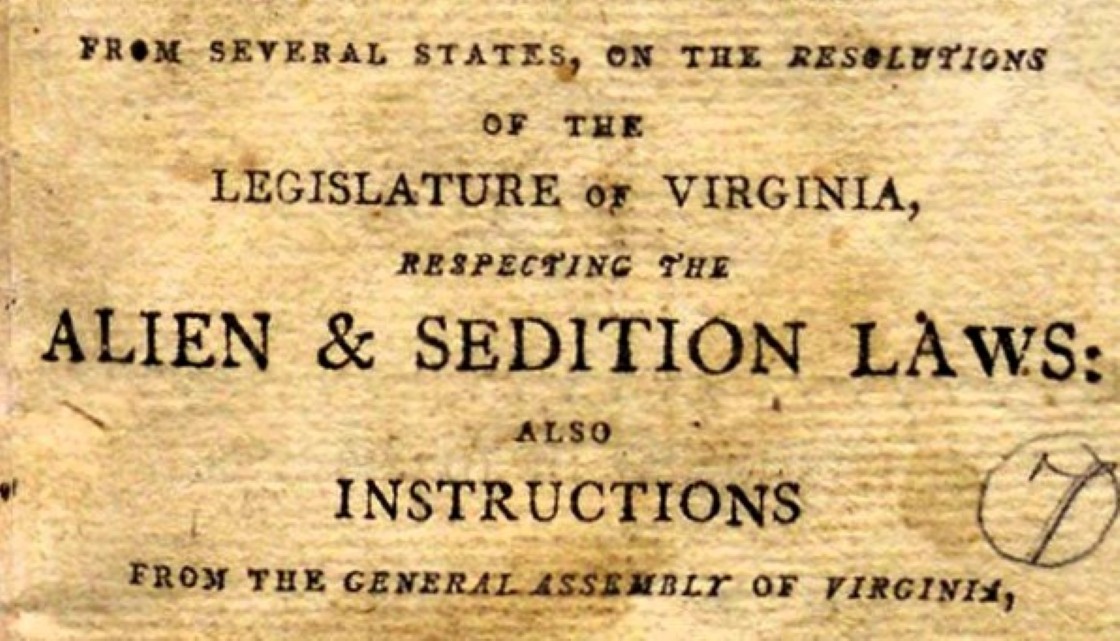
In the year 1798, the reactionary Adams Administration forced through Congress a series of laws known as the Alien Sedition Acts. These measures looked so much like our present-day “Criminal Syndicalist laws” and “Anti-Alien bills” that it is clear they belong to the same family tree. Two years later, the Adams Administration fell with a crash, dragging down the whole bloated structure of “Federalism” with it. Thomas Jefferson and the “Democratic-Republicans” were swept into power on the crest of what has become famous in American history as “the great Democratic revolution of 1800.” Jefferson’s principal slogan was: “Down with the Alien and Sedition Acts!” and the American people rallied to this slogan en masse, notwithstanding the lying propaganda of the kept press of the day. There were other important, and perhaps more fundamental, conditions in Jefferson’s victory over the Federalists, but the Alien and Sedition Acts were certainly a potent factor.
The Federalists were the Sinclairs and Denbys and Senator Falls of President Adams’ day. They represented (and practiced) “high finance.” They stood for what Adams described as government by “the educated and propertied few.” They had no faith in the common people. The Federalist Party ruled the country from the establishment of the Constitution to the so-called Jeffersonian revolution of 1800.
“The predominance of the Federalists in Congress, and in the country,” says the noted historian J.S. Bassett, “suggested to the leaders of the Party that they might do what they pleased. It was a temptation of pow er to which the wisest of them yielded. Their idea that government should be in the hands of the capable classes might now, for the first time in the history of the new government, be put into operation.”
They planned a concerted attack against the farming and poorer urban classes and, naturally, they did not fail to make use of the bogeyman of “un-Americanism” to further their dark, aristocratic, un-American, purposes.
Restrictive laws against the workers and farmers always seem to go hand in hand with special legislation against the foreign-born. The association is not accidental.
A measure which might be too unpopular if labelled frankly “anti-labor” may win a certain degree of acceptance when fixed up as “anti-alien.” No “anti-alien laws” have ever been passed which applied to Wall Street manipulators or the agents of capitalism in general.
First the Federalists took up the question of naturalization. Previous laws had given this privilege to aliens resident in the country 5 years. It was now enacted that foreigners who wanted to become citizens would have to prove they had been in the country 14 years, and would have to make a declaration of intention 5 years be fore sending in their final application.
By means of the vicious Alien Acts, the foreign-born masses were discriminated against in many ways. “Selective immigration” was proclaimed, as well as other similar schemes that are being revived now.
There was also the Sedition Act. “The Sedition Act,” says Bassett, “was intended to deal with citizens or aliens who, too severely criticized the government.” Like the Alien Acts, it originated in the Senate, where Federalism was rampant.
In reading over John Adams’ Sedition Act, one is struck by the startling resemblance to the Michigan “Criminal Syndicalist” Law, under which W.Z. Foster and Charles E. Ruthenberg have been persecuted–and, indeed, to many other State Criminal Syndicalism Laws throughout the country. In its final shape, it made it a high misdemeanor “unlawfully to combine and conspire” or “to commit, advise, or attempt to procure any insurrection and riot, or unlawful assembly, or combination.”
Under such a law, the powers that be could jail a class-conscious worker for almost anything–which is also the case under our contemporary assortment of Criminal Syndicalist laws. Ten persons, all of whom of course, belonged to an opposition party, were tried and convicted under the Sedition Act. Many others were indicted but not tried. The political effect of these cases was to make popular martyrs of those whom the government was persecuting. The state legislators of Kentucky and Virginia passed strong resolutions of protests, the Kentucky Legislature declaring that it would refuse to recognize the law. On all sides, the abhorrent Alien and Sedition Acts were denounced as un-constitutional and as a violation of the elementary rights of free speech and free assembly. Indignation among the enraged people ran high.
The Federalist Party tried to destroy the effect of the Kentucky and Virginia resolutions by Insinuating that they were all part of a French plot–the French plot theory being an expedient which the adroit Federalists could employ on any occasion. But, Bassett tells us, “The imputation of a French plot could not be sustained by the Federalists. The public realized that the issue was the Alien and Sedition Laws and back of them was the consolidating tendency of Federalism.”
The results were seen in the outcome of the election of 1800.
“Silent Cal” Coolidge is in high favor in the Republican Party today. He is without peer, as a servant of Wall Street and consequently, he is without peer as candidate for the Republican presidential nomination. He has given his approval to Mr. Johnson’s “Alien Bill” and has expressed himself as decidedly pleased with Mr. Sterling’s “Sedition Bill.” It was as a leading member of his Cabinet that the underworld character, Harry M. Daugherty planned his brutal raid on the convention of the Communist Party in Berrien County, Michigan, indicting Foster, Ruthenberg, Dunne and 29 associates. Ruthenberg’s appeal, which is being financed by the Labor Defense Council, will soon be heard.
For precisely the same reasons that the leaders of the Republican Party are so unanimously back of Coolidge for President, the workers and poor farmers are solidly against him. The toiling masses of today are no less determined to fight for the elementary rights of free speech and free assembly than their ancestors were in 1800; they will refuse to allow their unions to be weakened by a “selective immigration” which would “select” those docile workers making good scabs, and exclude all those who might add to the fighting power of the American labor movement.
There may well be a “revolution of 1924” comparable to “the great democratic revolution” which put an end to Federalism. I do not, of course, refer to a thoroughgoing revolution, in the sense of a complete overturn of society; Jefferson’s triumph in 1800 was not that either. Nor do I wish to draw any serious parallel between 1800 and 1924, except the obvious one of the Alien and Sedition Acts–although other points of similarity might well be urged.
The anti-alien (Johnson) and anti-labor (Sterling) bills before Congress typify the present period of Wall Street rule. They are not specifically Coolidge’s, for they follow on the heels of the Espionage and Criminal Syndicalist Laws of Woodrow Wilson’s term. Opposition to the resurrected Alien and Sedition Acts heralds the downfall of Republicans and Democrats alike. Already the Farmer-Labor forces are forming everywhere.
The Daily Worker began in 1924 and was published in New York City by the Communist Party US and its predecessor organizations. Among the most long-lasting and important left publications in US history, it had a circulation of 35,000 at its peak. The Daily Worker came from The Ohio Socialist, published by the Left Wing-dominated Socialist Party of Ohio in Cleveland from 1917 to November 1919, when it became became The Toiler, paper of the Communist Labor Party. In December 1921 the above-ground Workers Party of America merged the Toiler with the paper Workers Council to found The Worker, which became The Daily Worker beginning January 13, 1924.
PDF of full issue: https://www.marxists.org/history/usa/pubs/dailyworker/1924/v02a-n052-supplement-may-17-1924-DW-LOC.pdf

