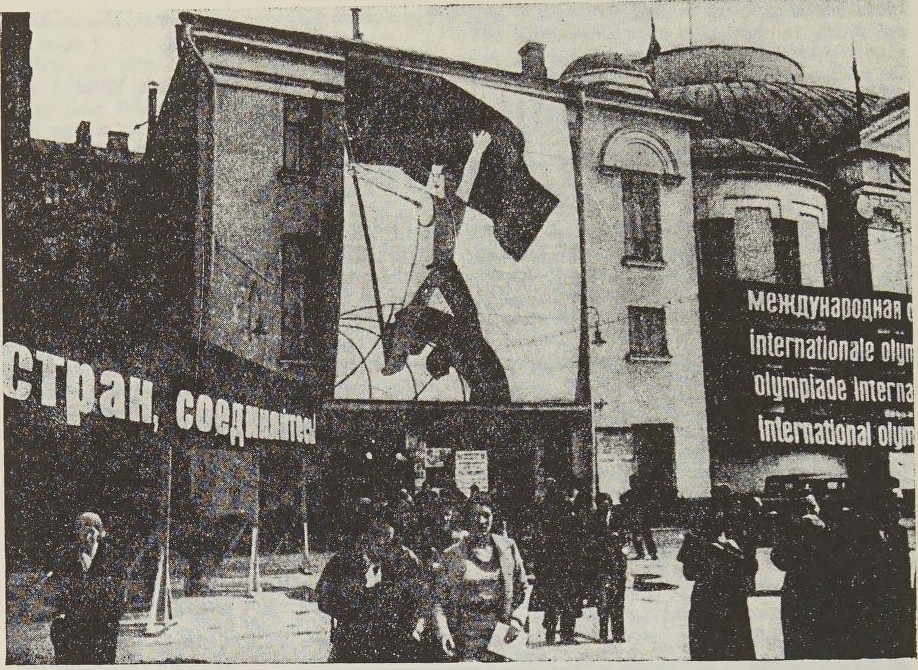
A report on the international gathering of revolutionary theater groups in Moscow as the agit-prop of the early 1930s begins to be eclipsed by new theatrical forms.
‘The First International Olympiad of Revolutionary Theatres’ by Nathanial Buchwald from International Literature. No. 4. 1933.
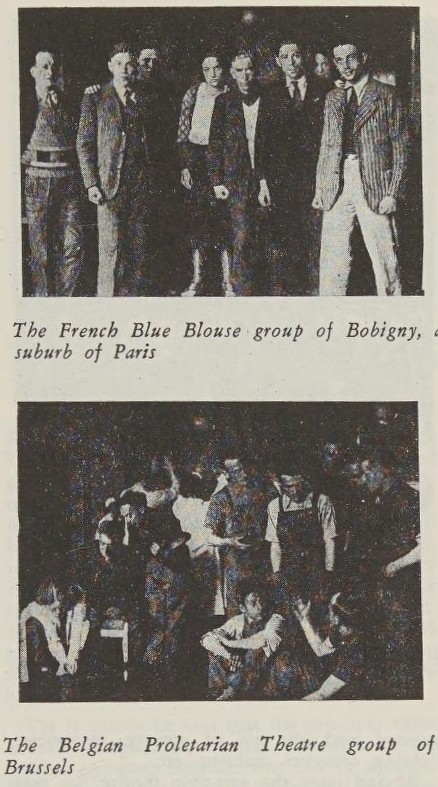
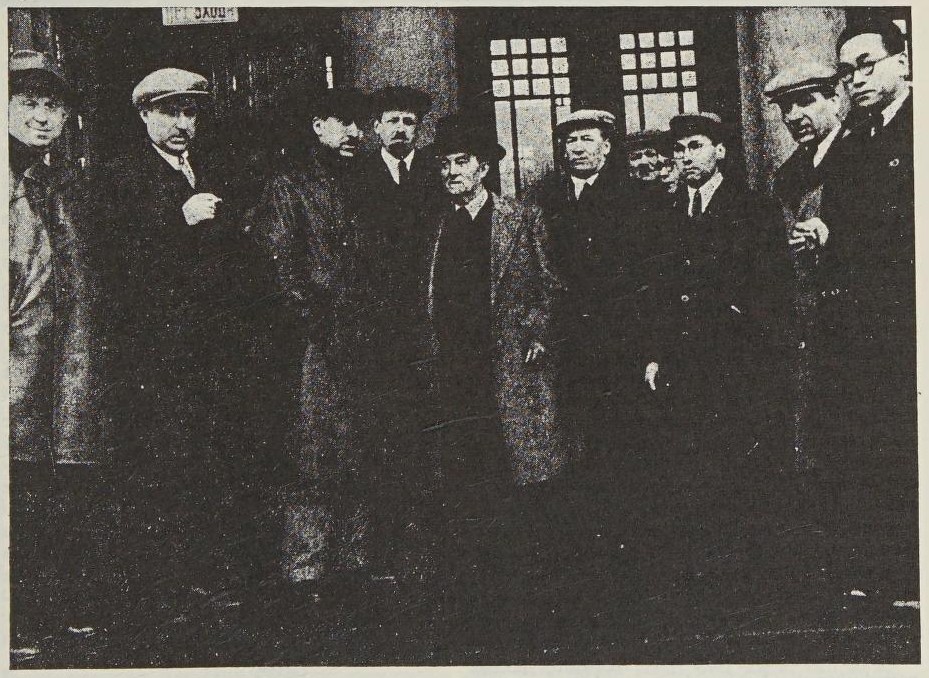
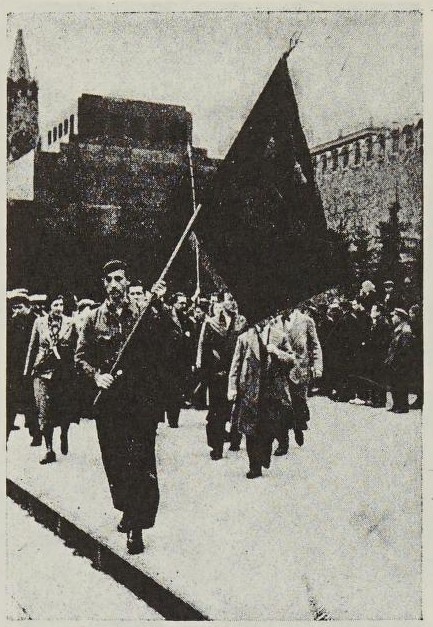
In accordance with the decision of the first Plenum of the International Workers’ Dramatic Union (now—International Union of Revolutionary Theatres), the first International Olympiad of International Revolutionary Theatres was held in Moscow in May, 1933. Twenty-five groups participated in the Olympiad of which sixteen were from foreign countries. In addition, delegations of twenty-two countries took part in the conference on the revolutionary theatre movement which was held immediately after the Olympiad. Within the period of May 25-31, afternoon and evening performances were given in the large Music Hall by agit-prop brigades of France, England, Germany, Czecho-Slovakia, Switzerland, Poland, Denmark, Belgium, Norway and Mongolia. The USSR was represented by a number of Young Workers’ Theatre groups (TRAMS) of Moscow, Leningrad, Kharkov, Dniepropetrovsk (Jewish Tram) Tiflis (Turkmenian Tram). The conference on the revolutionary theatre movement was attended by representatives of these groups in addition to delegations from Japan, the United States, Spain, Latvia and other countries which could not send any performing groups either because of fascist terror or financial difficulties or both. Conspicuous among the foreign delegates were such well known leaders and masters of the revolutionary theatre as Moussinac of France, Piscator and Wagenheim of Germany, Hijikata of Japan and others. Leading masters of the Soviet theatre as well as outstanding playrights and dramatic critics also took part in the conference and in the deliberations of the jury of the Olympiad.
Politically the Olympiad reflected the spirit of militant class struggle of the workers in capitalist countries. The leit motifs in the repertory of the foreign groups were: struggle against fascism, against imperialist war and for the defence of the Soviet Union, against attacks on the standards of living of the workers, against the treacherous policy of the social fascists bureaucracy, etc. The struggle against fascism figured prominently in the repertory of the Dutch, Danish, Swiss and Czecho-Slovakian groups in whose sketches and mass recitations Hitler and hitlerism came in for special scathing criticism and denunciation, Outstanding among these antifascist sketches was one by the Danish group showing Hitler seated at a table in front of a miniature model of the German Reichstag. At Hitler’s command, the Reichstag burst into flames. The audience greeted this scene with much applause and laughter.
In every one of the performances of the foreign groups the players were at one with their play, for the majority of the performers were young workers, fully a half of them members of the Communist Parties or Communist Youth Leagues of their respective countries. For them acting is merely one of the forms of struggle against the class enemy. At home the same performers who in the evening appeared before a workers audience had very frequently taken part during the day in a hunger march, a picket line demonstration, and encounter with the police, a heroic fight to beat off the attack of a fascist band. In all capitalist countries, with varying degrees of brutality, workers’ agit-prop groups are persecuted as dangerous revolutionary organizations—dangerous because effective in their propaganda, in their work of mobilizing masses for revolutionary action. In Germany, Poland, Japan, Latvia and other fascist countries where white terror and political reaction are rampant, agit-prop groups lead an illegal existence utilizing at the same time every opportunity for legal and semi-legal activity. They are frequently arrested, sentenced to varying terms of imprisonment, tortured by fascist hangmen—the ‘play goes on’. And the play is not a make believe, but a real struggle of two worlds, of class against class.
To the Moscow audience this aspect of the Olympiad and its participants was in itself dramatic. The Soviet workers who daily jammed the huge Music Hall fully appreciated the splendid militant spirit of these brave revolutionary theatre brigades and realized that the tense lines of the sketches and the mass declamations had derived their fire and fervour from the flames of the class struggle throughout the capitalist world.
A Proletarian Welcome
On the other hand the Soviet environment in which the Olympiad took place added an element of solemnity and eloquence to the event. The foreign guests were deeply touched and overwhelmed by the earnest attention and heart felt welcome accorded them in Moscow. The profound interest shown in the USSR to their work and to every aspect of creative self expression of workers, the hospitality and spirit of solidarity displayed by the Soviet workers both in the theatre and in the factories which the Olympiad participants visited, the absorbing attention paid by the leaders of art and theatre in the Soviet Union to each and every group and finally the contrast between the conditions under which workers theatres are compelled to work in capitalist countries and the splendid opportunities the Soviet Trams have for developing their art and experimenting with new forms of theatrical expression—all this filled the proletarian guests with a spirit of enthusiasm which was truly boundless. In some measure this spirit was reflected in the letter addressed by the participants in the Olympiad to the leader of the Communist Party in the Soviet Union, Joseph Stalin:
This is our first visit in the Soviet Union and these days are a tremendous experience in our lives. We have seen living socialism at work. We have seen the goal of our struggle, the goal that is here visible, tangible, all pervading. We have seen the fatherland of the proletariat, the truly free, truly splendid country, which is growing in strength, which is creating an unprecedented blossoming of proletarian all-human culture and art. And we say to you, Comrade Stalin:
All our strength, all the power of our art we will devote to the cause of transforming the whole world into a Union of Soviet Republics.
Yet the Olympiad was not only a demonstration of the militant revolutionary spirit of the proletariat in capitalist countries, not only a striking contrast between the attitude toward culture in the Soviet Union and in bourgeois countries, not only an international gathering which in itself exerted a revolutionizing influence upon the masses of workers in all countries—the Olympiad was also and mainly a critical review of the content and forms of the revolutionary theatre, particularly of the professional agitation and propaganda theatre. This was really the main purpose of the Olympiad.
From this standpoint every performance of every group was interesting both in its merits and its faults. Most of the groups that participated in the Olympiad had their own specific merits and distinguishing qualities; the faults and shortcomings on the other hand were of a common typical nature, faults of incorrect ideological approach towards the agit-prop theatre, shortcomings which showed that not all of the agit-prop groups had recovered in the same measure from their “infantile diseases.”
Development of Agit-Prop Forms
On the formal side the agit-prop theatre in capitalist countries began its development in the direction away from the theatre, away from the stage, from external scenic effects. This was quite natural. The form and style of the agitprop theatre were dictated by the circumstances under which the groups had to carry on their activities and by the tasks they had to perform in the revolutionary movement. The main thing required of an agitprop group was a maximum capacity to adapt itself to the needs of the moment and a maximum mobility in passing from position to position, from mass meeting to mass meeting. The work of the agit-prop group was calculated not for the stage but for the bare platform, for a meeting hall without a platform, for a bierhalle or for the street corner. This circumstance naturally determined the technique of the play. There could be no question of using scenery, lighting effects or make-up. All that was left to the agit-prop group from the component elements of the theatre was the bare word and through the power of speaking their lines, the agit-prop players had to bring home to the spectator a dramatization of the class struggle. The raw untrained proletarian performers, who have turned actors over night, had to assume the tremendous burden of raising the spoken word to a maximum of expressiveness, to endow the spoken word with those dramatic and theatrical overtones which on the stage are attained with the aid of scenery, properties, lighting, costumes, make-up, etc.
By and large the agit-prop theatre has mastered the spoken word, lifting it to a maximum of vibrant expressiveness, in point of mass recitation, of ringing tone, of rhythmic reading, the agit-prop theatre has made important gains. The speaking chorus and the rhythmic group movement has become one of the main forms of the agit-prop theatre, so that gradually an agitprop group could be identified by its external features, by the manner of distributing the lines as between individuals and the chorus, the manner of semi-military group movements of the performers, etc. Thus, a kind of formal agit-prop style has made its appearance. In the hands of creative directors this style has been used with tremendous effect in bringing about a complete rapport between stage and workers audience; but under inept leadership the agit-prop style has soon degenerated into a cliche, into a rigid form which stifled the spirit of the script and which grew duller and duller with repetition.
The worst part of it has been the tendency in some countries to make virtue of necessity raising the technical limitations of the agit-prop theatre, imposed by the circumstances, to the level and dignity of a principle. There arose a well known “theory” to the effect that true revolutionary theatre can get along without the “bourgeois trappings” of the professional theatre, that the proletarian theatre has no need of trained actors, that sincerity on the part of the worker—performer is quite sufficient to impress the audience with the spirit of his part, that the worker playing the role of the class enemy needs merely to understand the political meaning of his part and be imbued with a proletarian feeling of hatred toward the class enemy. This “theory” was carried so far that in some countries, some leaders in the agit-prop field put forth the thesis that one need not possess any previous training to write or direct or stage a proletarian play; that any class conscious worker can be both playwright, director and actor in the agit-prop theatre. On the other hand, every technical means, such as scenery, costume, make-up, etc., was rejected and decried as bourgeois and every attempt at systematic training was ridiculed as bourgeois intellectualism.
The First International Olympiad
From the very beginning of its existence the International Workers’ Dramatic Union waged a consistent struggle against this kind of “leftist” vulgarization. But due to the feeble connections between the center and the foreign sections, the sections were generally far behind the center in point of ideological orientation. The first Plenum of the International Workers’ Dramatic Union decided to organize an international review of the workers’ theatres and this review (or Olympiad) was scheduled for May then shifted to August 1932. But due to the inability of a few important sections to send groups at that time, the review was postponed until May 1933. This, in brief, is the history of the first International Olympiad of Revolutionary Theatres.
The results of the Olympiad have shown that the two years since the first Plenum of the International Workers’ Dramatic Union have not passed in vain. In the course of this period the international organization has become more consolidated, the central apparatus has been perfected and extended. The ideological and organizational ties between the center and the sections have grown stronger and the agit-prop theatres have begun rapidly recovering from their “infantile diseases.” The participants in the first International Olympiad of Revolutionary Theatres consisted of groups that have back of them considerable periods of earnest training, and the value of training and mastery of the theatrical medium was fully recognized by all the players of all the groups.
The agit-prop cliche (speaking chorus, bare words on a bare platform, uniform costumes, scant attention to the auxiliary elements of the theatre) was still in evidence at the Olympiad, but in the majority of cases skill, invention and training went a good deal in animating the cliche with streaks of genuinely creative revolutionary theatre.
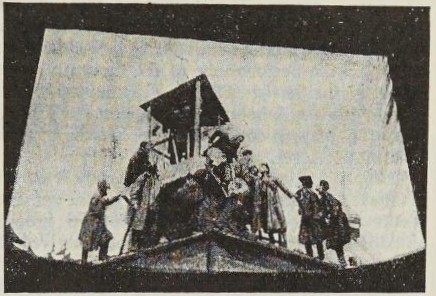
The French October Group presented a typical agit-prop playlet (dealing with the Citroen Strike in the automobile industry) in which mass recitation, the orchestration of voices, the coloring and variety of intonations and the plastic groupings have been lifted to the significance and eloquence of effective art form.
The October Group was not the only one that showed the agit-prop style at its best. The Danish players thrilled the audience with their nuances of this style, with the inventiveness of their mis-en-scenes and with their knack of turning an agit-prop play into a show presenting a maximum of spectacular effect with minimum of theatrical trappings (The Rotation Machine) The Dutch agit-prop group also demonstrated the agit-prop style at its best and livened up proceedings by introducing fetching grotesque bits of showmanship with the aid of a couple of masks and a few pieces of bright material (Religion is Opium to the People). Masks were also used effectively by the German dance group.
The Belgian group was among the most interesting and creative agit-prop brigades, operating with a minimum of technical means and attaining very impressive results with the use of placards, satirical scenes, mass recitation, movement and song. Without sacrificing the spirit of the agit-prop theatre this group displayed a high degree of theatrical effectiveness.
On the other hand, the English, Czecho-Slovakian and the Swiss group presented samples of agit-prop work which showed that the cliche and artistic poverty of the agit-prop theatre has not been eliminated everywhere. Even if the players of those groups spoke or recited their lines quite effectively they did not advance the agit-prop style much beyond its crude initial stage.
Soviet and Foreign Agit-Prop
The scope of this review does not include an analysis of the work of each group at the Olympiad (a detailed critical review of the Olympiad group by group will shortly be made public in the report of the jury of the Olympiad which included outstanding leaders of the revolutionary theatre in the Soviet Union and abroad). But it should be pointed out here that the Olympiad naturally divided itself into two categories so far as general quality was concerned: the agitprop groups of capitalist countries fell into one category and the Soviet TRAMS into another. That the latter displayed superior artistic form and skill goes without saying. But the TRAMS cannot be measured by the same yardstick as the foreign agit-prop groups. The Soviet agit-prop theatre grew out of non-professional workers theatrical circles of about the same type as in the agit-prop movement in capitalist countries. Under the leadership of the Komsomol (Communist Youth League) the more capable of the non-professional agit-prop brigades and individual players were professionalized and formed into Workers’ Youth Theatres (in Russian: Theatr Rabochey Molodezhi; hence the abbreviation TRAM). Surrounded with tender attention and given every material opportunity for development, the TRAMS naturally developed far beyond the limits of the agit-prop theatre as it is known abroad. Animated by the spirit of socialist construction, by the fervour and zeal of shock brigades and by the struggle against the remnants of bourgeois ideology and class resistance in the Soviet Union, the TRAMS also presented a thematic pattern quite different from the subject matter of the foreign agit-prop brigades.
Yet it cannot be said that the principal value in the juxtaposition of the TRAMS and the foreign agit-prop brigades was that of contrast. Both groups had much to learn from each other. To the TRAM performers who work under conditions of material security and full opportunity to develop their creative capacities, it has been both inspiring and instructive to see the substantial achievements of many of the foreign agit-prop groups working under the worst possible conditions of poverty, persecution and strenuous struggle on several fronts.
On the other hand, the foreign groups had a good deal to learn from the TRAM. For after all, much of the work of the TRAMS can be adapted (with further simplification, perhaps) to the circumstances of the agit-prop theatre in capitalist countries, Many of the TRAM performances are portable and require only such limited stage fittings as many of the agit-prop groups abroad can easily afford. Though some of the TRAMS gave performances of plays calling for bulky scenery and elaborate stage presentation, the distinguishing feature of the TRAM work at the Olympiad was not the complicated technique but the superior, more complicated form of agitation through the medium of the theatre, a higher measure of skill and discipline, greater inventiveness in utilizing simple technical devices for telling spectacular effects. The montage form of dramatic narrative organically interwoven with elements of song and dance can surely be borrowed with profit by the foreign agit-prop group. The higher degree of the rhythmically organized spoken word enriched through vocal and orchestral music, which was shown in the performance of the Oratorio Lenin Front by the Jewish TRAM of Dniepropetrovsk was in itself a whole school where the foreign agit-prop players could learn to lift their work to a higher level.
The primitive manner of utilizing the element of music, especially of singing, is one of the weakest points of nearly all agit-prop groups abroad. Even if they cannot avail themselves of orchestras or of accordions (which are used with tremendous effect by the Soviet groups) they can surely develop the use of the song in a higher measure than has been the case up to now. The Dniepropetrovsk TRAM showed a superior form of rhythmic organization and discipline which could be adapted to the limitations of the agitprop theatre anywhere. The Moscow TRAM of the Co-operative and State Trade Workers presented another oratorio where remarkable scenic effects were produced with the aid of such simple auxiliaries as megaphones, red flags and streamers, and where mass recitation interwoven with song and brightened with visual effects combined to make a show at once dazzling in appearance and stirring in emotional effect. The latter show was quite portable and all the “scenery” and properties could be packed in a medium sized grip.
The agit-prop theatre (the former “blue blouses” the “living newspapers” and the TRAMS of today) have been exerting their influence upon the agit-prop theatre in capitalist countries. Only through such an exchange of experiences as was made possible through the Olympiad, and only under the ideological and organizational leadership of the International Union of the Revolutionary Theatres was the possibility created for the spreading of the rich experience and high degree of artistic skill of the Soviet agit-prop theatre in the revolutionary theatre movement abroad.
The Conference Following the Olympiad
The conference of the delegations of the various sections of the International Union of Revolutionary Theatres was an organic part of the Olympiad. At this conference, organizational and artistic problems were discussed with a view to improve the work of the agit-prop theatre abroad. The difference between the former International Workers Dramatic Union and the present organization is a difference in scope. The former organization occupied itself almost exclusively with the agit-prop theatre and this in itself tended to create the impression that other forms of the revolutionary theatres could not come within the scope of workers’ theatre. The I.W.D.U. paid almost no attention to the professional theatre while the I.U.R.T considers the problem of establishing new professional revolutionary theatres and drawing the existing ones into the revolutionary movement as one of its principal tasks. The necessity of widening the periphery of the revolutionary movement in capitalist countries, has determined this change of attitude toward the professional revolutionary theatre.
The emphasis of quality, the struggle against sketchiness and superficiality and the slogan of more profound character portrayal which have been advanced as the urgent problems in Soviet literature and the theatre, have also found their expression in the theses of the second plenum of the I.U.R.T. held in Moscow in November 1932. In the light of these theses the agit-prop theatre abroad began reorganizing its work.
It cannot be expected of the agit-prop groups abroad to discard entirely the sketchy symbols of the characters in agit-prop plays and to go in for profound, searching character portrayal. But the new turn in the direction of quality, of artistic effectiveness may and should be translated in terms of higher theatrical forms of the agit-prop theatre, in the sense of better literary and dramatical quality of the scripts and of greater technical and scenic inventiveness that would allow to attain new forms of revolutionary theatre with a minimum of expenditure of time, money and materials, At the same time the foreign workers in the field of revolutionary theatre should omit no opportunity to establish stationary revolutionary theatres utilizing the services of the art intelligentsia which is ready to join in the struggle against fascism, war danger and political reaction in general.
In the course of the past year much has been accomplished by way of extending the revolutionary theatre front and enriching the arsenal of art weapons in the hands of the working class. The first International Olympiad of Revolutionary Theatres and the conference of the representatives of the sections of the I.U.R.T. mark a new high stage in the development of this international action in the field of the revolutionary theatre.
Literature of the World Revolution/International Literature was the journal of the International Union of Revolutionary Writers, founded in 1927, that began publishing in the aftermath of 1931’s international conference of revolutionary writers held in Kharkov, Ukraine. Produced in Moscow in Russian, German, English, and French, the name changed to International Literature in 1932. In 1935 and the Popular Front, the Writers for the Defense of Culture became the sponsoring organization. It published until 1945 and hosted the most important Communist writers and critics of the time.
PDF of full issue: https://www.marxists.org/subject/art/literature/international-literature/1933-n04-IL.pdf

