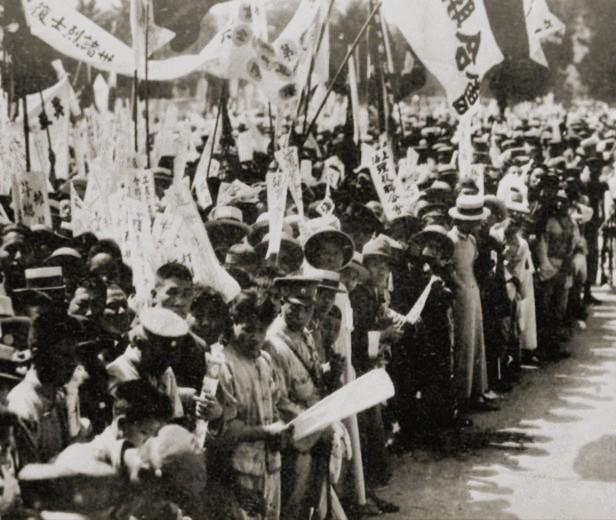
A Comintern orientation document dealing with relations between the C.C.P. and the bourgeois-nationalist K.M.T. written after the vastly changed circumstances brought forth by China’s May 30th Movement; a series of earth-shaking events which saw a wave of strikes in reaction to a massacre of student demonstrators against imperialist occupation in Shanghai on May 30, 1925. In the process that followed China’s relatively small Communist Party would grow into a significant force, especially among workers and students in the south’s coastal industrial and trading cities.
‘The National Revolutionary Movement in China and Tactics of Chinese Communist Party’ from Communist International. Vol. 2 No. 17. October, 1925.
THE main stimulus for the National-Revolutionary Movement was the movement in Shanghai. The culminating point of this movement was in the last days of July and the commencement of August. This period is characteristic above all in that the workers’ strike movement against the imperialists was surrounded by an atmosphere of sympathy on the part of all classes of the population, commencing with the small traders and students and ending with the street unions of trades-men, the Chambers of Commerce and the local civil authorities. It is characteristic that even the troops sent by Chang-Tso-Lin to Shanghai, headed by General Sin-Shi-Ling, to suppress the people’s and Labour movements, could not undertake to execute their orders and were compelled to don a mask fitting with the general mood in Shanghai. On arrival in Shanghai the commanding staff was compelled to adorn the soldiers’ sleeves with an armlet bearing the inscription: “We have come to defend the people.” The military authorities had even to allow the students to arrange assemblies and meetings for the soldiers. The first impression was such that one could openly draw the soldiers into the movement and the students did not let this opportunity slip by. However, Sin-Shi-Ling fairly soon bethought himself and stopped the revolutionary work of the Communist students among the soldiers.
All these factors characterise the ascending wave of the national movement existing at the time.
Later, in August, a certain decline in the movement took place and the characteristic feature of this period was the extension of economic strikes. At that time the Party was faced with a big problem as to how to manoeuvre the great masses in the strike struggle correctly and on the other hand how to preserve the alliance between the working class and the numerous urban petty bourgeoisie and revolutionary intellectuals. This was not only a very difficult problem of the Party, but it was an entirely new one. Great experience and a very firm contact of the Party with the striking workers was necessary if leadership was to be preserved during the process of the dropping of the Shanghai general strike from the level of national-revolutionary slogans to the level of economic-legal demands.”
Throughout August and September the Party received a tremendous practical lesson in this respect. It drew the conclusion that in a semi-colonial country like China the proletariat is not only compelled to rise to the struggle together with the petty bourgeoisie and with all oppressed sections of the people of the country, but also that it cannot manceuvre and retreat in an isolated manner.
This was concretely illustrated as follows: When the workers fought for and defended their demands–firstly, recognition of the trade unions, secondly increase of wages, and thirdly, receipt of compensation for the period of the strike the workers had also to put forward the demands which created a direct contact with the general national movement although they might bring forth new difficulties for the economic attainments of the workers. In Shanghai for example, the workers had to put forward demands concerning participation of the Chinese taxpayers in the municipality and the abolition of the Mixed Court-demands in which the bourgeois sections of the population were mainly interested. This shows how closely the struggle of the working class is bound up with the struggle of the national bourgeoisie, which is interested both in the independence of the country and in its democratisation. For the demands with respect to the municipality and abolition of the Mixed Court are not only nationalist demands, but also slogans of bourgeois democracy.
The alliance of the working class with the bourgeois-democratic classes of the population against imperialism, during the last strike movement, deeply reflected not only on the nature, but also on the forms of struggle of the working class. The financial support of the striking workers by the Chinese Chambers of Commerce, by the street unions of the petty bourgeoisie and the active moral support of the students naturally did not only help the struggle of the workers but also reflected on the actual form of the struggle. Despite the fact that trade unions were formed in Shanghai as well as a General Council of Trade Unions which led the struggle of more than 200,000 organised workers, and that immediately after the events of May 30th a joint committee was formed for the struggle with the imperialists, in which the workers, students and petty bourgeoisie entered–despite all these factors, at the time the brake was put on the general strike movement, the actual intermediaries between the striking workers and the foreign factory owners were the Chinese Chambers of Commerce.
Here, of course, one can speak in the same way about the relative weakness of the workers during the time of their first extensive entry into the arena of political struggle, just as one can say that the bourgeoisie, compelled to enter into a bloc with the proletariat in the national-revolutionary movement, were also interested in the workers receiving certain economic advantages, since this weakens the economic power of foreign entrepreneurs.
The descent of the general strike from the height of national-revolutionary demands to economic-legal demands was carried out under the guidance of the Party and the trade unions, by the workers in alliance with the petty and middle bourgeoisie.
If the Party had not taken heed of this necessity at once, it would have subjected the working class to the danger of being suppressed by a direct blow from the militarists; it would have enabled Chang-Tso-Lin’s military forces in Shanghai to have dealt with the workers just as they liked. In other words, having allowed the workers to become isolated from the bourgeois-democratic classes of the population, the Party would have enabled the militarists to break the backbone of the strike movement and to destroy completely the conquests of the workers, gained during the time of the spontaneous rise of the movement immediately after May 30th. These conquests were to be seen in the fact that many trade unions and a General Council of Trade Unions were formed in the most open manner–workers’ organisations, for the first time in the history of China, were founded in June of this year–and also wages were raised in a number of enterprises and compensation given for the period of the strike. By the time the liquidation of the general strike had started, there also began a cooling of certain bourgeois sections of the population in their attitude to the workers’ struggle on the one hand and most acute vacillations on certain sectors of the Labour front on the other hand.
Two main tendencies were to be observed among the most backward sections of textile workers: a mood was engendered in favour of returning to the factories as soon as possible, at all costs and on any condition, while among the most revolutionary workers, influenced by the exit of a section of the bourgeoisie and the vacillation among the backward workers, a Left mood made itself apparent, which was in favour of forcing events. One should not say that this latter tendency bore witness only to the feeling among the advanced workers (who for the first time felt a proper class instinct) that the working class of China was becoming an independent social-political force and, consequently, could now compel its enemies to satisfy its demands. No, there were also moods of despair; not the will to victory, but the seeking of a “noble,” “revolutionary” way out of the difficult and complicated situation created after two months of struggle.
These moods were bound to serve as a serious warning for the Chinese Communist Party. It was generally considered that any action of the workers at that time would be an isolated move and would represent a gesture of despair incapable of bringing any other results than the smashing up of the Labour movement not only in Shanghai, but throughout the entire country. Therefore, the Chinese workers had to choose another path. They had to effect a closer rapprochement with bourgeois democracy and to improve the trade union organisations of the strikers. The subsequent weeks show that the path that had been chosen was correct, that the workers of Shanghai with the workers of other towns behind them had attained economic conquests, that in the camp of the imperialists a serious cleavage had taken place between the British and Japanese owners, and that the result achieved by the economic conquests in foreign enterprises was the extension of the economic struggle to the enterprises of the Chinese capitalists.
According to the general estimation of the situation a military conflict had been warded off. A certain tranquilisation, a certain stabilisation between the opposing military forces created the soil for an offensive of militarists against the revolutionary movement in the country and against the working class. It is necessary to take these phenomena into consideration, in order to understand the role of the military groupings at the present time struggling among themselves in China. As soon as the possibility of averting a military conflict was felt, a wave of reaction immediately swept over the country.
This same Chang-Tso-Lin’s general, Sin-Shi-Ling, who in August had not succeeded in closing down the Shanghai trade unions, despite the fact that he had several times tried to do so, now smashed them up without even having recourse to any special formality. At that time his attempts consisted in quibbling over some negligible formality or other, thereby closing down two or three unions and feeling his way for a subsequent attack. But he had soon been compelled to abandon these attempts. In exactly the same way he had to reopen the joint committee which had been closed down for a few days for some insignificant articles concerning Chang-Tso-Lin.
But then things had reached such a stage that a clash between the Mukdenites and Feng-Yui-Sian was imminent; the position of Djan-Tsi-Djua was such that he had to appeal to the public opinion of the country from time to time since the disturbance of the correlation of forces between the militarists compelled him to seek support in public opinion. This was at the time when Djan-Tsi-Djua sent 100,000 dollars to the General Council of Trade Unions. But in September the General Council was smashed by Chang’s troops with the formal sanction of Djan-Tsi-Djua.
However, the imperialists and military authorities in China did not attain what they wanted by smashing the Council of Trade Unions. The power of resistance of the workers proved to be stronger than might be expected. In place of the trade unions, directing delegate meetings were formed. In October these semi-legal organisations had already a Council and continued to lead the workers’ movement.
These semi-legal organisations of the workers were regarded in a sympathetic manner by the bourgeois-democratic sections of the population. Instead of the formal connection which the Council of Trade Unions had maintained with the Chamber of Commerce and the democratic organisations, a contact was established which was not formal, but which directly influenced the negotiations between the foreign owners and the Chinese Chamber of Commerce, which continued to be the intermediary of the striking workers in the British enterprises.
Further Perspectives of Struggle.
All that has been alluded to above goes to show that the line of development of the revolutionary movement is by no means taking an upward course all the time, and that at the present stage of the revolutionary movement in China it has its vacillations, rises and falls.
The October 1925 Plenum of the E.C. of the Chinese Communist Party gave a general estimation of the political situation. It confirmed the fact that the development of the national-revolutionary and workers’ movements was continuing on the whole to take an upward course; it also acknowledged that the situation continued to remain revolutionary. However, the Plenum of the E.C. recorded the existence of a temporary political reaction and attributed its duration to the imminent military conflicts in the country between the Mukden and anti-Mukden military forces. The Plenum said quite plainly that the approaching conflict would take place on an extremely extensive basis as compared with former conflicts. It stated that the struggle between the Mukden and anti-Mukden forces would produce a tremendous tension of forces in the entire country and would inevitably absorb into the struggle the imperialists in one form or another. The national-revolutionary energy will thereby be let loose to such an extent, that the conflict may become the actual commencement of a movement to crown the 1911 revolution and will place the question of a revolutionary-democratic system for the country on the agenda.
A third force has now entered upon the political arena–this is Wu-Pei-Fu, whose group is undoubtedly also a considerable factor in the coming struggle.
In so far as we present the question as to the development of the movement in open and direct connection with the imminent military conflict, we must allude to the role of the militarists and of all military-national groups in the liberation movement, for the movement centres mainly around this question for the most part in Northern and Central China. In the South the question as to the relation toward the military groupings is a little less acute, for here the Communists form a bloc with the Kuomintang, which is the governmental Party.
With regard to the People’s Armies, the question is a little more complicated, as, the national-liberation movement must here have contact with the army neither through a national party, nor through a revolutionary government. For the first time in the history of the revolutionary movement the Communist Party in its everyday activity has directly to settle problems as to the attitude towards the militarists, who, though undertaking repressive measures against the Communists and the workers’ movement, nevertheless represent a factor of the national-liberation movement in the country.
How can one explain that in 1924-25 certain military groups have commenced to play a new role in the political life of the country and commenced gravitating towards the national-liberation movement? Firstly, this is to be explained by the general revolutionising of the masses of people in the country. There is not the slightest doubt that during the past year the revolutionary movement in China has taken a pace forward. Last year, after the defeat of the Chi-li (Wu-Pei-Fu) clique, Sun-Yat-Sen was able to come North. This fact alone had tremendous significance–this happened for the first time after the 1911 revolution. Sun-Yat-Sen, who for a period of thirteen years had been considered as a rebel by the Central Government and the Northern militarists, came to Peking where he was welcomed with honour as a national hero. Even the government of Djan-Tsi-Djua and Chang-Tso-Lin were bound outwardly to display their sympathy and good-will towards him. This journey served as a factor in the subsequent revolutionising of the intellectuals and the urban petty bourgeoisie.
Further, there is no doubt that the revolutionising of the country, particularly during the past year, was greatly assisted by Canton, which continues to maintain its position despite all the intrigues of the imperialists (including also the late MacDonald Government, which sent warships to Canton last summer) and despite the counter-revolutionary offensives of militarists such as Chang-Tso-Lin and the compradors (trading middlemen) such as Cheng-Lin-Pak, who were supported by the Hong Kong imperialists. The existence of the Canton regime, despite all these internal and external attacks, is no doubt a conquest of the revolutionary movement of the country as a result of the growth of the Labour movement and of the movement of the revolutionary intellectuals and petty bourgeoisie all over China.
Another reason is the intensification of the contradictions between the imperialists in China during the past year.
What was the situation in October of last year, when Feng, quitting Wu-Pei-u, brought about a coup d’état and drove Tsao-Kun out of power? How did this influence the correlation of forces between the Chinese militarists?
This meant that Japanese political influence began to prevail over American influence. Both for Great Britain and for America the coup d’état and the new correlation of forces between the militarists came as a great surprise. But the victory of Japan did not change the situation, since her political predomination did not correspond with her economic influence in the country. As a result, the contradictions between Japan and Anglo-American imperialism became more profound. Japan, during the whole of last year, exerted all her forces in order to maintain her political influence in China just as it had been built up during the autumn of last year, whereas America did everything possible in order to restore the correlation of forces which has been disturbed by the overthrow of the Chi-Li clique. These contradictions help the revolutionising of the Chinese masses. The Japanese Government and Japanese statesmen during last year helped the growth of the national movement of militarists to no small degree. Sun-Yat-Sen’s journey to Japan on the way from Canton to Peking was a result of the policy of the Japanese Government which at that time was endeavouring to rely on all decisive forces in China against the Anglo-American imperialists. This made the contradictions between the Japanese on the one hand and the British-Americans on the other still more profound.
Finally, a factor which influenced and is influencing the military groups in China and which should be estimated in all its magnitude, is the formal recognition of the U.S.S.R. This recognition made it possible for the U.S.S.R. to become an incomparably greater factor than it had ever been before in the political life of China. During the past year this new influence of the U.S.S.R. was felt everywhere in China. It was left in Chinese social life, commencing with the Government, the Chambers of Commerce and ending with the Labour unions and universities.
These are the main reasons which enabled certain military forces in China to commence a new role in the country to gravitate towards the revolutionary movement and in particular towards the Kuomintang Party. These reasons explain the role of the People’s Armies in the anti-imperialist ‘movement.
What are the subsequent tendencies of the People’s Armies? They depend entirely upon the development and influence of the factors enumerated.
If the revolutionary movement in the country continues to develop, as it began to do in the autumn of last year, the People’s Armies will gravitate more and more towards it and will follow it; should there be a prolonged stoppage in the revolutionary movement, and if reaction is established for a definite period, the exit of the People’s Armies may take place, vacillation may start in their midst and their role might change.
The contradictions between the imperialists continue now also to represent a tremendous factor in influencing the national-military groups in China. For example, the question as to the Tariff Conference now taking place, ultimately amounts to a question as to whether the imperialists will be able to stabilise Djan-Tsi-Djua, by giving him and Chang-Tso-Lin a definite amount of the customs receipts, thus balancing the Central Government on the side of Chang-Tso-Lin and the imperialists in order to counter-balance Feng. The subsequent tendencies of the People’s Armies will also depend upon the outcome of this conference.
The main task of the Kuomintang and the Communists with regard to the People’s Armies is to push them along the course of the national-revolutionary movement despite the contradictions between the People’s Armies and the Labour movement in the country which from time to time become apparent. It is necessary to pay attention not only to how the representatives of the People’s Army directly take up their stand towards the revolutionary movement in the sphere of their own influence, but also to what attitude the People’s Armies have towards the general policy in the country towards the Central Government and the imperialists.
But if one cannot regard the role and significance of the People’s Armies merely by one symptom, by the attitude which their representatives take up towards the Labour movement at one time or other, it stands to reason that great hopes should not be placed in the Generals of the People’s Armies at a time when they take up a sympathetic attitude towards the workers’ movement.
In the political theses of the Plenum of the E.C. the role and significance of the People’s Armies is taken from the viewpoint that they gravitate towards the national-revolutionary movement in proportion to the development and extension of the movement and the viewpoint that this is already one of the conquests of the liberation movement in the country.
Party Structure.
The last six months of the revolutionary movement in the country have created a new psychology in the Chinese Communist Party. The Party is imbued with the spirit of revolution. It is felt that the comparatively small Communist Party is commencing to have a great political appetite–it wants to become a mass Party. This was also shown by the fact that at the last Plenum an estimate was made as to the political situation in the country as behooves a proletarian party when it commences to play a political role. A serious estimation of the role of the various military groups in the country and the determination of tactics towards them is also without doubt a sign of the increasing maturity of our Party.
The Party feels the demand for mass agitation, a demand directly arising from the practice of everyday work. This demand is already receiving real formulation. Popular mass literature for the town workers has recently begun to appear. A popular pamphlet has been written for the wide masses of the peasantry in which the agrarian platform of the Chinese Communist Party is expounded, and the nature of organisation of peasant unions is indicated. The Plenum also decided to begin organising wall newspapers in factories and works.
These are all symptoms that the Party has commenced talking in the language of the masses–in the language of millions.
The Party weekly “Kaid Weekly,” which during the Shanghai event published 5,000 copies, has now a circulation of more than 20,000, and what is more, is reprinted in such centres as Kaifeng and Hankow.
The Party’s self-confidence has also increased. There is no longer any talk among the majority of the Party’s active members about our being small in numbers, as they used to say, or that we cannot do much, that we must wait until the Party’s ranks are extended, as we cannot train new members, etc. Such moods have already been outlived by the majority of Party comrades.
Another great result of the revolutionary movement during the last six months is the striving of the Party towards working masses, but also among the peasantry and the revolutionary intellectuals–an extensive strata of bourgeois democracy. Among other things the establishment of a more compact bloc with the Left-wing of the Kuomintang, the extension and strengthening of the alliance with the wide strata of democracy by means of this bloc, represents one of the organisational problems of the Party at the present period.
The Plenum made a number of decisions with regard to the Labour movement according to which during the next few months the Party should succeed in reinforcing its moral influence among the working masses, so that the moral leadership of the Labour movement by the Party receives an organised formulation in the form of factory nuclei, Communist fractions in various trade unions and federations, on the Boards of Clubs, etc. The last four months of struggle have shown that the Communist Party is really the leader of the Labour movement and that it has had no more or less important competitor. But organisationally the Party has not succeeded in becoming strengthened. There is a great danger in this, particularly now when civil war is entering a more acute phase. The Party has already formally taken into consideration this danger, with the correct instinct, and the question as to the organisational strengthening among the working masses was one of the main questions at the Plenum.
At no other time previously, neither at Congresses nor at Plenums has the question of the peasantry been taken so seriously as this time.
The Peasant Commission of the Plenum, having examined a considerable amount of material on the Peasant question coming from localities, arrived at the conclusion that it is time for the Party to commence popularising the idea of confiscating the land. The Plenum considered that the transitory peasant demands which the Party had put forward up to now, such as lowering of lease payments, reducing tax burdens, right of peasants to organise unions, arming of the peasants for the struggle against banditism and gentry, removal of salt monopoly from the hands of the imperialists and reduction of salt taxes and finally abolition of the inland customs duties–the Party considered that these partial peasant demands were too inadequate to draw the peasantry on to the side of the revolution and make them a support of the revolutionary democratic system.
Among the practical measures decided upon for drawing the peasants more into the revolutionary movement and for awakening them politically the following may be mentioned: (1) commencement of mass agitation; (2) sending of adequate forces into the villages; (3) to start organising peasant schools where Party members and young Communists will be trained for work among peasants.
The ECCI published the magazine ‘Communist International’ edited by Zinoviev and Karl Radek from 1919 until 1926 irregularly in German, French, Russian, and English. Restarting in 1927 until 1934. Unlike, Inprecorr, CI contained long-form articles by the leading figures of the International as well as proceedings, statements, and notices of the Comintern. No complete run of Communist International is available in English. Both were largely published outside of Soviet territory, with Communist International printed in London, to facilitate distribution and both were major contributors to the Communist press in the U.S. Communist International and Inprecorr are an invaluable English-language source on the history of the Communist International and its sections.
PDF of full issue: https://www.marxists.org/history/international/comintern/ci/new_series/v02-n17-1925-new-series-CI-grn-riaz.pdf

