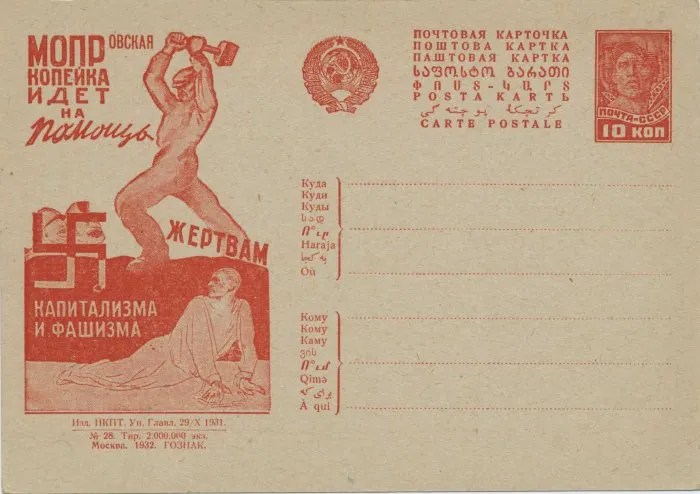
The International Red Aid was formed in November, 1922 at a meeting of the Association of the Old Bolsheviks and the League of Former Political Prisoners and Exiled. Joining with already existing national campaigns and groups, such as the Workers Defense League in the U.S., the I.R.A., devoted to defending class war prisoners and their dependents, was one of the most successful Comintern projects, becoming a genuinely mass organization in many countries, like the International Labor Defense in the U.S. Millions of Russian workers would give part of their wages to the project. Below the I.R.A.’s chair, Helena Stassova recounts ten years of activity and the document of Old Bolsheviks founding the group.
‘Original Appeal and Ten Years of the International Red Aid’ by Helene Stassova from International Press Correspondence. Vol. 12 No. 48. October 29, 1932.
The I.R.A. came into being at a time when the White Terror was raging without restraint or hindrance, in the period of the first few years following the war, when the bourgeoisie triumphed over the proletariat of Germany, Hungary, Italy, and the Baltic States, and the White Terror reigned all over the capitalist world. The orgies of White Terror at this time formed the apotheosis of the first cycle of wars and revolutions just ended, and at the same time the prologue to the following stage of the temporary relative stabilisation of capitalism.
It was not by accident that the first initiative for the creation of an international society in aid of the champions of revolution was provided by the land of the Soviets, upon whose vast territories tzarist Terror had raged up to the October revolution. This Terror, after ruling Russia for centuries under the tzars, was called into life again by the White Guardist hordes and the imperialists during the years of the intervention.
The toiling masses who had shattered the apparatus of bourgeois and landowning rule, and had driven the parasite classes out of the country forever, still retained the memories of the accursed past very clearly in their minds. The Schlüsselburg and the Peter-Paul fortress still stood as monuments to the memory of the best of the revolutionary fighters, who had languished and died within their walls. The sound of the swish and thud of the knouts still echoed in the air. The great Vladimir highroad still ran from the plains of Europe over the mountain ranges of the Urals, far into Asia, to the snow fields of Siberia, to the ore mines of Nertschinsk, to the uninhabited deserts of Taiga, where thousands of prisoners had dragged out their existence in chains, lost forever to the outside world.
The Association of the Old Bolsheviki, and the league of former political convicts and banished, when they suggested the idea of the founding of the I.R.A., merely gave expression to the thoughts and feelings of the millions of the toilers of the Soviet Union. The vitality of the idea was at once confirmed by the immediate and unanimous enthusiasm with which it was taken up by the toiling masses all over the world. The proletarians and toilers of the capitalist countries and the colonies, and especially their communist vanguards, grasped and felt the necessity of the immediate creation of an international organisation for the struggle against White Terror and for the relief of its victims. They saw clearly that the ebbing tide of wars and revolutions was bound to rise again before long, drawn irresistibly by the general post-war crisis of the capitalist system.
It was obvious that every effort must be made to maintain the revolutionary cadres. Every effort must be made, on the basis of international enlightenment, to strengthen the united Red front against the united forces of the bourgeoisie the whole bourgeoisie, from the fascist cut-throats down to the social democratic betrayers and murderers, whose hands are stained for all time by the blood of Karl Liebknecht and Rosa Luxemburg; by the blood of the tens of thousands of the workers of Bavaria, Hungary, Finland, and Italy, tortured to death; by the blood of the peasants of India, Palestine, of the African and many other colonies.
The decade which has passed since the I.R.A. was formed has shown how urgent is the need of the idea incorporated in this association. In spite of all persecution, in spite of the illegality forced upon it in dozens of countries and in all colonies, in spite of sabotage from the social fascists, who forbid the members of their parties to join the I.R.A., and induce them to become members of the counter-revolutionary and interventionist organisation of the “Matteotti Fund”, with its deceitful title of “Aid for the victims of Terror in countries without democracy”–in spite of all this the I.R.A. has grown steadily, and become steadily stronger. It appears at its World Congress on 10th November in Moscow as a mighty organisation of twelve million members, possessing Sections in 70 countries.
This fact is worthy of special note, for it must be remembered that the considerable majority of the members are non-party workers, peasants, and working intellectuals. The membership card of the I.R.A. is the proud possession of social democratic workers and members of reformist trade-unions, as well as of communists and adherents of the Red trade union movement.
These achievements have been won by long and persistent struggles. We need only remember the Sacco-Vanzetti campaign, the magnificent efforts of the masses mobilised. against the challenge of dollar justice by the I.R.A. Sections in both hemispheres. We need only remember the campaign against the Terror of the Rumanian occupation in Bessarabia, against the bloody summary courts of Tatarbund and Chotin. We need only remember the dozens of campaigns against the atrocities of fascism in Italy and in the Balkans, in Poland. And today we see the Scottsboro campaign, in which the I.R.A. is leading the struggle to save nine innocent Negro boys, and is carrying on this struggle on the basis of the international united front of the white and coloured toilers, linking up the movement at the same time with the slogans for liberation from the yoke of colonial oppression.
The World Congress of the I.R.A. takes place in the midst of a situation characterised by the close of the period of the relative stabilisation of capitalism, and by the transition to a new cycle of wars and revolutions, whose issue depends on the extent to which the camp of proletarian revolution is successful in winning over and welding together the majority of the working class.
This new phase of the general crisis of the capitalist system has already been ushered in by war on the territories of China and Manchuria, a war which must be regarded as the forerunner of a gigantic massacre of the peoples on the waters and coasts of the Pacific, and as the forerunner of a second world imperialist war. In capitalist Europe we already see the first flickerings of the conflagrations of war. The last hour has struck for the predatory “equilibrium” of Versailles. And meanwhile the preparations for a renewed and determined intervention against the Soviet Union are being deliberately and openly worked out in Geneva, to the accompaniment of a continuous obbligato on peace.
The revolutionary movement is increasing in breadth and strength. In China, wide territories are already under Soviet power. A number of capitalist countries are on the eve of a revolutionary crisis; in others the pre-requisite conditions for revolution are maturing. The miners of Illinois, in their self-defensive efforts against the police, vie with the unemployed in Belfast, with the proletarians in Warsaw, Dombrova, and Lodz, with the workers and agricultural labourers of Spain, with the pitmen of the Ruhr, and with Red Wedding in Berlin, the symbol of the militant spirit of the workers of Germany.
The broad waves of the turbid and bloody flood of capitalist Terror are rising, for the capitalists see in war and intervention their sole salvation from crisis and revolution. The whole history of White Terror cannot parallel the brutality being exercised by the apparatus of capitalist rule at the present time. There are over 200,000 revolutionists languishing in the prisons, the great majority of them stigmatised as common criminals. Derision, beatings, and murder, are the daily lot of the prisoners of capitalism.
10 years ago juridical executions might be counted by hundreds only, but today by thousands. In the same proportion the number of arrests have increased, the number of persons injured during the dispersion of demonstrations and meetings, the number of political trials, the number of persons simply shot down without trial or sentence. The right of asylum for political refugees exists no longer. Those who enjoy this right today are only the White Guardist bandits, the Gorguloffs, the cliques of terrorist conspirators–these indeed enjoy this right, and in addition the subventions of the governments and capitalists who calculate upon utilising these elements for purposes of intervention.
The I.R.A. must exert its utmost efforts to organise the resolute self-defence of the masses against the orgies of White Terror. Our organisation celebrates its tenth year of struggle under the slogans: “Down with Terror. Down with War. Defend the Soviet Union.” The work of our World Congress will be carried out under the same slogans.
Our Congress will subject every method of work to a careful analysis and self-criticism, will draw the conclusions from the experience gained in a decade of struggle, and will emphasise all measures which will be of service in winning over fresh millions under the banner of the I.R.A., for the strengthening of its ranks, and for the permeation of these ranks with real revolutionary internationalism.

The I.R.A. must and will remain steadfastly at its post in the great class struggles now impending. It will prove capable of fully coping with the demands put upon it by history.
***
First Appeal
to the Russian workers to aid the victims of Terror and class justice in the capitalist countries. Issued November 1922.
Appeal of the International Relief Organisation for the Revolutionary Fighters.
Advancing irresistibly, like a force of nature, the inexorable class struggle assumes ever more vast dimensions. The more imminent the approach of the last and decisive struggles, the intenser the savage fury of the world bourgeoisie. In the Poland of the Schlachta (nobility) as in the Italy of the fascists, in “democratic” America as in Roumania and Spain, groaning beneath the pressure of the last remnants of the dark middle ages, in “peaceful” Czechoslovakia as in bleeding Ireland, in triumphant France as in enslaved Germany—everywhere, to the remotest region of the civilised world, with the sole exception of the federation of the Soviet Republics, the blood of the proletariat is being shed. Thousands and thousands of proletarians, brave fighters for the high aim of world revolution, where they have escaped the bullets of the bourgeoisie, have been thrown into the prisons, where they suffer every martyrdom and torture which a cruel hunger regime can impose upon them. These helpless victims of bourgeois “justice” wait and suffer behind their prison walls for weeks, months, and years, with the Damocles sword of the executioner hanging over their heads.
War is war, and it would be absurd to expect feelings of humanity from the representatives of the class now doomed to extinction, the class now disappearing from the stage of history, towards the class which is their enemy, and will be their grave-digger to-morrow. It may be that all this cruelty inflicted by the bourgeoisie to-day is only the prologue to an even more frightful bacchanalia of the monster of capitalism. Let it come. The revolutionary proletariat does not fear the threatening dangers of a civil war. It knows that the more violent the dying convulsions of the monster, the more rapid the end of the death struggle, and the sooner the light of the final victory will dissipate the dark powers of the past.
As in every war, in the class war too there are positions at the front and behind the lines, there are vanguards and reserves, advanced lines meeting the brunt of the fire, first aid squads and nurses caring for those who fall in the struggle.
Our R.S.F.S.R., shrinking from no self-sacrifice, however, great, has freed itself of that militarist imperialism which endeavoured to hold it beneath its mailed fist, and has fought its way to free development. The thunder of the field guns and the clatter of the machine guns have been silenced. The capitalist monster has been forced to withdraw from our sorely tried country. Only the future can show if this pause for breath will be for long and if it will be far-reaching in effect. But this pause for breath certainly does not mean that the toiling masses of Russia have withdrawn from the bloody international struggles between capital and labour–quite the contrary. The Russian proletariat is only too well aware that the success of its cause depends entirely on the success of the world proletariat in its struggle against capital, that therefore it must utilise to the utmost this pause for breath which it has gained at the cost of so much bloodshed, and must throw the whole of its forces into the economic front in the interests of this struggle.
At the same time we must never forget that our Republic, liberated from the dictatorship of capital, forms a hinterland, a reserve fund of revolutionary forces, and furnishes a territory upon which large-scale relief action organised for the revolutionary fighters forced to leave the line of battle for the moment. Every soldier of the revolution, when torn from the ranks of the proletariat by the claws of the fascist bandits, or by the police of a Pilsudsky or a Poincaré, must feel assured of the solidarity of millions of his Russian brothers when he treads the path to prison, to hard labour, or to death; he must know that the toiling masses of the Russian people hasten to help with their pence the heroes of the class struggle of the proletariat, and offer them comradely aid and relief to the utmost of their powers. The prisoners languishing in the jails of European and American capitalism must have the assurance that their families are not left to the blind arbitrariness of fate, but their wives and children will be cared for by organised material aid. The rendering of material and moral support to the political prisoners enhances prisoners enhances and consolidates the militancy and steadfastness of the revolutionary fighters still in the ranks of the battle. Upon this field the seed of international solidarity and warmest fraternal sympathy will germinate.
The matter is urgent. The organisation of relief for the revolutionary fighters is not a matter which can be postponed. A group of tried and tested Bolsheviki (league of the old Bolsheviki) has therefore already taken the initiative towards founding such an organisation. With the collaboration of the Communist International and of the Central Committee of the Communist Party of Russia, an “International Organisation for the Aid of Revolutionary Fighters” (I.R.A.) has been founded in the R.S.F.S.R.
In the name of this organisation we appeal to all communists, and to all persons sympathising with the revolutionary struggle for the emancipation of toiling humanity from the yoke of decaying capitalism, and call upon them to participate in energetic work in aid of the prisoners of capitalism. We appeal especially to:
1. The gubernia committees and other Party organisations of the C.P.R., with the request that these support our initiative, and organise the collection of funds for the above purpose among the communists in the scope of their organisations. (The contributions should have the character of voluntary gifts, for instance the nuclei members should levy themselves to an amount equal to one per cent. of a month’s wages.)
2. The communists, who should set an example to all by their own gifts and by their support of the fund collecting campaign.
3. The Gubernia trade union councils, with the request that these organise gatherings and collections among the workers organised in the trade unions, and among all citizens. And finally to:
4. The non-party workers and peasants, and to all citizens of the state sympathising with the world revolution, with the request that they give voluntary contributions to the local trade union organisations, to be handed on to the I.R.A.
International Press Correspondence, widely known as”Inprecorr” was published by the Executive Committee of the Communist International (ECCI) regularly in German and English, occasionally in many other languages, beginning in 1921 and lasting in English until 1938. Inprecorr’s role was to supply translated articles to the English-speaking press of the International from the Comintern’s different sections, as well as news and statements from the ECCI. Many ‘Daily Worker’ and ‘Communist’ articles originated in Inprecorr, and it also published articles by American comrades for use in other countries. It was published at least weekly, and often thrice weekly. Inprecorr is an invaluable English-language source on the history of the Communist International and its sections.
PDF of full issue: https://www.marxists.org/history/international/comintern/inprecor/1932/v12n48-oct-29-1932-Inprecor-op.pdf

