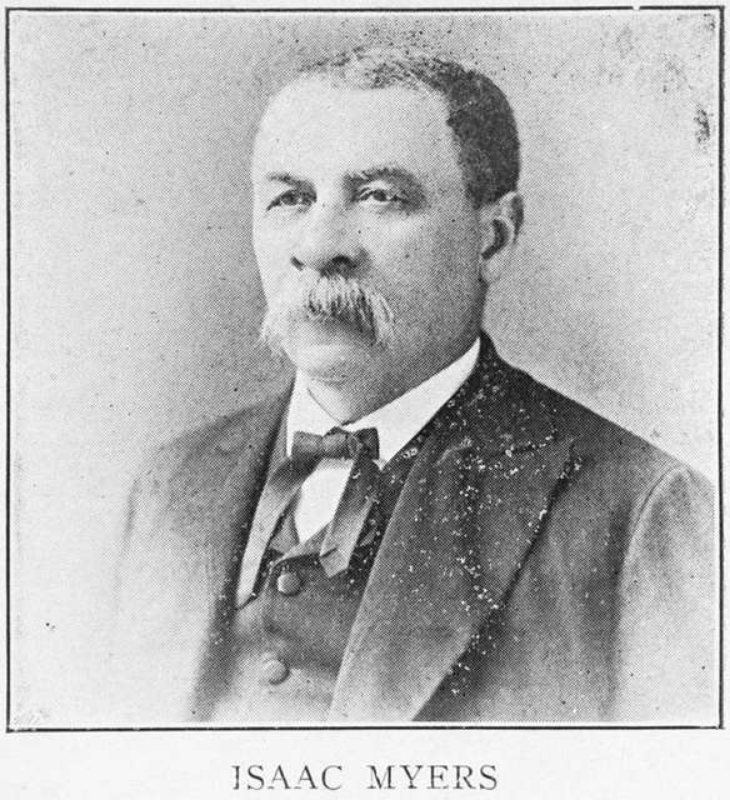
An important piece of U.S. labor history from its early days as the 1869 conference of the National Labor Union hears a speech from Black delegate Isaac Myers four years after the end of the Civil War. After Black ship-builders in Baltimore were refused admittance to early white-led unions during the 1860s, Black ship worker Isaac Myers formed and led the Colored Caulkers Trade Union Society in 1868, among the earliest Black labor organizations founded in the country. The Union would also start its own cooperative shipbuilding site, employing hundreds of Black workers. Leading figures in the N.L.U. like its founder William H. Sylvis, who died tragically just before this meeting, and Detroit’s Richard Trevellick supported the new national union federation, formed in 1866, being open to Black workers and invited Black delegates to its 1869 meeting. However, many parts of the organization simply refused to follow their lead. Shortly after this meeting what was to be n Black auxiliary of the N.L.U., met to form what would be called the Colored National Labor Union with Myers as its President. The following year, in 1870, the white-led N.L.U. did not seat any Black delegates. Both organizations lasted just a short time as the first attempt at workers organizing across race failed, with catastrophic consequences for the labor movement in the United States taking. It took generations until the founding of the C.I.O. for a genuine break through in organizing Black workers, over seventy years later.
‘Address to the National Labor Union’ by Isaac Myers The Workingman’s Advocate (Chicago). Vol. 6 No. 6. September 11, 1869.
ISAAC MYERS ADDRESS.
Mr. Isaac Myers (Colored); of Maryland, then made the following address, which was much applauded:
PRESIDENT AND GENTLEMEN: It would be an act of great injustice to your Godlike charity should I allow the deliberations of this convention to close without returning you the thanks of four millions of my race for your unanimous recognition of their right to representation in this convention. We sympathize with you in the loss of your great leader and champion–the immortal William H. Sylvis. God, in His wisdom, has called him to that bourne from which no traveller returneth, and our prayers shall ever be that his immortal spirit shall hover around the Throne, and bathe its wings in the morning dews of Heaven.
He labored incessantly for you and your posterity. No distance was too far for him to travel; no hours of labor were too long for him to work. Whilst he advocated eight hours for you for work, eight hours for rest, and eight hours for study, he gave all his hours in laboring to bring about that glorious result. His heart, soul, mind, and strength were absorbed in this labor of love, and to-day, by one stroke of the unerring pen of President U.S. Grant, you are enjoying the first fruits of victory. With his faults in the head and his virtues in the granite, gentlemen, silent but powerful and far reaching is the revolution inaugurated by your act in taking the colored laborer by the hand and telling him that his interest is common with yours, and that he should have an equal chance in the race of life.
These declarations of yours are ominous, and will not only be felt throughout the length and breadth of this great Republic, but will become another great problem in American politics for the kings and dynasties of Europe to solve. It is American. And it is only Americans that can work up and work out such revolutions in a day. God grant that it may be as lasting as the eternal bills. I speak to-day for the colored men of the whole country, from the Lakes to the Gulf, from the Atlantic to the Pacific–from every hilltop, valley, and plain throughout our vast domain.
Need I tell you that all they ask for themselves is a fair chance; that you shall be no worse of by giving them that chance; that you and they shall dwell in peace and harmony together, and that you and they may make one steady and strong pull until the laboring men of this country shall receive such pay for time made as will secure them a comfortable living for their families, educate their children, and leave a dollar for a rainy day and old age? Slavery or slave labor, the main cause of the degradation of white labor, is no more. And it is the proud boast of my life that the slave himself had a large share of the work of striking off the one end of the fetters that bound them by the ankle, and the other end that bound you by the neck.
The white laboring men of the country have nothing to fear from the colored laboring men. We desire to see labor elevated and made respectable. We desire to have the highest rate of wages that our labor is worth. We desire to have the hours of labor regulated, as well to the interest of the laborer as to the capitalist. And you, gentlemen, can rely upon the support of the colored laborers of this country in bringing about this result. If they have not strictly observed these principles in the past it was because the doors of the workshops of the North, East, and West were firmly bolted against them, and it was written over the door, “No negro admitted here.” Thus barred out, thus warned off, his only hope was to put his labor to the market, to be controlled by selfish and unscrupulous speculators, who will dare to do any deed to advance their own ends.
Mr. President and gentlemen, American citizenship with the black man is a complete failure if he is proscribed from the workshops of this country–if any man cannot employ whom he choose, and cannot work for any man he will. If American citizenship means anything at all, it means the freedom of labor, as broad and universal as the freedom of the ballot, cannot tell how far your action in admitting colored delegates on this floor is going to influence the minor organizations throughout the country. Shall they still proscribe the colored laborer? Or will they feel bound to follow your noble example of yesterday? Are the questions being asked today by the colored men of the country, only to be answered by the white men of the country.
We mean in all sincerity hearty cooperation. You cannot doubt us. Where we have had the chance we have always demonstrated it. We carry no prejudices. We are always willing to forget the wrongs of yesterday, and let the dead past bury its dead. An instance of this may be found in my own native Maryland. After we had been driven from shipyard to shipyard, until at last we were kicked completely out upon the cold charities of the world, we formed a co-operative union, got it incorporated, raised $40,000, bought a shipyard, gave employment to all of our men, and pay them outside of their wages fifty per cent. on their investment. And is that all? No! We give employment to a large number of your race, without regard to their political creed, and the very men who sought to do us injury. So, you see, gentlemen, we have no prejudice. We have issued a call for a National Labor Convention to meet in the city of Washington on the first Monday in December next. Delegates will be admitted without regard to color, and I hope you will be well represented in the Convention. Questions of the mightiest importance to the labor interest of the United States will be disposed of. We will be very glad to have your cooperation then, as you have ours now. The resolutions of this convention will have an important bearing on that convention. The more you do here, the less you will have to do there. The colored men of this nation are entirely opposed to the repudiation of the national debt. They go in for every honest dollar borrowed to be honestly paid back, and on the terms stipulated in the original agreement. Ay other course is more ruinous to the laborer than to the capitalist. The permanence, not of this Administration or any other, but the Government itself, depends on the honest paying of its debts. A dishonest government, like dishonest individual, will be arrested, tried, convicted, and placed in prison.
The money borrowed was from individual pockets. The slaveholders of the South, and their sympathizers in the North, forced us to borrow that money. It was borrowed to put down rebellion, not to put down slavery, for that was in the contract. Liberty to the slave was a bird hatched by the eggs of the rebellion. And of all men living in the United States, the laboring men of the North, East, and West are the most benefited by the money borrowed. And why? You know that, if you had not whipped slavery, slavery would have whipped you. If the rebellion had succeeded, slavery would have spread over the entire country, and you, white laboring men of the country, would have been forced to work for what a man chose to give you, and that very often under the lash, as was the case in South Carolina. What has stopped this? The money that our Government borrowed in good faith. Has the Government paid too much for its use? We think you will find it is no fault of the Government, but of those who rebelled against the Government. These are questions that require your weightiest consideration. We are not to be swayed by vast factories in the interest of any aspirant for political honors.
The workingmen of this country are a vast power, can take care of themselves, and will not be hoodwinked by any political demagogue in or out of power. What we want are low taxes on the necessaries of life, an honest administration, reasonable hours of labor and such compensation for the time made as will afford us an independent living. We want no land monopolies any more than we want money monopolies or labor monopolies. We want the same chance for the poor as is accorded to the rich. We do not want to make the rich man poorer, but the poor man richer. We do not propose to wage a war on capital, and we do not intend to let capital wage a war on us. Capital and labor must work in harmony, and all labor reforms to be made successful must be formed on the same principle of political economy.
We feel that in the person of President Ulysses S. Grant, the workingmen of the country have a strong friend. After the vast quibbling of the Attorney Generals and others in authority whether Congress meant that you should have a day’s wages for eight hours’ labor. President Grant ordered that eight hours were a day’s labor, for which there should be no reduction of pay. He is the type of Americanism as handed down by the fathers; he cannot be an aristocrat; he cannot feel himself above the common people, any measure looking to the elevation of the workingmen of this country we believe is sure to have his support. The colored men of this country thoroughly endorse him.
Gentlemen, again thanking you for what you have done, and hoping you may finish the good work of uniting the colored and white working men of the country by some positive declaration of this convention, I wish you a complete success.

