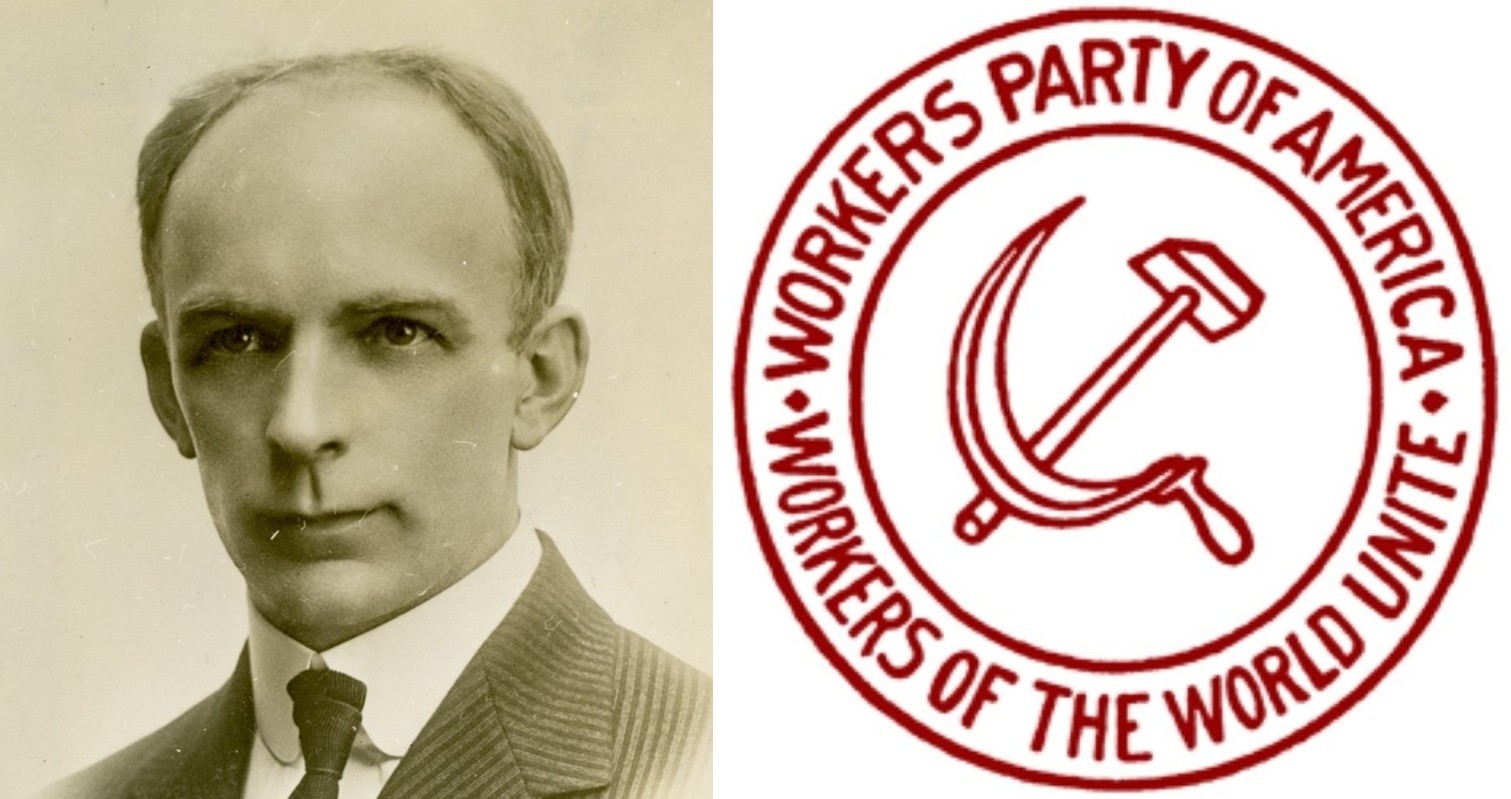
Split into several groups and working under conditions of illegality since forming in 1919, the Communist movement in the U.S. made a big step toward consolidating in December, 1922 with the formation of the above-ground Workers Party. C.E. Ruthenberg reports on the convention.
‘Communism in the Open Again’ by C.E. Ruthenberg from Liberator. Vol. 6 No. 2. February, 1923.
A LITTLE over three years ago the words “Soviets” and “Dictatorship of the Proletariat” appeared for the first time in the program of a political party in this country, when the Communist Party of America was born in Chicago in September 1919. For three years the ideas for which these words stand have been taboo so far as open expression in the program of a political party is concerned. They came to life in the open again in the program adopted by the second convention of the Workers’ Party of America, held in New York City beginning December 24th.
While the Chicago convention of 1919 and the New York Convention of 1922 wrote the same ideas into the program adopted, there is a great difference in the movement behind these ideas.
The Communist Party of 1919 came to life on the wave of enthusiasm inspired by the Russian Revolution. It was a spontaneous outburst in this country of the forces generated by the first proletarian revolution. The 1919 convention was satisfied to make its declaration of Communist faith. It did that with fervor and enthusiasm, but the practical application of the Communist principles to the life of the American workers was not undertaken. The movement was too young and too much under the influence of the great events in Europe for it to consider the necessity of planning the slow, difficult, painful process through which the American workers would be educated to the necessity of acting upon Communist principles.
The psychological attitude of 1919 was not favorable to such planning. The proletarian world revolution had begun. The workers were on the march. The Revolution would sweep on. In a few years–two, three, perhaps five–the workers of the United States would be marching step by step with the revolutionary workers of Europe. In such an atmosphere it was not likely that the details of the immediate struggles of the workers of this country would receive attention and that plans would be formulated to make these struggles serve the Communists’ ends.
In the three years that have passed since the open Communist convention of 1919, the Communist movement in this country has undergone a transformation. It is no longer a spontaneous outburst of enthusiasm. It has not lost its enthusiasm, but it has learned during these three years to direct this enthusiasm into the task of creating support for Communist principles among the working masses of this country. While it again publicly announces its faith that the Soviets and the Dictatorship of the Proletariat are the instruments through which the Proletarian Revolution will achieve its ends in this country as well as elsewhere in the world, it does not expect to convert the workers to a belief in the Soviets and the Dictatorship of the Proletariat by merely holding up the example of European experience. It proposes to teach the necessity of Soviets and the Proletarian Dictatorship to the workers through their own experiences in their struggles against the capitalists; and its campaigns and programs of action are therefore based upon the actualities of the life of the workers in the United States.
That was the distinguishing feature of the Workers Party Convention. It was a convention devoted to the discussion of the problems of the working class as they exist in the United States today. There was no hope or belief that the American workers would overnight become converted to Communism. The convention made the basic assumption that to make revolutionists of the workers of the country it was necessary to make the present state of mind of these workers the starting point, and step by step to lead them into revolutionary methods of thinking and into revolutionary action. The concrete plans adopted by the convention reflect this method of approaching the problem.
The Delegates
THERE were 54 regular delegates in the convention, 51 representing districts of the Workers Party, and three from the Young Workers League. The delegates represented every section of the country except that part south of the Mason and Dixon line where only the first shoots of the Communist movement are sprouting. Besides the regular delegates there were fraternal delegates from the 16 language sections included in the Party.
The convention got down to work without the usual waste of time in “organizing.” A half hour after the rap of the gavel which opened the convention the delegates were seated, officers and committees were elected and the convention had before it the report of the central executive committee giving an accounting of its year’s leadership of the Party.
This report showed that during the first four months of actual functioning as a Party–March, April, May and June–there were 8320 members who paid dues. During the next four months there were 12,394; and the December membership was estimated at 20,000. The major actions of the Party during its first year of existence were stated as a united front May Day celebration campaign, a campaign to promote united action of organized and unorganized workers against the open shop and unemployment, participation in the November election campaign, a nationwide celebration of the fifth anniversary of Soviet Russia and the campaign for the formation of a Labor Party.
The Labor Party
WITH the report of the Central Executive Committee out of the way, the Convention took up its first question of policy. It is significant of a new orientation of the Communist movement in this country that this should have been the question of a Labor Party. The emphasis becomes still greater when it is added that more time for report and discussion was allowed for this question than for any other point on the agenda of the Convention.
The Labor Party policy had been initiated by the Central Executive Committee after the convention of a year ago. In the early months of 1922 the Communist International had developed the tactic of the “United Front.” In applying this tactic to the United States, the Central Executive Committee of the Workers Party declared last May that “The problem of the United Political Front of Labor in the United States is the problem of the formation of a Labor Party,” and laid down a program of activity in the unions to develop sentiment for the formation of a labor party by the unions. When the Cleveland Conference for Progressive Political Action appeared on the horizon, the Central Executive Committee launched an aggressive campaign to crystalize the sentiment for a labor party so that such a party would be formed at the Cleveland conference.
Through a representative appointed for that purpose (the present writer) the Central Executive Committee submitted a report which included an analysis of economic and political changes which are generating the sentiment for a labor party and which make possible the organization of such a party and a statement of the tactics it has pursued. The resolution submitted by the Central Executive Committee asked for a vote of approval of its past action and proposed as a means of continuing the campaign the entering “into negotiations to bring about joint action by those elements in the trade unions, farmer organizations and other workers organizations which favor a labor party, for the organization of labor party committees, to consist of delegates from all working class organizations favoring the formation of a labor party.”
Five hours of discussion followed during which practically every delegate spoke. There was some criticism of the Central Executive Committee for not having acted promptly enough. Some of the Finnish delegates were suspicious about what would happen to the Workers Party while it devoted its energy to the campaign for the formation of the Labor Party. To the latter it was explained that it was through the campaign for the Labor Party that the Workers Party would grow stronger; that by this campaign it would become a factor in the life of the American workers and attract to itself the more militant elements among the workers. At the end all doubts had been cleared away and the resolution adopted by unanimous vote.
The Trade Union Policy
NEXT on the agenda came the question of the trade unions. The first convention of the Workers Party will stand as a landmark for the future historian who studies the attitude of the revolutionary movement in this country toward the trade unions. The Workers Party at this convention set its face against dual unionism. It adopted a program of permeating the existing trade unions for the purpose of bringing about their amalgamation into industrial unions and making these militant fighting organizations carry on the struggle against capitalism.
Here, therefore, it was not a question of adopting a new policy, but of finding out what progress had been made in carrying out the policy already adopted.
The report for the Central Executive Committee was submitted by William F. Dunne. The report and the discussion which followed illuminated the basic change which has taken place in the Communist movement here. In the Communist Party and Communist Labor Party conventions of 1919 it would have been difficult to gather together a half dozen delegates who knew anything about the trade union movement. The trade unions were an alien subject in these conventions. In the convention of 1922, delegate after delegate rose to tell, not of theories to be applied to the work in the trade unions but of the concrete things which had been done or were being done on the union field.
Dunne, known all over the country for his union work, made the general survey showing the sweep of the amalgamation movement through the state federations of labor and in the railroad unions. Fred H. Merrick told of the fight to elect a progressive ticket for the Pittsburgh district of the United Mine Workers of America. T.R. Sullivan reported the successes in the Southern Illinois mining fields. Charles Krumbein and Nells Kjar related the achievements in the Chicago building trades. Wicks and Canter were there from the printing trades. Others represented the needle trades. Earl Browder of the Trade Union Educational League was there to tell of the work of that organization.
These reports and the discussion following them emphasized the impression that the Communist movement is no longer an alien thing in the labor movement of this country. Already its roots have sunk deep into the labor unions. It has still many prejudices to overcome; it has a long and difficult road to travel before it will win the trade unions; but it is on the right road; it has adopted the right policy.
The convention reaffirmed the previous year’s policy unanimously and urged those members of the Party who were not members of the unions to join a union at once and thus make possible even greater work in this field.
Protection of the Foreign Born Workers
THE realistic character of the Communist Movement of today was again illustrated in the resolution adopted by the Convention initiating a campaign for the protection of foreign born workers.
The workers in the basic and large scale industries in the United States are so predominantly foreign born that an analysis of American society, even before the new developments, gave one the impression that in addition to the class division of capitalist society into worker and capitalist there exists in this country the additional division of an American exploiting caste and a caste of exploited and oppressed foreign born workers. Everything points to the fact that the exploiters are planning to make this previously existing division even sharper by all kinds of exception laws directed against the foreign born workers.
These exception laws include proposals for registration, photographing and finger printing foreign born workers like criminals, and the forfeiture of naturalization papers and deportation for rebellion against the exploiters.
Ludwig Lore, the reporter on this subject, showed a dark future ahead of the foreign born workers if these exception laws are passed. The convention declared itself for a campaign to protect the foreign born workers against this new aggression. It invited all organizations sympathetic with its purpose to participate in the organization of councils for the protection of foreign born workers. The campaign, in addition to being directed against the exception laws, will seek to bring the foreign born workers into the unions and into the political life of this country.
The Party’s Program
THE program adopted, as has already been pointed out, is a clear statement of the principles of Communism. It has the additional merit of being written in the terms of American life, all its illustrations being drawn from the experiences of the workers of this country. It states in unmistakable terms the sympathy of the Workers Party with the Communist International and its acceptance of the leadership of that body.
Resolutions were adopted pledging the Party to carry on the struggle for the release of all class war prisoners; of sympathy and support for Soviet Russia; endorsing the relief work of the friends of Soviet Russia and the reconstruction work of the Russian American Industrial Corporation; defining the relations of the Party with the Young Workers League and pledging assistance in building that organization; expressing the need of the language federations within the Party and appreciation of their work; approving the soldiers’ bonus and denouncing the American Legion and Ku Klux Klan as counter-revolutionary organizations and urging all ex-service men to join the World War Veterans.
One resolution which deserves especial mention is that dealing with emigration to Soviet Russia. The Party declares its opposition to mass emigration to Soviet Russia and urges all revolutionary workers to carry on the struggle against capitalism here. The Party will not permit its members to emigrate and declares that only especially needed experts should go to Russia.
Those who sat through the three days’ work of this convention and heard the reports and debates, gained new enthusiasm and new hope for the Communist movement in this country. Through all the proceedings one felt something young, virile, strong–a giant waking from sleep and becoming conscious of his strength.
The delegates went from the convention with new courage in their hearts. They expressed this in the last act of the convention, a cablegram to the Communist International, the vote being given by the singing of “The Internationale.” The cablegram read:
“Second National Convention Workers Party sends greetings to Comintern. Convention reports with joy absence of all factionalism. Convention devoted itself to constructive work of building a powerful revolutionary movement in America. All reports indicate greater influence of Party in actual struggles of workers. We go forward with new strength and enthusiasm. Long live Communism and the International.”
The Liberator was published monthly from 1918, first established by Max Eastman and his sister Crystal Eastman continuing The Masses, was shut down by the US Government during World War One. Like The Masses, The Liberator contained some of the best radical journalism of its, or any, day. It combined political coverage with the arts, culture, and a commitment to revolutionary politics. Increasingly, The Liberator oriented to the Communist movement and by late 1922 was a de facto publication of the Party. In 1924, The Liberator merged with Labor Herald and Soviet Russia Pictorial into Workers Monthly. An essential magazine of the US left.
PDF of full issue: https://www.marxists.org/history/usa/culture/pubs/liberator/1923/02/v6n02-w58-feb-1923-liberator-hr.pdf

