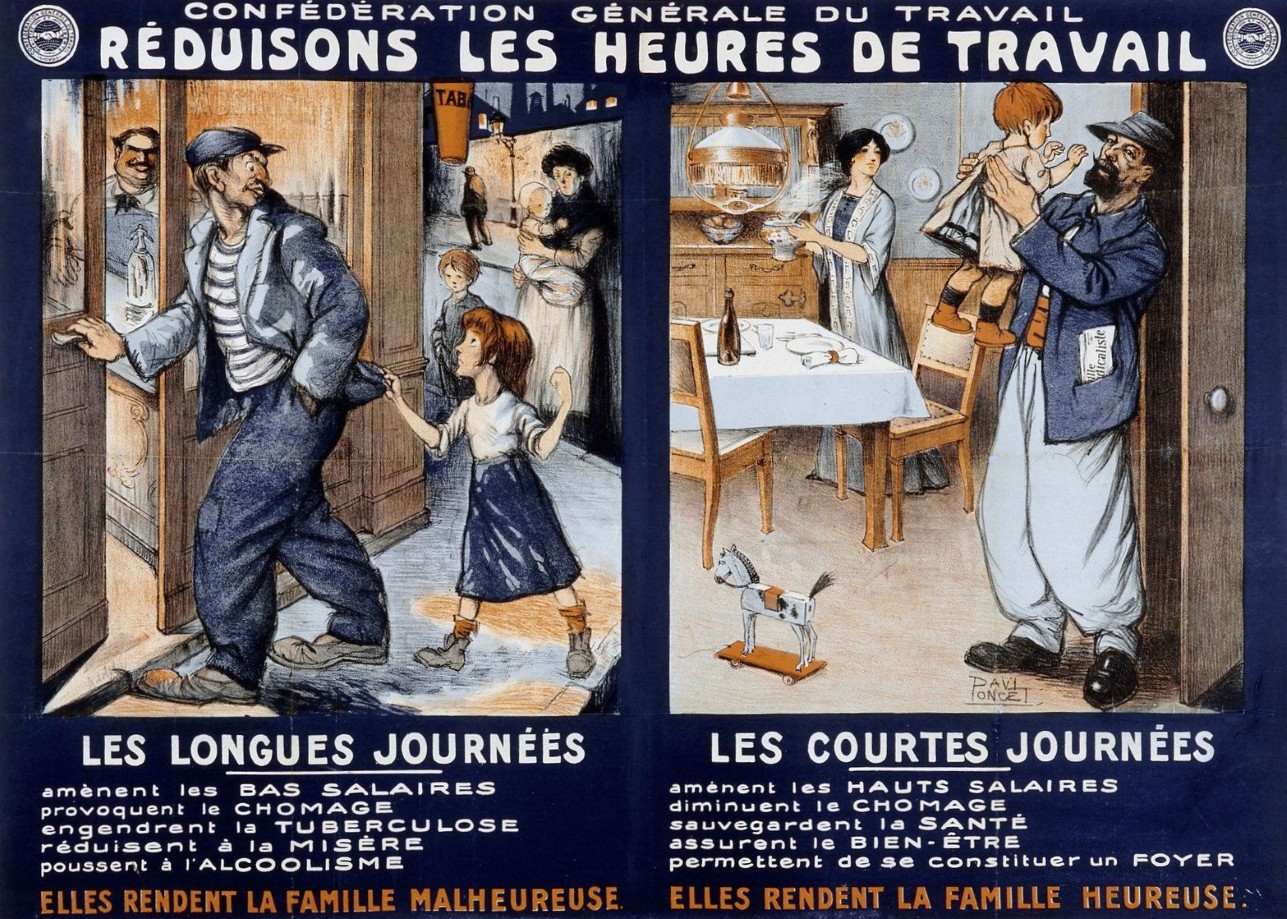
Paul Louis provides us with his perspective of the nature of French unionism in this valuable look at the history of France’s pre-war C.G.T.
‘Syndicalist Organization in France’ by Paul Louis from New Review. Vol. 1 No. 10. March 8, 1913.
In a former article I have examined briefly the organization of the Socialist party in France: I would now like to show the operation of the Syndicalist associations and their numerical strength, and speak not only of the syndicats, which are the primary form of such associations, but also of the Labor Bourses, the unions of syndicats, the federations of trade and industry and the General Confederation of Labor.
The French Syndicalist movement has developed especially during the last fifteen years. If we ask why it has taken so long to establish itself on a solid basis, we find numerous reasons:
(1). Legislation has always been placing obstacles both of political and of economic character in the way of labor associations. Every organization of the proletariat, whatever may have been its object, was regarded as suspicious and subversive. Immediately after the Great Revolution, or rather during the Revolution, the so-called Chapelier Law prohibited both labor unions and strikes. The Penal Code of the Empire was made stricter still, and the Monarchy of July, in the presence of the outbreaks at Paris and Lyons, which indicated the awakening of the industrial proletariat, added still more to this severity. It was by all sorts of expedients that the wage-earners succeeded, in spite of everything, in taking concerted action for the protection of their interests. They formed at first more or less professional “Mutualities,” and then “Resistances,” which, without threatening the framework of the social system itself, and faithful to the same spirit that moved old English trade-unionism, struggled against the reduction of wages or for increase in wages. But these “Resistances” were jealously watched by the police, and continually were attacked and dispersed. The Republic of 1848 showed some fleeting signs of liberalism, and suddenly there appeared an enormous efflorescence of labor associations; most of them succumbed, however, in the repressions of June, one of the wildest episodes in the history of class struggles in France. The Second Empire carried police interference still farther, until finally it discovered that in spite of all its measures to the contrary the labor movement was growing. The government was forced in 1864 to proclaim the principle of free coalition; shortly afterward, it was obliged to leave in practice a rudimentary freedom to the syndical chambers, which had replaced the “Resistances.”
The syndical chambers had concentrated especially in Paris, where they tried, on the eve of the War of 1870 and the fall of Napoleon III, to form a collective organization. But they were then in the period of arbitrary despotism: at the least movement of any significance, they were dissolved, and their directors arrested and imprisoned. They were obliged rather to conceal the fact of their organization and limit themselves to the same tasks as before, although the spirit of the International had already penetrated into their midst.
After the downfall of the Commune (March-May, 1871), in which many of the syndicals of that time participated in Paris, a new era of repression began. The syndical chambers were dissolved at one stroke. The associative movement was nevertheless so strong, and the French proletariat so energetic, that within six years after the Commune, corporative associations were springing up everywhere. It has been estimated that in 1882, 60,000 workmen were members of the syndicats or syndical chambers, the first name prevailing after the Law of 1884 recognized the existence of professional associations. This law, which was veritably forced through by the will of the proletariat, although it was not entirely favorable to the workers, assured a very relative freedom. Henceforth the syndicats could be formed without authorization, but they were obliged to communicate to the government their statutes and the names of their directors or administrators. Practically, the law left to the government strong weapons against the working class; and whenever the government has been able, it has sided against the syndicats. It has further made use of the provisions of the Penal Code whenever a social crisis, a general strike, has broken out, and it has never hesitated to arrest those whom it considered the leaders. Nothing, however, has prevented syndicalist enthusiasm from manifesting itself with increasing prestige.
(2). If the French syndicats present smaller contingents than those of the English Trade Unions or the German Gewerkschaften, it is not only because the French proletariat is slightly inferior to that of Germany and much inferior to that of the United Kingdom. The reason is that great industry has not made on the territory of the Republic the same astonishing progress that it has made elsewhere. It is not difficult to understand this. France has no coal deposits comparable to those of the United States, of England or of Germany. She has only 200,000 miners as compared with 1,100,000 in the United Kingdom. Her metal works, her weaving and spinning factories, although their products are advantageously quoted on the market, do not deliver to the trade quantities equal to those furnished by her two neighboring rivals. France has remained a country of artistic and “deluxe” industry, and the production of such commodities scarcely demands a powerful concentration of personnel: in addition to the great laboring groups of Lille, Roubaix, Tourcoing, Lyons, Saint-Etienne, Rouen and Reims, we must consider the artisan class as well. Finally the rural element forms a considerable bulk, and it is a matter of common knowledge that this class is less susceptible than any other to syndicalist propaganda.
(3). The French workingman, as I have already pointed out, is essentially individualistic, and hostile to close agreements imposing strict obligations. He does not like to bind himself. He understands solidarity and is quite capable of sacrificing himself on those great occasions when deep convulsions stir the proletarian class to the very depths; he shrinks on the contrary from the petty annoyances, the humdrum sacrifices, the tasks without glory, which unions demand from day to day. It is only recently that the French laborer has become aware of the virtue of permanent associations, which do indeed exact of each man a partial gift of himself, but which return this gift a hundred fold, by winning him inestimable collective advantages. As one reviews the history of the “Mutualities,” the “Resistances,” the “Syndical Chambers,” the “Syndicats,” in the nineteenth century, one notices at every moment, ruptures, dissolutions, reorganizations, all entailing endless expenditures. The federations of trades which are finally developing to-day, have passed during the last twenty years very critical moments. The groups composing them have waged the bitterest struggles against each other. Accusations were hurled against the most devoted militants, who finally in sheer exhaustion gave way. Their departure brought about confusion and all incorporation lapsed into the silence of death, till some element more active and courageous tried again to rouse it into life. It has seemed as though the French proletariat has been quite as eager to form syndicats as it has been careless about making them permanent.
Here then are some of the reasons why labor unions in France, have been and still are inferior in efficient contingents to those of other great countries. It might perhaps be desirable to touch on the history of the internal revolutions of France, revolutions which have followed each other in rapid succession, and at times without apparent or appreciable preparation. These uprisings have accustomed the masses to love insurrection for itself and to believe in the omnipotence of violence. It was not until the concept of the general strike, so revolutionary in certain of its aspects, came to replace the romanticism of the barricade, that syndicalism felt its power increasing.
The spread of syndicalism has been apparent from several considerations: (1). The membership of the syndicats has increased. (2). The syndicats of particular trades have tended to fuse with one another. It is noticeable that in direct ratio to this tendency, the total number of syndicats has progressed less rapidly than that of syndicat members. (3). The syndicats of particular trades have assembled in national federations so as to generalize their claims and to prevent the workers of one region from blocking the efforts of those of another. (4). The syndicats of all the trades of a given locality have formed unions and Labor Bourses (Bourses de Travail). So the labor unit must express itself in each city through the community of action which reigns among all the organized wage earners, whatever be their trade. A single enthusiasm thus impels the whole proletariat, conscious of unity, toward a single goal by sustaining the same claims. A given syndicat, very feeble in its isolated action, conducts a very efficient campaign if it can count on the support of all the other syndicats, from whatever trade they may come. Departmental federation, which has recently appeared, has extended largely and effectively the field of operation of the local union. (5). The unions and federations have concentrated, or more exactly federated, into the C.G.T. (Confederation Generale de Travail), the origins of which go back to 1895, and which equipped itself in 1904 with its present constitution.
These are the elements of syndicalism we are about to discuss in their order, overlooking for the moment the divers tendencies which manifest themselves among the French syndicats, as well as the doctrines which confront one another in the congresses.
It is extremely difficult to obtain authoritative statistics on the syndicats and on their members in France. The elementary groups do not themselves publish any census which might serve as a stable basis for calculation. The federations or the unions of syndicats are not acquainted with the numbers of their component elements, the latter often concealing the truth in order to obtain assessments as low as possible. The C.G.T., at its last congress at Havre, was obliged itself to recognize that its adherents numbered some 200,000 more than its taxed members. Certainly, regrettable abuses exist in this regard. It would be desirable that all the members of the local syndicats should become contributors to the departmental and national federations. At any rate, we must content ourselves with the few facts we possess. These are derived from the Bureau of Labor, from the Ministry of Labor and from the Social Bureau: they must be accepted with circumspection, first of all, because the sources of information of these official bodies are rather uncertain; then because the local corporations, when questioned, may consider it to their interest to conceal the truth; and finally, because the totals presented confuse the syndicats of the Reds–who stand more or less for class war–and the syndicats of the Yellows, which are properly associations of strike-beakers, started under the protection and for the protection of large capital. I may add that the Yellows represent but slight contingents.
In 1884 there were 68 known syndicats of workmen; in 1887, 501; in 1890, 1,006; in 1893, 1,926; in 1896, 2,243; in 1900, 2,682; in 1905, 4,625; in 1910, 5,260; in 1912, 5,217. Between 1908 and 1912 there has been a falling off of 307 syndicats, but this diminution, as we shall see, in no way corresponds to a numerical weakening of the syndicalist army. It results rather from a systematically prosecuted fusion of locals in a given trade, which formerly were running counter to each other to the greater prejudice of the proletariat.
In 1890, the syndicalists numbered 139,692; in 1893, 402,630; in 1896, 422,777; in 1900, 491,647; in 1903, 643,757; in 1906, 836,134; in 1910, 977,350; in 1912, 1,064,410. In short, the progress has been without interruption, save in 1909, a year, which in France as elsewhere, but less than elsewhere, was as might be expected from the economic crisis, marked by a reduction.
In 1890, the average membership of a syndicat was 139; in 1895, about 200; slightly declining then in 1900, to settle in 1912 around 204.
These syndicats have created around themselves institutions of varying nature. If in general they adhere to the doctrine of class war, and look forward to a complete overturning of the social system, they nevertheless do not repudiate partial reforms, such as the reduction of hours of labor, increase in the guarantees of hygiene and safety, improvement of the condition of the workers, the better thereby to strengthen their capacity for struggle. They also adapt themselves to the present social structure in order to organize a concrete solidarity for the mutual advantage of their brothers; 1,137 of them have bureaus of employment for the workers in their trades; 1,502 have started libraries; 808 have funds for mutual aid; 624 have funds for those out of work; 473 distribute mileage to those of their members who have to move in search of work; 357 have founded trade schools; 79 pension endowments; others have instituted co-operatives of distribution or even of production. Thus more than 6,000 locals serve as the centre, the home, of proletarian activity.
Above the syndicats, we have, as has been said, the unions. and federations, the functions of which we have defined.
The local unions of syndicats, which are also called Labor Exchanges, but inexactly (for the union is the assemblage of local syndicats, while the Bourse is the edifice, usually municipal [*For some years past the local unions have shown a tendency to leave the Bourses, where they were subject to annoyance from the municipal authorities.] which shelters this assemblage) are tending at present to give way or at least to subject themselves to the Departmental unions of syndicats. That is, the new unions are intended to have a vaster territory and their propaganda should cover a far wider zone. The last congress of the C.G.T. at Havre (September, 1912) decided that this transformation should be completed by Jan. 1, 1913, and it expected the greatest results therefrom, as far as regards the diffusion of syndicalistic ideas; for under the present organization it happens that two and even three local unions are operating in one department side by side, and accordingly a considerable portion of that department is lost for syndicalism; it also happens that unfortunate rivalries are occasioned between these neighboring unions.
According to the Annual Government Report, there are in France 141 Labor Bourses; according to the reports of the Co federation, there are 153 local unions of syndicats.
The trade Federations, which extend their influences over the whole territory, are numerically estimated only so far as they adhere to the C.G.T. This central, though not centralized, organization counted 53 federations, most of which are federations of particular trades: match workers, furniture makers, launderers, blacksmiths, tinsmiths, shoemakers, etc.; while others are federations of industries, foodstuffs, pottery, fabrics, skins and hides, etc. These 53 federations unite 2,837 syndicats. The tendency which has been in evidence for some years and is still at work, is in the direction of concentrating trade federations into industrial federation. Thus the federation of mechanics was expelled from the C.G.T. because it refused to fuse with the federation of metals. The latter federation of industry had already absorbed the firemen, conductors and engineers, while that of skins and hides was taking in the trade federation of furriers.
The largest federations are the builders (80,000 members), the railroads (11,000), skins and hides (10,600), metals (28,600), mines (20,000), ports and docks (16,000), textiles (13,500). Certainly these figures are underestimated, for the federations generally conceal a part of their membership, in joining the C.G.T., to avoid high assessments.
The C.G.T. has two branches, the one the Bourse section, the other the section of Federations. It has a permanent bureau formed by appointment: two secretaries, one treasurer and one assistant treasurer. It is administered by a federal committee composed of delegates of Bourses and Federations. A congress is held every two years. The budgets are likewise formed every two years, to cover the interval between congresses. From 1910 to 1912, the receipts for 24 months were 139,000 francs, derived especially from stamps sold by the federations and unions of syndicats, and of federal papers delivered to the members.
At the present moment, the Confederation has 400,000 dues payers and 600,000 members. The difference is explained from the facts that only general groups, that is federations or local unions, can be admitted as voting elements, and these groups enroll themselves always for a part only of their membership. In a word the C.G.T. embraces more than half but less than two thirds of the French syndicalists, admitting as exact, which it probably is not, the total of 1,064,000 given by the Annual Government Report.
New Review was a New York-based, explicitly Marxist, sometimes weekly/sometimes monthly theoretical journal begun in 1913 and was an important vehicle for left discussion in the period before World War One. In the world of the Socialist Party, it included Max Eastman, Floyd Dell, Herman Simpson, Louis Boudin, William English Walling, Moses Oppenheimer, Walter Lippmann, William Bohn, Frank Bohn, John Spargo, Austin Lewis, WEB DuBois, Maurice Blumlein, Anton Pannekoek, Elsie Clews Parsons, and Isaac Hourwich as editors and contributors. Louis Fraina played an increasing role from 1914 on, leading the journal in a leftward direction as New Review addressed many of the leading international questions facing Marxists. The journal folded in June, 1916 for financial reasons. Its issues are a formidable archive of pre-war US Marxist and Socialist discussion.
PDF of full issue: https://www.marxists.org/history/usa/pubs/newreview/1913/v1n10-mar-08-1913.pdf

