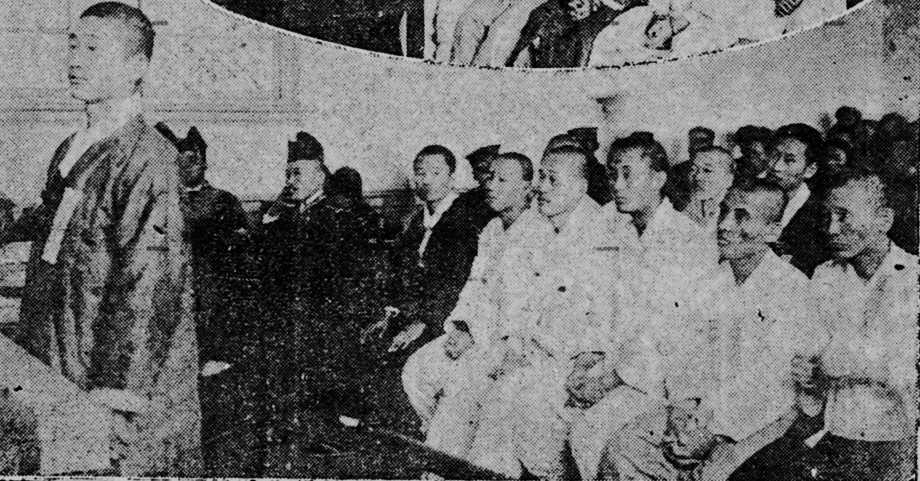
Japanese imperialism gives trials, tortures, and imprisonments to dozens of young Communists accused of participating in Korea’s 1926 June Tenth Movement against Japanese rule which coincided with the funeral of the last Korean emperor, deposed as a child by Japan’s 1910 invasion.
‘The Vengeful Judgment upon the Korean Revolutionaries’ by N. Fokin from International Press Correspondence. Vol. 8 No. 11. March 1, 1928.
In Soul (Korea) the trial of the 101 Korean Communists and Young Communists has come to a close. Eighty four of them have been sentenced to imprisonment for eight months to six years.
For nearly two years preceding the trial these young revolutionaries were tortured and maltreated. They were tortured before the eyes of other comrades and there were cases in which those who were waiting for their turn to come could not stand the terrible sight and declared themselves ready to make confessions if only a stop might be put to the torturing of their comrades. Two of the prisoners, Comrades Pak Sun Wen and Pak Kwey Chyn were tortured to death. Several lost their reason. Even during the course of the trial most of the accused were not secure from torture, and that was evidently the reason why the trial took place behind closed doors without the presence of the representatives of the Press and of the relatives of the accused.
The trial just concluded against the 101 revolutionary is only a minor act in the great tragedy of the duel between fettered, oppressed Korea and Japanese imperialism. The immediate reason for placing the representatives of the Korean working masses in the dock was the impetus in the Korean national emancipation movement, in which the Communists are beginning to play a role of increasing importance. This new impulse coincided with the funeral of the last Korean monarch, known by the name Prince I Senior.
On April 26th, 1926 occurred the death of the last of the former ruling house of Korea. This death excited the Korean population among whom the conviction was widespread that the previous ruler died a violent death, that his wife was murdered with the direct participation of Japan and that the recently deceased emperor was systematically poisoned by the Japanese and in consequence came to a premature end. The emperor himself had long ceased to be popular with the people, as he was accused of lack of courage in voluntarily agreeing to the annexation of the country.
The Japanese Government conceived the idea of exploiting the death of the Korean emperor in order by means of an imposing funeral, which was organised by the Japanese police, to demonstrate to the world the “reconciliation” of annexed Korea with the oppressive Japanese imperialism, of showing to the whole world its “solicitousness for the Korean nation” and so to make the first effort at a rapprochement with the leaders of the Korean intelligentsia.
This plan of the Japanese imperialists met with an anti- Japanese demonstration organised by the Korean revolutionaries. The funeral was a mere pretext. They concentrated the attention of the broadest masses on the national and economic yoke of the Japanese occupants. Hardly was the death of the emperor known before two organisations: “Man Gok Dan” (League of Plaint) and “Pon Do Dan” (League of Mourning), came into being and arranged a general mourning throughout the country. The Japanese General Governor sounded the alarm. The red danger of Bolshevism was proclaimed. Mass reprisals were instituted.
But the mourning protest extended further and further, encompassing new territory and fresh masses. On April 29th an attempt was made to assassinate the General Governor Saj To: Two Koreans armed with daggers boarded the automobile in which two officials of the General Governor (one of them closely resembling Saj To), were seated and stabbed them in broad daylight.
The first of May passed quietly in Korea. But on this day, as though at a given signal, the Korean population wore mourning, even the women and children. It was a silent demonstration affording no pretext for trouble. Many carried in their hands the leaflet announcing the attempted assassination. This attempted assassination served the Japanese police as a signal for violent interference with the Socialist organisations. They concentrated all their efforts upon ensuring that on the day of this funeral the broad masses should be without leadership. In the first place the leaders of the Socialist workers’ peasants’ and national-revolutionary mass organisations were removed. Altogether several thousand people were arrested in those days. A state of siege was declared. On July 10th there were in Soul alone ten thousand soldiers. In every port there were Japanese warships. Japanese Fascists were mobilised with revolvers and truncheons.
Nevertheless, the national-revolutionary organisations, with the Communists and the Young Communists at their head, and supported by the sympathy of the broad masses, decided to disclose the real relation of the Korean people to the Japanese yoke and to lead the masses on to the streets under the slogan of national independence. Tens of thousands of proclamations bearing the signatures of the Party for the Independence of Korea and of the Free Association of the Farmers of Greater Korea were distributed. In spite of all the precautionary measures which the Japanese took for the prevention of “disturbances”, an anti-Japanese demonstration was organised in the funeral procession in which about 400,000 persons took part. At a given signal proclamations were distributed in all parts of the procession, and speakers were raised shoulder high to hold short, spirited speeches containing anti-imperialist slogans and they met with the general sympathy and support of those taking part in the demonstration. When the police spies tried to arrest the demonstrators, they often had to resort to the use of weapons in order to contend with the hostile masses.
Similar demonstrations, took place in a number of big centres at the same time as the demonstration in Soul. In order to weaken the impression made by these events, the Japanese Government tried to represent them as exclusively Communist disturbances and at the same time speculated on at division between the Communists and the national revolutionaries. They were successful in neither instance even though they removed the Communists by placing them in the prisoners dock.
The maltreated, tormented and tortured young revolutionaries behaved heroically during the trial. That they had formed the right opinion of the court was evident from the speech made in the beginning by Comrade Pak Hen Nen in the name of all the accused:
“We are the representatives of the Korean proletariat which is engaged in a life and death fight against you. How can a court exist between enemies? We know the result beforehand. It will be a ruthless class judgment. Why this court comedy, when you have already avenged yourselves enough, when you have beaten us in prison with bamboo canes and tortured us with needle pricks. Down with the travesty of justice!”
The international proletariat will not forget the Korean revolutionary heroes languishing in the torture chambers.
International Press Correspondence, widely known as”Inprecorr” was published by the Executive Committee of the Communist International (ECCI) regularly in German and English, occasionally in many other languages, beginning in 1921 and lasting in English until 1938. Inprecorr’s role was to supply translated articles to the English-speaking press of the International from the Comintern’s different sections, as well as news and statements from the ECCI. Many ‘Daily Worker’ and ‘Communist’ articles originated in Inprecorr, and it also published articles by American comrades for use in other countries. It was published at least weekly, and often thrice weekly.
PDF of full issue: https://www.marxists.org/history/international/comintern/inprecor/1928/v08n11-mar-01-1928-Inprecor-op.pdf

