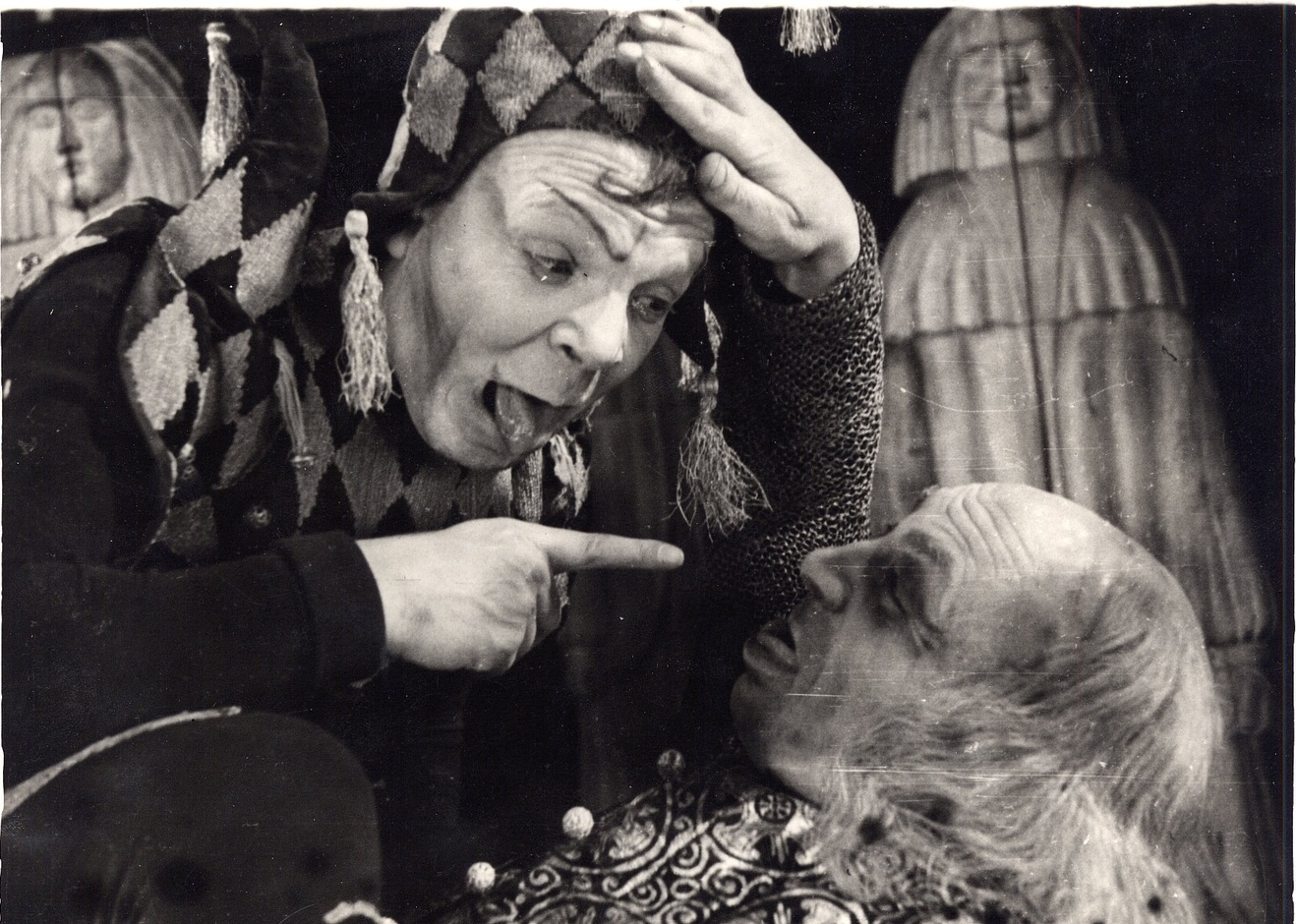
A wonderful essay on one of the greatest works of literature in the English-language by leading Soviet literary critic of the 1930s Sergei Dinamov. Among the many roles of the editor of International Literature was to popularize Shakespeare in the U.S.S.S.R., in 1935 editing a new collection and translation of Shakespeare’s plays and promoting productions in Soviet theaters, as with his championing of the legendary Yiddish version by Moscow’s State Jewish Theater (GOSET) with Solomon Mikhoels as Lear. You need not subscribe to Dinamov’s “Shakespeare as father of socialist realism” to appreciate this passionate appraisal and redemptive reading of a piece of art which continues to wield profound power over those who have been captivated by its poetry, as was Dinamov.
‘King Lear’ by Sergei Dinamov from International Literature. No. 6. 1935.
A Soviet View of Shakespeare’s Masterpiece
With what a sombre light the world of this tragedy is illuminated! How strange are its people! How black their malice! How bitter their hatred! How revolting their envy and how awful their vindictiveness! It is as though Shakespeare had gathered together all the malice and bloodthirstyness of the world and poured them into the heroes of this play.
Even reading King Lear is an emotional experience and carries us like a whirlpool into the lives of its characters. That is great art. It is real as life and vital as reality. This brilliant artist’s creation is intelligible to all. But how deceptive those winding pathways often are, which lead to the summit of a mountain. You think you have only to turn another corner to reach the top, but in reality there are still leagues to be climbed.
It is the same with Shakespeare. He is simple and easy to understand, he is lucid and accessible to all. He appears to be completely transparent. But it is the transparency of a clear sky which in the far elusive distance passes into a mist, so thick and impenetrable that it strains the eyes to try and see through it. Shakespeare makes one think. He exalts the mind, he kindles it at the flame of his genius.
Lear is the chief character in the play. He stands at the meeting point of all the threats of the tragic plot. His presence keeps it alive. His last exit coincides with the last lines of the play. The very first scene discloses him as a man for whom neither human beings nor human compassion exist, a man who had made his own ego a law for all living things.
Xerxes lashed the disobedient sea. Lear would have punished the sun itself if it had shone down on him with insufficient respect for his royal dignity.
He looks upon the whole world as a ball which he can throw in any direction he pleases, and men are only motes in the air, a mere breath will disturb them and a wave of the hand will bring them to the ground.
Here is King Lear’s first suave and serene monologue.
Meantime we shall express our darker purpose—
Give me the map there. Know that we have divided
In three our kingdom: and ’tis our fast intent
To shake all cares and business from our age
Conferring them on younger strengths while we
Unburdened crawl toward death.
What a majestic and benign old man. He is only wearied of his power and a little before his time he has resolved to free himself of it. But suddenly this smooth stream of words meets with an obstacle.
Cordelia dares to tell him, the King himself, the truth
…I love your majesty
According to my bond, no more nor less.
And Lear is enveloped, as it were, by a cloud of madness. All his benignity disappears and the audience sees before them a despot whose whims and caprices know no bounds.
“Come not between the dragon and his wrath” he cries, Cordelia is cast out by Lear, deprived of her dowry and immediately becomes for him a poor and despicable creature. He curses her, and his language becomes abrupt and harsh.
Better thou
hadst not been born than not have please’d me better.
He exposes his own daughter to the greatest humiliation and this only because she is unwilling to lie, because she cannot bring herself to be a flatterer and a hypocrite.
Later on his fool tells him that he has pared his wits on both sides and left nothing in the middle. And it is just here that the paring down of his mind begins. From here on Lear begins to fall from the height from whence he had seen only himself and no one beside him.
Hegel said that Shakespeare had depicted pure evil carried to the extreme of hideousness and repulsiveness: (Aesthetik, German Edition, 1931, p. 304). Hegel sees in the play “an extraordinary unity of unrestricted evil.”
How different the real Lear of Shakespeare is to the petty bourgeois sentimental Lear which The Studio Theatre (Now the Second Moscow Art Theatre) presented in 1922, interpreting Shakespeare as though he were Dickens.
The evil in this play is powerful, it is hard as steel.
Kent, the loyal and honest is incensed at the behavior of his superior, and he quite openly and fearlessly speaks out what he thinks. He shouts at the King as though at an ordinary human being.
Be Kent unmannerly
When Lear is mad. What would’st thou do old man?
Thinks thou that duty shall have dread to speak
When power to flattery bows? To plainness honour’s bound
When Majesty falls to folly. Reserve thy state!
And when Lear threatens him he answers that we will not keep silence as the King has acted wrongly. He goes away into exile with these words of farewell to Lear:
Fare thee well, King, sith thus thou wilt appear
Freedom lives hence and banishment is here.
But he remains loyal and this increases Lear’s guilt and heightens the dramatic situation. Kent after disguising himself, again enters the services of Lear and does everything he can to save him in spite of the rough treatment he has received at his hands.
Lear has cut himself off from the best and is left with the worst.
The world darkens for Lear, and the minute fragments of the world which are all that remains that his mind can grasp stand out sharply and are piercingly painful to his eyes.
There is something hateful, something terrible about this blindness of Lear’s, for this wave of anger finds its strength in the strength of authority. How fierce is Lear’s anger in the following scenes! How terrible are the curses he pronounces! But they do not shake the world; no one is demolished bv them. Here in the first scene however his sceptre makes every word that he utters a command and every command a sword, every flash of wrath a hurricane, Here his anger rends and destroys, but afterwards it becomes a mere state of mind, mere words that are caught up by the wind and dissipated in the wide spaces of the sky.
But the chief idea in the first act is not to be found in Cordelia. We must not forget that Lear looks upon his kingdom as his personal property. He cuts it in pieces and destroys its unity for a mere whim of his own. In this he is following a purely feudal practise which was customary when every baron was a king, recognizing the authority of no other, dividing England into small parts and struggling against the unity of the State and centralized authority. The Wars of the Roses, during which the feudal barons almost completely exterminated one another, are an example of the standpoint taken up by Lear.
Here Shakespeare, struggling, as in all his plays against the feudal disintegration of England, and the system of ideas and sentiments belonging to feudalism (especially in King John, Richard II, Richard III, Macbeth and Romeo and Juliet) continues his attack on feudalism, and shows this to be the social political basis of Lear’s psychology. During the period depicted by Shakespeare in this play, the bulwark of the system was the family. Family ties were extraordinarily strong. Shakespeare, in order to show the disintegration of Lear’s kingdom, does so chiefly by depicting the disintegration and collapse of the family (Goneril and Albany, Regan and Cornwall and the families of Gloucester and Lear himself).
And it is not the fact that he gives up his crown while still remaining King due to his regard for himself as a person of tremendous authority. There seem to him to be no limits to his power. To die and give up his crown after death is too ordinary a thing for him. Is it not rather the desire to enjoy his own generosity, to feel his own power during his life-time, to hear with his own ears the expressions of delighted gratitude from his daughters (who seem to him so insignificant that no shadow of a fear for the future passes through his mind) is it not this that made Lear take the step which proves so fatal and results in the kingdom being divided up into separate baronies? Between Albany and Cornwall a rift very soon forms and it is upon this, among other things, that Kent’s hopes of victory are built. We must not forget however that Lear himself refers to his plan to divide his kingdom as his “darker purpose.”
King Lear was written at a period when the idea of the unity of the realm was the dominant one, when the attempts of James I to put things back only served to show in a clearer light the impossibility of such a return to an earlier stage.
At a time when feudalism had not finally passed away but the new era was dawning, this act of Lear’s acquired particular significance. The theme of the play went off like a bomb and its fragments went home among the opponents of the newborn society and James I himself was hit by them.
Borrowing the story of King Lear from Holinshead (Holinshead in his turn borrowed it from other sources) Shakespeare worked it out as an attack on feudalism, which did not limit itself to Holinshead’s situation but went a good deal further. The drama took the form of a conflict of characters, The old morality was represented by Lear himself, Goneril, Regan and Edmund, while at the same time in the character of Lear Shakespeare showed how this morality was doomed and exposed the disastrousness of the sentiments cherished by the feudal nobility and all the horror of the old order.
The tearing out of Gloucester’s eyes, the number of deaths (Oswald, Cornwall’s servant, Cornwall himself, and officers of Edmund’s army, Regan, Cordelia and Edmund are all killed) as well as the whole background of cruelty and barbarity, show with remarkable clearness the sinister forces that Lear let loose when he destroyed the unity of the realm. Shakespeare made this play a great deal more gruesome than any of his previous ones.
While in King Lear the whole point was the simple truth that it is harmful to divide the State, this truth is only a part of the theme, and does not exhaust the great message of the tragedy. Goethe considered this first scene stupid, but this was merely the blindness of an artist who failed to see its tremendous meaning.
The loyal Kent who stood like a sharp sword before his King, ready to defend him, is banished. The terse and honest Cordelia is also banished. The kingdom is divided into two equal parts and handed ever to Regan and Goneril. The King becomes a mere father and his daughters become queens. The roles have been changed though the ties of blood and birth remain. But how tight this turning of the tables has stretched them. How high the daughters have risen and how low the father has fallen.
But have they become wiser? No. Have they become more generous? Certainly not. Have they become any more human than they were? Not a whit more. The reverse is the case. What then has changed? Only this, that in their hands is power and on their heads a crown.
It is as though Shakespeare were telling us how little it means to be a mere human being, how insufficient it is in a world which is so strictly arranged into hierarchies and ranks.
Consider Romeo and Juliet. The same melancholy flute note is heard here too. Men cannot be mere men because a blood feud, one of the petrified pillars of the feudal system, stands in the way of their hearts and feelings.
And now the first bitter drops of humiliation begin to soak into Lear’s finger tips without penetrating as yet further into his body or causing his brain to be bombarded with the poison of deadly insult.
In the third scene the ex-king receives his first blow (the second scene, as the reader will remember, takes place in Gloucester’s house and has not as yet any connection with Lear. It did not lake long for this blow to mature. That is what made it so painful. We do not know how long Lear has been staying with Goneril but we do know this, that there is not a single hint in the whole play, not a single scene where any evidence is given that Goneril has ever shown any attention to her father. But we hear as she speaks to her servant—her servant remember!):
By day and night he wrongs me; every hour
He flashes into one gross crime or other,
That sets us all at odds: I’ll not endure it
His knights grow riotous, and himself upbraids us
On every trifle—When he returns from hunting
I will not speak with him; say I am sick.
If you come slack of former services
You shall do well, the fault of it I’ll answer. (I.3)
Goneril is one mass of hypocricy. She has such an unctuous and courtly manner of speech when she lies but can only find the coarsest and most biting words for the truth. Her hypocricy never leaves her, it is her constant guide through life and prompts her in every action.
And now we find her ready to cast her father from her doors. She hates him. He is for her merely a tedious old man. But with what tenderness she pierces him to the very heart, what flattery and falsehood are in her words as though their steel were softened by them and the wound that they inflict were made less painful by their presence.
I had thought by making this well known unto you
To have found a safe red’iess but now grow fearful
By what yourself too late have spoke and done
That you protect this course, and put it one
By your allowance; which if you should, the fault
Would not scape censure, nor the redresses sleep,
Which in the tender of a wholesome weal,
Might in their working do you that offence,
Which else were shame, but then necessity
Will call discreet proceeding. (I.4)
It is after this hypocritical utterance that Lear cries out: “Are you our daughter?”
She speaks of being sorry for Lear; but Lear knows that if she is sorry for anyone in this world it is for herself. But how majestically and proudly she meets Lear when he has come to be dependent on her!
Yes, she is certainly the il-natured Lear’s daughter, he could not deny that she is his daughter, the evil in her character is an evil to which Lear gave birth.
Later on, in the second scene of Act IV she herself says that her life is hateful. She becomes so cynical that her husband, Albany, recoils from her and cries:
See thyself, devil!
Proper deformity seems not in the fiend
So horrid as in woman. (IV. 2)
Regan is not only Goneril’s sister in fact, she is spiritual sister also. Hers also is a lying tongue, hers also are bloody deeds and she too is ready for any crime in order to gain her end.
Listen to what she says when she answers the King after being given a third of his kingdom. How she loves him! For what sacrifices is she not ready?
I am made of that self metal as my sister,
And prize me at her worth. In my true heart
I find she names my very deed a love;
Only she comes too short,—that I profess
Myself an enemy to all other joys
Which the most precious square of sense professes
And find I am alone felicitate
In your dear higness’ love.
What is interesting about these two metaphors is that they contain a certain element of truth. Lear has indeed no need of a hundred knights if he has divided his kingdom. There is no reason why he should want to feel all the pomp of kingship if he has no longer the kingdom in his hands. But this is only a half truth and that is what complicates Regan’s and Goneril’s figures of speech and gives them life. Lear owing to the very nature of his psychological makeup needs all or nothing, absolute power or complete ruin. In taking from him the most insignificant thing they are taking everything, for Lear is an unusually whole and integrated character. His ambitions know no bounds.
In introducing the hundred knight episode Shakespeare gave expression in scene and action to this philosophy of primitive despotism.
Regan and Goneril are Lear’s daughters, they are cast in his mould. It is from him they have learnt their cruelty and tyranny. However terrible it may seem, it is he who has brought them up as they are. Their characters are supplementary to Lear’s. They are required in order to bring out those of the King’s characteristics which are revolting and despicable.
They humiliate the old King—and we are glad of this humiliation because we remember how he humiliated Cordelia and Kent.
Lear is receiving his first blow, his first insult.
Thus the first stage of the second cycle of Lear’s evolution begins. We have seen him unshakable on his throne at the heights of his power, but he has descended from his throne to the ground, little suspecting that he will soon have to grovel in the dust. He still stands, but the ground has already shaken under him and Lear has begun to totter. Beside him, however, as though on another piece of ground stands his daughter Goneril, whose words are now a command and whose command is now law, for in Lear’s world and that of his daughters might is law, authority is right. And the fool—his own fool taunts him.
Thou wast a pretty fellow when thou
hadst not need to care for her frowing: now
thou art an O without a figure. (I. 4)
Probably even the most thundering din seemed quiet to the inhabitants of Lisbon after the annihilating roar of the great earthquake. All that Lear has said heretofore seemed quiet, almost inaudible, for the time has come for the last and most terrible words to be pronounced, after which all other words fade into insignificance.
Lear pronounces them and they fall upon Goneril, his daughter, and tear her from him and him from her. “Are you our daughter?”
What a headlong descent, with what sudden force the bonds of kinship are rent asunder. Bitterness, gall, torment, rancor, helplessness—what a tangle of feelings was in his mind, darkened by his great humiliation.
Does any here know me?—This is not Lear:
Does Lear walk thus? speak thus? Where
Either his notion weakens; his discernings
Are lethargied—Ha! waking? this not so—
Who is it that can tell me who I am?
And the fool answers: “Lear’s shadow!”
The cycle is complete. Then it is that the thought of his guilt before Cordelia comes to him. We are brought back to the first scene which now appears in a new light. Thus Shakespeare introduces into this passionate symphony a new note of sympathy for Lear, a note that is scarcely audible or rather has been scarcely audible. He has been a tyrant and now he is a victim, he has been accustomed to doing people injury and now he himself is suffering injury.
…O most small fault
How ugly didst thou in Cordelia show!
Which, like an engine, wrenched my frame of nature
From the fix’d place, drew from my heart all love
And added to the gall. O Lear, Lear, Lear! (I. 4)
It is of Cordelia that Lear thinks in these moments of bitter despair. Up till now Cordelia has only appeared in the first scene, but nevertheless her character has been firmly impressed on our minds.
With Cordelia Shakespeare has brought an entirely new character into English literature and run counter to traditional esthetic canons. How different this King’s daughter is to all the princesses of English literature. There is no court sycophancy about her. She is plainspoken and her words are studied. She reminds one rather of a businesslike burgher’s daughter, who likes to have everything in black and white. She has a good many rationalist traits. She has no room for exaggerated rhetoric, she prefers to do without the sort of conventionalities which one is expected to say even when neither the person to whom they are said believes one word of them. There is something of the puritanism of the English bourgeoisie in Cordelia and very few royal characteristics.
For instance, here is one of her first speeches in Act I, scene I.
Cordelia: Good my lord,
You have begot me, bred me, lov’d me: I
Return those duties back as are right fit
Obey you, love you, and most honour you.
Why have my sisters husbands if they say
They love you all? Haply, when I shall wed
That lord whose hand must take my plight shall carry
Half my love with him? half my care and duty.
Sir I shall never marry like my sisters,
To love my father all.
Lear: But goes your heart with this?
Cordelia: Ay good my lord.
Lear: So young and so untender?
Cordelia: So young my lord and true. (I. 1)
Even at the most tragic moment when she suddenly learns of her father’s terrible plight and her sisters’ behaviour she does not lose control of herself.
Kent: Did your letters pierce the queen to
any demonstration of grief?
Gent: Ay sir: she took them, read them in my presence, And now and then an ample tear trill’d down
Her delicate cheek: it seem’d she was a queen
Over her passion: who, most rebel-like,
Sought to be king o’er her. (IV. 3)
She prefers to give up riches and honour than to lie. Unlike her sisters she will not allow a lying and deceiving tongue to plead her cause instead of deeds and genuine feelings. The king has told her plainly that if she wishes to receive the best portion she must speak fine words.
“What can you say to draw a third more opulent than your sisters? Speak!” “Nothing my lord.”
This soberness, this rational attitude, which seem even a little crude, but are in reality absolutely true to life, stand out in particularly clear relief against her times and her surroundings. A deliberate contrast seems here to be made between false romanticism and vigorous realism.
Cordelia: I yet beseech your majesty,—
If for I want that glib and oily art
To speak and purpose not; since what I well intend
I’ll do’t before I speak,—that you make known
It is no vicious blot, murder, or foulness,
No unchaste action or dishonoured step,
That have deprived me of your grace and favour;
But even for want of that for which I am richer
A still soliciting eye, and such a tongue
That I am glad I have not, though not to have it
Hath lost me in your liking.
Cordelia is a strong character who finds her support, not in physical strength but in the power of honesty and sincerity, the power of the new epoch of the Renaissance. It is by no means hardness of heart. Kent is right when he says
Thy youngest daughter does not love thee least;
Nor are those empty hearted whose low sound
Reverbs no hollowness.
Here two types of conduct are contrasted with one another, that of Lear, Goneril and Regan on the one hand and that of Kent and Cordelia on the other.
The difference between Goneril’s and Regan’s conduct and that of Cordelia is the difference between craftiness and straigtforwardness. We have here the clash between truth and falsehood, sincerity and hypocrisy, between fine words and plain speaking, between singlemindedness and arriére pensée. “I want that glibe and oily art,” says Cordelia and this throws light on the course she takes. How deep Lear must have sunk into the slough of worldliness not to be able to see Cordelia’s virtues, to be able to banish her without seeing through the “glibe and oily arts” of her sisters. Cordelia is a judgment on Lear, his attitude to her itself passes sentence upon him.
There is one other interesting trait in Cordelia’s character. Although a princess, one of the King’s daughters who has been brought up in luxury, she nevertheless values genuine human feelings above all else. These are for her worth more than all merely material or clan relationships. She is ready to live with her lover in a hut if he truly loves her. She says straight out to the Duke of Burgundy:
Since that respects of fortune are his love
I shall not be his wife. (I. 1)
She does not wish to lower herself. Her speech bears witness to an inner sense of dignity which does not allow her to be intimidated either by Lear’s anger or by her sudden fall from her high position. In losing the king’s favour she loses nothing of value that she formerly possessed, for Lear could not deprive her of her magnificent human qualities. The French King realises this when he says:
…Love’s not love
When it is mingled with regards that stand
Aloof from the entire point. (I. 1)
And when Cordelia goes with the French troops to fight against Edmund and her sisters she states quite clearly that she has no ambition but is fighting for honour and her father’s rights.
No blown ambition does our arms incite,
But love, dear love, and our aged father’s right.
Her character in the play brings out the ideas that plain ungilded feelings are of worth, that there may be great love without great riches, that wealth of feelings between human beings must not be associated with mere material wealth, that the worth of a man’s feelings does not depend on his fortune. Cordelia remains great even in her poverty, while riches turn her sisters into monsters.
But why in the end does she come to grief? Why does Lear appear in the last scene with the lifeless Cordelia in his arms? It is difficult to find an explanation of all details in a work of art. But one feels that Cordelia’s death is in perfect harmony with the gloomy atmosphere of the whole tragedy which raises doubts in one’s mind as to the possibility of happiness on such a frightful planet inhabited by such terrible people. Cordelia’s death also brings out most vividly the cruelty of Lear’s enemies (especially Edmund) who stop at nothing to gain their ends. The last scene leaves no room for optimism. Only in passing, in one phrase of Edgar’s, is confidence expressed that others will have a better lite and then only if they do not live so long as Lear.
But the chief cause of Cordelia’s death may be attributed to the fact that Shakespeare wanted to show the downfall of Lear’s whole line. No one was left of that cruel family. It had come to an end, as that whole epoch had come to an end.
Cordelia’s death is quite consistent with the main theme, for Lear’s blood flows in her veins; in her character also there are purely feudal traits, for she is obstinate and high handed on occasions when she ought to be yielding, and is no less ruthless than her sisters. The only difference is that her sisters’ ruthlessness is directed against their father, but Cordelia turns the French sword against her own country on the pretext of protecting her father.
But let us return to the scene where Lear repents at having banished his youngest daughter.
Lear has been false to nature in turning out Cordelia. Goneril turns him out and so the account is settled. And so later in Act II scene 4 Lear again returns to this thought like a murderer to the scene of his crime. It is the same old Lear, the man of extremes who cannot base true deeds on true thoughts. What a foul stream of imprecations he pours upon the head of his daughter Goneril, how crude and revolting he is in his powerless anger. It is not just the blind and malignant raving of an old man.
But through this viscid, offensive mass of vituperation one hears the fearful despairing cry: “O fool I shall go mad.” (II. 4)
And later on with Regan he repeats the same thought: “I pr’ythee daughter, do not make me mad.”
Lear tries to hold himself together, he grasps fiercely at his escaping thoughts and tries to make reason rule once more.
He clings hysterically to his departing reason which was of so little service to him in prosperity but which has now become so indispensable in misfortune.
He is shaken by a black and helpless fury. He is ready to curse everything and his terrible words burst like foul bubbles on a stagnant bog, filling the air with their poison. But they are impotent, these words of his, as impotent as if the wind were blowing in his direction and flinging his imprecations back into his face, only once more to torment his maddened brain.
If Lear had right entirely on his side there would be no tragedy, nor if he had been entirely in the wrong would passions have been heated to such blinding incandescence. He writhes like a prisoner before the guillotine. The guillotine stands there, black and silent, and in a few moments its knife will fall and the victim’s fear-contorted features will be bathed in blood.
He says that Goneril “looked black upon him, struck him with her tongue most serpent like upon the very heart,” and these wild and malignant words break from him:
You nimble lightenings, dart your blinding flames
Into her scornful eyes! Infect her beauty,
You fen suck’d fogs, drawn by the powerful sun,
To fall and blast her pride.
It is because Lear is right up to a point that he makes such a complex dramatic figure. If he had been entirely right like Edgar who was also turned out by Gloucester, a tremendous inward sense of strength would have supported him. He is turned out. But he himself has turned out Cordelia. He is humiliated by his own daughter? But has not one of his daughters been humiliated by him? But he was her father! And she was his daughter and was weak and helpless. But he is an old man! But she was young and inexperienced. Did he not give all that he had to Regan and Goneril? Yes, but in doing so he deprived Cordelia of all that she had.
He had been paid back in full, and this cancels, in a way, all his threats and imprecations. He cannot keep his dignity in misfortune, his strength in trouble and his pride in humiliation. He falls as soon as he has been struck.
He has been deprived of his high position and he finds himself as helpless as a snail that has been deprived of its shell. He used to be a king, but what has he now become? He asks Oswald, Goneril’s servant, “What am I, sir?” and he is told in answer, “My lady’s father.” Only his daughter’s father—no word about his royal status.
Thus majesty has been brought low, power has become weakness, strength impotency, sovereignty—defencelessness. How little was required to turn the first set of attributes into the second—merely a throne and a crown…But of what immense significance this is, it means that the chief thing is not the crown on the man, but the man himself, not the regal but the human attributes.
Is not the immensity of what Shakespeare is saying here due to the fact that we are prevented from understanding it fully by its apparent simplicity and transparency? Is it not a reflection of the humanist philosophy? I repeat (for those who need repetitions) that it is only a reflection. But does not the moon only shine with the light of the earth? And yet on a cold night with the snow on the ground how bright it shines. Lear had not been a human being, he had been a king.
The first act comes to an end. As the play was performed in 1606 it ended here. Lear goes out with a feeling of confidence in the love and care of his second daughter, Regan, lighting his way like a torch. He leaves suffering behind him thinking that he is about to find joy. He raves with humiliation, but thinks that he has the consolation of love to look forward to. He abandons the daughter who has ceased being a daughter to him and decides to go to her sister.
II
Lear is in Gloucester’s castle whence Regan has come in order to avoid him. Lear’s first steps towards Regan bring him to Kent who is sitting in the stocks. Earlier in the play Kent has disguised himself and entered Lear’s service, and on this occasion he has been sent in advance of the King as his messenger. Shakespeare immediately brings the action to boiling point. Lear looks upon it as an unheard of insult, worse than murder, that his messenger has been put into the stocks.
Lear has set out for Regan’s household with hope in his heart. He has been led there by a false hope and comes into the courtyard like an animal that steps on the floor of the slaughterhouse which is sticky with blood, without suspecting the fate that awaits it there.
Regan is like Goneril. Goneril is like Regan. Thus the evil is doubled, the misfortune is doubled. Shakespeare again brings Goneril on the scene and the dramatic situation becomes tenser still. Lear is afraid of losing strength and falling and he appeals to God to support him. It is here that he makes the following fearful and passionate speech.
I will have such revenges on you both
That all the world shall,—I will do such things
What they are yet I know not; but they shall be
The terrors of the earth. You think I weep.
No, I’ll not weep
I have full cause of weeping; but this heart
Shall break into a hundred thousand flaws ere
I’ll weep.—O fool, I shall go mad, (II. 4)
The words which Lear feared have been spoken. He loses his reason. Madness enters into him and his brain begins to cloud over.
The king has become a father, the autocrat has become a human being. How monstrous must his lack of understanding of himself and the world have been if suddenly being turned into a man has undermined his reason. Madness comes to Lear just at the moment when he ceases to be a king and becomes other peoples’ equal. Equality is for Lear unbearable and savours of death. It is equality which strikes the hardest blow.
Necessities are not enough for Lear, he wants more than what is necessary in order not to feel himself one of the herd. But just as the vast majority are members of the herd because they have not got even the bare necessities, so the more superfluous things Lear has the more exalted he feels himself to be. This is a clear example of philosophical inequality made into a law of life for all that exists. Here the reason of Lear’s anger is that he is deprived of the right to have a large suite, that the time has come when he has to weigh his desires before expressing them, to ask the price of a thing before taking it.
Shakespeare very clearly shows the economic foundation of Lear’s authority here in this scene and in all Lear’s conduct he shows that riches are not a source of power and that authority in society is based on exploitation. Authority is not merely power, it is also riches.
Lear was deprived of his authority, and thereby also of his riches. Lear is not allowed to enjoy what he wants, and this deprives him of his authority.
Lear is at a loss in a world where he is not the chief person. When he himself is not everything he has to run away. If he is not everything, then nothing is anything to him, for he begins and ends all his reckonings with himself.
The second act comes to an end. Darkness falls on the world. A storm like some dark cavalry breaks loose and makes for Lear. Can you hear the howling of the wind?
Cornwall: Shut up your doors, my lord, ’tis a wild night:
My Regan counsels well: come out o’the storm.
“Come out of the storm!” A warm hearth for them—the bare heath for Lear.
Thus a new chapter of suffering opens for Lear. He becomes a lonely exile who has no hope to illuminate his horizon. The darkness of night intensified by the storm are his companions. Remember Bagritski’s words from the Ballad of Whittington: “Twas twilight and the wind did rave.” But here is was not twilight but night, it was not a wind but a hurricane by which Lear was surrounded. Let us follow him on his new path of misery.
But let us introduce ourselves first to Lear’s companion, the court fool. We do not know how Shakespeare painted the character of the fool. We do not know everything that the fool said on the stage in Shakespeare’s day. The stage fool was expected to come out frequently with new quips and witticisms, So a a rule hie actors who took his part added a great deal to their text. But from what has come down to us in the extant text of King Lear we can draw certain conclusions as to the character that is concealed behind the fool’s mask. The fool in King Lear performs a special function, he utters the unspoken, he breaks through the outer covering, to disclose what is within.
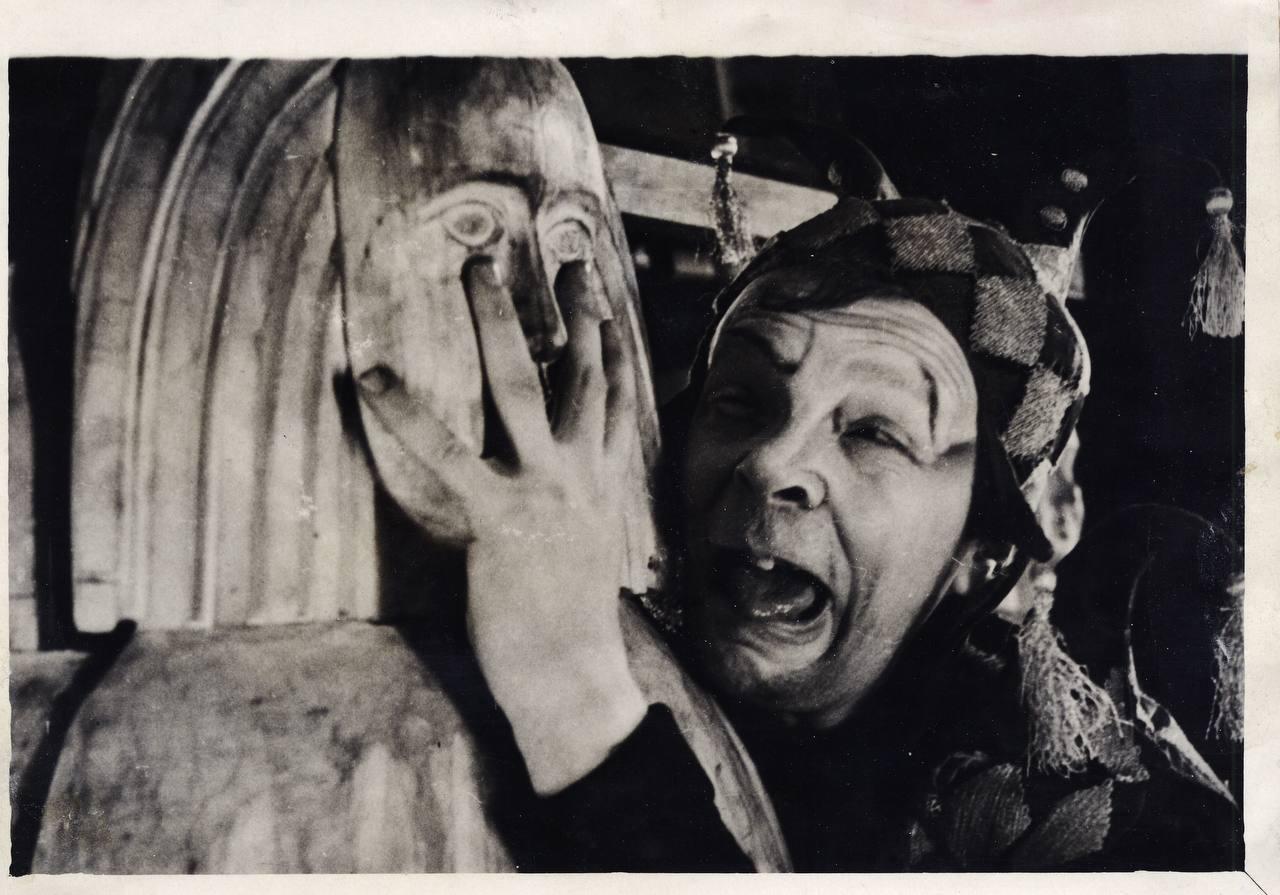
The fool appears on the scene as Lear’s mirror, or Lear’s twin, he comes to the fore at those moments when Lear begins to admit the madness or stupidity of his actions. Like the siren of a ship: he pierces the fog and sounds the alarm. He makes faces and jokes, and mixes stupid puns with caustic wit, constantly wounding Lear’s self-conceit, poking fun at his proud confidence in himself and inspiring hatred of Regan and Goneril.
Their attitude to Cordelia is a test of the spiritual qualities of all the characters in the play. (For Edmund and Edgar their attitude to Gloucester is the test.) And it is significant that even before the fool appears on the scene the knight says of him:
Since my own young lady’s going into
France, sir, the fool hath much pined away (I. 4)
At his first entrance he says to Kent in Lear’s presence:
Why this fellow has banished two own’s daughters
and did the third a blessing against his will.
His words are plainspoken and cutting. He lashes with his words as with a whip, leaving painful stripes and sparing no one.
He does not appear in Act I Scene I when Lear turns Cordelia away, but he appears in the fourth scene when the servants, at Goneril’s instigation, begin to be rude to Lear, and the latter feels for the first time his humiliating position. Without mincing matters he practically calls Lear a fool to his face.
That lord that counsell’d thee
To give away thy land
Come place him here by me
Do thou for him stand:
The sweet and bitter fool
Will presently appear
The one in motley here,
The other found out there.
He cuts through events with a sharp blade’ that discloses their meaning, he uncovers them and turns them over in order that their true content may be seen. It is he who shows Lear the significance of what has happened to him. His inanity is merely a cloak for his acumen. It is like a pair of those dark spectacles through which you can see so much without other people seeing that you see.
He is full of sayings and folklore, and he spices his speech with the humour of the people.
Winter’s not gone yet, if the wild geese fly that way
Fathers that wear rags
Do make their children blind:
But fathers that bear bags
Shall see their children kind.
Fortune that arrant whore
Ne’er turns the key to the poor.
But for all this, thou shalt have as many dolours
for thy daughters as thou canst tell in a year. (II. 4)
There are notes of Moliere in the fool’s words. He does not merely amuse the aristocracy, his humour conceals a sharp sting. He is a thinking person and not merely a buffoon.
Fool: Pr’y thee, uncle, tell me whether a madman
be a gentlemmn or a yeoman?
Lear: A King, a King!
Fool: No, he’s a yeoman that has a gentleman to his son, for he’s a mad yeoman that sees his son
a gentleman before him.
When he foretells a time when the established order of things will change and a golden age will set in, his Utopia is essentially progressive but is expressed humourously and in a rather muddled way.
Fool:….I’ll speak a prophecy ere I go:—
When priest are more in word than matter
When brewers mar their malt with water
When nobles are their tailors’ tutors,
No heretics burn’d, but wenches’ suitors,
When every case in law is right;
No squire in debt, nor no poor knight;
When slanders do not live in tongues;
Nor cut purses come not to throngs;
When usurers tell their gold i’ the field;
And bawds and whores do churches build;—
Then shall the realm of Albion
Come to great confusion;
Then comes the time, who lives to see’t
That going shall be us’d with feet
This prophecy Merlin shall make; for I live
before his time.
Nothing can destroy Lear’s boundless self love, his monstrous egoism. Things have gone badly with me! Then let the whole world choke itself like a beetle in a puddle of dirty water. Lear hates everything and does not know what pity is.
He is a man in whom all feelings have dried up and died except one and that is love for himself. Listen to that tremendously powerful speech of his in the storm;
Blow, winds, and crack your cheeks!
rage! blow!
You cataracts and hurricanes, spout
Till you have drenched our steeples,
drown’d the cocks!
You sulphurous and thought executing fires,
Vaunt couriers of oak-cleaving thunderbolts,
Singe my white head! And thou, all-shaking thunder
Strike flat the thick rotundity of the world!
Crack nature’s moulds, all germens spill at once,
That make ungrateful man!
[Tolstoi regarded this speech (and indeed the whole drama of King Lear) as nonsensical. S.D.]
Here the richness of the metaphors somewhat conceal the meaning of the speech, but another speech follows which brings out the point. Lear calls upon the thunder and the lightning to strike the earth. They are not his daughters so why should they not rage.
This makes Lear’s words all the more terrible, for how horrible must his daughter’s deeds be if they call for such comparisons.
There is a thunderstorm on the heath, and a thunderstorm in Lear’s own heart. He offers his gray hairs to the torrents of rain so that the insults they have borne may be washed away. But one horror cannot be washed away by another; it can only be intensified by it.
The King alone with the fool—this is a crude and cynical but dramatically effective expression of the ex-king’s fall.
O! nuncle, court holy water in a dry
house is better than this rainwater out o’door.
Good nuncle, in; ask thy daughter’s blessing:
here’s a night pities neither wise men nor fools (III. 2)
Immediately after this Lear makes another speech:
Rumble thy bellyfull Spit, fire! Spout, rain!
Nor rain, wind, thunder, fire, are my daughters;
I tax not you, you elements, with unkindness;
I never gave you kingdom, call’d you children,
You owe me no subscription; here I stand your slave,
A poor, infirm, weak and despis’d old man:—
But yet I call you servile ministers,
That will with two pernicious daughters join
Your high-engendered battlers ’gainst a head
So old and white as this. O! O! ’this fool. (III. 2)
But no sooner has Lear uttered these words than the fool begins singing his obscene rhyme. Here we have two interesting planes—madness and cynicism, despair and vulgarity, thunder and giggling, oaths and jests.
This is the culminating point of the play. Lear has fallen to the very lowest point. He has become the equal of the fool and of every other human being whatever his station, for lower than this there is nothing but the grave. The despot has become a pauper, the king has become a clown, the proud egoist has become an outcast and the fool is now on a level with the king, for the king has fallen to the level of the fool.
And Lear who has stood up against the storm in the hope that it would scatter his misery to the winds, who has just cried out against the elements like one possessed, suddenly stops like a man who has stepped onto the edge of a precipice and draws back to save himself. “No. I want to be a model of patience. I shall say nothing,” he says. Here the transition to prose has a most striking effect. It represents an abrupt change in the emotional experiences which Lear is undergoing. It is the transition from loud cries and thundering eloquence to an unwonted understanding of himself, of his will and psychology.
His madness leaves him. Reason immediately enters into his clouded brain and he becomes calm again.
He is broken, he is humbled. Strange how easily Lear has been humbled. Is Shakespeare, perhaps, no longer true to life here? Let us not draw hasty conclusions.
What is it that restores Lear’s calm. What is it he says? He says that others are more guilty before him than he before them. That is what is at the bottom of his new state of mind. The bitter experience through which he is passing is some measure for his fault. He is beginning to find some consolation in the thought that if he is to blame, others are more to blame than he, that if he is cruel, others are more so.
But what has this in common with his old philosophy of inequality? It has nothing to do with it and that is just the point about his new state of mind: he is beginning to reject his old philosophy. Lear has made a tremendous step forward, and this change in his outlook has been most brilliantly brought out by Shakespeare. A new word appears in Lear’s vocabulary, the word “necessity.” Lear formerly regarded only himself as necessary and recognised no obligation to carry anything out himself, since everything was carried out for him. Then suddenly in the torrential rains on the heath, amid the roar of the thunder the word “necessity,” so foreign to him hitherto appears on his lips. He had been brought to this word through suffering. A long and: painful road had led him to the truth.
Lear, as we have said, had been humbled. What seemed impossible had come about. This was perfectly natural and true to life, for humility had only entered into his conscience without becoming the whole of his being.
In the fourth scene, which follows immediately after this fall from pride, Lear again cries out wildly:
…the tempest in my mind
Doth from my senses take all feeling else
Save what beats there —Filial ingratitude!
Is it not as this mouth should tear his hand
For lifting food to it?—But I will punish home:—
No I will weep no more.—In such a night
To shut me out! Pour on: I will endure:—
In such a night as this! O Regan, Goneril!
Your old kind father, whose frank heart gave all,—
O, that way madness lies; let me shun that;
No more of that…
He says bitterly “O, that way madness lies,” and a little while later, in the fifth scene, Kent says of him “His wits are gone,” and again in the seventh scene he says words to the same effect.
Lear himself several times speaks of this and his reason departs from him drop by drop leaving the old man tottering about the heath in the darkness of the night like a wounded bird.
But it was just here that Lear spoke of necessity. It was just here that Lear realized the value of simple things and the horror of inequality.
It was only now that Lear was beginning to see the real world from which as it were the thunder rain had washed away all court conventionalities.
What strange words Lear utters
Poor naked wretches, wheresoe’er you are
That bide the pelting of this pitiless storm.
How shall your houseless heads and unfed sides
Your loop’d and window’d raggedness, defend you?
Lear speaks of justice. Lear wants to purge himself of pride. Lear sympathises with the poor. We have here a new man. We see him like this for the first time. Can it be Lear? Yes, it is Lear, but a transformed Lear. The realities of life become actual to him for the first time in the form of the mad, dirty, half-naked Edgar. Lear again reverts to prose. The sudden change from verse to prose represents a break in Lear’s stream of consciousness.
Edgar is a man, Lear is a man. And the fool is also a man. Then perhaps they are all equal? Lear is struck with horror. This idea of being equal with naked men and beggars makes his flesh creep.
Why, thou wert better in thy grave
than to answer with thy uncovered body this
extremity of the skies—Is man no more than
this? Consider him well. Thou owest the
worm no silk, the beast no hide, the sheep no
wool, the cat no perfume.—Ha! here’s three
on’s are sophisticated!—Thou art the thing
itself; unaccommodated man is no more but
such a poor, bare forked animal as thou art—
Off, off, you lendings! Come unbutton here. (III. 4)
Here the new Lear after he has come to know the world through fire, cold and darkness, through hatred and malice, through pity and honour, gains some understanding of reality. But the limits of his understanding of the real world are marked by his departure from that real world, for it is at this point that he finally goes mad.
Lear comes to understand something new and this understanding nearly kills him. He rushes into madness with the same speed as the wind rushes at him in the darkness of that stormy night.
Men are equal? Yes, and he has seen that equality in its most revolting form. It is the equality of beasts. And he tears off his clothes as Shakespeare tells us in one of his terse stage instructions. He wants to stamp out the last traces of his royal grandeur. He wants to make himself comparable to the very lowest beggar who is despised by all.
Thus the circle is completed. The king is no longer a king and he throws himself into the very lowest depths of life in order to drink his humiliation to the last drop. He takes his bitter draught and although his lips are burnt by it as he drinks he will not put the cup down.
And then he hears the voice of Gloucester who has not yet begun to share the King’s fate: “What company are you in sir?”
There is reason in this madness. Lear wishes to know whether nature or he himself is guilty in his fearful misfortune. And this is mixed up with the most terrible nonsense like a grain of corn in the midst of a heap of chaff.
…Let them anatomize Regan; see
What breeds about her heart. Is there
any cause in nature that makes these hard hearts?—
(to Edgar) You, sir, I entertain you for one
of my hundred; only I do not like the fashion
of your garments: you will say they are Persian:
but let them be changed.
Kent: Now, good my lord, lie here and rest while—
Lear: Make no noise, make no noise; draw
the curtains.
Soso. We’ll go to supper in the morning.
And later on in Act IV Scene 6 Lear himself speaks of the light that comes to him on the heath, which blinded his reason. Shakespeare does not like obscurity, he is ready to repeat endlessly,—and how wonderfully he puts it each time!—in order that the audience may catch the meaning.
Ha! Goneril, with a white beard!—
They flattered me like a dog, and told me I
had white hairs in my beard ere the black ones
were there. To say ay and no to everything I
said! Ay and no, too, was no good divinity;
when the rain came to wet me once and the
wind to make me chatter; when the thunder
would not peace at my bidding, there I found ’em,
there I smelt em out. Go to, they are
not men, of their words: they told me I was
everything: ’this a lie—I am not ague proof.
Lear returns to his sufferings in the storm and gives i them. The repetition here heightens and throws new light on the situation.
Thus two streams meet, one turbid and the other clean, one disconnected and the other logical, one mad and the other rational. Lear gone mad. What a tragic scene and what magnificent art. Here one has complete inanity But in Lear’s mind a new process is taking place. Old values are being broken up, new thoughts are being born which are difficult to seize. They flutter up out of his brain and disappear before they have been able to form into connected sentences. But then suddenly a picture of the world takes shape. Lear cries out in a rage against the injustice of society which he himself has created. Lear, the ex-king suddenly finds words in which there glows a spark protest. In which there is a challenge to society. It is hardly believable but it is Lear, the same Lear who has been so intolerant of the slightest insubordination that speaks these words:
Why dost thou lash that whore? Strip thine own back;
Thou hotly lust’st to use her in that kind
For which thou whipp’st her. The usurer hangs the coziner.
Through tattered clothes small vices do appear;
Robes and furr’d gowns hide all. Plate sin with gold,
And the strong lance of justice hurtless breaks;
Arm it in rags, a pigmy’s straw doth pierce it—
None does offend, none, I say, none, I’ll able ’em:
Take that of me, my friend who have the power
To seal the accuser’s lips. Get thee glass eyes;
And, like a scurvy politician, seem
To see the things thou dost not—Now, now,
Pull off my boots:—hard, harder:—so. (IV. 6)
Think well on these words. Here the stream of meaningless words comes to an end. A definite meaning takes shape, and the speech becomes linked up with the main stream of the tragedy.
But Lear is mad and Shakespeare does not forget this. Lear speaks the truth as though he were raving, and raves as though he was speaking the truth. His words have a deathly ring about them when he says that he is a king from the crown on his head to the tips of his toes (we must remember that in leaving his kingdom to his daughters he reserves for himself the title of the king). Here Shakespeare uses his favourite trick of contrast. In his tattered clothes, with his wandering eyes, the lunatic Lear is not a king at all and so his sudden proud announcement only serves to intensify the wretchedness of his plight.
Edgar: O, matter and impertinency mixed! Reason in madness!
These are Edgar’s words. Through Edgar’s words Shakespeare emphasises the tremendous significance of Lear’s speech about the powers in society. The artist seems to be afraid that this may not be fully understood, that the audience may make the mistake of ascribing everything to Lear’s madness, and he wants to avoid this at all costs. There is a great deal more here than the raving of a madman. There is a truth here which we must not allow to escape us. As I write these lines a strange and oppressive feeling comes over me. How terrible that we do not know what Shakespeare himself thought about this that we have no word of commentary from the poet himself and that succeeding centuries have so carefully removed all possibilities except one—that of knowing Shakespeare through his works. How splendid that we have these works. I do not belong to any biographical school, but there are secrets which disturb one’s peace of mind. It is his poetry I am thinking of. Is there even the slightest word of criticism one could find against his poetry?
How small Lear was before he went mad. But how great he is now that his wits have left him, now that the scales have been lifted from his eyes and he can look the world straight in the face. We can now understand Gloucester when he says that a great one is fallen. It is only after this that Shakespeare begins to talk of Lear’s greatness.
When Lear lived he was dead, but now that he is almost dead he has become alive. The greatness that was not has fallen to the ground and Lear has become great for he has suffered much not only for himself but also for the world. Yes, Lear has started to think of the world and of others. The great egoist has begun to think about humanity and of that portion of humanity that suffers most, because it is groaning under the weight of that huge pyramid of inequality on the summit of which he himself once stood.
With what horror is the scene inspired in which those once powerful men Lear and Gloucester meet. One of them has lost his reason and the other has had his eyes plucked out and stamped into the dust, and beside them is a third witness no less horrible of aspect, Gloucester’s son Edgar in a beggar’s clothes in the guise of a madman.
Here Lear unfolds everything of his new philosophy that he has not yet unfolded in the preceding scene. The new Lear and his madness do not prevent us from understanding his wisdom.
This is the climax of the whole play. All the action of the drama tends to this point where the scales at last fall from Lear’s eyes. All that happens is illuminated by a great idea and events are endowed with a profound significance. The action is raised to the level of the idea and the idea is expressed by a truly passionate power of action. The parts are gathered up into a whole and the result is a mighty symphonic whole.
These words of Lear are not by any means identical with the bourgeois ideas of equality. What is most important for Lear is not equality, but inequality, and it is the latter that Lear finds in the world.
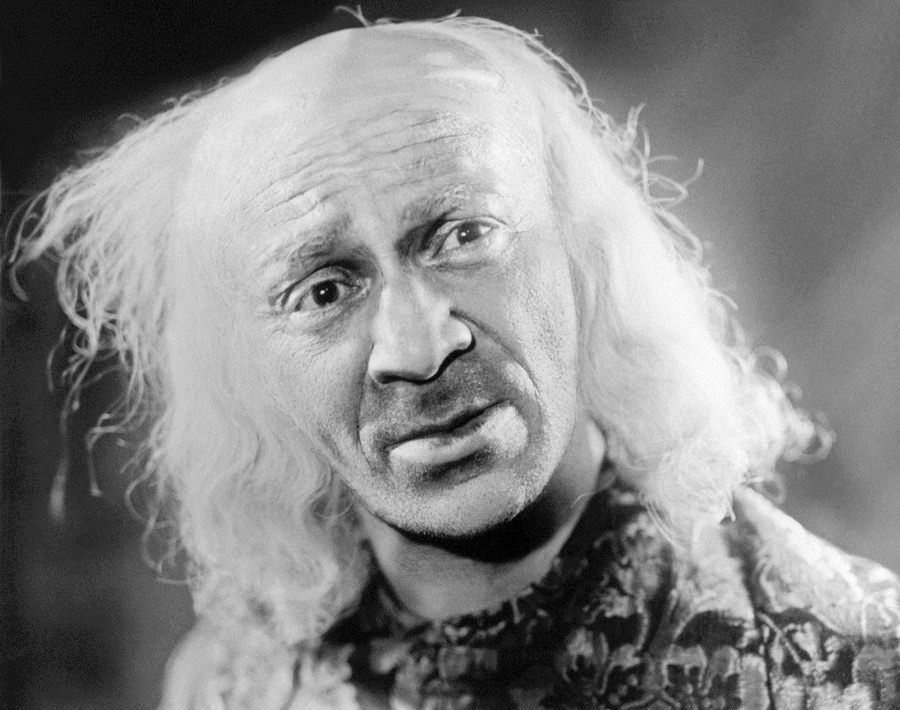
We have almost forgotten about our antipathy for Lear, we are beginning to have a soft spot for him and to follow his misfortunes with sympathy. Thus the tables have been turned. Lear’s friends alter their attitude to Lear–and so our attitude also alters. Adversity has broken his pride and brought out his human feelings. His sufferings have shattered his egoism and created a new Lear who comes to know for the first time what shame and repentance mean. Misfortune has destroyed Lear’s cruelly and put mercy into his heart.
Kent: Well, sir, the poor distress’s Lear’s i’the town;
Who sometime in his better time, remembers
What we are come about, and by no means
Will yield to see his daughters.
Gentleman: Why, good sir?
Kent: A sovereign shame so elbows him: his own unkindness,
That stripped her from his benediction, turn’d her
To foreign casualities, gave her dear rights
To his dog-hearted daughters,—these things sting.
Thus the time has come for Lear to go through his last trial, this time not alone, but with our sympathy. Lear is in the hands of his enemies, in the hands of Goneril, Edmund and Regan.
A new trait now appears in his character,—a certain nobility and courage, the hardihood of a soldier who scorns to fear or even notice the hand of the enemy stretched out to kill. He says to Cordelia:
Have I caught thee?
He that parts us shall bring a brand from heaven,
And fire us hence like forces. Wipe thine eyes;
The good years shall devour them, flesh and fell,
Ere they shall make us weep: we’ll see ’em starve first.
Thus Shakespeare continues to raise Lear morally, and traces of nobility, self sacrifice, staunchness and love are seen to enter into the ex-king’s character. All this leads up to the final situation, where we cannot help having complete sympathy with Lear now that he has become but a shadow of his former self, of Lear the despot.
He meets Cordelia and he is overcome with joy. But this joy is short lived as the last ray of the sinking sun. The earth becomes darker than ever it was, life departs and in front of him there is not a gleam of hope. Consciousness is again covered with a pall of darkness. Cordelia is dead, and Lear cries out to the unfeeling world which he himself has created, he cries out to that evil reality, with all its hatred and malice which he himself has nurtured.
Why should a dog, a horse, a rat have life,
And thou not breath at all?
Thou’lt come no more,
Never, never, never, never, never!—
Lear dies. The tragedy is at an end. Finis….
IV
We have followed Lear through all the stages of his wanderings. But that is not the whole of King Lear. We have seen only a part of the tragedy, though, it is true, the most important part.
We have left out a number of scenes where the no less tragic story of the Duke of Gloucester and his two sons, Edmund and Edgar, is unfolded.
No sooner do we gather the thread of this second story than we see how it fits in with that of King Lear, we see how much it has in common, what a strong resemblance it has and how unimportant are the differences. Lear turned Cordelia away, because she truly loved him. Gloucester drove out his devoted and upright son. Lear was driven away by his hypocritical daughters and Gloucester was condemned to death by his son Edmund.
But in following the running threat of Gloucester’s fate we do not only see a unity of action and of behaviour. We see a resemblance and what is most important of all, we see what made Lear a human being, and what it was that opened up before him the world that had previously been concealed from him by his crown.
Gloucester’s eyes were trodden under foot by Regan. He wanders over the country with blood suffused sockets, unknowingly led by his son Edgar who is pretending to be a mad beggar. Gloucester says bitterly: “Tis the times’ plague when madmen lead the blind.”
The world is dark, the world which Gloucester can see no more, but which crumbles from beneath his feet like an avalanche and hurls him from his height.
And suddenly pity awakens in Gloucester and he is willing even to thank heaven that his misfortune has been of benefit to the beggar that is leading him:
Here, take this purse, thou whom the heaven’s plagues
Have humbled to all strokes; that I am wretched
Makes thee the happier;—heavens deal so still!
Let the superfluous and lust-dieted man,
That saves your ordinance, that will not see
Because he doth not feel, feel your power quickly,
So distribution should undo excess,
And each man have enough. (IV. 2)
The same thought emerges here as in the case of Lear. One has to be in the position of the unfortunate in order to know the full weight of their misery, one has to be in the position of the poor in order to know the horror of poverty, one has to change places with the person who has formerly seemed only to be there to fulfill one’s wishes, in order to understand that person.
Let me repeat it. Here we have only the most misty, the most elementary expression of the idea of the evil of inequality. But nevertheless it is this idea that is being presented, with however weak a flame it is burning.
That is what makes King Lear stand out among all Shakespeare’s plays and gives us a side of Shakespeare’s character which is clearly an essential and important one, without which our idea of the man would be incomplete.
Gloucester’s fate is a repetition of Lear’s. His son Edgar takes the same part as Cordelia. His illegitimate brother Edmund slanders him, and Gloucester who believes what he is told, leaves his enemy Edmund and drives out Edgar.
Shakespeare in dramatising “The Story of the Blind Man” from Philip Sydney’s Arcadia (1590) and fusing it into the tragedy of Lear was not merely following a whim. He had a very definite plan in his mind. The story of the trials and misfortunes of Gloucester make a splendid supplement to the story of Lear. He brings out the points in common and thereby makes what is most important still clearer, and makes what is clearest most important.
Until Act II Scene 3 Edgar hardly appears. He is merely a dumb, one might say limp incarnation of good characteristics. In order for his true character to be seen to the full he has to undergo great trials.
There is something in common with Hamlet in the way he acts. In order to save himself be becomes mad. In order to preserve his reason he externally divests himself of it. In order to save himself from ruin he pretends that he has already been ruined. He goes into the darkness of the night in order to see the dawn, he turns away from the sun in order not to die in its light.
But is not this mask of the madman the last step into the abyss? Is it not the very depths of humiliation?
Madness is terrible when it is real, but the madman himself does not know this, otherwise he would not be mad. But to be mad while yet possessed of reason, to be beyond reason while yet possessing all the faculties of thought; to wear this frightful and humiliating mask—how unendurable, how terrible that must be.
Edgar’s father, Gloucester, longs for madness, for reality has become too horrible, the truth that life has to offer is too impossible to bear.
The King is mad: how stiff is my vile sense,
That I stand up, and have ingenuous feeling
Of my huge sorrow! Better I were distract:
So should my thoughts be sever’d from my griefs,
And woes by wrong imaginations lose
The knowledge of themselves. (IV. 6)
That is the borderline. And Shakespeare, great artist that he is, loving great contrasts of tone and blinding colours, flings his heroes beyond that borderline so as to show them the lowest depths of despair, so that one may feel the utter hopelessness of their position. A strong man has his sensibility only increased by suffering. A brave man is only made braver by a fight. Suffering only heightens the heroism of the hero. Edgar after falling to the very bottom of the pit does not stay there, but rises up from it.
He derives his strength from the thought that it is better to come to know the truth through suffering than to be enthralled by falsehood.
Yet better thus, and known to be contemned
Than still contemned and flatter’d. To be worst
The lowest and most dejected thing of fortune,
Stands still in esperance, lives not in fear:
The lamentable change is from the best;
The worst returns to laughter. Welcome, then,
Thou unsubstantial air that I embrace!
The wretch that thou hast blown unto the world
Owes nothing to the blasts—But who comes here
My father, poorly led?—World, world, O world.
It is not by chance that Shakespeare puts into the mouth of Edgar those remarkable words. These words of Edgar are among the most important in the tragedy. They are inscribed in flaming letters on the realist banner, which is streaming in the wind of great ideas. Can it be merely a coincidence that Gloucester says the same thing? Shakespeare repeats the same thought twice, in order that it should not merely illuminate for a moment and then disappear like a flash of lightning.
Old man: You cannot see your way
Gloucester: I have no way, and therefore want no eyes
I stumbled when I saw: full oft’ ’thjs seen
Our means secure us and our mere defects
Edgar asserts that evil contains its own punishment, that sin punishes the sinner.
The gods are just, and of our pleasant vices
Make instruments to plague us.
Recollect the Duke of Albany’s words:
This shows you are above,
You justicers, that these our nether crimes
So speedily can venge! (I. 1)
Let us recall, finally, the last magnificent scene where Edgar saves his blind father from suicide, and the latter eventually admits his weakness. Evil must not be meekly endured but must be combatted—that is the idea that Shakespeare wishes to bring out here.
The idea of the salutariness of suffering for people who are too happy, and happy through no virtue of their own, is one of the threads which knits together the whole action of the tragedy and determines its movement and line of development. This is a confirmation of the greatness of truth, it is a defense of the realist’s attitude to the world. It is war—and war to the death—with the false art of many artists of Shakespeare’s day.
Enter into life and it will teach you to live. Go to meet suffering and it will open your eyes. Descend into the depths and you will learn the worth of people who spend their lives there and never rise up into the sunlit heights. Go down to the people yourself or you will be thrown down, thus Shakespeare continues his line of thought a year later, in creating the character of Voluminius who was so well aware of the power of the people, in Coriolanus.
A representative of the ideas of the section of the nobility who were becoming capitalists, Shakespeare in creating King Lear at a time when James I was trying to put the hands of the clock back to feudalism, shows with extraordinary force how destructive the ideas of feudalism are and how fatal it is to divide the realm into little pieces (we might recall here Kent’s words where he refers to “this scattered kingdom”). Shakespeare sympathises with Lear when he begins to understand his fatal mistakes but he paints him with hatred when he sits on his throne and like a proud feudal lord shows that he is a law unto himself by dividing the map of his kingdom according to his caprice.
The final situation is built up on contrasts, the rapid change of events and the rapid culmination of the plot. Cordelia is at the head of powerful forces and victory seems certain, but nevertheless she is defeated. Edmund comes out victorious, his colours flying. He is covered with honour and proud as Caesar—when suddenly the Duke of Albany threatens him with arrest, the herald blows his trumpet, and Edgar appears on the scene and draws his sword. Regan dies of poison, the blood is warm on the dagger that has pierced Goneril’s heart.
All the lines of the plot are worked out by the artist to their logical conclusion. Lear has come to the end of his journey, Edmund falls defeated in single combat, Gloucester has died at the happiest moment of his life. The last words have been said, the last deeds have been done. The dead crowd to the finale as though death itself were standing by the curtain and preventing it from falling, until the last sight of those who are doomed to fall had died away on the murder-poisoned air. But the full toll of deaths has not yet been taken. Lear and Cordelia still remain. We are rejoicing in their victory when Lear appears with the dead Cordelia in his arms. A few minutes more and Lear’s heart breaks. He is the last to fall. “Curtain,” cries Death…The tragedy is finished, murderers and victims, guilty and innocent lie on the same piece of ground and there is not a breath left in any of them, not a spark of life.
It is not by chance that Shakespeare took such a remote period in order to have an effect on his contemporaries. More verisimilitude was thus lent to the bloody end, but at the same time parallels with the present must inevitably be drawn.
The evil done by Lear, the hatred let loose by him, the falsehood that was allowed to flourish, had taken root like a poisonous weed and grown up to suffocate Lear himself. It is as though Shakespeare were saying: “Evil does not die.” It lives once it has been given birth. Food conquers, says Shakespeare, in this terrible world, though evil has its last word to say. Good is a power which becomes weakened in its struggle with evil but does not die. It is man that paves the road to evil and to good, to love and to blood. Is that a happy ending? No, it is pessimistic. It is a bitter ending this finale of King Lear, although Edgar hopes that he, being young, will not see so much and live so long. Is it not pessimism when such a modest hope is the conclusion to such a terrible story? It is a candle flame which will be extinguished by the first gust of wind.
Translated from the Russian by N. Goold-Verschoyle
Literature of the World Revolution/International Literature was the journal of the International Union of Revolutionary Writers, founded in 1927, that began publishing in the aftermath of 1931’s international conference of revolutionary writers held in Kharkov, Ukraine. Produced in Moscow in Russian, German, English, and French, the name changed to International Literature in 1932. In 1935 and the Popular Front, the Writers for the Defense of Culture became the sponsoring organization. It published until 1945 and hosted the most important Communist writers and critics of the time.
PDF of full issue: https://www.marxists.org/subject/art/literature/international-literature/1935-n06-IL.pdf

