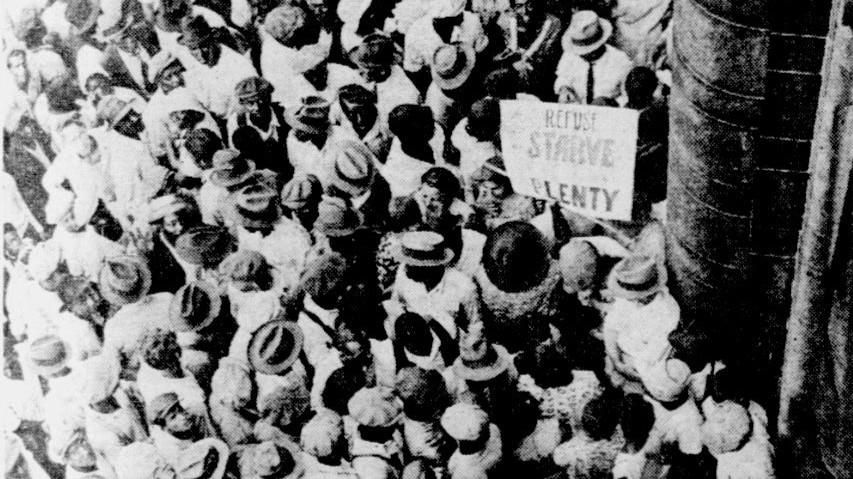
Gebert reports on the actions of the Communist Party and St. Louis Unemployed Council surrounding a ‘riot’ at city hall in July, 1932 that led to emergency aid being sent to the city from the Federal government.
‘How the St. Louis Unemployed Victory Was Won’ by B.K. Gebert from The Communist. Vol. 11 No. 9. September, 1932.
JULY 8 and 11 will go down in the history of the working class of St. Louis as the beginning of a mass movement of the Negro and white workers. On these two days the workers in St. Louis, under the leadership of the Unemployed Council, obtained important victories.
On July 8 the city administration was forced to give immediate relief to 1,000 unemployed workers to whom relief had previously been denied. The demonstration of July 11 forced the city administration to appropriate $200,000 as emergency relief and pass recommendations to issue bonds to the amount of $4,600,000 and apply for a $2,000,000 loan from the Reconstruction Finance Corporation.
These victories were won when the city administration took 15,000 families, involving 45,000 persons, off the relief list. There is no victory in any other city in the United States that parallels this in the long years of struggles of the unemployed masses. It is true that in the State of Illinois, under the leadership of the Unemployed Councils, the State Legislature was forced to appropriate $20,000,000 for relief. Evictions had been stopped for a time in Chicago. But this involved a long struggle for weeks and months. In St. Louis results were obtained on the day of the mass mobilization of the workers.
Comrade Foster, in his article published in the Daily Worker, has already outlined the meaning of this victory. I want to deal here with (1) how this victory was won and (2) our next steps in St. Louis.
When the St. Louis administration, under the leadership of the Republican Mayor Miller declared that they would take something like 15,000 families off the relief list because “there is no money,” the Unemployed Council in St. Louis took this issue before the starving masses of St. Louis where there are over 100,000 unemployed Negro and white workers. The Unemployed Council called upon the workers in many wards to come to public hearings and testify as to their conditions also calling upon the aldermen, local charities, local Republican, Democratic and A. F. of L. officials to face the workers at these public hearings. In three instances Aldermen came to these public hearings. They attempted to pacify the angry masses, making fake promises. But the masses would not listen to them and they were simply not permitted to speak by the spontaneous outbursts of condemnation of the fakers. At these public hearings workers discussed their conditions and the demands that should be put before the city. They elected committees to carry on the work and at one of the public hearings a motion was made by a worker that a Hunger March to the city hall be organized. Two weeks of preparations, neighborhood activities and house-to house canvassing, led to the Hunger March.
UNEMPLOYED COUNCIL TAKING THE LEAD
In the course of these activities the Unemployed Councils grew to 6 branches with between 700 and 800 workers. When the first Hunger March took place on July 8, for the first time in the history of St. Louis, 5,000 Negro and white workers assembled in front of the City Hall. They sent a delegation to the mayor presenting their demands. For three hours, under the scorching sun, they stood around the City Hall while their committee demanded immediate action upon the demands presented to the City Hall. The Mayor was finally forced to immediately order all the relief stations to give, without any questions asked, relief to all unemployed workers who will come for relief. When this was announced to the 5,000 Negro and white workers, many hungry, who had not eaten for a day and two and some even longer, they greeted the victory and they marched to the relief station, especially the central relief station where they got relief and money.
Meanwhile, the Mayor told the committee that he would call a meeting of the Board of Aldermen on July 11 to take up the other demands of the committee and invited the committee to come down. The workers said they would come in larger numbers than before.
On Monday, July 11, more than 10,000 Negro and white workers came to the City Hall. The delegation of 12, headed by the leader of the unemployed movement, Comrade Stone, went into the City Hall. The delegation was practically kept under arrest and the Mayor refused to see the delegation. Again, for more than three hours, the workers stood outside waiting for word from the delegation. Finally, they sent another delegation to see what had taken place. The second delegation reported that the Mayor had refused to see the first delegation and that they were practically held prisoners. The masses in front of the City Hall greeted this with indignation and determination that the voices of their spokesmen be heard.
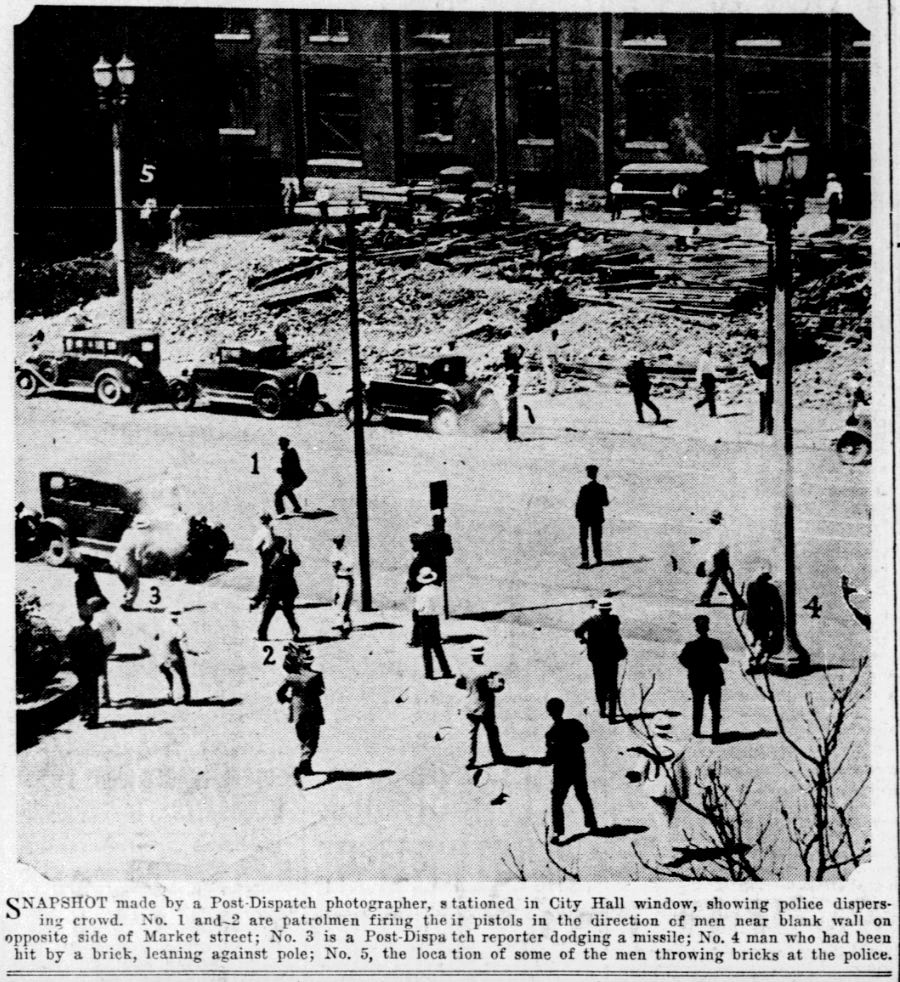
The delegation finally stated that if the Mayor would not see the delegation in 15 minutes they would not be responsible for what the workers in front of the City Hall might do. In the mean time, the workers decided to send another delegation of 100 women, supported by 200 ex-servicemen, elected by the workers in front of the City Hall. They began to march into the City Hall. At that point, the police, who were stationed inside the City Hall, which looked like an armed fortress, began to fire at the workers. But the workers did not run away in face of the fire from shot guns, gas bombs, etc. On the contrary, the militancy of the workers grew. They caught gas bombs before they went off and threw them back at the police. The police continually fired upon the workers. A dozen police were hurt.
In this struggle, the Negro workers particularly showed militancy and determination. They were the last ones to be driven away from the grounds. The police shot four workers, beat up twenty-five and arrested them and on the following day, a total of forty-eight workers.
WIDESPREAD MASS INDIGNATION
The news of the struggle in front of the City Hall spread like wild-fire. Throughout the city workers gathered in the streets, met at street corners, in houses, everywhere. The indignation of the masses grew. The local papers came out with stories of what took place in the City Hall, interpreting it from their own angle. The workers in the shops discussed this. Such was the indignation of the masses, employed and unemployed, Negro and white throughout the city that the Republican candidate for United States Senator, Mr. Priest, issued a statement condemning the shooting of the workers. The Socialist Party and Young People’s Socialist League sent letters to the Communist Party, expressing their “sympathy.” Pastors in the churches told their parishers that it is unchristian to shoot workers. Newspapers came out in detail with fear. The so-called liberal Post Dispatch stated, “This occurred in July. What is awaiting us in December?” The bourgeoisie was quite panic stricken. They were so frightened that an extraordinary meeting was called by Mayor Miller at which a plan to cope with the situation was discussed and at this meeting it was agreed to appropriate $6,800,000 relief for the unemployed. It put back on the relief list all those who were cut off from the list. It did everything to pacify the hungry masses. The arrested workers were turned over to Judge Blaine, Mayor Miller’s appointee, who held the trial behind closed doors in fear that an open trial would result in a huge demonstration in behalf of the arrested workers and leaders of the unemployed. Among them was the delegation of twelve elected by some ten thousand workers to speak in their name. And it was behind closed doors that the flunkey of the bosses, Judge Blaine, began to do his duty—$50 fines for most of the arrested workers. He went the limit. The capitalist law did not give him an opportunity to fine more than $50 and he expressed his dissatisfaction that he could not fine them more. Eleven of the arrested workers who were charged with inciting to riot, had their trial set for August 8. In the mean time, the I.L.D. mobilized the workers and bailed out every arrested worker and appealed the cases of those who have been sentenced.
The City Committee of the Unemployed Council called an emergency conference to cope with the situation. Sixty delegates, representing the branches and block committees of the Unemployed Councils, trade unions, fraternal organizations, the Communist Party, Young Communist League, League of Struggle for Negro Rights, etc., answered the call. They adopted a statement which was issued in 50,000 copies informing the working class of St. Louis what had taken place and called upon them to carry on the fight. At the same time a delegated body called for a broad united front conference of all mass organizations in St. Louis for July 24. The call for the conference pointed out what took place and called upon the workers to unite in struggle for immediate relief and unemployment insurance at the expense of the government and the bosses, against terror, and demanded the unconditional release of the arrested workers.
One of the arrested workers, Thomas Beezley, an unemployed laborer released on bond, committed suicide. Fellow Worker Beezley, as every other worker arrested, was put through the third degree. Every one of them was beaten up by the police thugs of the Republican Mayor Miller. They were told that ten police were killed and every one of the arrested workers would be held for murder. They attempted to make them sign statements of all kinds. From some of the workers they attempted to get statements that they would vote Republican and Democratic and promise to have nothing to do with the Communists. To others they said that if they would tell who the “Moscow agent” in St. Louis is, who pays $75 a week to the Unemployed Council organizer, they would be released. But not one worker gave the police any information. They refused to sign the statements and refused to believe what the police told them. They were held for forty-eight hours behind bars, incommunicado. This is particularly significant in view of the fact that out of the forty-eight workers arrested, only ten were Party members and only about half were members of the Unemployed Council. Fellow worker Beezley was beaten up and terrorized to such an extent that it effected his mind, drove him practically insane and forced him to commit suicide. The responsibility for the death of Beezley rests with Mayor Miller and his administration and police.
MAIN STRUGGLE EXPOSES DEMAGOGY
The Governor of the State of Missouri, who just a few months ago, in a telegram to Hoover, declared “no one is starving in Missouri” was forced to wire Hoover to loan $2,000,000 from the Reconstruction Finance Corporation. While the bosses were forced, thanks to the militancy of the masses, to grant immediate concessions to the workers, they also proceeded immediately to carry on a fight against the working class, to use both ends of the stick: terror, and social demagogy, with all the emphasis on the social demagogy. First of all, they immediately began to play up Father Cox as the “leader of the unemployed.” Up to these events in St. Louis, Father Cox was hardly mentioned in the papers in St. Louis, although he called a conference for July 17. But after these events, the stocks of Father Cox went up high. The papers printed a special interview with Cox in Rome, Italy, in which he stated that he is going to St. Louis to be nominated for President and that he will get 17,000,000 votes. He further stated that in this situation there is only one issue—between his party and the Communists.
The local press prominently displayed this news under the following headlines: “Unemployed to Form League Here Today.” It is very interesting that these “unemployed” consist of reverends, priests, ministers, bank directors, and the local charity “Providence Association.” All this is sponsored by the city administration. They called a meeting to organize the “Unemployed Citizens League in St. Louis” similar to that of Seattle, Washington. The purpose of this League, the organizers of this meeting explain in the following manner:
“The organization functions largely through self-help and interchange of products. The league will be anti-Communist and will encourage unemployed men and women to spend their time profitably. The league will urge members to produce commodities for sale.”
So, the local bourgeoisie attempts to organize the unemployed in an attempt to use them to defeat the struggles for immediate relief.
The Party organization in St. Louis before the events of July 8-11 was characterized from time to time by the District Committee as a narrow, sectarian organization. We always looked upon St. Louis as if nothing happened there, despite the misery and starvation of 100,000 Negro population, Jim-Crowism and segregation. Our Party members always attempted to explain the lack of mass movement in St. Louis by saying that the working class in St. Louis is an “exception”—“you can have struggles in Chicago, but not in St. Louis.” The District Committee was determined to break this opportunist position of a section of the Party membership in St. Louis. And when the Hunger March was considered, the representative of the District Committee went into very thorough explanations as to the character of the Hunger March and how to mobilize the masses in the preparations. The entire preparations was on the basis of a united front from below and this was an eye opener to those comrades who could not see the working class.
The St. Louis Party organization constituted only 90 members in the city of over a million population—in a city of misery and starvation,—in a city where workers are working on many jobs for as low as 10 cents an hour. But immediately after July 8-11 the Party membership was doubled. One hundred and fifty workers signed applications into the Party and Y.C.L. The Unemployed Council undertook a campaign to organize block committees which are developing very fast. In one day on the south side seventeen block committees were organized.
Comrade Foster, whose tour brought him to St. Louis during these days, in a speech to about 2,000 workers, assembled on a hot day in a hall, declared:
“The workers had been so quiet that they’d just starve like sheep. Well, you fooled them, didn’t you? You gave them a little smell the other day. You ought to have learned that you can only get relief by fighting for it. You made them afraid.”
This meeting, according to the capitalist press, was “the largest gathering inside a hall in the history of Communist meetings in St. Louis.” The workers fully realize that they can win further victories in the same manner and if they will not consolidate their movement organizationally, the temporary victory will soon be taken away from them. In addition to this they must mobilize the workers to fight the attempts of the bosses to divide the working class by use of fake promises and fake organizations, which they are attempting to set up now, especially boosting fascist Father Cox. The workers of St. Louis are prepared to make the best use of Father Cox’s convention. They will be heard. It will not be easy sailing for fascist Father Cox in St. Louis.
There are a number of journals with this name in the history of the movement. This ‘Communist’ was the main theoretical journal of the Communist Party from 1927 until 1944. Its origins lie with the folding of The Liberator, Soviet Russia Pictorial, and Labor Herald together into Workers Monthly as the new unified Communist Party’s official cultural and discussion magazine in November, 1924. Workers Monthly became The Communist in March, 1927 and was also published monthly. The Communist contains the most thorough archive of the Communist Party’s positions and thinking during its run. The New Masses became the main cultural vehicle for the CP and the Communist, though it began with with more vibrancy and discussion, became increasingly an organ of Comintern and CP program. Over its run the tagline went from “A Theoretical Magazine for the Discussion of Revolutionary Problems” to “A Magazine of the Theory and Practice of Marxism-Leninism” to “A Marxist Magazine Devoted to Advancement of Democratic Thought and Action.” The aesthetic of the journal also changed dramatically over its years. Editors included Earl Browder, Alex Bittelman, Max Bedacht, and Bertram D. Wolfe.
PDF of original issue: https://www.marxists.org/history/usa/pubs/communist/v11n09-sep-1932-communist.pdf

