Still only a semi-professional journalist, Beals left Mexico after some fine reporting on that country’s revolution for Spain and school at the University of Madrid in 1921. Quickly finding the country’s insurgents, as was his instinct, he shortly sent the Liberator this essay on the divisions in the labor movement and the morning-found bodies of midnight shootings that made up much of Spain’s class war in the last decades of the Bourbon Restoration.
‘The Class Duel in Spain’ by Carleton Beals from The Liberator. Vol. 4 No. 4. April, 1921.
AS our incoming steamer swung slowly past the old Roman Tower of Hercules and the Castillo de San Anton, into the beautiful Spanish port of Corunna, with the breezy terraced little town behind it, all sorts of memories revived of the charming easy-going romance of the Spain of Cervantes and epic Boabdil.
But when we landed, the soldiers were guarding the twisted streets, Mausers in hand, busily prodding those who for a single moment stopped to stopped to converse with some passing acquaintance.
“Are not people permitted to talk on the streets in Spain?” I asked the dapper young, minister-trousered lawyer who had disembarked with us and courteously steered us through the intricacies of voracious Spanish officialdom. He had just spoken with haughty reverence and proud humility of “when he had been in the service of His Majesty,” but I was not prepared for such a frank answer.
“Oh, yes, but an uprising is feared. The last time I was in Corunna the soldiers did not carry guns on the streets. But the people are very turbulente these days, and if given the least chance would overthrow the government.”
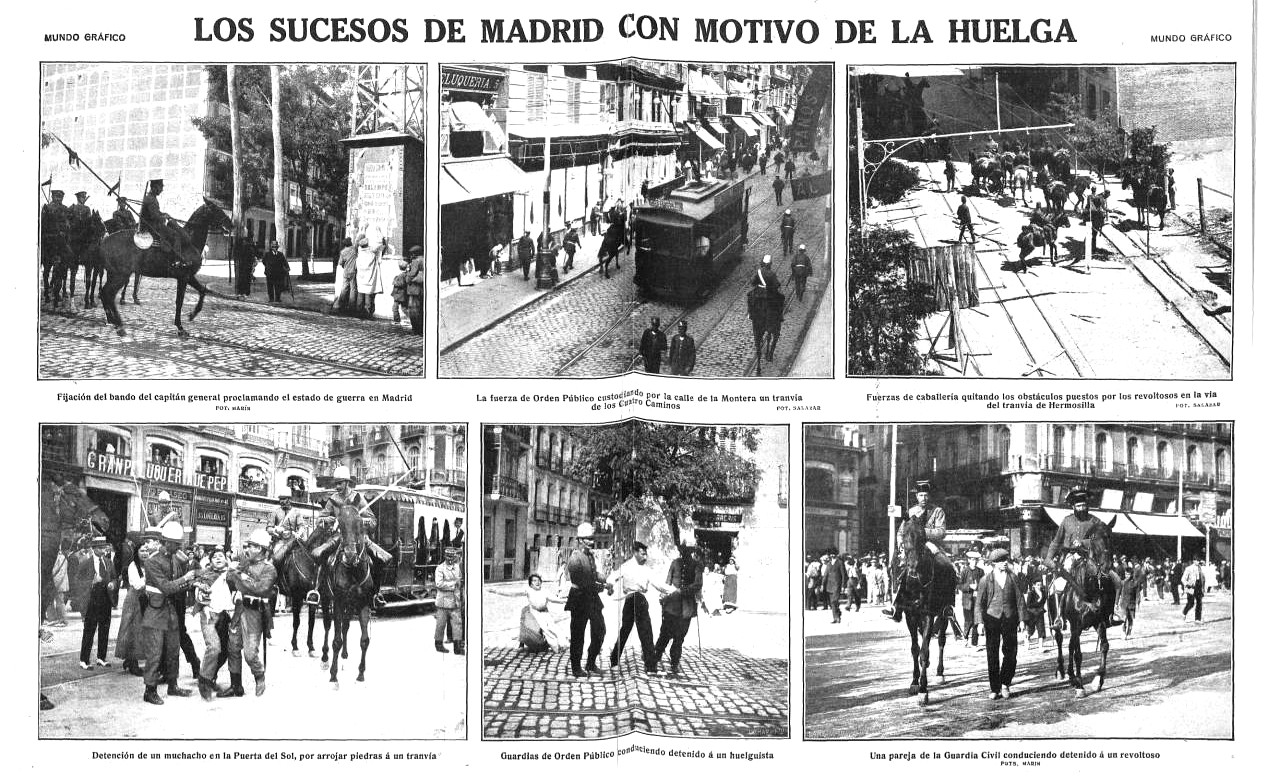
The following morning I saw a little squad of mounted Guardias Civiles scatter a group of gesticulating street-car strikers. They were picturesque in their black, Napoleonic- shaped hats, black boots, and black capes; their bristling, Kaiserite moustaches giving that studied aspect for which they are so renowned and feared, of being the most serio of all the military elements. Handsome black devils–but as one of the capotes bellied open I caught the flash of a scarlet lining. When the day comes…the cape need only be turned inside out.
But that day is not yet, although it was foreshadowed a year and a half ago by the military uprising in the barracks of Zaragoza. The government, however, constantly is increasing the number of civil guards and building up a strictly-disciplined, highly-paid, murderous organization. Against the day of reckoning the Spanish government, senile and decadent amidst the general dissolution of every national institution, is balancing the Guardia Civil, its one efficient undertaking nothing more.
Spain, though ethnologically a strange mixture of races, has always proved a docile child of the Roman Empire. It was conquered three times–by arms, by the Church, by the law. This meant a unity of administrative power scarcely parallelled in history, and in modern Spain it means the sublimation of the institutions from the life-blood of human liberty. Beneath the inherited system of the super-state and the effacement of all individual rights–this system of centralized Church, State and Law, Spain has been crushed to a condition of slothful inertia–as isolated from the forward-facing movements of Western Europe as was old Russia. Spain might have continued indefinitely in its sleepy sacerdotal routine, still practicing its auto da fe and its murders of free-thinking Ferrers, had it not been for the Great War. That introduced far-reaching contradictions into Spanish life.
Along with all the neutral continental nations Spain experienced a sudden expansion of industry and commerce. Its exports leaped from $166,695,000 the year before the war to $293,490,000 in 1917. And although, owing to abnormal conditions, feudal restrictions, and persistent strikes, exports dropped immediately in 1918 to $170,000,000, Spain had in certain sections become highly industrialized. To-day its new industries are marching to a collapse.
In Madrid the court of Alfonso XIII still holds pompous, anachronistic sway with its immense feudal retinue of Chocolate-soldier costumes, its Guardians of the Wardrobe, its Keepers of the Royal Stables, its High Stewards and Chamberlains. These feudal trappings, necessitating heavy taxes, government lotteries, and ever mounting import duties, have also debilitated industry, and contributed to the rapid loss of any prosperity that Spain gained during the War.
The Secessionist Movement.
The new capitalists of Spain who have emerged from the years of war manufacturing are not the old aristocracy. Here and there a count or a marqués has survived in the new role of captain of industry. The most notable is Conde de Romanones, leader of the so-called liberal party, who is so close to the seats of the feudal mighty that the present war in North Africa which is draining the strained resources of the nation, is known as the Romanones War. The Count controls the mining industry in the disputed area.
In general, therefore, the new industrial lords, however inefficient they may be, are dissatisfied with the present government in Spain, even though it provides them with royal military support in every strike. Yet, much as they resent the feudal incubus, they do not relish the idea of any change in government, any forcible overthrow of the existing regime. The specter of Bolshevism looms across the Pyrenees, and revolutions are not so easily controlled in these days of ravening populations tinctured with sentiments of class freedom.
This is why there is no Republican movement in Spain. The present Republican party proposes everything in the way of futile reform, but is haughtily indignant at any aspersions cast upon the crown. The old battling figures of Pi y Margall, of Castellar, Zorrilla and Costa have been replaced by a sentimental Blasco Ibañez, a retired Pío Baroja, and the Republicans of today spend their time conspiring against the noisy Lerroux, the one individual who vigorously attacks the crown as an institution.
The capitalists of Cataluña have sought to avoid this burden of an inefficient, oppressive, yet decadent feudal rule by advocating secession. To this end they have aroused a rabid local patriotism and created a separatist movement. And while the government has cleverly sidetracked the movement by lifting the principal independence protagonist from a squabbling recalcitrant to a dignified minister at Madrid, the bourgeoisie of Cataluña, the most industrialized state of Spain, are still plotting to break away from the feudal center, set up an independent government, and take their appeal to the League of Nations. The Catalan schism is as much a ruling-class feud as was our own sentimental Civil War.
The rapid industrialization of Spain has set in motion forces likely to disrupt the Spanish Kingdom. It has created an organized proletariat. Life is not easy in Spain. Prices are going up, fuel is scarce, food at times lacking. Only a few days ago I saw a mob in the street below my balcony smashing the windows of the bread stores, because there was no bread. Meanwhile the queen spends her free time in the hospitals holding the hands of the poor soldiers wounded in the Romanones War. The government is letting the situation run its full length to an end that is not difficult to foresee. The general harshening of life is squeezing the last drop of easy-going romance from the Spain of yesterday. Spanish labor is face to face with a situation which threatens to level it to semi-starvation and utter misery.
Against this process the workers have sought to organize and at least to maintain wages at a level corresponding to the increased cost of living,–a procedure that has aroused the most bitter opposition upon the part of the patrones of industry, and which has resulted in the appearance of struggles that can only be compared to Homestead and Ludlow, or to those now occurring in West Virginia. These struggles occur day after day in the larger industrial centers, and particularly in Barcelona, Valencia, Zaragoza, Bilboa, and in parts of Galicia. They are characterized by violence, terror, riots, murder. They have developed into a war between the classes, but a crude, troglodytic war without vision on either side, in which the larger revolutionary significance is swallowed up.
In most centers this war is conducted by the Confederación Nacional de Trabajo, the C.N.T., an outlaw organization which recognizes the partial and general strike, sabotage, and secretly organized terror. At present it is split between those who favor the Third International and those who are opposed, not only to political action of any sort, but also to the dictatorship of the proletariat. The organization as a whole does not see its real revolutionary purposes and the struggle has degenerated into brutal reprisal and counter-reprisal.
These wars proceed much in this fashion: A small strike is called in Barcelona. The police arrest the leaders. Several policemen are assassinated. More arrests are made. The small strike becomes a general strike. More leaders are arrested. The remainder go in hiding. Meetings are illegal, and the police discover frequent secret assemblies, and stores of union cards, stamps and propaganda. More assassinations. The patrones retaliate by assassinating the lawyer for the unions. Several patrones are found dead the following night. A Guardia Civil breaks up an impromptu gathering. That night several Guardias are picked up, stiffened corpses. A judge condemns a worker to a jail sentence. The next morning the judge fails to make his appearance upon the bench. At this point the crown picks out the most vicious military man to be found and installs him as governor of Cataluña to the noisy delight of the patrones. The act is solemnized by organized violence on both sides. A few days later thirty-six leaders, including the biggest of them all–Segui–are deported to the little island of Minorca. More violence! Angel Pestaña, the C.N.T. delegate to Russia, returns via Italy and is locked up in jail. More violence and assassinations! The same incidents are repeated everywhere. In Zaragoza the Governor calls for troops to eject strikers from the factories. The next day prominent officials are assassinated. The strikers in the British coal mines at Rio Tinto have been on strike for six months. Their children are scattered from one end of Spain to the other in the homes of sympathetic workers. The adults have been living upon acorns which they gather from the nearby mountains. The radical papers are full of photographs showing how the strikers have been reduced to consumptive bags of skin and bones. Now the acorn supply has been cut off by the aggressions of the mine guards. And while the government holds almost daily conference with Browning, the owner of the mines, the conflicts between the guards and strikers become more bitter and bloody. Thus has the class struggle in Spain been reduced to blind terrorism.
Yellow Versus Red.
The other organization, numbering some 250,000 members, is the Union General de Trabajo, the U.G.T., which always attempts to play safe, an organization in which Gompers would almost feel at home. The leaders of this organization, Iglesias, Caballero, Bestiero, Prieto, are the leaders of the Socialist Party. Into the U.G.T. and the Socialist Party fell the bombshell of the twenty-one conditions of Moscow. The U.G.T. to all appearances withstood the shock as all hallowed institutions should do. The Socialist Party has been rocked to its foundations. Almost a year ago came the first secession from the Socialist Party, and the formation of a small Communist Party, led by Merina Gracia, now in Russia, Juan Andrade, editor of El Comunista, and Eduarde Ugarte, and others some of whom are still under military sentence for having supported the Zaragoza uprising. This group is nothing more than the Spanish Young People’s Socialist League, which was suppressed by the Socialist Party, along with its organ, the Renovacion, because of its opposition to the Romanones War and its support of the Third International. Today the Socialist Party must decide upon the Twenty-One Conditions, which all the leaders with whom I have talked declare will split the party anew, creating a much more formidable communist group than now exists.
The government has been the first to declare civil war. It has suspended all constitutional guarantees except elections, making it a crime even to campaign for an anti-government candidate. It has imposed by force and violence crown-appointed mayors in every doubtful town and city in the country to insure a proper counting of the ballots; it has instituted a reign of terror throughout the land that has destroyed all semblance of legality or order. Private homes may be entered by the military without warning or warrant; men may be searched upon the streets for weapons and documents. While this is not so common in Madrid as in the industrial centers only the other day I was held up at my very door by a Guardia Civil, interrogated and searched for weapons. Unfortunately I had neglected to register with the municipal authorities and hence could show no cedula. I ushered the Guard into my room, dived into my trunk, and produced my last university diploma, and with a voice vibrating with indignation flaunted the Columbia seal beneath his nose, demanding how he dare insult an official. Mumbling a thousand apologies the Guard withdrew. It was the only use I have ever found for the bellicose signature of Nicholas Murray Butler.
It is thus however that the Spanish government has precipitated the present form of class war; it is thus that it has made the national issue its own existence. Several days ago I elbowed a fat, black-gowned priest–his “linda” clinging to his arm, for position in front of some striking election posters. One below the other they read:
WORKER! WHAT HAVE THE BOURGEOISIE DONE FOR YOU? DON’T VOTE.
CITIZENS! NOT TO VOTE IS A VOTE FOR THE LEFT. VOTE FOR THE MONARCHICAL PARTY AND LAW.
WORKERS! NOT TO VOTE IS TO GIVE A VOTE TO THE GOVERNMENT.
VOTE FOR THE SOCIALIST LABOR PARTY.
I marvelled at the wheel of time which had led the Socialist Party of Spain, the old disciplined party of Pablo Iglesias, into advocating the same tactics as the most vicious feudal monarchist, when even the semi-conservative papers and the capitalist organs in issue after issue were bewailing the fact, in spite of persecution, injunctions and charges of lése majesté that government stupidity had made the ballot worthless; that its visionless, arbitrary conduct had put Spain on the edge of a precipice, that tomorrow the bloody class struggles which are paralyzing industry from one end of the country to the other will lead directly to national chaos if not to revolution. As a matter of fact the people know that the ballot is useless. The government coercive measures and the propaganda of the C.N.T. have convinced them. During the last three years the number of ballots cast in Spain has steadily decreased. Yesterday in Madrid, a city which now claims over a million inhabitants, only 56,247 votes were cast and this is a decrease of over twenty per cent. In Madrid the vote has decreased, in spite of increasing population, over thirty per cent in one year!
At this hour in Spain the leadership of the Socialist Party and the U.G.T. amounts to nothing less than betrayal of the working class. It offers as little that is truly fundamental toward the solution of the present industrial war as does the Dato Government. It is permitting the country to drift into chaos, and even today Spain faces the fact that no one is capable of exercising a dictatorship: neither monarchist or capitalist; capitalist or working class. The terror is the only actuality today or tomorrow. Last July the U.G.T. and the C.N.T. signed a pact which amounted to a defensive and offensive alliance. While not extending to tactics it guaranteed mutual financial assistance and the sympathetic strike. The U.G.T., led by the Socialist Party politicians, has been the first to break that pact. At a moment when the workers of Cataluña were being herded at the point of the bayonet, deported, tortured and murdered, when terrorist reprisal had failed to bring amelioration, the call was sent out by the C.N.T. for a general strike throughout Spain which should not end till the military coercion of the workers had ceased. Strikes were called in Valencia, Zaragoza, Bilboa, Murcia and other important centers, but in Madrid the U.G.T. which had conducted a small bakers’ strike that has resulted in nearly doubling the price of bread, refused to sanction a general strike on the eve of a national election, fearing the extension of violence. The strikes in Valencia, Zaragoza and other centers collapsed like pricked bubbles. The workers of Barcelona are prostrate beneath martial law, and the darkest, most hopeless hour in the history of the Spanish labor movement has struck. The manifesto of the C.N.T., fighting with its back to the wall, is the one bright ray:
“The situation in which we find ourselves obliges us to put plainly before the working class of Spain the manifest treason committed by the Union General de Trabajo at a moment when a determined and energetic attitude would have put an end to the governmental repression which for two years we in the vanguard of the revolutionary labor movement have suffered.
“The Socialist Party whose influence in the aforementioned Union is so manifest, has preferred to interpose the political interests of the party in front of any united action answering to the pressing needs of the present. A national protest was not consummated because the directors of the indicated organization, in view of the promises of the Dato Government, preferred to collaborate with the bourgeois regime rather than support united action.
“In view of such conduct, with the authorization of our local organizations, we hereby withdraw from the pact of Madrid, the continuance of which one day longer would be a dishonor, a blot upon the clean record of our organization…
“From this time on we shall turn to the international proletariat for aid in the struggle which we are maintaining against the Inquisitorial and political government of Spain.”
The Liberator was published monthly from 1918, first established by Max Eastman and his sister Crystal Eastman continuing The Masses, was shut down by the US Government during World War One. Like The Masses, The Liberator contained some of the best radical journalism of its, or any, day. It combined political coverage with the arts, culture, and a commitment to revolutionary politics. Increasingly, The Liberator oriented to the Communist movement and by late 1922 was a de facto publication of the Party. In 1924, The Liberator merged with Labor Herald and Soviet Russia Pictorial into Workers Monthly. An essential magazine of the US left.
PDF of full issue: https://www.marxists.org/history/usa/culture/pubs/liberator/1921/04/v04n04-w37-apr-1921-liberator-hr.pdf

