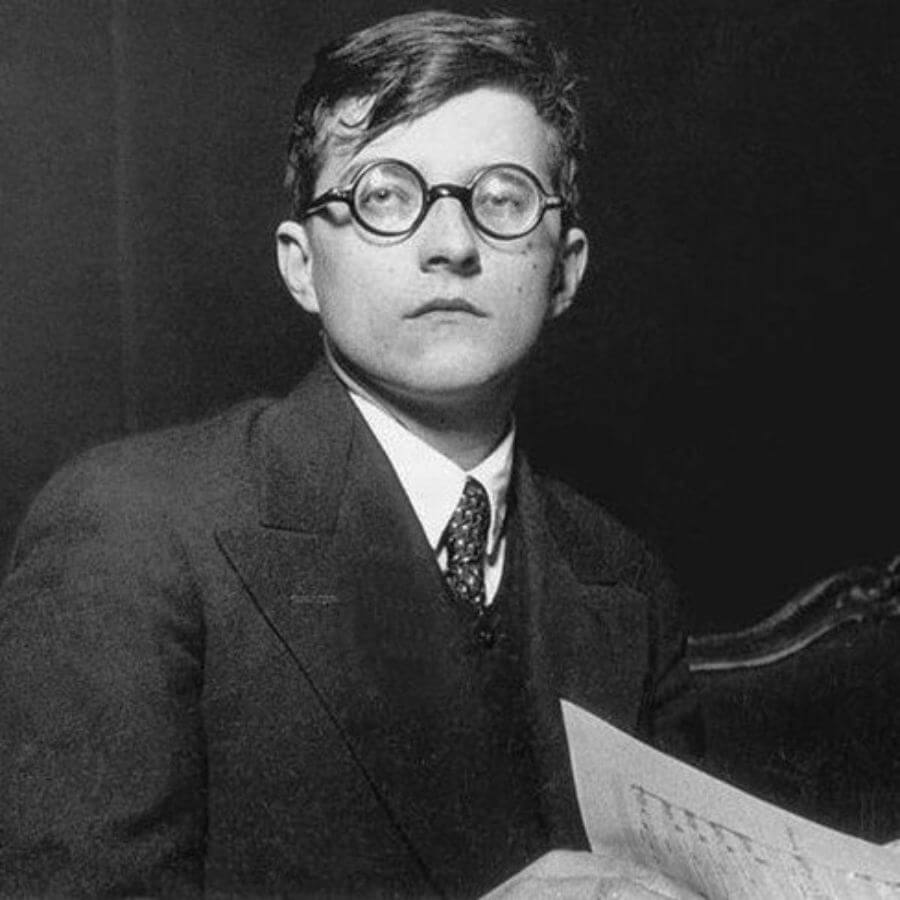
Introducing Daily Worker readers to the work of Soviet composer Dmitri Shostakovich, still in his twenties, and the world of symphonic music developed after the revolution, and promoting a New York production of his 1929 work ‘The First of May.’
‘Shostakovich’s Magnificent May Day Symphony To Be Performed’ by P.S. from The Daily Worker. Vol. 12 No. 88. April 12, 1935.
Composer Recognized as Most Brilliant in Soviet Union–Fine Program of Soviet Music for Benefit of Workers School
NO revolution in the history of mankind has ever devoted so much care to art as has the Russian revolution. No other revolution has shown such an understanding of the profound social significance of art or has trusted so firmly in the power of art for the fulfillment of its broad cultural tasks.
The rapid development of socialist industry and agriculture in the U.S.S.R. has been accompanied by no less important development of the arts.
Millions have turned to music, have become amateur musicians. At present everywhere in factories and works, in state and collective farms, in workers’ clubs and palaces of culture and rural meeting houses, one hears the sound of music. In fact, the quality of this amateur music is extraordinarily high. The annual Olympiads organized in Leningrad, Moscow and other big cities of the U.S.S.R. consisting of reviews and competitions of the best choruses, orchestras and soloists stimulate this brilliant development of music among the huge masses of the people.
The Opera
The Russian revolution offered tremendous possibilities for the development of the Opera art in the U.S.S.R. New opera houses have been opened: in Leningrad the Small Opera Theatre and the Opera Studio of the Conservatory; in Moscow–the Experimental Opera Theatres of Stanislavski and Nemirovitch-Danchenko, and in the capitals of many of the constituent Soviet republics, such as Kiev, and Tiflis. Significantly, opera performances have become regular events in the theatrical life of former provincial towns where the public has never seen them before. Now such remote places as Sverdlovsk, Perm, Novosibirsk, Samara, Baku, Tashkent and Erivan have their own opera houses with artistic staffs of high quality.
This multitude of opera theatres has naturally given rise to an increase in the number of operas written by Soviet composers. Every year witnesses the production of several new operas with new themes as the efflux of a modern conception of the world and the new interests of Soviet life. A new musical style is in the making. One of the most successful attempts at the mastering of this style is “Lady Macbeth of Mzensk” by Dmitri Shostakovich, one of the latest of Soviet operatic art.
Symphonic Music
The development of symphonic and chamber music serves as an even more significant indication of the growth of the musical culture of the Soviet Union. The philharmonic orchestra formed in all larger cities of the U.S.S.R. are especially intended for the cultivation of these musical genres. The work of the Soviet Philharmonics has been intensely developed. The Leningrad Philharmonics has been intensely developed. The Leningrad Philharmonic generally gives 18 symphony concerts every month, aside from frequent chamber concerts and solo performances. Another powerful means of popularizing symphonic music is the Soviet broadcasting stations which maintain their own symphonic orchestra. As part of this general development the U.S.S.R. has a whole group of composers who are real masters in the symphonic field.
Dmitri Shostakovich
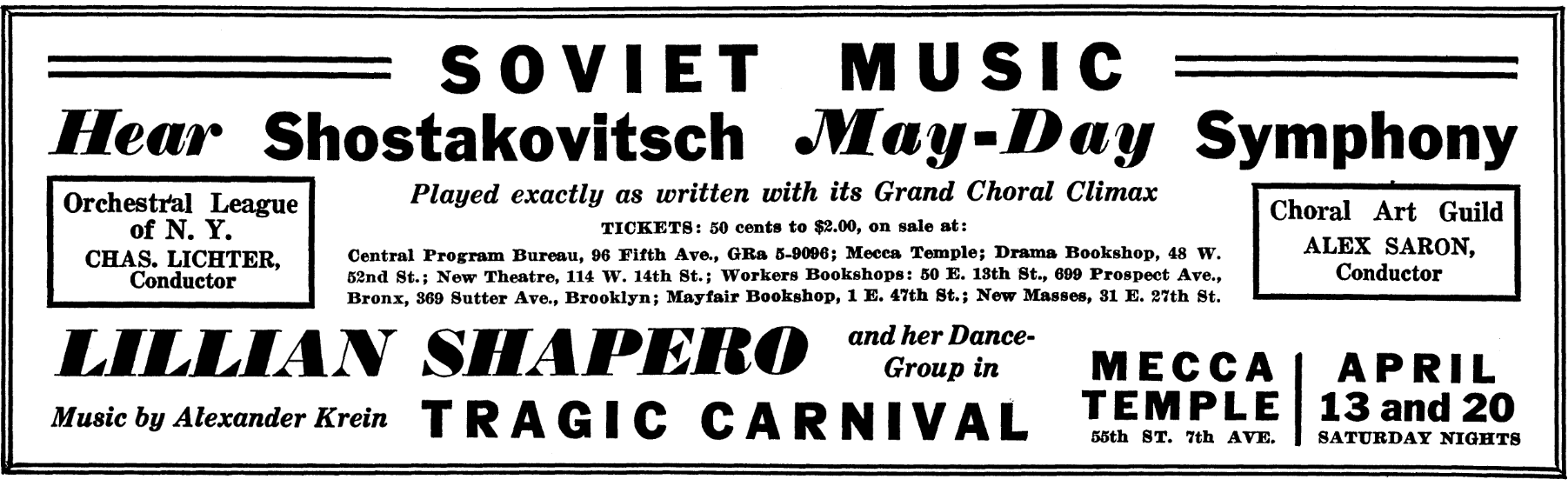
Among the young composers Dmitri Shostakovich comes forward with meteoric brilliance. He is universally recognized as the greatest genius among young composers, not only in Russia but the world over. At the age of 18 he composed his first symphony and at 23 he completed his May Day Symphony (which to be given here for the benefit of the Workers School this Saturday night, April 13th, at Mecca Temple) which is recognized as the greatest single symphonic work coming from the Soviet Union.
The symphony is predominantly melodic and the casual listener is sometimes apt to be confused with the profuseness of the melodic, the constantly changing relations of the apparently new themes. This has led many casual listeners to believe that there is no organic form or development of ideas in this symphony. From the beginning, the work builds in general intensity of feeling, variety of rhythmic device, and richness of melody towards the last section, or movement, which is a choral setting of an ode to May Day, whence the symphony derives its name.
The text begins with the dark note of the misery and weakness of the workers on previous May Day celebrations: “then a whisper went through the land: brightly the sunrise flamed.” In the grayness of winter workers and peasants began the task,” referring to the October revolution. May comes with sunshine…and ever forward goes the great Plan.” “Gigantic new works spring from the newly sown seed. Grain, coal, steel, this is the New Era.”
It ends on a militant call to all workers to “destroy by fire the olden Time light a new path ahead. Every May Day draws us nearer to the goal.” The choral writing throughout is simple, both rhythmically and melodically, and follows the Beethoven Ninth closely in style.
The Symphony is played without pause, all the material being fused into one encompassing movement. Yet it divides itself quite naturally into four complete movements, which are more dependent on each other than is usually the case because of their completely encyclical character. The same thematic material that is introduced in the first movement is used throughout the work being reintroduced again and again, and often being used as the counterpoint for new material with which Shostakovich is very lavish. Material from the first movement even serves as accompaniment for the choral setting of A text by Ussov which comprises the last movement. Incidentally, at the performances in this country this chorus has been omitted, and Mr. Lawrence Gilman refers to it in the program notes as being “ad libitum.” The optional character of the choral text is not indicated by the composer in any way, and it is inconceivable that it should be, as the entire last movement of the symphony, and the climatic resolution of the rest of the work are built around the chorus.
This is a rich work, vital, vigorous, compact, a thoroughly worthy musical expression of the revolutionary implications of its text and programs. From a purely musical and technical viewpoint its method and approach suggest interesting fields for our exploitation in composition. I believe local audiences will share my gratitude to the Workers School for the opportunity to hear this complete performance tomorrow evening. April 13th, at Mecca Temple.
The Daily Worker began in 1924 and was published in New York City by the Communist Party US and its predecessor organizations. Among the most long-lasting and important left publications in US history, it had a circulation of 35,000 at its peak. The Daily Worker came from The Ohio Socialist, published by the Left Wing-dominated Socialist Party of Ohio in Cleveland from 1917 to November 1919, when it became became The Toiler, paper of the Communist Labor Party. In December 1921 the above-ground Workers Party of America merged the Toiler with the paper Workers Council to found The Worker, which became The Daily Worker beginning January 13, 1924. National and City (New York and environs) editions exist.
PDF of full issue: https://www.marxists.org/history/usa/pubs/dailyworker/1935/v12-n088-NAT-apr-12-1935-DW-Q.pdf

