Rakosi, who decades later would be the central figure of post-war Hungary and the main rival to Imre Nagy, was the subject of one of International Red Aid’s largest campaigns of the 1920s. In exile since the fall of the Hungarian Soviet Republic in 1919, Communist Party leader Mátyás Rákosi was arrested in 1924 attempting to return to build the underground organization. Facing death, the trial was intensely followed by Communists around the world, with Rákosi eventually spending fifteen years in prison.
‘Story of Fight to Save Mathias Rakosi and His Fellow Workers from Horthy’s Hangmen’ from Labor Defender. Vol. 1 No. 1. January, 1926.
American Workers Under Direction of International Labor Defense Play Notable Part
Mathias Rakosi, former People’s Commissar ill the short-lived Soviet government of Hungary, was saved from the jaws of death at the hand’s of the Fascist dictatorship of the notorious Horthy, by a world-wide protest of labor, initiated by the International Red Aid and supported by labor defense organizations in every country in the world.
As The Labor Defender goes to press the news has arrived that the court martial instituted to try Rakosi has declared itself incompetent which probably means that Rakosi and his co-defendants will be granted civil trials. With Rakosi were arrested over one hundred members of the Independent Socialist Party The plan of the Horthy government was to execute ten of the leaders including Rakosi and Weinberger, letting the others off with prison sentences.
The power of labor was never better demonstrated than in this campaign even though only a fraction of its strength participated in the mighty demonstrations held throughout the world.
That the Horthy government thirsted for Rakosi’ s life there is no doubt. The capitalists and big landowners hated him. Why? When the battalions of the central powers retreated, Defeated and demoralized before the victorious armies of the allied nations in 1918, revolution followed in their wake. The masses who were dragooned into the bloody shambles of the capitalist war revolted, only to see their efforts drowned in a sea of blood, in every country except Russia.
The Hungarian workers and peasants raised the standard of revolt. They organized a Soviet government but they were not strong enough to sustain themselves. They were crushed under the iron heel of the Hungarian bourgeoisie aided by world capitalism and particularly by the Wall Street bankers. The story of the short-lived but glorious venture is recorded in history and will forever remain a bright page in the annals of labor’s struggle for power. Here we are dealing with one chapter of the white terror that followed the overthrow of the proletarian government headed by Bela Kun. The supervisor and general butcher of this period is Admiral Horthy, commonly called by the sobriquet: “The Hangman of Hungary.”
Mathias Rakosi was one of the People’s Commissars in the Bela Kun cabinet. He spent Russia for Hungarian white guards in the custody of the Workers Republic.
Horthy’s firing squad was kept busy until he thot that all opposition to his dictatorship was crushed. Labor unions and all political working-class organizations that dared stand on the platform of the class struggle were outlawed. But their spirits were not daunted. In their hearts the fire of revolt was still blazing.
Mathias Rakosi was safe in Soviet Russia. But he was not content with serving the cause of labor in a land where labor was already free and where a powerful Red Army existed to protect labor against its enemies, native and foreign. Rakosi decided to return where the battle raged the hottest, where the gallows and the firing squad were the probable penalty for one caught in the act of organizing the workers. Rakosi returned to Hungary.
He was arrested by Horthy’s bloodhounds and with him over one hundred others—members of the Independent Socialist Party.
The government of the capitalists, big landlords and of the international bankers was in great glee. Horthy promised a speedy trial by court martial and a still speedier execution. Rakosi and his comrades after being subjected to torture of a kind unsurpassed in mediaeval days were to be dragged before drum head court martial and executed two hours after the verdict which was already written. The verdict would be “guilty.”
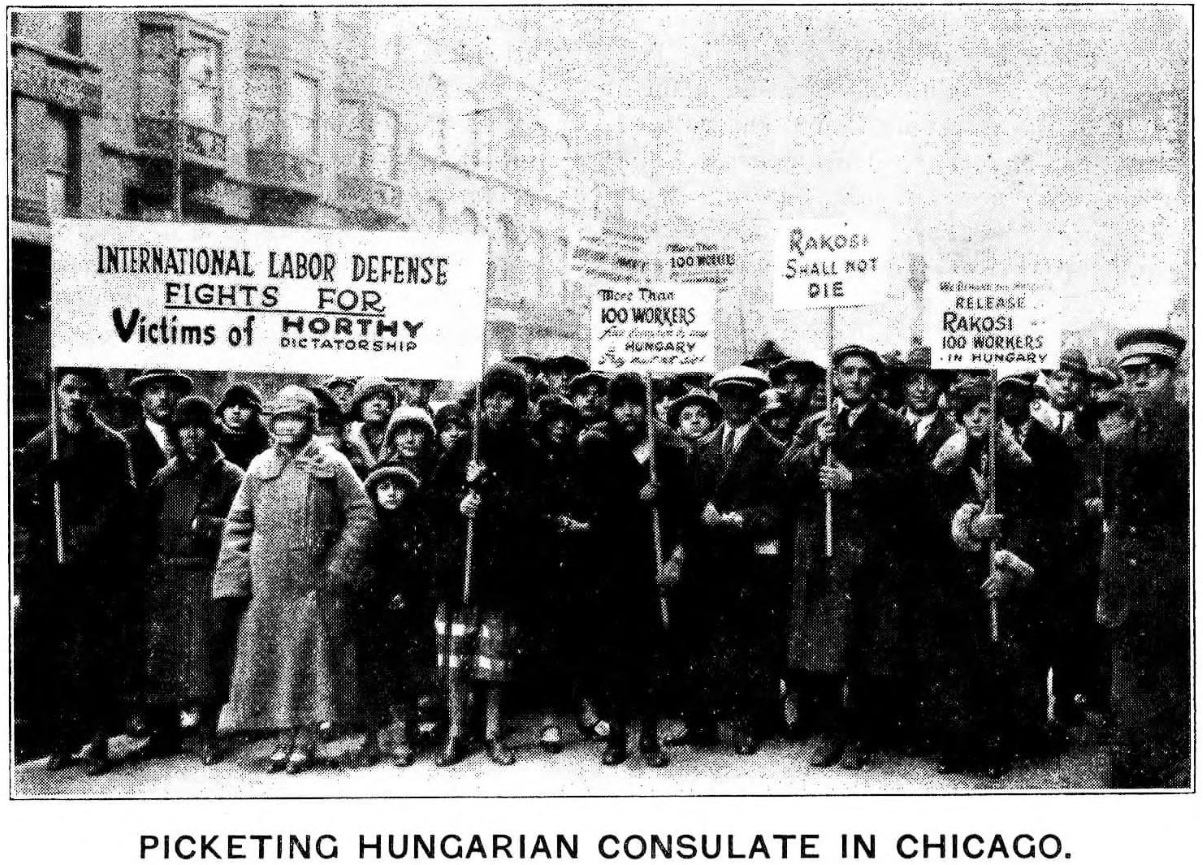
But the bloodthirsty Horthy government reckoned without the international working-class. No sooner was news of the arrest made public than a campaign of protest was organized that mobilized millions of workers in every country under the sun to save the lives of the leaders of the Hungarian working-class. The international Labor Defense responded for the workers of the United States and here is the story of our campaign told in words and in pictures: On receipt of a cable from the defense organization in Berlin on October 9, a giant campaign of mass meetings and demonstrations was organized. Hungarian consulates in New York and Chicago were picketed and also the Hungarian legation in Washington. Mass meetings were held under the auspices of the I.L.D. in the following cities: Philadelphia; Kansas City, Miss.; Washington; Minneapolis; Pittsburgh; Chicago; Boston; Cleveland; Buffalo; and New York.
The New York section of the International Labor Defense picketed the Hungarian consulate in that city continuously since the campaign to save Mathias Rakosi and his comrades was launched. More than fifty members of the I.L.D. were arrested by the police during the demonstrations.
In Washington, the police attempted to break up the demonstration in front of the Hungarian legation but failed. In Chicago, newspapers took photographs of the demonstrations but with one exception all of them killed the story. This was done, according to reports, at the request of the Hungarian consul.
The I.L.D. cabled a protest to the prime minister of Hungary. It was signed by the National Executive Committee. At the same time a wire was dispatched to a long list of American liberals requesting their permission to sign their names to another protest cable to the Hungarian government and to the Hungarian minister in Washington.
The following gave their consent to the message: Upton Sinclair; Roger N. Baldwin; Clarence Darrow; William Holly; Robert W. Dunn; Andrew T. McNamara; David Rhys Williams; Robert Whitaker; Edward C. Wentworth; Bishop William Montgomery Brown; and Alice Stone Blackwell.
The Hungarian minister in Washington is an aristocrat who is married to a daughter of the Vanderbilts and is said to have considerable influence with secretary of state Kellog.
The indignation aroused in the United States by the new wave of white terror in Hungary was communicated to the Horthy government by his agents in this country. In order to calm the protests of the international working-class, the Horthy government sent out deceptive stories purporting to be “confessions” made by Rakosi and others that their treatment at the hands of their captors was most humane. As a matter of fact Rakosi’s lawyer (a right-wing bourgeois advocate) was not even allowed to visit his client in order to consult with him on his defense.
In protest against their inhuman treatment the prisoners went on hunger strike. Their brutal jailers prescribed “artificial nourishment.” Before the tube was inserted into the throats of the victims, they were first beaten over the head with rubber clubs. While in a state of unconsciousness, the prisoners were “nourished” until they fainted and had to be carried back into their cells, and many of them to the hospital.
Horthy’s surrender to the great protest of the workers of all lands is no guarantee that he will not seek some other method of getting rid of an enemy of capitalism. The workers must be on guard.
The action of the class-conscious workers of all lands in rallying to the support of their class, unknown to them personally, is a hopeful sign for the future. It is a demonstration of the spirit of international class solidarity which presages the downfall of capitalist rule the world over.
Labor Defender was published monthly from 1926 until 1937 by the International Labor Defense (ILD), a Workers Party of America, and later Communist Party-led, non-partisan defense organization founded by James Cannon and William Haywood while in Moscow, 1925 to support prisoners of the class war, victims of racism and imperialism, and the struggle against fascism. It included, poetry, letters from prisoners, and was heavily illustrated with photos, images, and cartoons. Labor Defender was the central organ of the Scottsboro and Sacco and Vanzetti defense campaigns. Editors included T. J. O’ Flaherty, Max Shactman, Karl Reeve, J. Louis Engdahl, William L. Patterson, Sasha Small, and Sender Garlin.
PDF of full issue: https://www.marxists.org/history/usa/pubs/labordefender/1926/v01n01-jan-1926-LD.pdf

