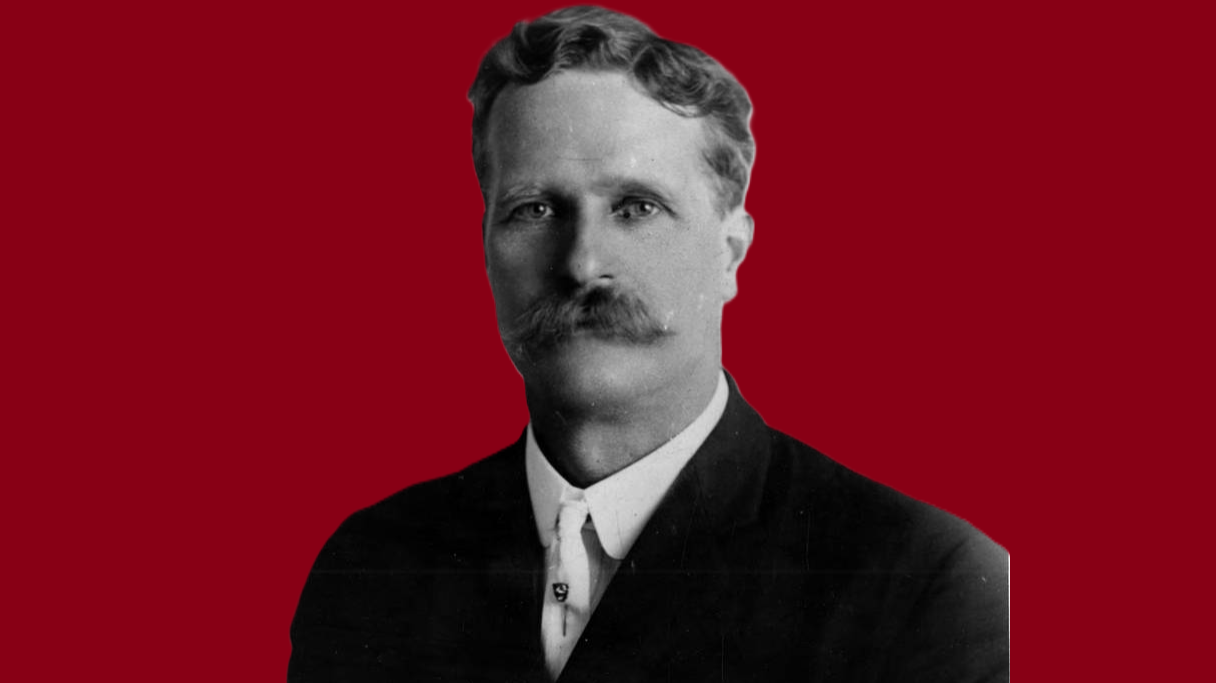
Accounting for his work over the previous year, the veteran I.W.W. activist and legendary soap-boxer (his orator’s gifts apparent) reports to 1912’s I.W.W. convention. Largely, though not exclusively, focused on two major struggles; the strike in Lawrence, Massachusetts with its associated Ettor-Giovannitti defense campaign, and the strikes in the silk mills around Passaic, New Jersey with the destructive attempt of the ‘Detroit I.W.W.”, supporters of Daniel De Leon’s Socialist Labor Party, to use the hard-fought prestige of the wobbly name to build their own organization. Will be of interest to all students of U.S. labor history and the I.W.W.
‘James P. Thompson’s Report as General Organizer to the Seventh Convention of the I.W.W.’ from Solidarity. Vol. 3 Nos. 43 & 44. October 19 & 26, 1912.
Fellow Workers:
Solidarity of labor is spreading rapidly throughout the world. Each act of solidarity shows the possibilities of greater solidarity. Events following fast upon one another are attracting the attention of the world to our movement, and, at the same time, demonstrating the soundness of the principles for which we stand. As a result, every hour that passes sees the One Big Union idea gaining ground with giant strides.
Since of the main ideas for which we stand is that we learn by experience, I take it that the chief purpose of this report should be to throw as much light as possible upon things I came directly in contact with during the past year, to the end that we day, as far as possible, know what to seek, what to avoid, and what course to follow in the struggles yet to come.
One of the first things I have to deal with is the strike of the textile workers at Lawrence, Mass. In order to understand this great strike, we must go back into history a little and study some of the things that went before.
Workers in other towns and other industries in the state of Massachusetts bad the same grievance as the slaves in Lawrence, and yet while everywhere else in the state all was quiet, in Lawrence the storm broke and raged with a fury and endurance that startled the world.
Lawrence Strike A Harvest
It is absolutely foolish to say “it happened without any apparent cause;” “that it was the lightning out of a clear sky,” etc.
As a matter of fact, it was a harvest; it was a result of seeds sown before; it was the ripened fruit of propaganda. The strike and the remarkable solidarity shown between the many nationalities and different crafts was simply the carrying out of ideas drilled into them before the strike began.
Conditions among the textile workers of this country are unspeakable.
Infamous
The mills are not only slave pens, but their operation under present conditions is literally a case of murder on the instalment plan.
For years the mill owners have been systematically grinding the workers down. Their plan has been more work with less workers. For instance in the Woolen Mills, during the last few years, the two-loom system has been gradually forced upon the weavers. This fans that each weaver was compelled to run two looms where be only ran one before. The Weavers fought hard against the introduction of this system, but lost. They were compelled to run two looms, first on plain goods then on fancy. In most of their struggles against the introduction of this system the weavers were compelled to fight alone, while all the other crafts remained at work and helped the mill owners to whip them. When the weavers were on strike it was considered proper for the spinners to spin yarn for scab weavers, for loom fixers to fix the looms, for finishers to finish the cloth woven by scabs and so on down the line.
Such is the craft autonomy and organized scabbery of the A. F of L.
Where before in a mill with a hundred looms a hundred weavers were employed, after the two-loom system was introduced, it was a case of a hundred looms with work for only fifty weavers.
One half of the weavers lost their jobs. Of course those who lost their jobs were the gray haired among the men and the frail among the women.
Then with one-half of the weavers in the mills at a pace that kills, and the other half searching in vain for work, the mill owners bad them where they wanted them. Then came down the wages. And so with the spinners, twisters, finishers and all the other crafts in the mills. It was a case of speeding up and grinding down.
Just as in the other industries, so here, the premium system was introduced in order to find out how much they could do when they worked at breakneck speed. Then prices were fixed so they were compelled to “break their necks” in order to live. So for years the textile workers have been ground down; whipped, one mill at a mill, one craft at a time, until today many of them are not getting enough to keep themselves in normal condition, and as the days come and go they are dying by inches, going down to the grave without ever having REALLY lived.
I went into Lawrence in 1907 and found the local there defunct. Two or three men still held the charter, but there had been no meeting of the local for several months. I got in touch with Fellow Worker Gilbert Smith and August Detollenaire, the latter an active worker among the Franco-Belgians. We arranged a meeting and succeeded in organising a Franco-Belgian branch of Local No. 20.
This branch has been the backbone of the Textile Workers’ Industrial Union in Lawrence from that day to this.
During the winter and spring of 1908 we succeeded in organizing a local of textile workers in Lowell, which city is only nine miles from Lawrence. In Lowell just as in Lawrence, it was a determined band of Franco-Belgian Fellow Workers who kept up the agitation and held the local together.
By the way, Fellow Worker Fred Heselwood told me when I was in Spokane that the local in Lowell sent in more money for the Spokane free, speech fight than any other local of its size in the country.
These locals in Lowell and Lawrence kept up the agitation, distributed literature, arranged meetings for such speakers as could from time to time be sent in to aid their local agitators. They held aloft the banner of industrial unionism until the great strikes and victories of this year came to reward their efforts and prove their propaganda had not been in vain.
In the latter part of August, 1911, 100 cotton weavers in the Atlantic Mills in Lawrence went on strike. They were up against the same kind of proposition that the woolen weavers had fought so long. Another case of doubling up the looms.
The company was trying to force these cotton weavers to each run 12 looms, where they had been running only 6 or 7 before, and at a reduction in price from 79 to 49 cents per cut
This strike, although small, was vigorously conducted by the I.W.W. and caused a great deal of discussion among the slaves of the mills and did much to arouse them and attract their attention to the Industrial Union that was forming in their midst.
In September, 1911, an independent organization of textile workers in Lawrence, 500 strong, joined the I.W.W. in a body.
All this helped to place the local there on a sound footing, and enabled them to carry on a more complete and vigorous propaganda than ever before.
While I was in Omaha, Neb., in the latter part of October last year I received a very optimistic letter from Fellow Worker Wm. Yates, secretary of the National Industrial Union of Textile Workers, inviting me to come East, if possible, and work for the National Industrial Union for a couple of months.
In order to show that he plainly saw signs of the coming storm, I will quote a few passages from his letter:
Under date of Oct. 16, 1911, he says: “I am writing you this to find out if you can come East for six weeks or two months, to start in Lawrence as soon as possible. I was over there yesterday and find conditions such that some one is wanted in that city at once. Conditions are rotten ripe for reaping the harvest that we have so There is a strike in the diligently sown. Atlantic Mills, as enclosed circular explains. Also one in the Arlington Mills, which is one of the largest in Massachusetts. The fellow workers of Local No 20 are desirous of keeping up this spirit of revolt. The worm (textile workers) has turned at last. He has been stepped on in such a way that there was nothing left for him to do but kick over the traces. The I.W.W. is to the front in Lawrence.
The events that followed certainly showed that Fellow Worker Yates knew what he was talking about.
Methods of Agitation
Upon receipt of the above, letter, I at once arranged to go East. I arrived in Lawrence Nov. 2 and, meeting with the organization committee, at Franco-Belgian hall, 9 Mason street, we soon outlined a plan of action. We got out stickers reading as follows:
“STRIKE IN ATLANTIC MILLS, LAWRENCE, MASS.
“Anyone who is working in the mill is helping the company to BREAK THE STRIKE. All workers stay away. Don’t be STRIKE BREAKERS.”
Several thousand of these stickers were printed and pasted up almost everywhere in Lawrence and in some of the surrounding towns.
We arranged several hall meetings during the time I was there, and in drawing up the circulars advertising these meetings, we aimed not only to advertise the meetings, but also to make the circular itself sort of a propaganda leaflet.
The following is a sample of one of these circulars:
—
OVERWORK FOR SOME MEANS OUT OF WORK FOR OTHERS
Shorten the Working Day and Lengthen the Workers’ Lives.
WAGE WORKERS, ATTENTION!
Fellow Workers, Men and Women: You know that while some are working at a pace that kills, others are out of work.
Do you know that the reason we have an army of employed is because one part of our class does all the work and there is nothing left for the others to do?
Do you realise that overwork shortens the lives of the workers and makes their short lives miserable?
COME to the meeting advertised below.
Hear the lecture on a subject that means much to you and yours.
—
Then followed, of course, the announcement of the mass meeting, etc.
Another one of the circulars read as follows:
—
AN INJURY TO ONE AN INJURY TO ALL
OVERWORK FOR SOME MEANS OUT OF WORK FOR OTHERS–SLAUGHTER SALE OF LABOR POWER NOW GOING ON TEXTILE WORKERS.
ATTENTION! Fellow Workers. Men and Women:
The other class form trusts and get all they can for that which they have to sell. Let no do likewise with that which we have to sell!
The other class curtail production to affect markets. Let us curtail our labor to affect the labor market.
Remember, the longer we work and the harder we work, the less workers it takes to do the work of the world and the larger the army of unemployed.
The larger the army of unemployed, the more independent the bosses, and the lower the wages.
In other words, as a class the longer we work and the harder we work the less we get:
Let us all unite in ONE BIG UNION and look out for ourselves. Are you game! Come to the meeting advertised below.
—
About ten thousand of these circulars were distributed among the slaves of Lawrence and 4,000 distributed in Lowell for the hall meeting I held there.
In addition to the hall meetings, we also held many open-air meetings at the mill gates at noon and on the street at night when it was not too cold.
I spoke at the mill gates in Lawrence nearly every day at noon for two weeks, then went to Lowell for a week, then returned to Lawrence for another week.
During the three weeks I was in Lawrence, I spoke several times near each of the big mills there. The crowds at these noon-day meetings were simply enormous, and the applause and shouts of approval showed plainly that the sentiment for the One Big Union was very strong.
The thousands of stickers and circulars and many meetings reaching thousands and thousands of workers, brought the I.W.W. with its form and tactics to the attention of practically every slave in Lawrence.
When I arrived in Lawrence Local No. 20 consisted of prosperous English and Franco-Belgian branches and an Italian branch, each of course with delegates on the central committee The Italian branch, however, not having paid any per capita tax for several months, and having had no delegates on the central committee for a long time, was practically defunct.
A meeting for Italians was arranged for Nov. 26, and on that date with the assistance of some active Italian fellow workers and some delegates from the central committee, we succeeded in reorganizing the Italian branch. It was this branch that sent for Fellow Workers Ettor and Giovannitti when the great strike started in January.
54-Hour Law and Short Pay
As you all know, the politicians bad passed a law reducing the hours of la or for women and children in the mills from 56 to 54 hours.
When this law went into effect Jan. 1 the masters met it by speeding up machinery, etc., and thus succeeded in getting as much, if not more, labor out of the workers in 54 bours than they bad before in 56. Thus the law was a benefit to the mill owners, as it enabled them to save the coal and light bill, etc., for two fours on every week. But the masters were not satisfied. Without saying a word to the workers they cut wages.
On pay day when the workers discovered the robbery they looked at one another as much as to say: “What are we to do now?” “Many of us could hardly exist on the wages we were getting before.” “What are we to do?” They had the idea what to do, and they proceeded to do it STRIKE! The word was flashed along. They had the right idea how to strike, and that idea was also passed along. EVERYBODY STRIKE! STRIKE! EVERYBODY STRIKE! These words were passed along from slave to slave; from om to room: along the streets; from mill to mill until the idea was carried out, and the great industrial strike of Lawrence was on.
They all had some idea as to what organization they should join. There was no argument about it. The very mention of the I.W.W. was greeted with cheers. The fellow workers of Local No. 20 got busy. They sent out telegrams. Fellow Workers Ettor, Giovannitti, Yates and others came. The fact that they were I.W.W. organizers gave them the right of way among the strikers. In a few days the strike was organized according to the I.W.W. plan. The famous strike committee was formed, consisting of delegates from all the different nationalities. Other committees, finance, press, etc., were formed. Demands were formulated, agreed to at a giant mass meeting of strikers and presented to the masters.
The “Magic” of Solidarity.
Then in almost no time the mill owners were confronted with a labor organization more powerful than any they had ever seen before. To them it seemed to have been conjured out of the very ground; to have been formed by magic. They were dazed. Thunderstruck. The whole country was thunderstruck. Many are that way yet.
In the meantime the masters got busy. They sent out telegrams. The militia and firemen were sworn in as special policemen. These slugging committees and hired butchers proceeded to demonstrate the class character of government. The labor fakirs and lieutenants of the capitalist class also got busy. On Jan. 14 John Golden, president of the United Textile Workers, A. F. of L., sent a telegram to Cornelius F. Lynch, police commissioner of Lawrence, which read as follows:
Golden Offers Aid to Mill Owners
“When you think it wise for our international Union to enter into the situation let me know.”
Police Commissioner Lynch immediately wired President Golden as follows:
“Come at once.”
Golden came, but could do nothing. The workers were wise to him and his whole scabby outfit.
Later, in a statement to a Boston pa per, Golden said: “The cosmopolitan character of the operatives in Lawrence makes it difficult to organize. They are foreign to our institutions and unacquainted with the spirit of Massachusetts. Teaching them our methods is a slow process and their ignorance makes them susceptible to the influence of unwise leaders.”
It is not my purpose at this time to a tempt a detailed history of the strike. Most of the main, points in connection with it are too well known to you to need comment from me. There are some points, however, we should always bear in mind and keep continually before the working class. You all know how dynamite was planted by prominent business men in a cowardly attempt to discredit their starving slaves.
Only the fact that their plans miscarried saved some of our fellow workers from rotting in prison or going to their death in the electric chair. Had their murderous plan been carried through without a bitch we can easily imagine bow the cheap politicians, editoretts and stool pigeons of the capitalist class the world over would now be throwing mud at the whole I.W.W.
Fortunately the master class have over-reached themselves. They stand self-convicted. The world is coming to understand that there is nothing too underhanded, mean or murderous for them to do.
The robber class will do anything sneaking or cowardly, from poisoning the milk that babies drink to adulterating the drugs that sick people take.
Their courts of “justice” and all their damned institutions are being convicted along with them.
They surely are a holy crowd of hypocrites.
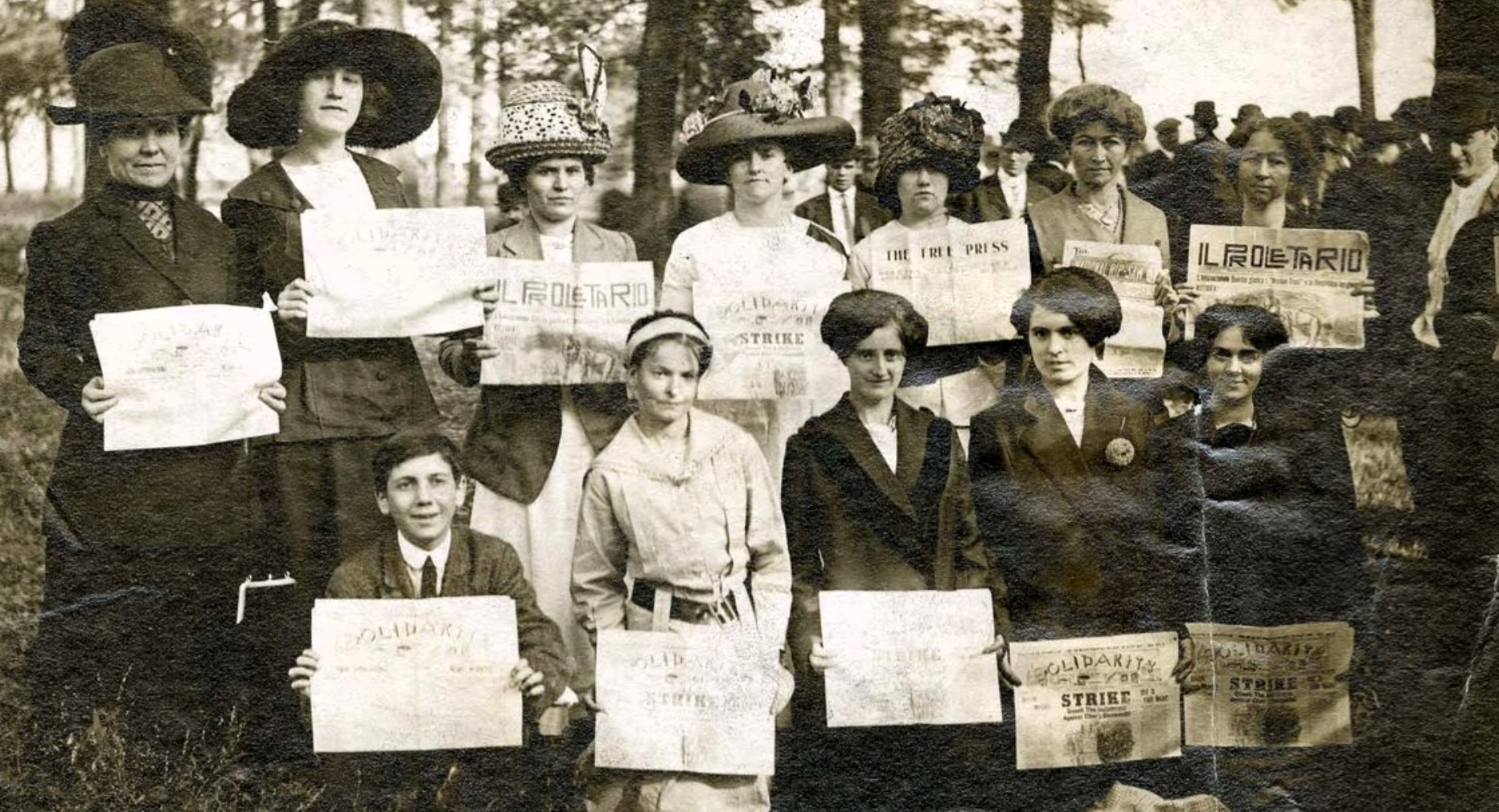
On one occasion during the first days of the strike the mill bosses turned streams of water upon a large body of marching strikers in zero weather, and then pretended to be horrified because the slaves resented it.
Murder of Ramy and LaPizza
Murderers marched the streets of Lawrence. It was easy to tell many of them because they had their uniforms on and murderous weapons in their hands. One of them killed John Rami, a 16-year-old Syrian boy, member of the Syrian band. This young boy had a cornet in his hand ready to furnish music to cheer his fellow slaves in their fight for bread. He was murdered when a soldier plunged a long, cold, gleaming, steel bayonet in his back.
On Monday morning. Jan. 29, a gang of imported thus smashed some car windows and it seems tried hard to start a serious riot. The streets were full of soldiers, but, mark you well, they had strict orders not to shoot on that day. Another clear case of a frame-up in an effort to discredit the strikers.
About 5:30 in the afternoon of that same day, Jan. 29, a peaceful crowd of strikers were doing picket duty when a squad of police with guns and clubs in their hands attacked them and began clubbing them and driving them in every direction.
It was at this time that Annie La Pizza was killed. Many witnesses not only testified that she was shot by a policeman, but some of them identified Oscar Benoit as the policeman who shot her.
Fellow Workers Ettor and Giovannitti were two miles away at a German meeting when Annie La Pizza was killed, and yet these two fellow workers have been in jail since Jan. 31 charged with being accessories to her murder.
Officer Oscar Benoit has not been arrested. Think of it! A slugging committee of the capitalist class club and beat a crowd of peaceful strikers; shoot a woman dead. Then they have the gall to try to put the blame for the whole business upon Ettor and Giovannitti. The master class of this country is actually trying to make the people of this world believe that both the riot and the murder was caused by something that Ettor and Giovannitti are alleged to have said at a meeting some time before.
Ettor and Giovannitti, denied bail, have been held in jail for nearly a year awaiting trial on this charge.
Then some people wonder why respect for courts as institution of justice is dying in this country.
The soldiers had strict orders not to fire when the thugs were smashing the car windows on the morning of Jan. 29, and had the police had strict orders not to fire when they were smashing the heads of the strikers on the evening of that same day Annie La Piza would not have been murdered.
Ettor and Giovannitti Not Guilty.
Ettor and Giovannitti did not kill Annie La Pizza. They had nothing to do with her murder. They would gladly have saved her life if they could. None of her blood is on their hands. They were miles away when she was killed. There is no chance to be mistaken about this. The prosecution admits that Ettor and Giovannitti were not near there at the time. And yet they have held our fellow workers in jail for nearly a year and are boasting that they will send them to the electric chair.
Ettor and Giovannitti are not in jail for murder. They are really in jail because they helped to prevent murder. The mill owners are the real murderers. For years systematic murder and exploitation of the textile workers has been going on. Men, women and children suffering from malnutrition, overworked, dying off like sheep. Tortured to death Murdered for profit. Read about the infant mortality among the slaves of the mills.
See the number of babies born dead. Then you will get some idea of the amount of murder being committed. Look at the scale of wages. Many getting less than $6 a week. Does any one want any better proof than that? Everybody knows that people can not live on such wages, and they are not living. It is a cold, terrible fact, they are dying by inches.
The crime of Ettor and Giovannitti is that they helped these slaves of the mills in their fight for life. The mill owners were trying to drive the strikers back into the mills to die. Ettor and Giovannitti helped to organize them into a powerful fighting union. The masters noted the great ability of our fellow workers and thought that by putting them in jail and holding them there without bail they could break the strike, but they failed.
The united workers whipped them; just as a united working class may whip their whole damned robber class if they don’t set Ettor and Giovannitti free.
Fellow workers, solidarity of labor must be our slogan. Ettor and Giovannitti are members of our class, and the whole working class is one. To hit them is to hit us. An injury to one is an injury to all. If the enemy hits them, in self-defense we must strike back. And strike back hard as hell.
The general strike is a powerful weapon. The working class are now looking at that weapon. They are studying how to use it, and they are getting the idea. They are thinking of using it. If the masters crowd them a little too hard they will use it. They will learn by doing it. Once our class learns to act together, in any great number, they will break their chains.
There are many kinds of strikes. The intermittent strike and passive strike are being studied by the working class. They are getting the idea, and they may soon carry out the idea.
The Lawrence strike came as a big surprise to the masters. They may get a greater surprise the first thing they know.
Fellow workers, Ettor and Giovannitti must go free. We must prepare to use our economic power to set them free.
At the coming trial expert lawyers have been engaged for our fellow workers. Not so much for the jury, in the court room but for the great jury. The people of the world will be looking on. Ettor and Giovannitti have already been tried by the working class and found innocent. It is really the court itself that will be on trial. Every ruling made by the judge, every act of the court will be compared with the actions taken in other cases when members of other classes were the ones involved.
If any high-handed methods are used by the masters so much the worse for them. The very methods used by the masters to crush us are paving the way for their overthrow
Every hot-box, every bull pen, every set of the vigilantes, every murder committed by the hired butchers of the capitalist class, all acts of repression are simply seeds of the revolution.
The high handed tyrannical acts of the ruling class have done more to kill patriotism and discredit the masters and their institutions than anything any agitator could ever say, “Actions speak louder than words.”
If the capitalist class send Ettor and Giovannitti to the electric chair and turn on the juice and murder them, along with them will die in the hearts of the workers what little respect remains for the ruling class and their institutions.
The cut in wages in Lawrence was the last straw which caused a storm to break that cost the masters mil tons of dollars, and taught the slaves a lesson, the benefits of which will never be lost by the working class.
Let the exploiting class beware. These have already gone too far in the case a Ettor and Giovannitti
If they hit our fellow workers again it may be the signal for a storm to break, a storm that will never end until the last vestige of capitalism is swept forever from the earth.
C.L.U. Tried to Break Strike
The Central Labor Union of Lawrence, John Golden and some other leaders of the A. F. of L., did all they could to break the strike, but failed.
The plan of these fakirs and would-be strike-breakers was to get as many workers as possible from each different trade or craft to break away from the I.W.W., form craft unions and each craft make the best terms they could with the mill owners and go back to work without regard to anybody else.
Many meetings were called and appeals made, first to one craft then to another, in an effort to carry out this plan. One meeting would be for weavers, another for spinners, and so on down the line. They explained to such strikers as they were able to get to listen to them, that the plan would enable any who wished to do so to go back to work with a union card in their pocket, even though all the other workers saw fit to remain out on strike until they starved to death.
How well the slaves of the mills stood by the grand principle of solidarity advocated by the I.W.W., and turned down the organized scabbery of the A. F. of L. may be learned from the following statement made by the agent of one of the largest mills in Lawrence.
I quote from an interview with Agent James I. Milliken, of the Everett Mills, published in the Boston Herald. Feb 18. “Speaking of a deputation from the A. F. of L. that called upon him, Mr. Milliken said: In the deputation which came to see me the other day I was surprised to find not a single employee who either works or has worked at our mills. There was even one who does not live in Lawrence at all. The leader of the deputation admitted that the American Federation of Labor had not succeeded in getting enough of the Everett employes to their meetings to make up or form part of a committer. Under the circumstances, negotiations are, as far as I am concerned, out of the question. I have not heard from them since. and I do not expect to.”
He saw plainly that the A. F. of L. could not deliver the goods
When these A. F. of L. leaders saw how the I.W.W. was winning at every point they became frantic. They even went down to the State House to protest.
The following is a report of this protest, as published the Boston American of Feb 23d:
“A large delegation of organized labor men met the Legislative committee today in secret session and lodged a protest against any recognition of the I organization Organized labor was strongly represented at the meeting and they protested against any recognition of the I.W.W., declaring that it was an organization that did not aim to help workingmen, but had for its object abolition of the wage system. It was learned that the labor men had left the meeting with the proposition before the committee that if they recognized the I.W.W. that the position will be fought to a finish by the American Federation of Labor. One of the committee felt so strong in the matter that he said: We have protested. Now let the committee dig its political grave if it wants to do so.
“This delegation of protest included John Golden of Fall River, representing the United Textile Workers of America: a committee from the Fall River Textile unions; Martin P. Joree, representing the Massachusetts branch, A. F. of L. Frank H. McCarthy, for Boston Labor Union; James R. Menzie, for Lawrence Central Labor Union, and a group of Lawrence citizens, headed by Judge Mahoney, of Lawrence District Court.”
This Judge Mahoney is the judge who presided at the preliminary hearing of Et tor and Giovannitti and who entirely ignored the witness who identified Oscar Benoit as the man who shot Annie La Pizza.
From the above it may be seen that the A. F of L. leaders left no stone unturned in their efforts to break the strike of the overworked and half-starved slaves of Lawrence.
One of the things that worried the masters very much and that made them anxious for the strike to be settled, was the advertisement it was giving to the I.W.W. and its principles.
“One Big Propaganda Meeting”
The strike itself was one big propaganda meeting. Every hour that the strike lasted the One Big Union idea was spreading like wildfire. The strikers of Lawrence were actually teaching the workers of the country how to fight. A thing of most vital importance in carrying on the strike was, of course, the meetings of the strikers themselves. Large halls were secured in all parts of the city, and day atter day the bails were packed to the limit. Sometimes as many as 17 meetings were held in one day. The Lithuanians often held meetings in the Lithuanian church, the Syrians in the Syrian church, while the Jewish fellow workers held great strike meetings in the synagogue. Speakers were kept busy speaking at one great meeting after another, day after day.
Every question of importance that came up during the strike was taken up and analyzed by these speakers; tricks of the masters to weaken and break the strike were exposed; sophistry coming from every source was answered; wild rumors were knocked on the head; everything was explained to the strikers, they were kept posted as to everything that was going on; and ideas were drilled into them during this strike which when carried out will mean their emancipation.
In a way, perhaps the most important of these meetings held during the whole strike, were those held on Sunday, March 3rd. The strikers on that day were facing the crisis of the strike. The milers had played their trump card. They had offered a five per cent increase of wages to go into effect the next morning, Monday, March 4th. The A. F. of L. had accepted this five per cent and were urging the strikers to go back to work, while the I.W.W. speakers were urging them to stand pat and not accept the bribe.
A great meeting of English speaking strikers was held in the Star Theatre on that Sunday afternoon. This meeting was watched closely. The reporters for the mill owners were there. Much depended upon the attitude of the strikers at this meeting. The crowd was immense.
Fellow Worker Thomas Power and myself were the speakers. Powers is an old war horse of the labor movement. He was the leader of the great strike of the woolen weavers against the introduction of the two-loom system in 1902. Those, who failed to hear his speech to those strikers in the Star Theatre that Sunday afternoon will never know what they missed. He certainly out-did himself. He out-did anything I ever heard in my life. And the audience responded to a man. When be finished speaking the demonstration of approval was remarkable; It wound up with three cheers for Tommy Powers.
It was up to me to follow Fellow Worker Powers. I went on and did my best. Everybody realized the importance) of the meeting. The question before them was whether those who had shown such solidarity that the world was applauding were to go back into the mills the next morning with the brand of scab on their crown. I put the question to them. They voted unanimously to stay out. Amid tremendous enthusiasm the meeting adjourned with three cheers for solidarity of labor and the social revolution.
There was great consternation in the camp of the enemy when the news of this meeting reached them.
The next morning when the whistles blew there were less scabs in the mills than at any time since the strike began.
Thugs Attack Thompson
The whistles hardly stopped blowing that morning when the thugs tried with guns and blackjack made a determined effort to take my life.
So many cowardly, baseless lies have been circulated about this incident, in an effort to discredit me, that I feel justified in taking up a little time in a brief statement of what actually occurred.
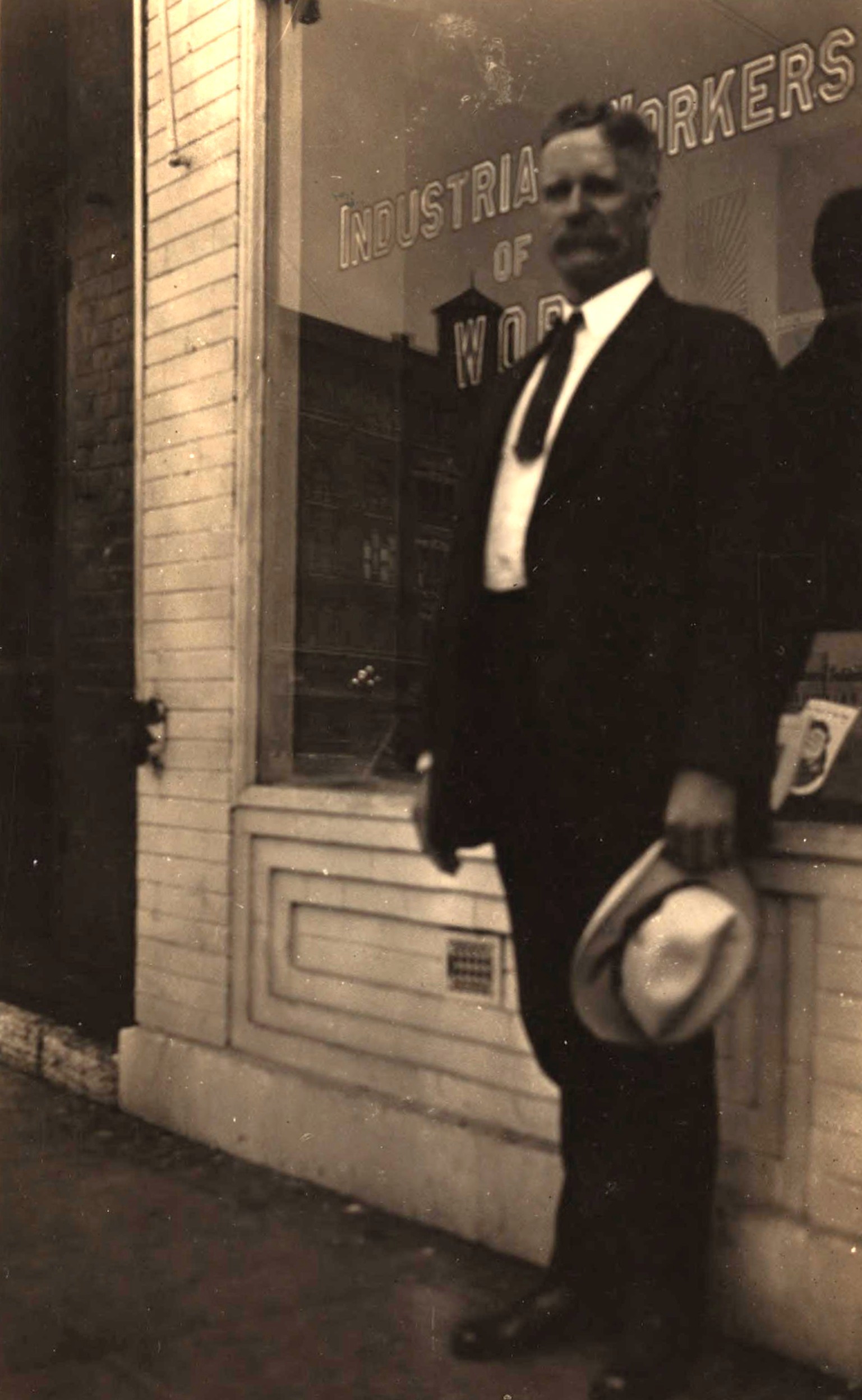
About 7 o clock, Monday morning. March 4th, I was awakened by a knock at the door of my room. I got up and went to the door thinking it was somebody with a telegram or message of some kind. Not being dressed I stood behind the door as I opened it a few inches and looked out. Immediately and without saying a word three large well-dressed men, looking like plain clothes policemen crowded into the room and attacked me. One of them seized me and tried to hold me while another one hit me on the head with a blackjack. I saw the blow from the blackjack coming and dodged just in time to keep it from landing on the top of my head. It landed on my forehead which is! the thickest part of the skull. The doctor who examined me afterwards told me that had that blow landed on top of my head it would have broken through the skull. Before could break away from the man who was holding me, I received another blow oh the head from the blackjack. Although dazed and hardly knowing what I was doing, I did not go down. Then followed a fight that was fast and furious while it lasted. My strength saved me.
In some way I succeeded in breaking away from them and getting out of the door and down the stairs. They shot at me about three times but missed. I made my way down the stairs into the street and around the corner into a harness shop, from where I was taken to the Needham Hotel and a doctor called.
Afterwards the police found wo valuable guns, two blackjacks and a five dollar Stetson hat, which the thugs left behind them when they made their get-away.
Fellow Worker Francis Miller got a chance to examine the hat and on the inside of it he found these inscriptions: “Spellman, New York–109-111 Parks Row–Size 7 ½–To duplicate mention 3205–Stetson 5425.”
One of the weapons, I understand was a “knuckle gun” designed to be fired between the fingers.
These two guns and the hat should still be in possession of the police at Lawrence. If indeed they have not been returned to the owners.
I have no idea who the three thugs were, but whoever they were, they seemed to have very little fear of being caught, as they selected a time when the pickets were out and the streets literally swarming with police and soldiers.
Now that the facts regarding the planting of dynamite are being brought out, some facts in connection with this case may also come out. It is quite likely that the same gang who hired men to plant dynamite also hired the thugs to make the murderous assault upon me.
I had no sooner escaped from the three would-be assassins than I found myself attacked on all sides, and from the most unexpected directions, by another kind of assassins. Character assassins. All kinds of dirty lies were circulated. It was a case of lie here, sneers and silence there. These things hurt me in every way more than the blackjacks of the thugs.
I escaped from the thugs, but it is hard to escape from the sneaking, cowardly, insinuating character assassins.
After the assault of Monday morning, I was compelled to remain in my room for a day with an ice bag on my head most of the time, then during the remainder of the week I spoke at meetings in different parts of Lawrence. Speaking at Franco-Belgian Hall, the Star Theatre, German Turn Hall, etc.
Saturday, March 9th, in answer to a telegram from Fellow Worker Ewald Koettgen, I went to Paterson, N.J., and spoke there in Turn Hall in the afternoon. That evening while I was in New York on my way back to Lawrence I received word that it would be necessary for me to fill a date for Haywood in the Monticello Theatre at Jersey City, the next day. After I finished speaking at this meeting in Jersey City I received a telegram from Lawrence, Mass., which read as follows:
“Fill Haywood date. New Haven, impossible for him to leave.
“(Signed) FRANCIS MILLER.”
I went to New Haven and addressed a tremendous crowd there that evening. The next day the strike in Lawrence being all over except the shouting, I returned to Paterson to continue the work among the silk workers.
This I think is answer enough to the lying. Insinuating snakes of 28 City Hall Place who have been saying to the workers. “Ask Thompson why, he left Lawrence?”
What Won the Lawrence Strike?
Some who do not know, or knowing are not willing to admit it, are asking what won the Lawrence strike.
There is just one answer to that question and that is SOLIDARITY. It would have been won more quickly had there been greater solidarity. All during the strike the members of the craft union of Stationary Firemen remained at work; members of the Electrical Workers’ Union furnished light and power to run the scab mills; while the Brotherhood men on the Boston and Maine railroad delivered car loads of raw material to the mills and stood ready to haul the scab cloth away. Although these craft unions scabbed on the slaves of the mills, a great number of other workers throughout the country rallied to their support in a manner that was simply grand. Money to help win the fight poured in from almost everywhere. Many organizations donated money, while others, having no money themselves, got busy and collected some and sent it in. Many of the organizations and clubs sending in the most money, did not really donate the money themselves, but did fine. work by sending committees to other organizations and getting them to donate.
The way the strikers rose above petty jealousies, craft pride and national prejudices and stood together as one, attracted the attention and commanded the admiration of the world.
The workers in surrounding cities seeing the great fight the strikers were making and noting that they were hampered by the large number of underfed children, reached out their hands and said to the brave fighters: “Give us your children, we will hold them and feed them while you fight on and win.”
That, Fellow Workers, is solidarity. And it is that kind of solidarity that will finally emancipate the working class.
Ah. But, says the politician: “That is not true, solidarity did not win the Lawrence strike. Look at me! I won it!”
Some say the Congressional investigation won the strike. It would be more nearly correct to say that solidarity won the Congressional investigation. The slimy politicians are the same the world over.
Whenever the workers unite on the economic field and put up a winning fight for any point, just when everybody sees that they are bound to win, and all is over, but the shouting, the politicians always get busy, and by some grandstand play try to get credit for the victory.
Some claim that the Socialist Party won the strike. If that is true why don’t they win some more strikes? Why, for instance, don’t they win the strike of the shopmen on the Harriman railroads? If the workers on the Harriman system were, all united into one great railway workers’ Industrial union and they would stop every train and refuse to handle a pound of freight, how long do you suppose it would, take them to win their point?
As it is, the shopmen on that system have been on strike for one year now and they are still out. The politicians tell them to just wait until election, then vote, then wait four years until election, then vote again, and so on.
Solidarity would win for them within 24 hours.
The Socialist Party did not win the Lawrence strike. Many members of the Socialist Party, as well as many members of other organizations, did fine work in helping to win it. But they did not help to win it by talking politics to the workers.
The strike was won by the red-blooded workers of the country, cutting out their isms for the time being and getting right down to business and supporting the fighters at Lawrence.
And so when workers in any great numbers concentrate their efforts upon winning a fight on the economic field they can get about anything they go after.
Many believe that the strikers all stood together and won because they had to win or die. But that is not the case. While it is true that many of them were really! fighting for their lives the fact remains that the better paid workers stuck just as well as the poorer paid.
They all fought together as one.
One member of the strike committee, who was at the same time, one of the most active on the picket lines every day was Mrs. Annie Welzenbach, a young woman known as the highest paid and most expert mender in the mills. The better paid workers of Lawrence insisted that the lowest paid workers receive the largest increase in wages.
Some have an idea that the strike was won because the strikers happened to be better stickers, a more game and determined lot than is generally found among the workers. The workers everywhere when they go into a fight, are generally good game fighters. Look at the long hard fights members of craft unions have put up. There are great numbers of workers who would crawl out of the country on their hands and knees before they would scab.
They are game and determined enough, but the great fault in the past has been that they have not made their fights together.
When workers unite and make common cause against the enemy as they did in Lawrence, solidarity becomes contagious. As they stand together and back up each other they develop feelings of solidarity for one another. Enthusiasm grows and spreads They learn to act together by acting together; they learn by doing. The power of solidarity is demonstrated. The world takes notice The strike becomes a school in solidarity It is a lesson to the workers everywhere. Every day that the strike lasts the idea of the One Big Union. spreads. The masters become frantic to end it. They see that they must end it. The strikers win. They won at Lawrence. Solidarity of Labor won the Lawrence strike and it will be solidarity that will end the last form of slavery on this earth. During the time I was in Lawrence it was a case of addressing one meeting of strikers after another. All the speakers worked until they were about ready to drop. Many of us speaking to as high as four or five meetings a day. Each day I would get a list of the meetings where I was billed to speak and start out. Other speakers would do the same. It would be a case for instance of Needham Hall at German Turn Hall at 3 and perhaps the Lithuanian Church at 4:30, Syrian Church at 7 and the Star Theatre at 8, and so on day after day. Besides speaking at meetings of strikers I also spoke at many meetings in surrounding towns. During the time the strike was on I addressed big meetings in Lynn, Brockton, Haverhill Worcester, Maynard, Milford, Reverly Lowell, Boston, Fall River, New Bedford, New York, Jersey City, Paterson and New Haven.
***
As soon as affairs in Lawrence were in such shape that I felt justified in doing so, I left there and proceeded to get busy Among the silk weavers in Northern New Jersey and New York City.
This was especially necessary because a bunch of fakirs, with main headquarters in New York, were operating among the slaves of the mills there and using the name of the I.W.W. to defraud them.
Role of the “Dan-ites”
A complete report of the operations of this gang and the manner in which they imposed upon the workers would require considerable space, and as a statement is to be printed regarding them I will simply touch upon some of the main points at this time.
At the Fourth convention of the I.W.W. in 1908 Daniel DeLeon, editor of the New York People, came here to represent a local which according to the constitution he had no business to be a member of.
By the way, I wish to state for the benefit of those who do not know, that at 28 City Hall Place, New York, there is operated a large job printing plant, in connection with which is published a scurrilous sheet called the New York People. This sheet is the official organ of a gang of slanderers and knockers calling themselves the Socialist Labor Party, and DeLeon is the editor.
The National Treasurer of the Socialist Labor Party is Frederick W. Ball, a mill owner in Paterson, N.J.
His seat in the convention was contested. The convention tried his case and refused to seat him. This hurt him very much, as he is very narrow and conceited; has an exaggerated ego, whatever that means. He was very much put out because some of the western delegates who voted against him wore overalls and had beat their way to the convention. He has been calling these rugged workers of the West “slum proletariat” and so on ever since.
Some of the songs sung by the fellow workers from the mines and camps also got on his delicate nerves.
When he was refused a seat in the convention he went East and called a conference of Socialist Labor Party members in Paterson, N.J. This conference, which was held in the fall of 1908, decided that what they needed was another organization on what they called “civilized plane.” So right there among themselves they formed an organization and decided to go out before the workers and claim they were the Industrial Workers of the World.
“Detroit I.W.W.”
Then with a political clause in their preamble to shield them from all harm, they rented a small box in a little town in Michigan and each day printed a notice in the New York People which read in part as follows:
“Send all communications, contributions or other matter intended for the general organization of the I.W.W. to so and so…” giving the address of their mail box.
As hardly any body ever read their lying sheet, the chances are that very few “contributions” or other matter intended for the General Organization of the I.W.W.” ever was sent to their mail box. Some time ago they changed the address of their mail box to Detroit, Mich. On that account they now call themselves “The Detroit I.W.W.”
This fake organization existed practically only on paper until last fall. That this is so can easily be learned by asking them to furnish you with a financial statement of receipts and expenses from 1908 to date.
The Lawrence strike advertised the I.W.W., so that especially among the textile workers everybody was eager to learn more about it and many anxious to join and help build it up.
This was a chance for the fake outfit and they proceeded to reap where we had sown.
While our organizers and speakers were all busy in Lawrence this so-called Detroit I.W.W. succeeded in doing some rank faking among the silk workers.
Worst Kind of Faking.
All the speakers of the Socialist Labor Party were called in from all over the country and sent into the textile towns of New Jersey. They went into Paterson, Passaic, West Hoboken and many other places and advertising “I.W.W. meetings” they got big crowds. They would say to the workers: “See what the I.W.W. is doing in Lawrence.”
If anyone got suspicious and asked them if there were two I.W.W.’s. they would say: “No; there are not two I.W.W.s; there is only one; we are the only I.W.W. there is.”
In this way they obtained members and money under false pretenses.
When cornered and confronted with proof that they were not the I.W.W. that was conducting the Lawrence strike; not the I.W.W. that published the Industrial Union papers, Solidarity and Industrial Worker, they would crawl and say: “Oh, that is the Chicago I.W.W. They are not the I.W.W. at all, they are the ‘I’m a-bummery.'”
The silk weavers were anxious to better their conditions, knowing that if the slaves in New England could unite and win those in New Jersey would do the same.
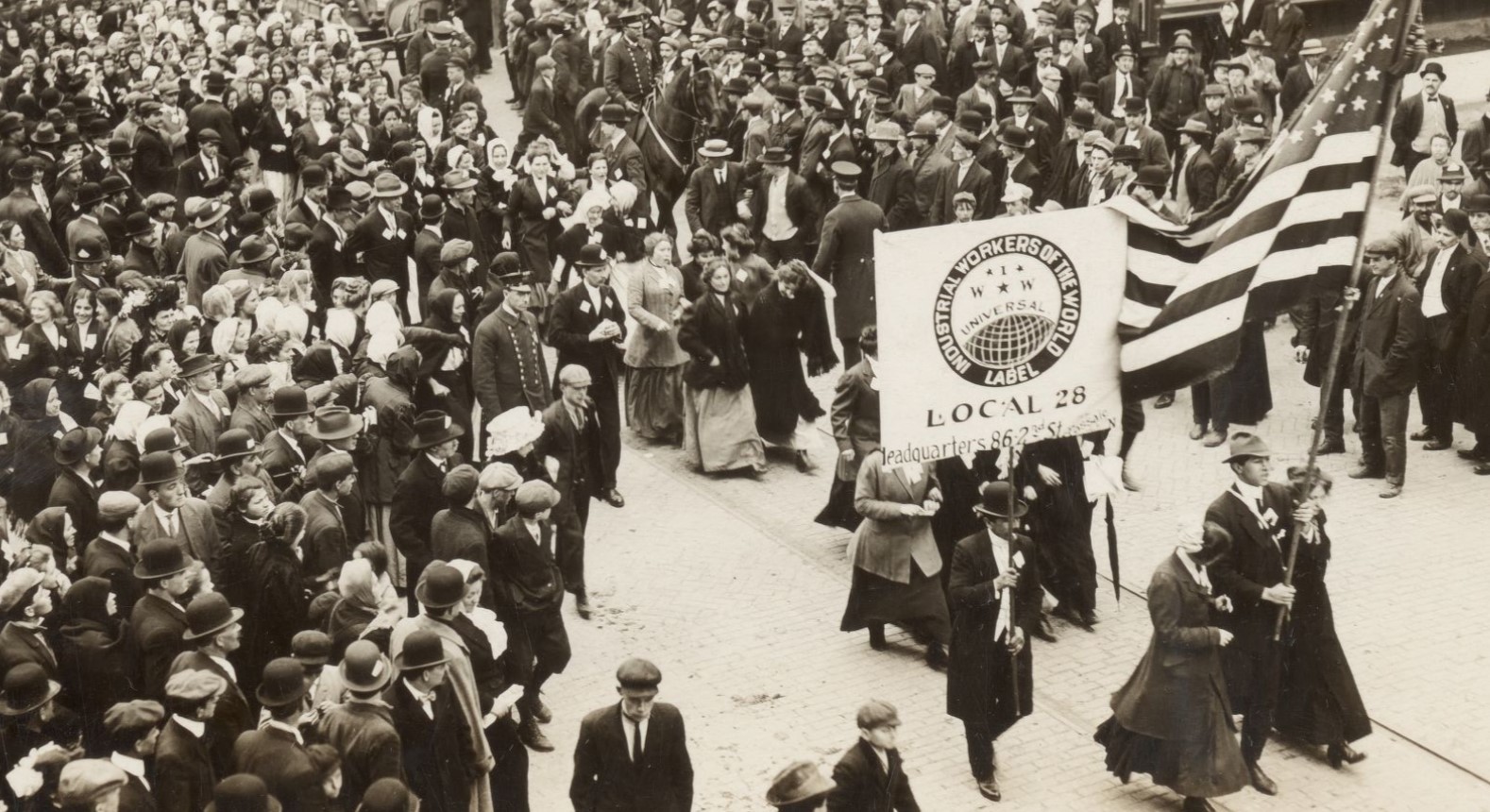
The fake S.L.P. outfit practically succeeded in running the energy of these workers into the ground. They pulled off a lot of craft strikes, mostly of broad silk weavers. They would appeal to one craft at a time and, if possible, get them out on strike, then organize them into what they called the Detroit, I.W.W., get money out of them for initiation fees and dues, then on account of having them fight one craft at a time they would get them whipped so badly they would discourage the other workers. Then they likely got some money out of the mill owners for their dirty work. If they didn’t they are scabbing on the fakirs in the A. F. of L.
In Passaic they got a big bunch out on strike. After they had been out a while some of the strikers discovered that they had been faked. Most of them joined thinking they were joining the I.W.W. that conducted the Lawrence strike. When they discovered they were not in the I.W.W. they revolted and withdrew from the fake outfit. I received a telegram from them asking me to come at once, which I did.
Fellow Worker Rossoni, Italian speaker; Rothfisher, Hungarian organizer; G.E.B. Member Koettgen and several other fellow workers went along with me.
We found a bad situation. A large body of mill workers, mostly weavers, out on strike, and the strikers divided into two camps. It was bad enough to practically have nothing but weavers out while all the other crafts were working, but to have even those who were out divided simply spelled defeat. Unless indeed we could get the two fractions to co-operate and get other workers out to support them.
We went ahead and made the best of it. We held several meetings, got out part of the strikers organized, with their strike committee, pickets out, and so on. We succeeded in instilling a new spirit into the strikers.
We were in a fair way to do things even in spite of the terrific handicap.
The masters and everybody else saw plainly that if we captured the strike it was likely to mean victory for the strikers. We had Fellow Worker Haywood over there at one meeting. Enthusiasm was spreading among the strikers. It was liable to spread to the slaves in the mills. Passaic was threatened with a general strike of mill workers Thus instead of the craft strike of the S.L.P., which was being used to run the energy of the slaves into the ground, the mill owners suddenly found themselves confronted with the possibilities of a real strike conducted by the I.W.W.
The S.L.P. gang knew that as soon as the workers got wise to them it would be “all off” and their chances for further grafting in the name of the I.W.W. in that locality at least would go glimmering.
They were anxious, of course, to impose upon the slaves of the mills as long as possible, especially so on account of the fact that this is the busy year of the politicians, and they needed money for the campaign fund of the S.L.P
The S.L.P. outfit knew that if we stayed there it would not be long before the workers would get wise to the fact that we represented the real I.W.W. and that the Detroit I.W.W. was a fake.
The mill owners knew well enough which was the I.W.W. and plainly showed it by the fact that, as anyone could see, they feared us and were not at all afraid of the bunch from the S.L.P.
The mill owners feared us because we threatened their economic interest and the S.L.P. outfit feared us because we also threatened their economic interest.
Since the interest of the mill owners and that of the S.L.P. bunch was identical in regard to keeping us out these robbers and fakirs proceeded to cooperate to do it.
Reinstein Adopts “Civilized” Methods
Boris Reinstein, a drug store keeper from Buffalo, N.Y., was the leader of the Detroit I.W.W. in Passaic. He and his gang of stool-pigeons went to the police and to the press with all kinds of stories. They gave the mill owners to understand that while the so-called Detroit I.W.W. was perfectly harmless there would be hell popping in Passaic if the real I.W.W. got a foothold there.
They told the police that we advocated destruction of life and property. This gave the police the excuse they wanted, and they took steps to prevent us from holding meeting there. Policemen went around and instructed hall keepers not to rent any halls for strike meetings without permission from Reinstein.
One morning when we went to our hall in Garfield, across the river from Passaic, to hold a meeting, we found the hall closed and the following proclamation tacked on the door:
PROCLAMATION!
State of New Jersey, Bergen County. By virtue of an act of this state, entitled “An Act to prevent routs, riots and tumultuous assemblies,” I am directed to charge and command all persons, being here assembled, immediately to disperse themselves and peaceably to depart to their habitations or to their lawful business, contained in the said act. God save the State. ROBERT CONKLIN, Sheriff of Bergen County. Dated April 4, 1912.
When those who came to attend our meeting found the hall closed they all went across the river to Passaic and went into the hall where the Detroit I.W.W. was holding a meeting. When I arrived I went over there also. They were meeting in a large hall with a balcony, and on account of the two groups of strikers all being in the same hall it was packed to the limit.
When I arrived there Reinstein was speaking. As I entered the hall the crowd sprang to its feet and yelled for me to speak. The house was in an uproar. I walked down the center isle and climbed upon the stage, and Fellow Workers Koettgen, Rossoni and Rothfisher followed me.
Of course Reinstein did not want to allow us to speak, but the crowd insisted and he was compelled to give way.
I.W.W. Urges Solidarity.
We explained to the strikers that now that they were all together they should resolve to remain together and fight together until the strike was over.
We said to them: “You are confused now. You don’t know which is the real I.W.W. You don’t know which to join, but you do know that you work bard in the mills and that you want to win this strike. You know that if the strike is lost it will be you who will suffer.”
We explained to them the power of solidarity and that they should allow nothing to divide them while they were in a fight with the masters.
We said to them: “Join one union or another, or no union at all, as you see fit, but whatever you do all stand together. Just as you work together in the mills so must you stand together and fight together in this strike. It is the only way to win.”
The strikers were enthusiastic over the position we took. We suggested that the two strike committees get together and came to some arrangement regarding demands, then all make common cause against the enemy.
In accordance with our plan a joint meeting of the two strike committees was arranged for that afternoon and a joint mass meeting of all the strikers, to hear the report of the joint strike committee, was called for 9 o’clock the next morning. While the strikers were enthusiastic over the turn things had taken there was consternation in the camp of the “Detroit I.W.W.” and the mill owners.
They got busy, and the next morning when Fellow Worker Koettgen and I arrived at the hall we found it surrounded by policemen, with instructions not to allow us to enter.
The hall was full of strikers. They wanted us in there, but the organizers of the “Detroit I.W.W.” and the police working together barred us out.
Many strikers were outside of the hall and refused to go in unless we did. Many of those inside came out when they learned what was going on. We advised them that in spite of the fact that we were not allowed in the meeting they should all go in and stand together, as it was their only chance of winning.
Some went in, but came out again. They were discouraged. A group of Italian girls, many of them with bandages on their beads, where the thugs of the mill owners had clubbed them, came to us and with tears in their eyes said: “We work bard in the mills and the bosses abuse us. We want to win this strike. We want you in the meeting. You can not come in. Now we are discouraged. We know that you are right, and that we should all go in the meeting and stick together anyway, but we can’t do it. We no like Reinstein. He is no good. He is a stool pigeon.”
Every time I see an S.L.P. man now I think of that group of girls, discouraged and crying outside of that hall in Passaic. They are in the mills now being murdered on the installment plan. Conditions in Passaic are worse and wages are even lower than they were in Lawrence. The slaves of the mills in Passaic know now which is the I.W.W.
Fellow Worker Rossoni is holding meetings there among the Italians and over 500 of them joined the I.W.W. there in the last month.
The mill owners of New Jersey and elsewhere are using the same tactics to grind down the silk workers as were so successfully used by the masters in the woolen and cotton industry.
Slowly but surely the four loom system is being introduced in the broad silk and the two loom system in the ribbon mills. The silk workers realize something must be done, and lone quick. Sentiment for the One Big Union is growing fast. The S.L.P. gang did a whole lot of harm by starting a fake I. W. W. helped the mill owners very much. During the winter, as the Lawrence strike developed, the attention of the silk workers was attracted to the I.W.W., but when they found two organizations each claiming to be the I.W.W. they did not know which to join, and so many of them didn’t join any.
The S.L.P. gang distributed thousands of copies of the New York “Daily People” in all the mill towns of Northern New Jersey. By means of this slimy sheet and at their mass meetings and so on they circulated all kinds of lies about the I.W.W. Nothing was too sneaking and cowardly for them to say.
All we could do was to explain the situation to the workers, knowing that it was only a matter of time when they would find out who was lying and who was not. They are learning fast. Today the “Detroit I.W.W.” in that section is about dead, while the same gang of fakirs who stole the name of the I.W.W. are now there trying to get the workers to vote for them as candidates of the S.L.P. Sentiment for the eight-hour day is very strong among the silk workers.
Local 152 in Paterson and the Local in Passaic are now growing fast, while other locals of the I.W.W. are being formed in West Hoboken and other mill towns in New Jersey. Taken all in all, the prospects for the One Big Union and the eight-hour day are very bright among the silk workers.
During the time I was working among the silk workers, we often had two or three meetings in one day. Sometimes, for instance, I would speak at a shop meeting in Paterson at 4 o’clock, another one at 6 and then at a meeting in New York or somewhere else at 8 o’clock.
Agitation in Other Places.
In New York I was invited to address an independent organization of piano and organ workers. I spoke before them a couple of times. On April 15 they joined the I.W.W. They have about 500 of a membership.
This is the Local represented here by A.F. Lundgren. They have five votes in this convention.
There are about 9,000 piano and organ workers in New York City and, considering the start we already have, I feel sure that if systematic organizing work is caried on among them a powerful organization can be built up there.
In the latter part of April in answer to telegram from Fellow Worker Fletcher, I went to Philadelphia. A joint meeting of two independent unions of carpet weavers had been arranged and I was sent for to address them.
These two unions, with a total membership of 1,800, joined the I.W.W. This gave us a good foothold among the textile workers in Philadelphia. They now have shop control in 11 different shops in that city.
Philadelphia is a good field for organizing work.
Fellow Worker St. John having written to me that be would route me West, I remained in Philadelphia all during the month of May.
I spoke before the different organizations of the I.W.W., held open-air meetings, and so on, expecting each day to receive word from St. John to start West.
Not having seen my wife and family for a year, I was naturally anxious to get back to Seattle and, besides, I felt sure I could hold some big Ettor and Giovannitti meetings in the Northwest.
On June 11 I received a letter from Fellow Worker St. John saying that the General Office could not very well stand the expense of sending me West.
On receipt of this letter, I started for Chicago, holding meetings in Pittsburg, New Castle, Youngstown, Cleveland, Elyria and Detroit on the way. I arrived in Chicago July 1.
After spending a few days here, sort of getting a line on things and preparing for a trip South in answer to an urgent request from the B.T.W., I left for Alexandria, La.
On my arrival there, I consulted with Fellow Worker Jay Smith, secretary of the B.T.W. In the meantime the murder of our fellow workers at Grabow, La., had taken place. Fellow Worker A.L. Emerson, after the desperate attempt to kill him, had been thrown into jail by bis would-be murderers, and dozens of fellow workers were in there with him.
I went to Lake Charles, where our fellow workers were imprisoned, and, after getting a line on the situation there, I returned to Alexandria, where I attended a meeting of the executive board of the B.T.W. Then in accordance with plans adopted at this meeting, I returned to Chicago.

I arrived back in Chicago July 15, and then, after being on the sick list for a few weeks, I held several meetings there, then went to Minneapolis and did agitation work there and in St. Paul until it was time to return here for the convention.
Importance of Propaganda.
Now, fellow workers, I believe events of the past year emphasize more than anything else the importance of propaganda. Workers can not carry out ideas they do not have. We can not reap until we have sown. It is our business to propagate such Ideas, which, if carried out, would make toward the emancipation of our class.
In order to systematize the propaganda and make it more uniform throughout, I believe circuits should be formed wherever possible and one speaker after another routed over them. Unity of thought and action can come only as a result of an education which gives the same conception of things to all.
Locals should employ local organizers just as soon as they are able. The idea that they can not afford to should be discouraged. The fact is they can not afford not to.
Locals should insist and see to it that their speakers talk industrial unionism. To bawl out the cops and the mayor and the governor does not impress the idea of the one big union upon the brains of the workers.
The importance of shortening the working day and the working week should be emphasized by our speakers and writers at every opportunity.
I believe one good way to propagate ideas is by means of stickers, each sticker designed to emphasize certain ideas. Why we have unemployed, for instance; the effect of shortening the working day and how to shorten it, and so on, could be drilled into the workers by me ns of stickers.
Locals should elect press committees and see to it that they function. A press committee in each locality could, if they would attend to it, assist our papers very much. They should send in brief items of interest as they occur, especially those from which lessons can be drawn. They could also arrange special meetings on the street, for instance, every week or so for the definite purpose of getting subs, and taking up a collection for our papers.
I would like to call the attention of the convention to the fact that in the past it has been the custom for the General Organizer to simply function as a national organizer, and as the constitution now stands that is about all that he can do.
He might have many good ideas regarding how his office should be conducted and the organizing work carried on, but if he is not in a position to carry out his ideas bis ability, or lack of ability, can not be demonstrated.
If he is to function simply as a figurehead, we may as well abolish the office and be done with it.
It would perhaps be a good idea to so change the constitution that Article III, Section 8, could and would be enforced.
In conclusion, Fellow Workers, I would like to impress upon the delegates the importance of giving a true and impartial report of the convention to their locals when they return. You should report not only what was done, but why it was done.
We have a grand organization. Its principles are worthy of the best efforts of any worker in the world.
We should always aim to keep our propaganda on a high plane and thus keep the I.W.W. an organization to which every red-blooded rebel will be proud to belong.
Yours for Industrial Freedom,
JAMES P. THOMPSON, General Organizer.
The most widely read of I.W.W. newspapers, Solidarity was published by the Industrial Workers of the World from 1909 until 1917. First produced in New Castle, Pennsylvania, and born during the McKees Rocks strike, Solidarity later moved to Cleveland, Ohio until 1917 then spent its last months in Chicago. With a circulation of around 12,000 and a readership many times that, Solidarity was instrumental in defining the Wobbly world-view at the height of their influence in the working class. It was edited over its life by A.M. Stirton, H.A. Goff, Ben H. Williams, Ralph Chaplin who also provided much of the paper’s color, and others. Like nearly all the left press it fell victim to federal repression in 1917.
PDF of full issue: https://www.marxists.org/history/usa/pubs/solidarity-iww/1912/v03n43-w147-oct-19-1912-Solidarity.pdf
PDF of full issue: https://www.marxists.org/history/usa/pubs/solidarity-iww/1912/v03n44-w148-oct-26-1912-Solidarity.pdf

