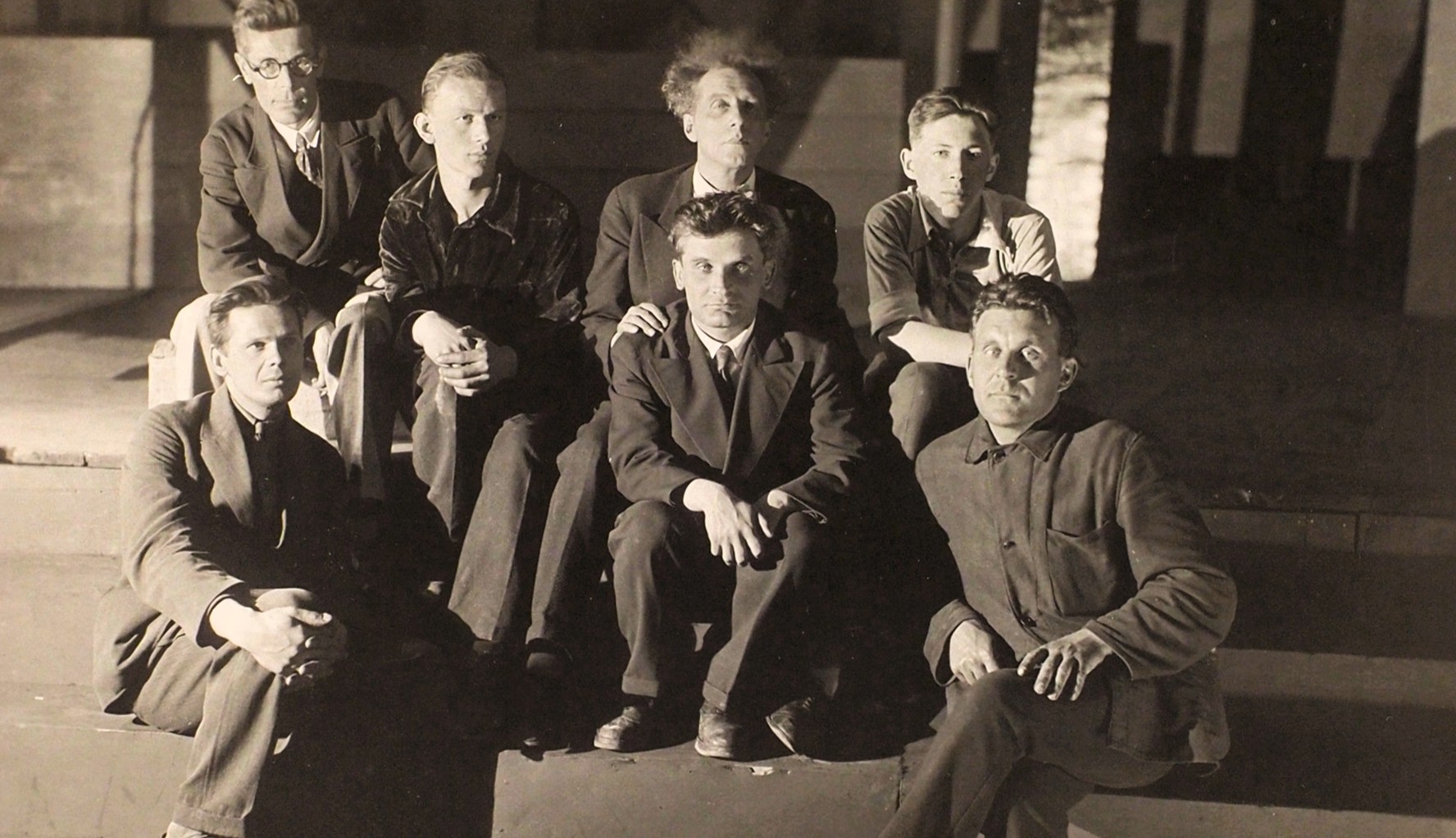
Among the great artists of the 20th century, Vsevolod Meyerhold was, before and after 1917, the central figure in the crowded room of Russian stage and an international pioneer of many elements of modern theater. With Meyerhold seeking to break down barriers between audience and performance, world grew even bigger as the revolution expanded artistic possibilities, with vast segments of the Soviet people brought into the arts for the first time. In the vanguard of sets and effects, theater conception and construction, subject matter creators, graphic arts and costumes, music and lights, Meyerhold theater touched many talents and was an essential influence on a whole generation of post-October artists across all mediums. One of those was the writer Yuri Olesha, a key figure in Odessa’s Poets Group who would later collaborate with Meyerhold producing his plays on the Moscow stage. Here Olesha writes a wonderful celebration of his friend and fellow artist. Though world-renown and celebrated the Meyerhold Theatre and Meyerhold himself would be victims of the Purges and the mid-1930s Stalinism that sanctioned only Socialist Realism, damning all other schools in the Socialist camp as deviations. The theater a staple of revolutionary culture in Moscow since 1920, was closed by order of the Politburo in January, 1938 and in 1939 Vsevolod Meyerhold, an artist of singular talent and importance, was arrested and charged as a ‘British and Japanese spy’ to be shot on February 2, 1940. Well-known himself (a number of his stories went onto to become films), Olesha also could not conform to the new artistic constraints, though he survived Meyerhold and so many other’s fates, by fully withdrawing from active life, it seems into poverty and alcohol. He died in 1960. His writings, unpublished since 1936, were republished and celebrated after 1956, again with work turned into Soviet films in the 1960s and 70s.
‘Meyerhold: Soviet Director–On His Sixtieth Birthday’ by Yuri Olesha from International Literature. No. 2. 1934.
It was in Odessa. I was a student in the gymnasium. I sat in the moving picture show “Urania” and looked at a film entitled A Portrait of Dorian Grey. The motion picture was then called “Illusion.” The word “film” did not exist. The picture was shown in a small premise. They had selected for some reason or other an oblong hall, It is strange that the first appearance of a new art, an industrial art, connected with the technique of a new century, was surrounded by a style which had nothing in common with the new century. I remember the clay decorations, the staleness. Ventriloquists came forth with dolls in the intermissions between shows. The dolls were frightfully painted, impersonating French sergeants and chambermaids. They sang couplets. This was all very old fashioned and related somehow to ancient Paris, the Paris from which Maupassant ran after being frightened by the Eiffel Tower.
Meyerhold played a part in the film. He was thin, bent, smoked a cigar. There was a monocle over one of his eyes, from which a tape hung over his face. He was in a dress suit with orchids.
This was my first meeting with Meyerhold.
The second meeting took place in Moscow. I stood on the corner of Tverskaya and Chernishevski Alley, at the building of the Moscow Soviet. It was a day of celebration of the anniversary of the October Revolution, Demonstrators passed by. Among them, at the head of a group of actors was Meyerhold, dressed in a short fur-coat, in boots, a grey, lamb-skin cap cocked over his eyes.
“Meyerhold,” I thought. The Death of Tarelkin. An innovator, No curtains, Honorary member of the Red Army. How proudly he holds Moscow. I am in Moscow. October Revolution. This is October. The poet Meyerhold. The red banners of the demonstrators, workers. Workers and actors. Moscow. Meyerhold passes by. What a nose he has. A strange nose. A big round bone of a nose. The big-nosiness of heroism. It often figures in stories, in fiction.
At the third meeting, I made his acquaintance, After the opening night of The Conspiracy of Feeling at the Vakhtangov Theatre, Meyerhold gave his opinion of the play to the actors, to the stage manager and to me, the author. This was customary at the Vakhtangoy. After a new play, they invited Meyerhold to a discussion and he gave them his opinion.
Some time later, Meyerhold staged my play. I am proud of the fact that my ideas found a response in this talented artist. When he began to work over the play, I understood above all that he is a poet. During the rehearsals, he suddenly whispered in my ear, “This is Cinderella.” That is to say, he saw in my conception that which had escaped me, which I had wanted into the plot but could not. I think that the play The Roll-Call of Blessing did not turn out well for me. I created a very difficult role for the star actress. Zinieda Reich played the role with distinction, but it seems to me, that if I had understood earlier that the plot on which I built the play was the plot of Cinderella, then perhaps the play would have been better.
Phrases are bandied about that Meyerhold disregards the playwright. I think that Meyerhold belongs in the front ranks of those who judge the good and the bad in art and that the author, even the most arrogant can believe in him, I doubted, I felt like protesting more than once, but there never was a case that I finally did not say to myself, “No, he is right and I, most likely am mistaken.”
I remember how Mayakovsky felt towards Meyerhold.
“Are you not tired of this, Meyerhold?” he asked the master. (Guests asked Mayakovsky to read his poetry.) Several times he interrupted the reading, “Are you not bored, Meyerhold?”
A conversation took place about Edgar Allan Poe. Someone said that the American playwright Sophie Treadwell (Machinal) had a play about Poe. I asked what the play was called. The tithe was not liked. (I do not remember it). They began to think up a tithe for a play about Edgar Allan Poe. Meyerhold said:
“Simply, Edgar.”
He said this with unusual tenderness.
“Edgar.”
And I agreed with him in spirit at once, that a play about the sorrowful life of the poet should only be called by a simple name, which appeared very tender and helpless. Some kind of business appointment was made for this poet, the result of which might promise security for him. He set out for the appointment, but along the way he saw a girl jumping rope. He also began to jump rope. It happened that he tore off a heel. He could not appear at the important appointment with a heel torn loose and in this manner good fortune slipped away from him.
Meyerhold related this incident to us.
He spoke with the same kind of tenderness about Lermontov.
The Man in Action
He takes off his jacket during rehearsals. He wears a striped sweater, His hairs stand on end. There is powder on his shaven cheeks. He goes out to the end of the hall. He looks from there. If the work of the actors pleases him, he shouts:
“Very well!”
From the darkness, he quickly goes to the footlights. He rushes onto the stage. He goes over the stage, bent slightly.
Then he “demonstrates.”
It seems to me that this is a peculiar theatre, this Meyerhold exhibition. It is a theatre which captivates, which is fantastic. And if the rehearsals of Meyerhold were accessible to spectators, the spectators would see the most astonishing actor of our times.
Igor Ilinsky once said to me:
“Sometimes, I do not agree with the suggestion of Vsevolod Emilevich. It seems to me that it would be better not to do it as he says. I try the opposite. And I usually find I’m wrong.”
Ilinsky said this!
The director appears in the theatre in the evening. A play goes on. The director leans against a door. A sheen of light, radiating from the stage scarcely touches him. With crossed arms, his profile to the public, he stands elegantly, manfully.
If a friend sits in the hall nearby, then Meyerhold, breaking his attention, turns his face to his friend and winks at him. This means, “Well, and what do you say? Very well?”
The Sixty Year Old Youth
I was at the rehearsal at the Art Theatre. During the rehearsal, Stanislavsky entered the box, He did not want to cause the least disturbance by his appearance. A man of huge size, he began slowly, with great pains to sit in a manner: that would make him appear shorter. He sat down very slowly, with extreme care, fearing he might make the seat creak, and although the seat did not creak, the expression of concern did not leave his face until he had sat down. He sat down as easily and noiselessly as a butterfly.
After this he watched the actors.
All the feelings which the actors exhibited were reflected in his face. He grimaced like a child. One would have thought that this great innovator of the stage had come to the theatre for the first time.
Youth is an indispensable quality of a genuine artist. Meyerhold is full of it. Teacher and pupil alike. He is above all, simple.
Meyerhold is a connoisseur of music, painting and architecture. He loves music passionately, Among the young composers he has encouraged are: Shostakovich, Shebalin, Gabriel Popov.
Meyerhold loves youth. When he entered the ranks of the revolutionaries, he joined with youth forever. He is on intimate terms with young people, Aviators, sailors of the Red fleet enthuse him.
If a new Art arose after the October Revolution, an Art which at present enthuses the world of Soviets, then it can be said, that the first years of this Art were called, “Meyerhold.”
He invented all that with which others are so familiar now. The whole style of contemporary Soviet performances proceeds from him.
He continues to invent, furiously and untiringly. It seems absurd to think, that this man, who wrangles with attendants because of their smoking during rehearsals; this youthful, happy spirit so inspired by Communist Youth; this artist who can speak all night long about Art and in the morning go to a rehearsal as if nothing had happened; that he is sixty years old.
The youth of this sixty year old man is one of the wonders of the Revolution. He dreams about a new theatre. On the day of his sixtieth birthday, we expressed the wish that the theatre about which he dreams would be quickly built. We wished for the new theatre on Triumphal Square, with the new stage invented by Meyerhold. A remarkable man will confirm the fame of Soviet Art.
Literature of the World Revolution/International Literature was the journal of the International Union of Revolutionary Writers, founded in 1927, that began publishing in the aftermath of 1931’s international conference of revolutionary writers held in Kharkov, Ukraine. Produced in Moscow in Russian, German, English, and French, the name changed to International Literature in 1932. In 1935 and the Popular Front, the Writers for the Defense of Culture became the sponsoring organization. It published until 1945 and hosted the most important Communist writers and critics of the time.
PDF of full issue: https://www.marxists.org/subject/art/literature/international-literature/1934-n02-IL.pdf

