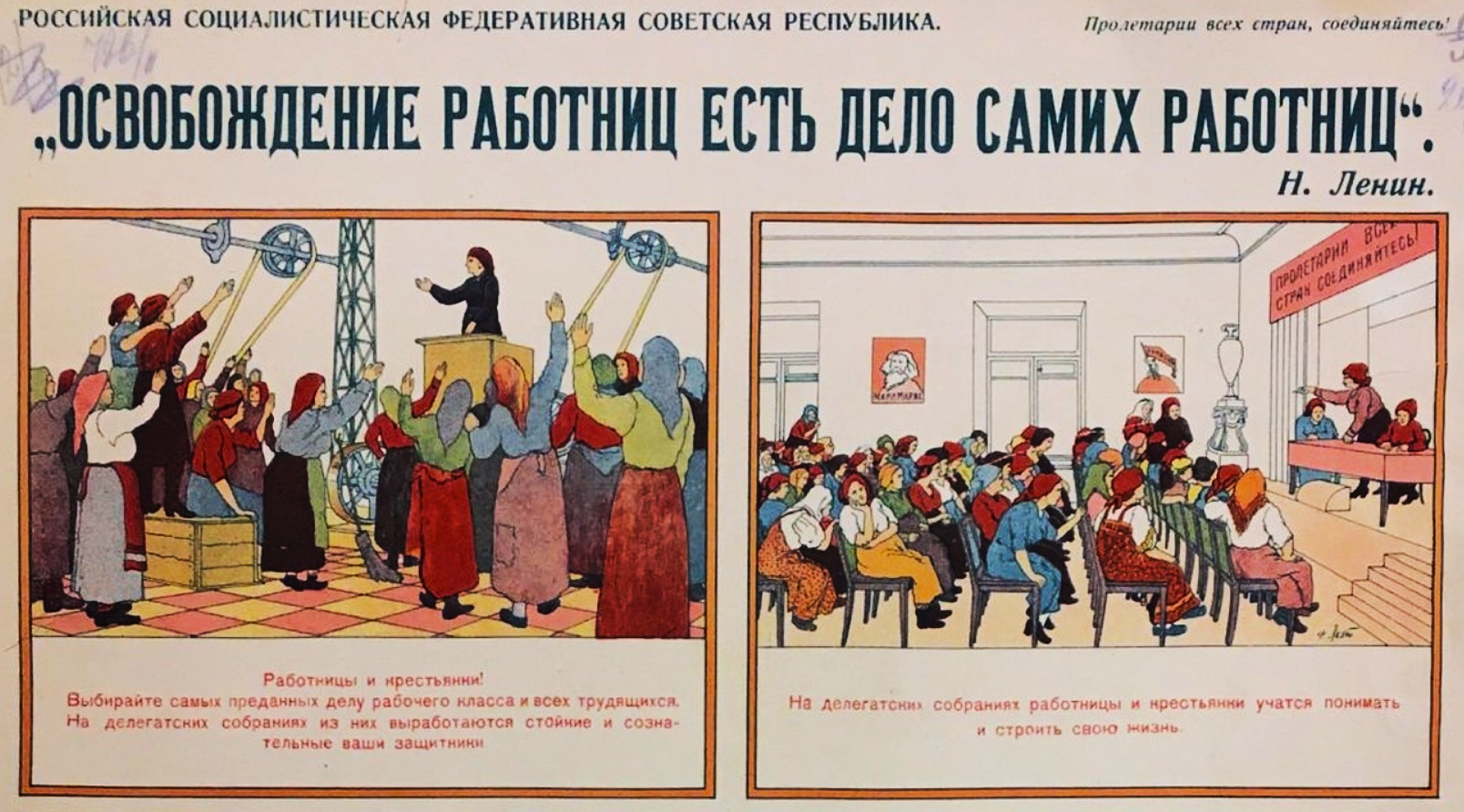
Choose the most dedicated to the cause of the working class and all working people. At delegate meetings, they will develop persistent and conscious defenders–At delegate meetings, a worker and a peasant woman learns to understand how to build their own lives.
The campaign to introduce masses of women, largely unorganized and until recently divorced from public life, and in Russia mostly peasants, to Communism, the work of the Soviets and of their participation in the management of society, was based primarily on ‘Delegate Meetings’ of mainly non-party women elected from a certain location. A true success in the Soviet Union, with millions of women participating, many in civic life for the first time. Though attempted, its process, let alone its outcomes, were not able to be reproduced by Communist Parties outside of the U.S.S.R. and not in state power. A summary of the meetings held in the Soviet Union.
‘The Women’s Delegate Meetings in the U.S.S.R.’ by S. Bojarskaja from International Press Correspondence. Vol. 6 No. 44. May 27, 1926.
The October revolution which has liberated the female workers and peasant women from centuries of bondage and despotism has also opened for them the way to social work, and has given them full rights as co-operators and supporters of the Soviet Republic. In order to gain the bulk of working women for active, soviet reconstructive work, the women’s sections, called into being by the Communist Party, have adopted the system of Women Worker’s Delegate Meetings. The chief idea of these meetings is, to win the working women for Communism by means of active propaganda, by practical realization of communist aims, and by securing their co-operation in all the branches of the Soviet Union’s political and economic life.
The first Women Worker Delegates Meetings were very different in character from the present ones; they were nothing but meetings of the most advanced and most active female workers. The Party was anxious to win those workers for the Delegate meetings who, within their own sphere of work, were especially noticeable for their great activity and for their taking a prominent part in meetings and conferences. In other words, the Communist Party, with the help of their Women’s Sections, selected the most active, most combative and most ingenious elements for the Delegate meetings out of the bulk of women workers. The deep faith in the healthy, revolutionary class instinct of working women runs like a thread through the whole work of the Delegate meetings. These meetings gradually extended their influence over an ever-increasing number of backward female workers, and became communist schools for the masses, schools, where working women were practically trained for public political work. All the reports made in the Delegate meetings on our political situation, on our inner and outer political condition led to resolutions about measures which should Support and strengthen the proletarian revolution. At the same time hundreds and thousands of Women Worker Delegates were employed as probationers in all the Government institutions, in order to co-operate, and to study and control the work done there. Under the guidance of instructors the workers were initiated in all the fields of the soviet, the trade-unionist and co-operative reconstruction to which they will have to devote themselves. In 1921 about 25,000 workers were engaged on such work. Already in 1920 150 women from Moscow and over 700 women from Leningrad were selected from these probationers and entrusted with leading positions. They organised the “Saturday and Sunday Work” which was supervised by women workers from Government institutions. The following figures may give an idea of the number of workers attending this “Saturday and Sunday Work”: in 1918-1921 over 30,000 women took part in Ivanov Vosnesensk, and over 90,000 in Samara. In 1919-1921 these probationers were paid a fixed salary from the institutions for which they worked. With the extension of the new system of political economy, however, the number of probationers had to be largely reduced, as their maintenance was too heavy a burden on the recovering economic life. Although the Delegates are as hitherto partaking in the work of the Soviets and their sections, they are not taken away from their own activities. They continue their productive work and, at the same time, are members of the Factory Council Commissions as well as members of the Soviet sections and those Trade Union and co-operative sections which are linked up with the Delegate meetings.
The greater number of Delegates assist in the work of the town Soviets. In the public educational sections they carry out the inspection of schools and educational institutes, provide funds, and supervise the classes, in order that the brains of the children may not be stuffed with middle class ideals, with prejudices and superstitions, but that the teaching may answer the exigencies of the modern spirit. A specially important point is the linking up of Women Delegates with school councils or school subsidizing committees. Through close contact with school life and school activity they help the schools in many ways, they often suggest improvements and increase their own knowledge. Moreover, they supervise the work of the pioneer sections and take part in the campaign for the care of homeless children.
The Women Delegates who are working in the health section visit hospitals and ambulances, notify abuses and defects, suggest necessary improvements and support the administration in the carrying out of the same. In the children’s and mothers’ welfare sections the women workers help in the foundation and the running of children’s inspection health centres, crèches, mothers’ and infants homes, they assist the Social Welfare Commissions and take part in the inspection of worker’s homes. The Delegates who join the work in ambulances frequently organise cells for tuberculous persons in the working plants. The Delegates of the sanitary section, together with the members of sanitary commissions, visit factories and workshops, draw their attention to facts which might imperil the health of the workers and make proposals with regard to rectifying mistakes.
In the communal section the Delegates inspect worker’s homes. They state whether those are noxious to health, whether improvements could be obtained by public measures, whether it would be possible to lay on water, to introduce electric light, to improve the heating etc.
Together with the section for public education the Delegates take part in sanitary-hygienic inspections of schools, children’s homes, creches etc. with regard to appropriate rooms, sufficient light and air.
The election of the Delegates is preceded by an extensive election campaign in which Party and Trade Union Organisations, as well as a large number of men and women take part. Responsible Party comrades are in most cases put in charge of the carrying out of this campaign, as this work is not only a matter of the women’s section but of the whole party. The elections demand an intense preparatory work, well in the women workers meetings of the individual sections and workshops, as in the meetings of the hitherto appointed Delegates, in meetings of workmen’s wives, and in co-operative tenement houses. In certain houses the candidateship of the newly to be elected Delegates is put up and discussed.
The list of candidates is placarded in workshops, clubs etc. in order to bring them to the knowledge of the bulk of workers. In the general meetings of women workers, where the elections of Delegates take place, every candidate is an object of lively discussion on the part of the workers. The elected Delegates regularly report to their electors on their activity, provide them with information and answer their questions.
According to the law in force in the towns one Delegate is elected for every 10 workers. In working places where 300 or more women workers are employed, the Delegate meetings are held right there.
These Delegate meetings are attended by the women workers, the female staff and the wives of the workmen who work in this plant. The Delegate meetings for workers in smaller industrial enterprises, for female employees. workmen’s wives, women servants and other dispersed elements of the female working class are assigned to the sub-district or administrative district centres.
The Delegates of the women workers and women personal are engaged in the social work of their plants or institutions, for instance in factory council commissions, in conferences on production, in co-operative Societies, creches, communal kitchens etc., while the Delegates of housewives, home workers etc. are employed for the work in the sub district administration and the Corresponding co-operative Societies, children’s homes, creches, etc.
Part of the Delegates are doing practical work in the Workers’ International Relief, the “Society of Children’s Friends” and in the Chief Associations (protectors of the village).
The Agenda of the Delegate meetings consists mostly of a question of a more general nature taken from the programme which the C.C. has drawn up for the C.P., and of practical questions of local life.
Also among the peasant women the Delegate meetings represent the acknowledged form of public work. The peasant women Delegate meetings are organised in all such places where a satisfactory party administration is ensured. The representation rules for the rural Delegate meetings are fixed by the district and working area administrators. In most of the provinces it is stipulated that each Delegate represents 10-15 peasant women of the village where the elections take place, while the Delegates of remoter villages represent 20-25 peasant women.
The elections of the Delegates usually take place at special peasant women’s meetings, and only seldom at general peasant meetings. This is only the case in such places where there exist strong party groups and where the Delegate meeting enjoys great esteem.
The elections of Delegates in rural districts start as a rule after the termination of agricultural work, and they come to an end in October-November, when the Delegate meetings begin to function systematically. In the course of Spring and Summer conferences are held about vital questions, and excursions are arranged for visits to cooperative farms, communities, model farms, neighboring towns, industrial plants, etc.
The peasant Delegates are doing a great deal of practical work in the sections and commissions of the village soviets, especially with regard to the organising of creches, children’s play grounds, women’s corners in the village libraries, and thus improve the cultural standard in the village. They are invited to peasant meetings, to congresses and conferences, and share party work, Soviet work and public work.
The number of peasant Delegates has considerably increased. In 1923-24 it amounted to 12511, in 1924-25 to 246,702, In Autumn 1923 4,012,438 peasant women took part in the elections. in Autumn 1924 their number had increased to 7,830,508. During the past year 74,617 peasant women partook in the practical public work.
The composition of the Delegate meetings has changed. Up to a recent period they consisted of the poorest peasant women, soldiers’ widows etc. but at present a larger percentage of better situated peasant women, married women who have more credit in the eyes of the population are assigned for these meetings.
In the East the Women’s Delegate Meetings are, besides other types of work, the acknowledged form of work among working women. In the Delegate meetings of larger industrial cities such as Baku, Tiflis, Taschkent, Simferopol, a well-planned-out systematic work which follows the programme drawn up by the C.C. is carried out. These meetings are divided into language groups but once a month general meetings are held. During the last few years native women are more and more called to the Delegate meetings, so that their number represents half of the 59,074 Delegates elected in 1924-25.
The Delegate meetings of the East have the following sections: Legal and co-operative section, children’s and mothers’ welfare, social education, political training. In villages, in Abuls and Kischlaks similar work is being done. In the most backward areas the Delegates are not only chosen by women, but a more primitive system is being applied, viz: the selection by the authorities of the most advanced and most active women workers. In regions where the number of workers and of co-operatively organised home workers is small, the election of the Delegates takes place in clubs and schools. In the Eastern Republics and districts where centenary traditions and customs form a great obstacle for the introduction of the older women workers into the Delegate meetings, especially great attention is given to the training of young women, who gradually free themselves from the bonds of the old form of living.
In cities as well as in the country the activity of the Delegate meeting (which as a rule lasts 6-7 months) is terminated by a festivity and by the admittance of old Delegates to the Party. In 1925 this was done with 30% of the Delegates in Moscow and with 40% in Leningrad. A record is kept of the work done and of the achievements obtained such as admission of Delegates in the Party and the Young Communist League, their progress in Soviets, Trade Unions and co-operative Societies etc. In 1924 25 378,163 Delegates, elected by 9414,513 individuals have shared the activity of the Delegate meetings of the U.S.S.R.
At the 12th Party conference Comrade Stalin has characterised the role and the importance of the Women’s Delegate meetings with the following words: “They are perhaps not a striking but a very important driving mechanism which links up our Party with the women of the working class”.
International Press Correspondence, widely known as”Inprecorr” was published by the Executive Committee of the Communist International (ECCI) regularly in German and English, occasionally in many other languages, beginning in 1921 and lasting in English until 1938. Inprecorr’s role was to supply translated articles to the English-speaking press of the International from the Comintern’s different sections, as well as news and statements from the ECCI. Many ‘Daily Worker’ and ‘Communist’ articles originated in Inprecorr, and it also published articles by American comrades for use in other countries. It was published at least weekly, and often thrice weekly.
PDF of full issue: https://www.marxists.org/history/international/comintern/inprecor/1926/v06n44-may-27-1926-Inprecor.pdf

