A wonderfully rich look at the person and politics of one of the 20th century’s most influential artists. Brecht referred to his biographer writing this essay as ‘my teacher,’ in what was clearly a relationship of two-way learning. Sergei Tretyako, Brecht’s Soviet friend, translator, and artistic collaborator, culled interviews and memories for these insights into the work of the great playwright and anti-fascist, then exiled in Denmark. Only months after this essay was written and Tretyakov would be dead. Sergei Tretyakov began his significant literary career publishing futurist poems while in Moscow law school in the years before 1917. Serving in the Red Army in in the Russian Far East, he details below how events in Vladivostok under occupation inspired his first book of poems in 1919. In the early 1920s he became part of the Proletcult movement and began working in theater with Eisenstein. Writing for Pravda, he lived China for two years, which inspired his most well-known works outside of Russia, Roar China, in 1926. Adapted for stage by Meyerhold, Roar China was translated and performed around the world. He was a founder of LEF, Left Artist Front, with Myakovsky, and edited its journal. A leading Soviet voice in the International Union of Revolutionary Writers, he traveled Europe widely in the early 30s, where he began his relationship with Brecht, who he translated into Russian, and other arts figures. Like so many of that revolutionary generation, especially those with international connections, his life was taken in the Purges, murdered (or possibly took his own life to prevent execution) on September 10, 1937 on the fantastical charge of ‘spying for Japan.’
‘Bert Brecht’ by Sergei Tretyakov from International Literature. No. 5. 1937.
The air is thick with cigar smoke. The only place where it gets any thicker is the smokers’ car in the Berlin subway. People have drawn up their chairs and are sitting in a circle around a large ashtray. A telephone on a long cord is handed back and forth across the room as if it were a sugar bowl. The wires slide and tangle across the floor to the accompaniment of scraping chairs, scuffling feet and polite apologies.
The conversation proceeds in circular fashion (the way Georgians drink). Everyone speaks in an even tone, avoiding emphatic gestures or inflexions. The craniums of the assembled intellectuals, economists, critics, men of politics, pamphleteers and philosophers are like chemical retorts from which comments on the burning issues of the day dribble. No one interrupts, each waits his turn until the preceding speaker has squeezed out his last drop of utterance.
“Somewhere fascists, with knives, have attacked YCL’ers.” (For this is Berlin in 1931).
“Workers taken to jail in patrol wagons stick their fists through gratings and shout ‘Rot Front!’”
“Another dozen factory chimneys have stopped smoking.”
“Another thousand workers do not go out in the morning when the factory whistles blow.”
“Another hundred women join the prostitutes on Berlin street corners.”
Statements and aphorisms issue distilled, and perfectly bottled, from the human retorts. The most highly trained German minds discuss the situation. They hunt for formulae, formulae of cognition.
I am surprised. Formulae of cognition are all very well, but where are the formulae of action?
Climb out of your low armchair, Comrade Bert Brecht. Tell me why these people are here instead of in the Party units, or in the demonstrations of the unemployed? Why does the present welter of smoke and words remind me of the expression “Stammtisch-Politik”?
Every beer-hall has its habitués. And these habitués have their table—“stammtisch—where they swill beer and talk politics. They acquire distended livers from the beer and a complete aversion to political action from the talk.
“You’re from the Soviet Union and a man of action,” Brecht answers. “You do not appreciate to what extent the German intellectual requires a formula of cognition. People laugh at us. Germans for our exaggerated sense of obedience and say we are prepared to regard every clause in the rules as a Kantian categorical imperative. This gives rise to the joke that Germans never will make revolutions, for in order to do so you must occupy the railway stations—and how can you do that without a pass? A logical formula has a hypnotic influence on the German mind.
“Today, the old saying that Germany is the country of thinkers and poets, Denker und Dichter, has been replaced by Denker und Henker—thinkers and hangmen.”
And puffing on a poisonous black cigar of the kind Karl Marx used to smoke, Brecht adds with an upward flick of his fingers. “I suggest replacing the word ‘Denker’ in the formula by the word ‘Denkes.’ Germany is the land of ‘Denkes’!” And he proceeds to explain. “Denke is the name of a criminal who killed people in order to use their corpses. He canned the meat and made soap from the fat, buttons from the bones and purses from the skins. He placed his business on a scientific footing and was extremely surprised when, after his apprehension, he was sentenced to be executed. In the first place he couldn’t see why the pointless sacrifice of thousands of people in war time was considered legitimate! Why should the judges, prosecutors and lawyers make such a show of indignation? He had put his corpses to good practical uses; and he had utilized only second grade people, human ballast, so to speak. He had never made a briefcase out of a general’s hide, or soap from the paunch of a factory owner or buttons from the skulls of journalists.
“I contend,” Brecht continued, “that the best people of Germany, those who condemned Denke failed to recognize the qualities of true German genius which the fellow displayed, namely: method, conscientiousness, cold-bloodedness and the ability to base one’s every act on a firm philosophical foundation. They should not have executed him, they should have made him a Ph.D. with honoris causa.”
And resuming an interrupted argument, Brecht proceeds to weave a subtle web of refutations.
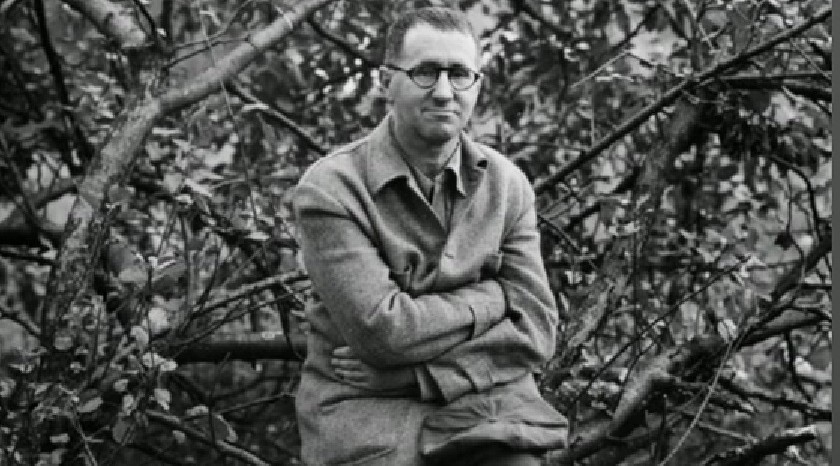
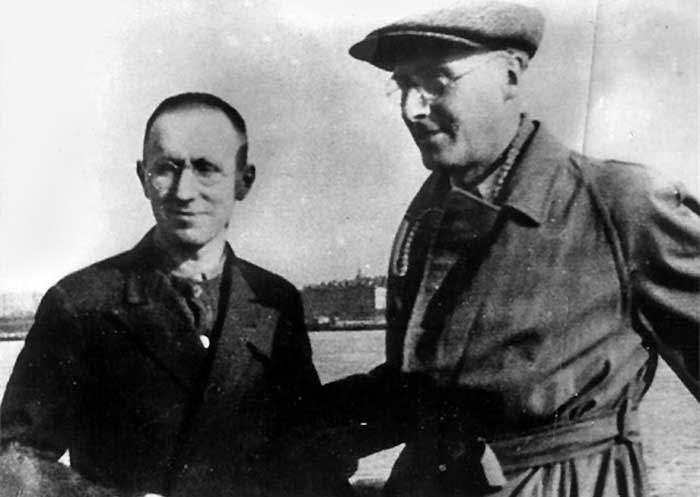
But Brecht himself is a living refutation. A full-fledged German from Swabia, he disconcerts all our notions of things German. Physically he resembles a note blown through a very slender clarinet. His hooked-nosed face recalls that of Voltaire or Rameses.
Berlin is the proverbial city of patent machinery and nickle-plated automatons, but the elevator that takes you up to Brecht’s sixth-floor garret lodgings is so shaky and dilapidated that you hesitate to enter it. It rises with jerks and spasms. And when you finally reach his landing you have to manipulate the lock for a long time before the door suddenly gives. It is the service elevator, used by delivery boys, the housemaids and writers who rent the garret rooms.
When a German is down and out the first thing he gives up is bread, next he sells his dishes; only after that does he part with his starched collar. I have seen unemployed Germans on the street give their ties to pushcart tailors to be pressed. Brecht, however, goes around in a rumpled shirt without a tie. He appears at brilliant first nights where everyone is in evening clothes, unshaven and wearing a black shirt!
His nose supports a pair of old-fashioned rimmed spectacles such as nobody else wears.
But do not imagine that he is an absent-minded sloven of the type of Kant, who once walked with one foot on the sidewalk and the other in the gutter and decided he was lame.
Brecht is a good chauffeur, he can assemble a machine or take it apart. The scar on his cheek he received in an automobile accident. Read Feuchtwanger’s novel Success. His engineer Prechl is patterned on Brecht.
In his native town of Augsburg Bert leads you past the huge cathedral. The drone of a lecture comes from the windows of the adjacent theological seminary. Brecht looks for the traces of bullets on the cornice and says: “I am a physician by education. As a boy I was mobilized in the war and placed in a hospital. I dressed wounds, applied iodine, gave enemas, performed blood-transfusions. If the doctor ordered me: ‘Amputate a leg, Brecht,’ I would answer: ‘Yes, your excellency,’ and cut off the leg. If I was told: ‘Make a trepanning,’ I opened the man’s skull and tinkered with his brains. I saw how they patched people up in order to ship them back to the front as soon as possible.” In the evening, accompanying himself on the banjo, Brecht sings the Ballad of the Dead Soldier, the most famous of his ballads, describing how they dug up a soldier, patched him up and sent him back to the front.
Brecht did not write this ballad, he composed it orally and it traveled through the land by word of mouth. The “pure German gentlemen” answered this ballad with furious hatred.
“I was a member of the Augsburg Revolutionary Committee,” Brecht continued. “Nearby, in Munich, Leviné raised the banner of Soviet power. Augsburg lived in the reflected glow of Munich. The hospital was the only military unit in the town. It elected me to the Revolutionary Committee. I still remember Georg Brem and the Polish Bolshevik Olshevsky. We did not boast a single Red Guardsman. We didn’t have time to issue a single decree or nationalize a single bank or close a single church. In two days General Epp’s troops came to town on their way to Munich. One of the members of the Revolutionary Committee hid at my house until he managed to escape.”
In the days of the Hitlerite “beer-hall” Putsch, Brecht’s name was fifth on the fascist murder list, an honor earned by his Ballad of the Dead Soldier. He survived only because the Hitler Putsch failed.
Bavaria gave way to Berlin—ballads, plays, discussions, clashes. The solitary intellectual cynic took the field, one against many, puncturing hypocrisy with his pen, his only weapon.
He passed through a period of the cult of brawn and brute force. He wrote of huge hairy men with bulging muscles, who smelled of sweat, who took what they wanted, without asking.
“However,” a neighbor recalls, “it was impossible to induce Brecht to do morning setting up exercises. He would think up any excuse to get out of it.”
Playwriting, Brecht’s main literary expression, began in Munich.
He wrote Drum at Night. This work contained echoes of the revolution. The drums of revolt persistently summon the man who has gone home. But the man prefers the quiet peace of his hearthside.
The work was a scathing satire on those who had deserted the revolution, and toasted themselves at their fireplaces. One should recall that Kapp launched his drive on Christmas Eve, calculating that many Red Guardsmen would have left their detachments for their family Christmas trees.
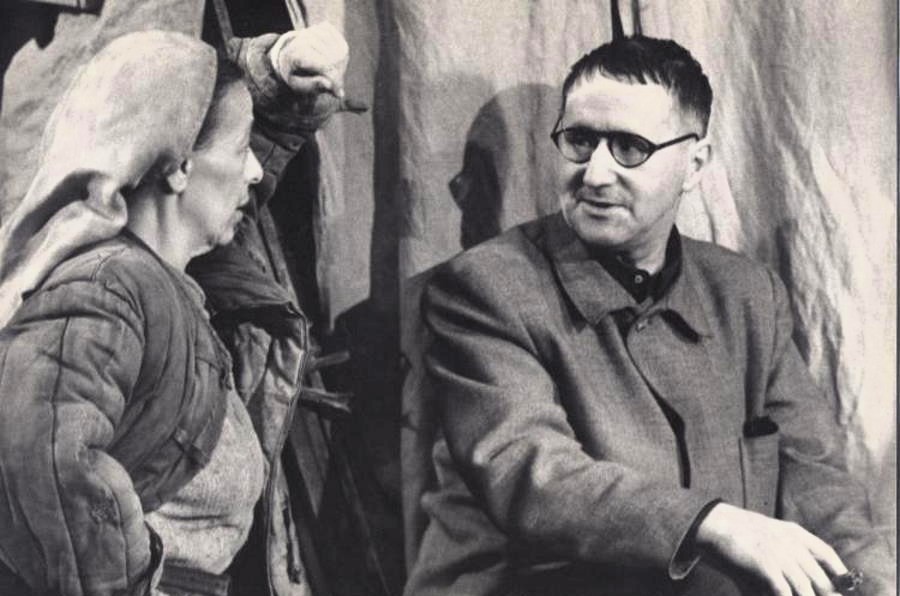
Brecht, the playwright, was at the same time Brecht the director. He himself staged all his own plays. His persistence, eagerness and stubbornness trained a whole generation of actors. Karola Neher, who played in the Beggar’s Opera, Helene Weigel who played woman roles in Mann ist Mann, in Mother and in The Highest Measure, Ernst Busch—these are only a few of the actors trained by Brecht.
In his rehearsals Brecht strove not only for clarity of speech but for coordination of speech and gesture, that the speech might simply serve to complete and explain the gesture.
“The gesture precedes the word,” says Brecht. And if the word is discordant with the gesture, he discards it for another.
Luther’s language, in Brecht’s opinion, is expressive because of its conformity to gesture. And one can learn much from Buchner and the early dramas of Goethe.
Brecht’s plays usually bear several signatures. This is the result of his special way of working on them.
He does not write them but composes them, acting them out before a small group of collaborators.
The audience make comments, object to some expressions and suggest others. When someone has a variant version to propose, he gets up and acts it. Arguments proceed over the form and meaning of the composition. Sometimes, at the opening of a scene, Brecht merely goes through the motions and instead of words intones a melody which only gradually evolves into words.
And when the play is produced, another phase begins. One must, forget the bourgeois audience and critics and listen carefully to the comments of the proletarian audience.
Brecht received several hundred notes from workers after Die Massnahme was produced and he inserted some twenty corrections in the play.
On one occasion the Vienna typesetters refused to set an episode which they considered incorrect; and some one had to be sent to convince them.
Thus, from antagonism to the audience the playwright went over to an alliance with that part of the audience whose friend, comrade-in-arms, teacher and disciple he was.
I myself saw in 1931 how, after six performances, his play Mann ist Mann was hastily taken off the stage of the Schauspielhaus, a theater which in importance compares with the Maly Theater in Moscow. In its respectable repertory Brecht’s play fell under suspicion. The performance produced a tremendous impression on me, second only to Meyerheld’s Rogonosetz.
Giant soldiers armed to the teeth and wearing jackets caked with lime, blood and excrement stalk about the stage, holding onto wires to keep from: falling off the stilts inside their trouser legs. According to the plot the soldiers belong to a British detachment in India, automatons for slaughter and pillage. And into the midst of these monsters wanders the softhearted civilian Gaily Guy (the man who cannot say “no”). This is the plot:
While pillaging an invaded village a soldier disappears. Someone must be found to replace him—otherwise the whole company will be punished. The soldiers induce Gaily Guy to stand on roll-call with them, buying him beer and cigars; but they need him. permanently and not just for this occasion. This means they must implicate him in a crime which will compel him to deny his own identity and remain with them. They persuade him to sell the regimental elephant. A fantastic deal ensues. Two soldiers, covered with an oilcloth table cover and the proboscis of a gas mask dangling in front of them, impersonate the elephant. As soon as the deal has been made, they arrest Gaily Guy and tell him:
“A man by the name of Gaily Guy has committed a triple crime. In the first place he sold an elephant that did not belong to him, in the second place he did not sell a real elephant. In the third place the elephant belongs to the regiment. It is a clear case of swindle and treason. You say you are not Gaily Guy, but why then do you conceal your identity and what are you doing in camp? Are you a spy? The penalty for that is death.”
The retreat back to the name of Gaily Guy is thus cut off. What remains now is a man without a name. There are two alternatives. He is either a spy, and in that case he must be shot; or he is a soldier and he must hurry into line because the bugle has just blown. Gaily Guy gives his answer. The soldiers cluster around him in a circle. When the circle opens, out of it rushes a man with a knife in his teeth, weighted down with hand grenades, in a uniform that stinks with trench filth. The shy, well-meaning civilian has been put through the mill, has been transformed into an efficient cog in that machine of extermination called a capitalist army. The intellectual of yesterday who couldn’t say “no” is transformed into a fascist, for whom others say “no” and “yes,” while all that is required of him is the unthinking yell “heil.”
But the intelligent Berlin bourgeois does not go to the theater to be made to feel uncomfortable.
The spectator wants to be above the action of the play or at any rate on a level with it. He will not tolerate action that puzzles him and perhaps affronts his comforting sense of respectability. This is why women stamped their feet during Brecht’s play. Indignant lawyers rushed out of the theater throwing crumpled program sheets at the actors on the way. In the cloakroom a sobbing woman snatched her coat from her husband and went to put it on in a far corner. She was guilty of having watched the performance without, being roused to indignation.
Ossip Brik aptly remarked that Brecht’s plays are usually in the form of court proceedings. This is true. Brecht the playwright is an able and resourceful casuist.
He is incomparable when he comes to litigation. He strips the time-honored concepts of “beauty,” “truth,” “justice” “honesty,” “progress,” forces them down on their bare knees and rubs their nose in the filth of the system which developed them.
I strolled with Brecht through a churchyard in a Bavarian village. The first-class dead were buried along the main path. The thick, short-armed marble crosses atop the family vaults were more substantial than bank entraaces. Lists of names were chiselled in the stone, in which enameled portraits were imbedded. The words “druggist,” “teacher,” “miller,” “ekonom” preceded the names. “Ekonom” was the local title of the rich peasants, the kulaks, as we call them. These were all strictly respectable corpses.
The crosses in the second row were a bit thinner. “Ekonoms” who were more economical. This was the second class area. It only cost sixty marks to lie here for a ten year period while in the first class it cost a hundred.
Third class was in a far corner.
There the crosses were so thin that from the side they were almost invisible. The inscriptions on the crosses were laconic, almost telegraphic in style. Beneath these frail monuments lay the inmates of the local “hospice.” The hospice was a sort of alms house where couples who had “worked themselves out” were allowed to end their days. The majority of the war invalids, thrown out of the shops and shoved off the streets by the aggression of younger and stronger hands, ended up in the hospice.
Aman climbed out of a grave and pulled a spade up after him. He invited us to the chapel to view the body of an old woman from the hospice, which was thinner, he said, than any corpse that had ever come to the cemetery before. He spoke of that corpse with genuine enthusiasm and was offended when we refused to inspect it, but he consoled himself by showing us his fourth-class tenants, the disreputable people, the suicides who occupied a strip along the churchyard wall. He was especially indignant over one grave. In it lay a motion-picture operator from Munich and a girl, the daughter of a respectable local “ekonom.” The couple had shot themselves on a nearby mountain peak, visible over the top of the wall.
In its time doubtless each of these graves had stirred the imagination of the quiet hamlet, where generation after generation trod the well-worn path of changeless customs. The village felt the march of history and changes in the mould of life less through daily fluctuations of world economic and political indices than through the sudden shocks of local village tragedies.
The sexton passed over a fresh grave covered with wreaths. A cross stood over it. A peasant boy who had been apprenticed to a metal plant in the city had been buried here two days before. He had fallen in with company that wanted to live like gentlemen, to dress, eat and amuse themselves like gentlemen. The boy ran short of money. He got into a mess and five days ago had been found with his skull perforated. The official certificate stated “killed at work by a falling rivet.” The sexton explained: “By a bullet.” And added: “The parents were very anxious that their son should not lie among the suicides. They got the curate to agree to this little white lie.”
Brecht was beaming. He proceeded to compose the plot for a play about a youth who committed suicide, crashes the gates of heaven on false papers and places the celestial judge in an awkward position, as the latter must either discredit his agent, the curate, who forged the papers, or else keep quiet about the matter.
“I do not like plays to contain pathetic overtones,” Brecht said, “they must be convincing, like court pleas. The main thing is to teach the spectator to reach a verdict. This trains the mind. Any fool knows how to feel sad and to share suffering. And not only fools. You should see the salty tears swindlers can shed when they are moved.”
And he teaches people how to reach a verdict, transforming the spectator’s chair into that of the judge.
His play Die Massnahme, the first of Brecht’s plays on a Communist theme, is arranged like a court where the characters try to justify themselves for having killed a comrade and the judges (the chorus), who at the same time represent the audience, summarize the events, and reach a verdict.
When he visited Moscow in 1932, Brecht told me his plan to organize a theater in Berlin which would re-enact the most interesting court trials in the history of mankind.
“The theater would function like a court room. Two trials an evening, each lasting an hour and a quarter. For example, the trial of Socrates, a witches’ trial, the trial of Karl Marx’s Neue Rheinische Zeitung, the trial of Georg Grosz on the charge of blasphemy for his cartoon Christ in a Gasmask.”
Brecht was carried away by his enthusiasm. He began to elaborate: “Let us suppose that the trial of Socrates is over. We organize a short witch’s trial where the judges are armored knights who condemn the witch to the stake, Then the trial of Georg Grosz begins, but we forget to remove the knights from the stage. When the indignant prosecutor storms at the artist for having insulted our mild and compassionate god a terrific racket breaks loose, as though two dozen five-gallon samovars were applauding. The noise is caused by the knights who are moved to applause by the defender of the defenceless god.
“We shall stage an eviction trial against an unemployed worker in Germany,” Brecht continued, “and alongside it a Soviet trial where a working woman wins a title to space in an apartment.”
Brecht acquired a world reputation with his play, Beggars’ Opera. The score is the work of the composer Weill. The plot is taken from an English melodrama. The peppery irony scattered through the play belongs to Brecht.
The tremendous success of the Beggars’ Opera is not due to Brecht’s text but the veil of Weill’s music, that conceals it.
The action proceeds on two planes—a false one and a real one. On the false plane a representative of the law catches a scoundrel and murderer concealed in a rat hole. On the real plane this same scoundrel and murderer stands revealed as the wielder of dictatorial power. The chief of police is his accomplice and is on his pay role. Is not this a parody on Chicago’s Al Capone?
I know of nothing that Brecht despises more than “Kitsch.” “Kitsch” is the German term for cheap sentimentalism and pseudo-heroics.
The applause received by the Beggars’ Opera is more than balanced by the catcalls and indignation which Brecht’s other plays evoked. Everywhere the philistine, who suddenly recognized his own image, took offense and forced play after play off the stage.
But Brecht’s drama, the drama of paradox, began to develop more and more in the direction of the educational theater and epic drama, as the playwright came closer to the Communist movement.
Brecht conceived the idea of writing a play about the tariff tricks resorted to by the landowners in order to peg the price of grain. But this requires a knowledge of economics. The study of economics brought Brecht to Marx and Lenin, whose works became an indispensable part of his library.
Brecht studies and quotes Lenin as a great thinker and as a great master of prose.
Brecht bases the new departure in his drama on two propositions.
According to the first the theater must be epic in character. The epic theater must narrate events and compel the spectator to understand them, as opposed to the traditional theater, the Aristotelian theater, as Brecht calls it, which involves the spectator in a chain of emotional experience and acts upon his emotional responses. According to Brecht the theater should act upon the spectator’s intellect. Brecht prefers the clash of judgment, the struggle of syllogisms, the conscious discovery of what is false and stupid in the world, to the emotional discovery of what is disgusting and bad,
1. The Aristotelian Theater
Action
Involves the spectator in the stage action and destroys his own will to action
Touches
Emotional experience
Suggestion
The spectator shares in emotional experience
Man is given as a known quantity
Interest in the outcome of the action
Every scene preconditions the next Organic development
Feeling
2. The Epic Theater
Narrative
Makes the spectator an observer and arouses his will to action
Calls for decisions and a world outlook
Argument
The spectator is taught
Man is a subject of investigation
Interest in the course of the action
Every scene is independent
Montage
Intellect
The traditional theater does not like argument on the stage. What usually convinces us in a play is not so much the correctness of the hero’s arguments as his attractive personality or the emotional richness of his conduct.
The conflict of passions and not the conflict of judgments determines the character of the traditional theater.
In his efforts to establish a line of demarcation, Brecht published a chart showing where the center of gravity lies in each of these theaters.
The traditional drama portrays the struggle of class instincts. Brecht demands that the struggle of class instincts be replaced by the struggle of social consciousness, of social convictions. He maintains that the situation must not only be felt, but explained, crystallized into the idea which will overturn the world.
When I say “which will overturn the world,” I am already intruding on the second proposition, which makes his drama not only epic, but didactic as well.
The creation of a rational theater along the lines we have outlined above, the transformation of the stage into the tribune, might easily lead to sophistry. The play of logic is just as liable to become the object of smug contemplation as the play of emotional outbursts.
Discussion for its own sake is just as socially retrograde and reactionary as emotional experience for its own sake. However, this does not occur in Brecht’s drama. The full-blooded lyricism of the materialist artist breaks through his logical patterns.
The age taught the poet to be ashamed of sentiment and he conceals his emotion.
Brecht, the artist, has an extremely broad and varied range. He has composed many ballads, songs and choruses on the subject of revolutionary ruthlessness. But these themes are dyed in many different hues. The play The Highest Measure still retains a considerable element of court proceedings, of paradox. Brecht’s first truly epic drama is Mother (from Gorky’s novel).
This production had a political significance, since it marked Gorky’s jubilee in pre-Hitler Germany. Furthermore, it was not a simple adaptation of Gorky’s novel to the stage. Gorky’s Mother merely supplied the initial impulse for a new work which went beyond historical novels and which was addressed to all proletarian mothers of present-day Germany.
At first sight Brecht’s Mother deals with the revolutionary development of the Tver working woman Pelageya Vlasova.
But this is misleading. It would be wrong to regard it as a historical play about a Russian working woman. Such an interpretation involves one absurdity after another.
Would a Russian teacher of the 1905 period spend his evenings over a beer mug, arguing with friends that science and technics are unable to better human life and that the only method is the moral transformation of the individual? Would such a teacher take foot-baths at night and speak in a Spenglerean tone of the decline of civilization?
Would workers in Tver sit on a bench and discuss the nature of the lesser evil? Where in Russian history can you find agricultural workers, brought to the country from the city, who go on strike and throw stones at the strikebreakers?
Where could you find houseowners who evict their tenants and supply them with bibles for consolation?
Where, finally, in wartime Russia might you find women standing in queues before booths which accept patriotic offerings of copper utensils?
Of course none of this is Russia. It is Germany. Change the Russian names in the play to German ones and you will have the story of a contemporary German professional revolutionary woman doing her bit to enlighten millions of German Vlasovas who have not yet recognized reality.
This play is a whole seminar on methods of propaganda and tactics in revolutionary struggle. How should people be utilized in the struggle? How should one enlighten the ignorant, by frontal attacks or by incursions from the rear? How can one deceive the enemy? How can the experience of an alien culture be utilized? How to be disciplined?…
Regardless of whether Brecht likes it or not, I must mention the vividness of the teacher, the houseowner, the shopwoman and the policeman in the play. The workers are hard to distinguish from each other; this is a general shortcoming of all Brecht’s plays, which shows that he does not know the proletarian milieu intimately (this is a warning to him that he must get to know it so).
An exception is Vlasova. This professional working woman revolutionary has a face, a voice and a stride that are peculiarly her own. She is unmistakable.
In this play the skeleton of Brecht’s algebra is already clothed in the flesh of live circumstances and this immediately renders the play effective. Brecht’s play Johanna of the Chicago Stockyards is a parody of Schiller’s Maid of Orleans, adapted to the present-day relations between the condors of finance and the quiet turtle-doves of the Salvation Army. This play contains the phrase: “A sloven in the home nest,” a term which stockbrokers use to describe a fellow broker who strips them by clever deals.
Brecht was just such a “sloven in the home nest” of the bourgeoisie until, by a decisive turn in the direction of Communism, he brought his drama face to face with a wholly new audience—the audience of the proletariat.
The nobles in Gogol’s Dead Souls could vent their spleen on Nozdrev and even beat him, but for all that, he was a nobleman and therefore one of them.
So in Germany they jumped on Brecht for his earlier plays; but their indignation was coupled with the gloomy assertion: “There’s always a ne’er-do-well in the family.”
After Die Massnahme the newspapers became wary. When Mother appeared on the stage the howl of the press died down and the reviewers’ voice was replaced by that of the police official. After thirty performances Mother was banned. It was only allowed to be read from the stage. The actors stood in a row and began to read.
“Halt!” the policeman shouted. “This is not a reading but a performance. Your actor turned towards another actor when delivering his reply.”
The readers sat down and continued: “Halt!” the same voice rang out. “You made a gesture with your hand. This isn’t a reading, it’s a performance. I declare the reading discontinued.”
Johanna of the Chicago Stockyards was produced in Darmstadt. Half an hour after the play began, the shouting and catcalling fascists provoked a brawl that put a stop to the performance.
Brecht’s room is a living diagram of his literary biography. A dusty banjo hangs upon the wall. Brecht seldom sings his ballads to his own accompaniment now. Beside the gramophone lie records from the Beggar’s Opera sung by Brecht himself.
A sketch, intentionally rough and indecipherable, sprawls on a huge wooden panel. It is the work of the artist who designed the sets for Mann ist Mann, where huge portraits of the characters took the place of stage scenery.
There is a plaster head of Brecht which looks for all the world as though it had been detached from the mummy of Rameses. A head of the same type protrudes from a Chinese robe on which the columns of Chinese characters compose a cartoon.
Brecht in the guise of Confucius. He is interested in Confucianism as a science of conduct. His bookshelf, however, contains books of science and action—Lenin.
The abstract logician finds the road to reality; he becomes Brecht the dialectician and activist. It is not enough to make cynical mock of reality,—one must change it. Brecht regards the old forms of art as too static and passive. But he does not try to enliven art by concretizing the material from which the work is fashioned. He wants to concretize the action of the work of art upon men.
Brecht claims that art is a branch of pedagogy—that its purpose is to teach. Capitalism deforms education so that people consider themselves insulted by a didactic tone; its schools are a travesty on the human mind. Real education is something to be desired and the educated man is glad because he has become cleverer and stronger. A good example of this is the attitude towards education in the Soviet Union.
Brecht favors a “clever theater.” He wants conflicting opinions to be as absorbing as conflicting passions.
The point is not to leave the spectator purged by a cathartic but to leave him a changed man, or rather, to sow within him the seeds of changes which must be completed outside the theater.
The performance must not be a closed circle where the heroes and villains balance, where all accounts are settled. On the contrary it must be spiral in form, a circle which is sprung, which rises to new horizons; the spectator must be brought out of equilibrium.
In Johanna the dying heroine says:
Make it not your goal
That in the hour of death,
You yourself be better.
Let it be your goal
That in the hour of death,
You leave a bettered world.
What is the source of Brecht’s strength? It is his implacable hatred of bigotry, hypocrisy, and all forms of conceit.
He hurls his trenchant aphorisms at the well-groomed and well-bred poetry of the symbolists. He constricts a sentence with biblical sedateness and then shatters it with a sudden whack. He makes stock brokers talk in Shakespearean pentameters but he makes his pentameters stagger like drunkards.
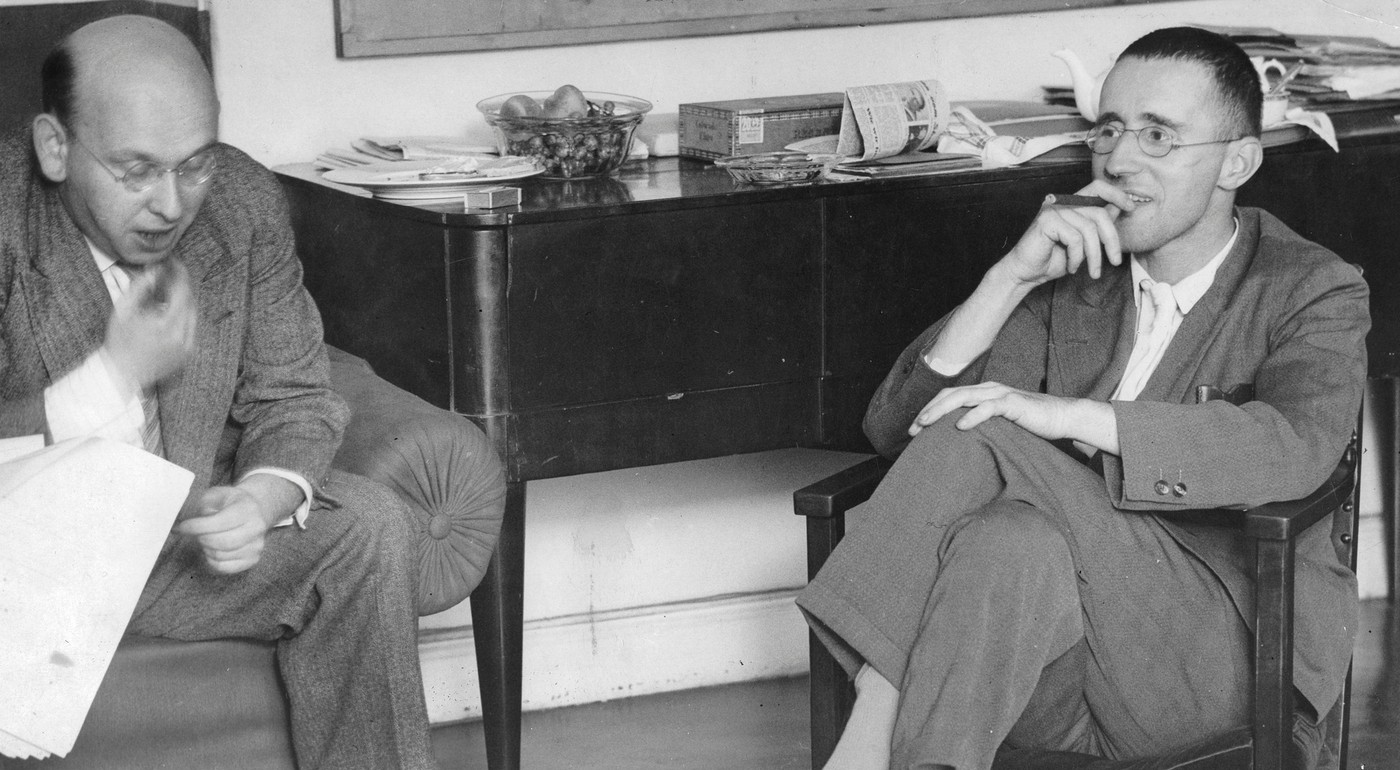
On the wavering heights of intellectual tight rope walking Brecht came, by guidance of Lenin’s articles, to Communism, and reached the place where men fight for their living cause. He applied his training in argument and logic to specific work. In collaboration with Hans Eisler he wrote songs for the proletarian stage, for demonstrations, and mass choruses. He wrote the Ballad of Paragraph 218, Lullabies for Proletarian Mothers, the Solidarity Song.
The man who sat in a smoke-filled room where synthetic opinions dribbled from human chemical retorts, has walked over to the window. He has flung the window wide open and heard the police whistles, and the thud of police clubs, the “Heil” of brown-shirted shopkeepers, the hum of the underground Communist press.
He goes out on the street. He no longer confines himself to scathing epigrams which only a refined intellectual audience can fathom. He speaks the truth in simple words. He talks to the proletariat of Wedding, Neukolln, Essen, and Hamburg. And they answer with thunderous laughter and applause.
Brecht writes about a worker who goes from a breadline into a stormtroop detachment. Put to music by Hans Eisler, Brecht’s song breathes over the shoulder of the worker who does not know that his shirt is brown because it is caked with the blood of his class brothers.
Brecht’s old arch-enemy back in Munich, Adolph Hitler, takes power. Brecht emigrates abroad. He answers with the play Round Heads, Peak Heads which tells how a certain dictator averted the approaching social revolution by dividing the population into two racial types and pitting them against each other. The scene of action is presumably Peru. But it is clear to everybody that the Peru in question does not border on Chili, but on France and Poland.
Abroad Brecht collaborates even more closely with Eisler. His poetry has a firmer and truer ring. The poet’s pen attacks the enemy with unrelenting fury.
The positive strain also grows. It was already audible in the chorus of Die Massnahme. But abstract formulae were posited then. As time goes on, however, the arithmetic of a warm, living reality intrudes more and more insistently upon Brecht’s algebra. This living reality was lacking in the earlier Brecht, who developed his concepts in terms of imaginary Perus, Chinas, Englands, and Russias, removed from specific historic epochs.
Brecht came to the Soviet Union twice, and while here searched eagerly for episodes from our construction which contained crystallized thoughts and which at the same time would provide concrete samples of socialist reality.
The mathematician Leverier who calculated the location of the planet Neptune on paper was not even interested in seeing his discovery through the telescope.
Brecht, likewise enumerates in the formulae of the epic theater, the laws of growth of the new man. He, however, is not satisfied with that. He wants to touch the new man and feel the threads that lead to him from the geniuses who foretold and who organized the October Revolution.
If not for this trend of Brecht’s, away from dead schematism to throbbing life, he could not have conceived the proletarian mothers with their lullabies and the rugmakers of Kuyan-Bulak who honor the immortal name of Lenin.
“The things you create are so unique in human history,” Brecht says, “that they should be recorded in the rock, just as the ancients recorded victories or the founding of cities.
“Your subway is lined with marble slabs but they contain not a single word as| to what a miracle in the history of humanity this undertaking was.”
From the book of portraits of contemporary literary figures, called People of the Same Bonfire.
Literature of the World Revolution/International Literature was the journal of the International Union of Revolutionary Writers, founded in 1927, that began publishing in the aftermath of 1931’s international conference of revolutionary writers held in Kharkov, Ukraine. Produced in Moscow in Russian, German, English, and French, the name changed to International Literature in 1932. In 1935 and the Popular Front, the Writers for the Defense of Culture became the sponsoring organization. It published until 1945 and hosted the most important Communist writers and critics of the time.
PDF of full issue: https://www.marxists.org/subject/art/literature/international-literature/1937-n05-IL.pdf

