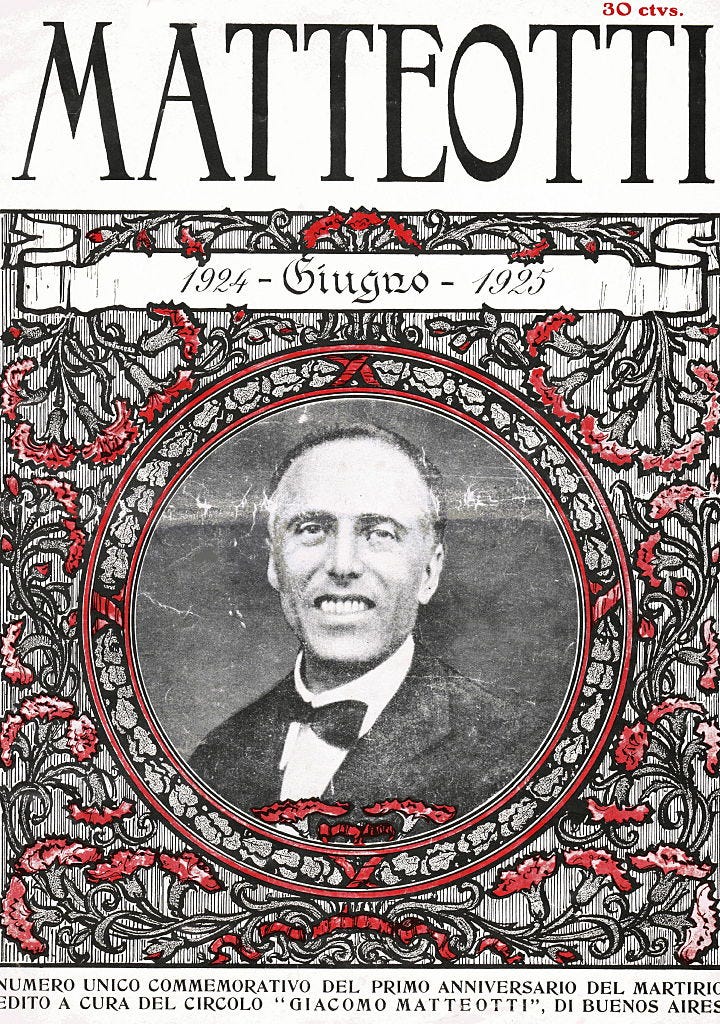
The Secretary of Italy’s Unitary Socialist Party and anti-fascist parliamentarian Giacomo Matteotti was kidnapped and murdered by a Blackshirt death squad on June 10, 1924 for exposing financial corruption of leading Fascists. A look at the specific circumstances of his assassination.
‘The Political Murder of Matteotti and its Consequences’ by G. Nicci from International Press Correspondence. Vol. 4 No. 36. June 26, 1924.
The case of the abduction and murder of the leader of the unitary Socialists, Giacomo Matteotti, has assumed the greatest importance and constitutes a turn in the political history of Italy. The fact in itself is without precedent. As is known, Fascism has on several occasions had recourse to political crime, but never have the circumstances, taken as a whole, been of such an atrocious character. It must be added that Fascism, as a rule, has not directed its blows against prominent leaders, but has sought to spread terror by striking at the rank and file and at the non-party workers; preferring not to convert the leaders into so many martyrs, but to discredit them by the easy process of designating them as worthless creatures. This time there was also entirely lacking the usual stage-managed “anti-national” provocation, while at the same time there was a lack of anything which could have given it the appearance of being in the nature of a collision or of a conflict. The attack by five armed men upon one solitary unarmed man, and the cruel murdering of the latter by means of revolver shots and dagger thrusts, had been coldly premeditated and prepared in all its details.
Furthermore, the chosen victim was not an extremist, but belonged to that reformist party which is obstinately following the chimera of social pacification and of purely legal action by the masses. Giacomo Matteotti, who came from a rich bourgeois family, who was derided as the “millionaire”, was a serious and dispassionate man. In 1919 at the Bologno congress he sided with the Maximalists, but subsequently went over suddenly to the reformists and became one of the most faithful followers of Filippo Turati. Member of parliament for the province of Rovigo since 1919, he had long since been banished from that province by the Fascist reaction ever raging in that district, which was at one time completely socialist. He showed great activity as a parliamentarian and was, moreover, an active secretary of his party. It was in this capacity that he sent the well-known replies signed by him to the proposal made by the Communist party for common action, the last replies being couched in very hostile terms.
As regards the perpetrators of the crime, it has become known that nearly all of them have been arrested. Who are they? On whose behalf did they act? They are well known Fascists and to those who were familiar with Italian affairs it was known that they belonged to an organization of the Fascist party which specialized in acts of violence of this kind, which organization was kept secret and was intended to be officially repudiated in the event of a scandal; nevertheless, it was formed, maintained and liberally financed by the Fascist party. This Fascist “Black Hand” had already carried out acts of violence against the homes and the persons of well known leaders of the opposition parties, enjoying meanwhile the fullest immunity from the law through the good will of higher circles. There is no reason to suppose that the leadership of the Fascist party and Mussolini himself had issued the order that Matteotti be removed an act which could not fail seriously to damage Fascism–nor, on the other hand, is it to be believed that the group of persons concerned acted on their own initiative, prompted by a wave of criminal passion. Not even a case of downright “political madness” can suffice to explain the choice of the victim, who was not the man upon whom the hate of the Fascist fanatics must concentrate itself. The unavoidable explanation is that one, the evidence for which is coming to light through a political scandal of enormous extent: the assassination had been desired by prominent Fascists who had been compromised by shady personal speculations to the detriment of the state, and who had reason to fear that the victim would have proved an implacable exposer of their misdeeds. Already the Italian press is referring to enormous sums spent by Italian and foreign capitalists in order to bribe members of the Fascist government who had an influence upon the measures and dispositions of the state.
Thus we have before us, not a case of extreme political fanaticism, but rather of the most sordid crime, carried out in order to keep concealed the guilt of those who, under the cloak of patriotism, were selling even to foreigners those interests which they claimed to defend.
This rapid survey of the facts is sufficient to explain the wave of indignation and disgust which is sweeping over the whole of Italy and delivering a terrible blow to the already shaken popularity of the Fascist government. One also knows that a crisis is developing in the high offices of the government and of the Fascist party, involving the removal of individuals whose power but yesterday appeared to be unshakeable.
It seems that Mussolini, who, as is known, precisely on the eve of the crime, had delivered a speech aimed at conciliating his opponents, desires to remedy the grave situation by turning to the left and by definitely breaking with the extreme elements of his party.
It is certain that the situation in Italy has at one stroke entered on a phase of instability. The aversion to Fascism, which until yesterday only expressed itself in under-tones, now shows itself in public demonstrations and agitations and in a spontaneous tendency on the part of the masses to reply with the general strike. The various groups of the opposition today express themselves in a language which they would not have ventured to utter a few days ago. One must ask oneself whether one is not confronted with the last drop which causes the measure to overflow.
When estimating the consequences of the grave crisis, and also if one is disposed to believe that the Fascist control of the state apparatus is in any way less firm, it must not be forgotten to what a great extent Fascism still has at its disposal a formidable political and, before all, military apparatus, which ensures it a very large degree of power.
In the parliamentary sphere, although the majority, obtained by the well known methods, will prove to be somewhat shaken, there is no reason to believe that the opposition parties will be able to overcome the disadvantages imposed on them.
In the sphere of civil struggle, nay, of civil war, the opposition parties have neither forces nor organizations which could in any way be compared to those of the Fascisti.
The Fascist government shows itself to be in the highest degree disturbed, and while being compelled to make by no means small concessions, it is mobilising the national militia and concentrating forces on the capital.
The parliamentary opposition parties have not succeeded in placing in a clear light the questions of the joint moral, political and historical responsibility of the Fascism of Mussolini for the horrible outrage, and have confined themselves to demanding the ordinary juridical procedure against the perpetrators and their principals. In such cases the revolutionary action for averting the blows and ensuring their due punishment is quite a different one.
Only the proletariat, led by the Communist Party, can state the problem in its proper terms, demanding and carrying out the trial of a whole political system of offensive class brigandage, of which the last action, the assassination of Matteotti, is the terrible but logical conclusion.
International Press Correspondence, widely known as”Inprecorr” was published by the Executive Committee of the Communist International (ECCI) regularly in German and English, occasionally in many other languages, beginning in 1921 and lasting in English until 1938. Inprecorr’s role was to supply translated articles to the English-speaking press of the International from the Comintern’s different sections, as well as news and statements from the ECCI. Many ‘Daily Worker’ and ‘Communist’ articles originated in Inprecorr, and it also published articles by American comrades for use in other countries. It was published at least weekly, and often thrice weekly. Inprecorr is an invaluable English-language source on the history of the Communist International and its sections.
PDF of full issue: https://www.marxists.org/history/international/comintern/inprecor/1924/v04n36-jun-26-1924-inprecor.pdf

