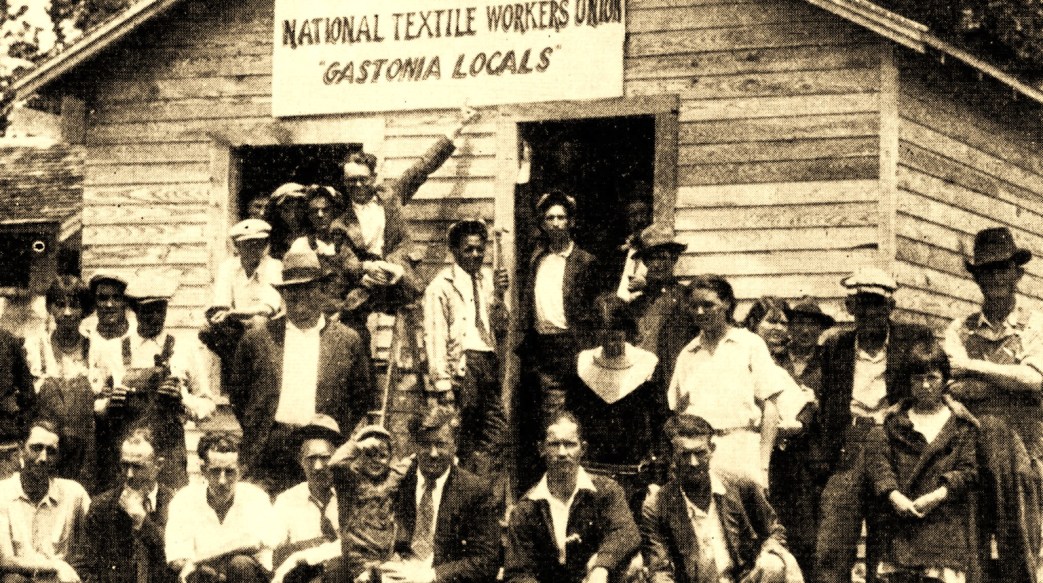
Briggs criticizes leading Communist Party activists Karl Reeve, Jack Johnstone, and Otto Hall for opportunistically conforming to white chauvinism and Jim Crow during the 1929 Gastonia strike in North Carolina led by the T.U.U.L.’s National Textile Workers Industrial Union.
‘Further Notes on Negro Question in Southern Textile Strikes’ by Cyril V. Briggs from The Communist. Vol. 8 No. 7. September, 1929.
Since writing the article on “The Negro Question in the Southern Textile Strikes,” which appeared in the June number of The Communist, certain developments have occurred which necessitate an elaboration of the subject.
Significant of the change which has been wrought in the minds of the white strikers and concrete proof of the correctness of the Union’s policy of organizing the Negroes together with the white workers on a basis of full equality is the fact that following the unprovoked police attack on the strikers’ tent colony, the shooting of the chief of police and the arrest of the strike leaders, the white strikers themselves took action to save Otto Hall, Negro organizer for the union, from the lynching fate prepared for him by the local mill owners and the police. The fact that Hall had been absent in Bessemer City at the time of the attack on the strikers’ tent colony and could have had no part in its defense made no difference to the mill bosses and their business allies and police tools who saw in Hall’s connection with the union an opportunity to whip up a lynching spirit against the strikers and their leaders. They planned to use the Negro question to mobilize the community against a cause so unpopular to the white ruling class as the organization of Southern workers against capitalist rationalization and starvation wages. It would not have been the first time that the Negro question had been utilized by the Southern bourgeoisie against an unpopular cause. Had the police succeeded in laying their hands on Hall it is certain that not only would Hall have been lynched but it is highly likely that with the Negro question to serve as a fuse there would have been a tremendous emotional explosion and other lynchings that night. The Gastonia newspapers did their best to work up a lynching spirit, but lacking the Negro issue which the capture and lynching of Comrade Hall would have furnished, fell far short of actual success. However, these newspapers are now busy mobilizing sentiment for a legal lynching via the capitalist courts and the electric chair of the fifteen strike leaders under arrest on the charge of murder in connection with the killing of the chief of police, and it behooves our Party to exert every ounce of its strength in defense of these fifteen victims of one of the most murderous frame-ups in the history of the labor movement.
Unaware that there had been trouble in Gastonia and that the stage was even then set for his lynching, Comrade Hall was on his way back from Bessemer City. The white strikers were up against a test. Deprived of the guidance of their leader, all of whom, with the exception of Beal who was away, had been rounded up by the police, they faced a situation calling for quick thinking, quick action and a spirit of loyalty to their Negro organizer, based upon an acceptance of the Negro policy of the Union. They responded magnificently! Breaking through the police cordon thrown about the roads leading into Gastonia, a committee of white strikers succeeded in intercepting the car in which Comrade Hall was returning to Gastonia and, warning him of his danger, rushed him to a railroad station forty miles from Gastonia where they raised sufficient money for his fare and put him on a train for New York City. Also, even before this, the white strikers had furnished Comrade Hall with a body guard in his movements about the strike area, giving notice to the world in general and to the mill bosses and their police thugs in particular that they accepted him as an organizer and leader of their union and were prepared to protect him. It seems that we had less trouble in convincing the Southern white strikers of the correctness of our policy than with some of our own comrades in the strike area!
That men who a few months before would have willingly and avidly responded to any proposal of the white ruling class for the lynching of a Negro, should have risked their liberty and even their lives in breaking through the police cordon to save the life of a Negro union organizer is both significant of the change which has come over the first section of the Southern white working-class to come under our leadership and indicative of what can be accomplished with the actual launching of a broad ideological campaign among the Southern white working masses against white chauvinism.
In the light of this change in the attitude of these white strikers toward the Negro, the capitulation of some of our comrades to white chauvinism becomes all the more inexcusable. For this retreat before white chauvinism it is my opinion that Comrade Jack Johnstone was mainly responsible. Comrade Johnstone was several times severely censured by the Party Secretariat for his attitude on the Union’s Negro policy, his statement that the Union had no policy for the South (tantamount to saying that the Union’s Negro policy for the South must be different to its policy for the North), his wrong interpretation of R.I.L.U. and C.I. decisions to “set up special unions for these Negro workers who are not allowed to join the white unions” as authority for setting up Jim Crow locals in the left wing unions we ourselves are organizing, and for his opportunist proposal that “if we found that the Negro workers did not want to join the regular locals that special Negro locals be formed.” Also, Comrade Johnstone, as the C.E.C. representative in the strike area, committed a serious breach of Party discipline in his failure to fight in the fraction for the line of the Party, confining himself to a mere presentation of that line with the declaration that he had opposed it in the meetings of the Secretariat at which he was present. Comrade Johnstone based his opposition to the Party line on his opinion that any effort to organize Negroes and white in the South in the same locals and on a basis of full equality for the Negro would militate against the opportunity to organize the white workers and, if persisted in, would amount to an abandonment of the white workers.
Comrade Karl Reeve appears to have had much the same attitude on the Union’s Negro policy as Comrade Johnstone. He particularly took the attitude that the putting into effect of the Union’s Negro policy would mean the destruction of the Union. Comrade Reeve must share with Comrade Johnstone the responsibility for the disgraceful retreat before white chauvinism.
Comrade George Pershing was the organizer in charge of the mass meeting at Bessemer City at which a Jim-Crow wire was stretched across the hall to divide the Negroes from the white strikers. Comrade Pershing did not give instructions to put up this wire. His responsibility lies in the fact that he did not discourage and prevent such an insult to the Negro strikers. But this is hardly surprising when we take into account Comrade Pershing’s inexperience, plus the confusion in the fraction, plus the wavering of older and more experienced comrades like Reeve and Johnstone.
That there are still large sections of the rank and file that have not yet fully orientated themselves on the Negro decisions of the Communist International, the R.I.L.U. and the Party was evident even before the Southern retreat occurred to dramatize our weakness on the Negro question. That leading comrades like Johnstone could be so confused was not, however, to be expected.
That there is still a good deal of confusion on this issue on the part of responsible comrades is evidenced even in the treatment of my article in the June Communist. My caption for that article “The Negro Question in the Southern Textile Strikes” although correct in the title was made to read in the page heads as “The Negro Problem, etc.” And worse yet, an unauthorized and wholly impermissible change was made in a sentence of the article in which the words “the Negro Question in the South” were changed to read “Our Negro Problem in the South.”*
It should be crystal clear to any Communist who gives this question the serious consideration it deserves that the Communist Party can have no Negro problem, South or North. Our problem is rather a problem of white chauvinism among the working class and in the very ranks of the Communist Party itself.
Communists must be careful not to fall into the error of accepting the capitalist estimation of the Negro as a problem. Even viewing the country as a whole the correct Communist viewpoint would be that there is at worst a race problem, not a Negro problem. And certainly our problem is not what to do with the Negro, but rather how to overcome the capitalist ideology of race separation and racial hatred in order that we may, as the Party equally of the Negro and white workers, achieve complete working-class unity in the furtherance of our struggle for the overthrow of capitalism.
*NOTE
Comrade Otto Hall has sent in the following note of correction in connection with some remarks made by Comrade Briggs in his article in the June issue of The Communist:
“At the time Comrade Briggs wrote his article I was still in Gastonia and therefore all the facts were not fully available. I did not make the motion to organize the Negro workers into the A.N.L.C. What I did propose was to organize those Negro workers who could not be organized into the N.T.W.U. into the Labor Congress, that is those Negro workers who were not working in the textile industry. This is quite a different thing. My mistake was in not making this motion clear enough and in not keeping a copy of it.”
There are a number of journals with this name in the history of the movement. This The Communist was the main theoretical journal of the Communist Party from 1927 until 1944. Its origins lie with the folding of The Liberator, Soviet Russia Pictorial, and Labor Herald together into Workers Monthly as the new unified Communist Party’s official cultural and discussion magazine in November, 1924. Workers Monthly became The Communist in March ,1927 and was also published monthly. The Communist contains the most thorough archive of the Communist Party’s positions and thinking during its run. The New Masses became the main cultural vehicle for the CP and the Communist, though it began with with more vibrancy and discussion, became increasingly an organ of Comintern and CP program. Over its run the tagline went from “A Theoretical Magazine for the Discussion of Revolutionary Problems” to “A Magazine of the Theory and Practice of Marxism-Leninism” to “A Marxist Magazine Devoted to Advancement of Democratic Thought and Action.” The aesthetic of the journal also changed dramatically over its years. Editors included Earl Browder, Alex Bittelman, Max Bedacht, and Bertram D. Wolfe.
PDF of full issue: https://www.marxists.org/history/usa/pubs/communist/v08n09-sep-1929-communist.pdf

